
Hybrid Wattled X Blue crane fledges
By Jacquie van der Westhuizen, senior EWT field officer
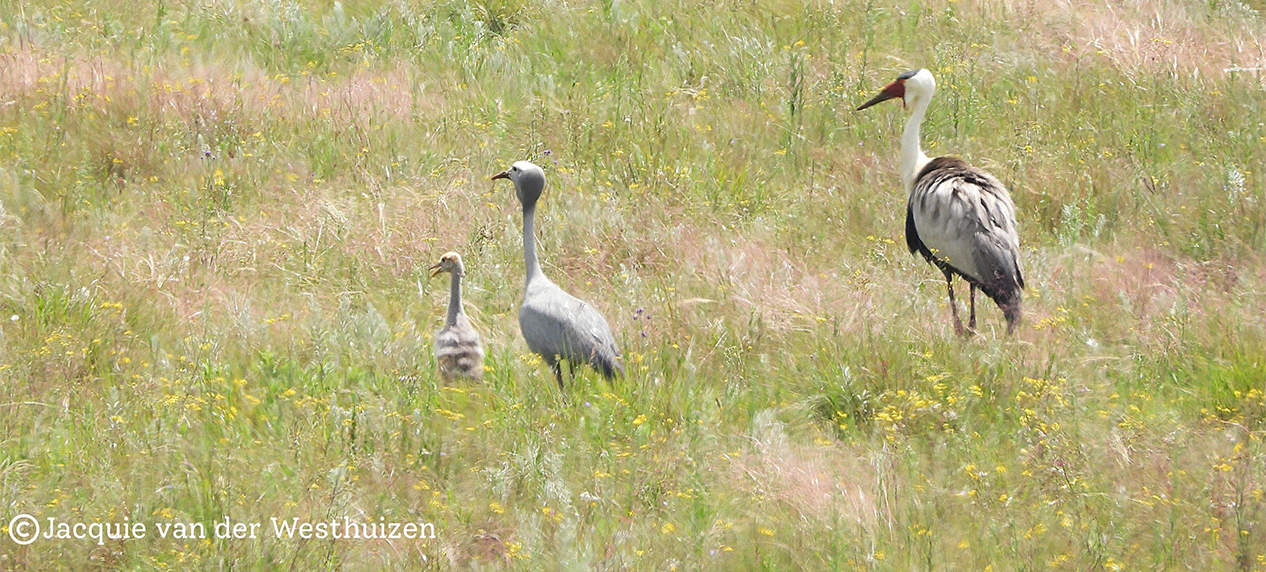
For the last couple of years, we have been getting reports of a lone Wattled Crane hanging around with some Blue Cranes in Mpumalanga. Never in our wildest dreams did we think that a Wattled crane would pair up with one of the Blue Cranes, but the inevitable happened.
In early February I got a report from the farmer, accompanied by photo evidence, of the pair walking with, yes, a Chick!
There are not many known cases of hybridisation such as this and even less of it being documented, so I went up to Mpumalanga to see for myself. I spent a few days monitoring, photographing and documenting the interaction between the adult Wattled and Blue crane and their chick, and their general behaviour. At that point I guessed the chick was approximately 5-6 weeks old resembling a Wattled crane chick in looks and size.
In the normal life cycle of a Wattled crane, chicks fledge at approximately five months and, at approximately 10 months of age the parents take them to a floater flock – a group of cranes that are not yet of breeding age or have yet to pair up – and leave them there to grow up, find a mate and begin a whole new circle of life.
During our monitoring we decided that in the event that this hybrid chick survived to adulthood and joined a floater flock, we needed to ring it so we would be able to identify him amongst a dance (flock) of cranes. The purpose of this would be to see if it eventually paired up with another crane and bred. We also took genetic samples as this would give us a better idea of the genetic makeup of the hybrid crane and the sex of the bird. This was done when the chick was approximately 13 – 14 weeks old, and looking more like a Blue Crane with a smaller bill and head and Blue Crane colouring.
It has since fledged. This has meant less sightings and more difficult monitoring as the chick and his parents move around. He was last seen a few days ago (in May 2026) and, interestingly, now looks more like a Wattled Crane – lighter neck colouring, grey back and is almost as big as the Wattled crane. But, he is as fast as a Blue Crane when he runs!
In the animal kingdom, hybridised species are generally infertile, but it has been confirmed by none other than the International Crane Foundation’s (ICF) founder, George Archibald, that hybrisation between Brolga and Sarus Cranes in Australia not only occurs, but results in fertile chicks, and is actually more common than one realises. These majestic birds are now known as Sarolga. We have no evidence to prove this in Wattled / Blue crane hybrids as very little has ever been documented.
One of the reasons these types of hybridisations happen could be as a result of habitat loss, which in turn results in the decline of cranes in certain areas. When crane numbers drop – in this case Wattled Crane numbers declined dramatically – the remaining few cranes start mingling with other crane species and eventually pair up.
We have seen a huge decline in the number of Wattled Cranes in Mpumalanga in the past 20 years. This province was once home to the second largest population outside of KwaZulu-Natal. This has resulted in the EWT / ICF partnership implementing a research project in the province to investigate the causes of the decline and how we can improve key crane habitats in the province to bring back this beautiful and iconic species.
Here’s a challenge for you, our readers: What should we call our South African hybrid Wattled / Blue Crane? A Watblue or a Bluewat? Your suggestions are welcome and can be mailed to emomberg@ewt.org or jacquiev@ewt.org