Sustainable
Finance
Unit
Building the financial systems that sustain wildlife and functional ecosystems
Across Africa, the biodiversity finance gap remains significant, with more than $130 billion (R2 trillion) in annual investment needed to protect and restore resilient landscapes and ecosystems. While public funding and philanthropy play an important role, they are not sufficient to secure the scale of conservation action required.
Long-term conservation impact depends on financial systems that recognise the economic value of healthy ecosystems. The Sustainable Finance Unit (SFU) works to design and mobilise innovative finance mechanisms that unlock sustained investment in biodiversity, ecosystems and people.
The SFU acts as the bridge between finance and conservation implementation – structuring investable projects that deliver measurable outcomes for wildlife, habitats and communities across southern and eastern Africa.
Strategic Objective
Drive the establishment of sustainable financing mechanisms that enable large-scale conservation impact over extended timescales.
Strategic Pillars
Core focus: Nature Finance Innovation
- Develop and pilot innovative finance mechanisms (e.g. carbon credits, biodiversity offsets, species bonds etc.)
- Scale successful pilots into long-term, impactful conservation projects
Additional: Policy and Advocacy
- Shape biodiversity offset policies to curb biodiversity loss amid Africa’s development
- Engage with financial institutions and governments to integrate nature into decision-making
- Build capacity on biodiversity offsets and the mitigation hierarchy within the sector
With Biodiversity and Business Unit: Private Sector Demand
- Highlight ecosystem service dependencies and risks and linkages to bankable, outcomes-based projects
- Prove the business case for nature investment from the private sector, to ultimately mobilize private sector nature finance beyond compliance-driven funding
Why: The Biodiversity Finance Gap
- Annual finance flows to Nature-based Solutions need to increase by more than two and a half times to US$571 billion by 2030 and by more than triple to US$771 billion by 2050 (United Nations Environment Programme, 2026)
- Africa needs more than $130 billion in nature investing (DBSA)
- R16 billion is needed annually for 30×30 implementation in South Africa (Wildtrust et al, 2025)
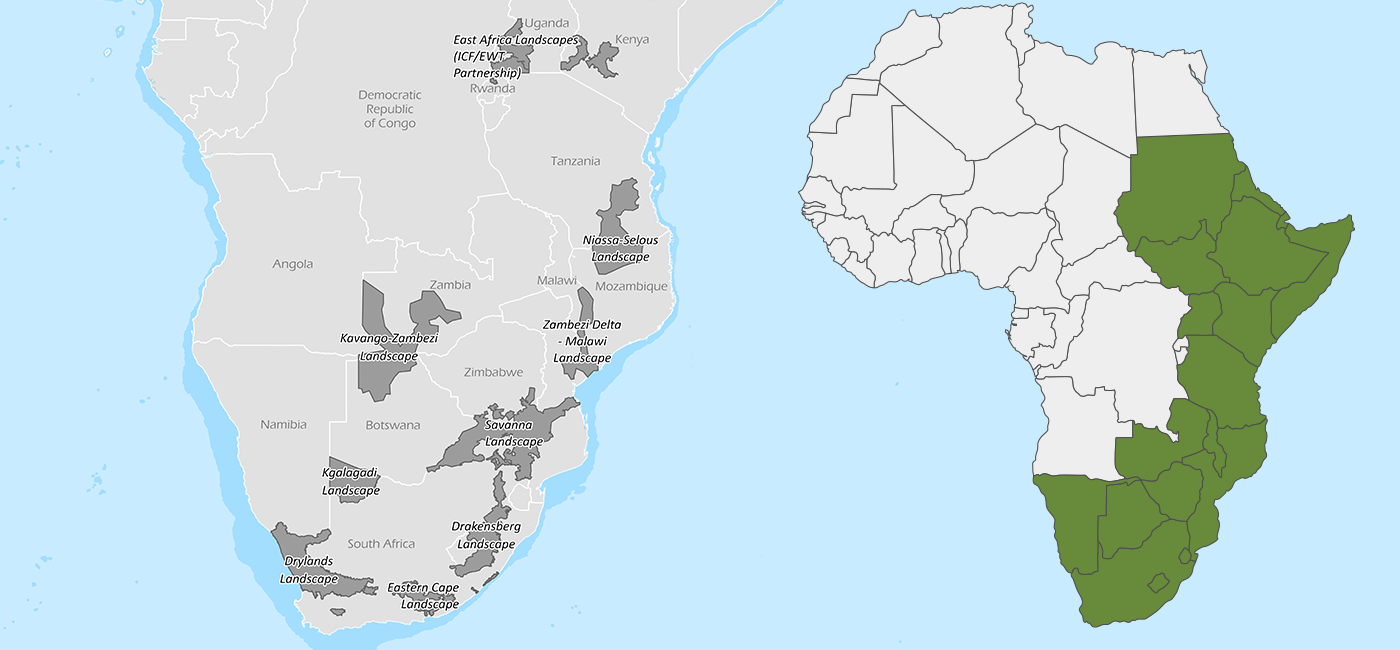
Where we work
We work in the EWT’s priority regions (right) and, where possible, try to positively impact the EWT’s strategic conservation landscapes (left)
(click/tap to enlarge)
Sustainable Finance Mechanisms
Main focus:
- Biodiversity offsets – applying the mitigation hierarchy and using the EWT’s conservation expertise to design and implement biodiversity offsets for development projects according to best practice. We are considering innovative models to strengthen proactive offset / habitat banking efforts in Africa.
- Carbon credits – generating carbon credits through nature-based solutions such as ecosystem restoration
- Biomass beneficiation – green economy development to incentivise invasive plant clearing & management
Additional mechanisms:
- Species compensation
- Tax incentives
- Water instruments – payment for ecosystem services, water credits, bonds and funds
- Extended Producer Responsibility
- Certification schemes
- Project finance for permanence
- Tourism levies / micro finance
- Debt for nature swaps
- Green insurance