
Pollination is the story of ancient partnerships between insects and plants
By Renier Basson, senior field officer, Drylands Strategic Conservation Landscape
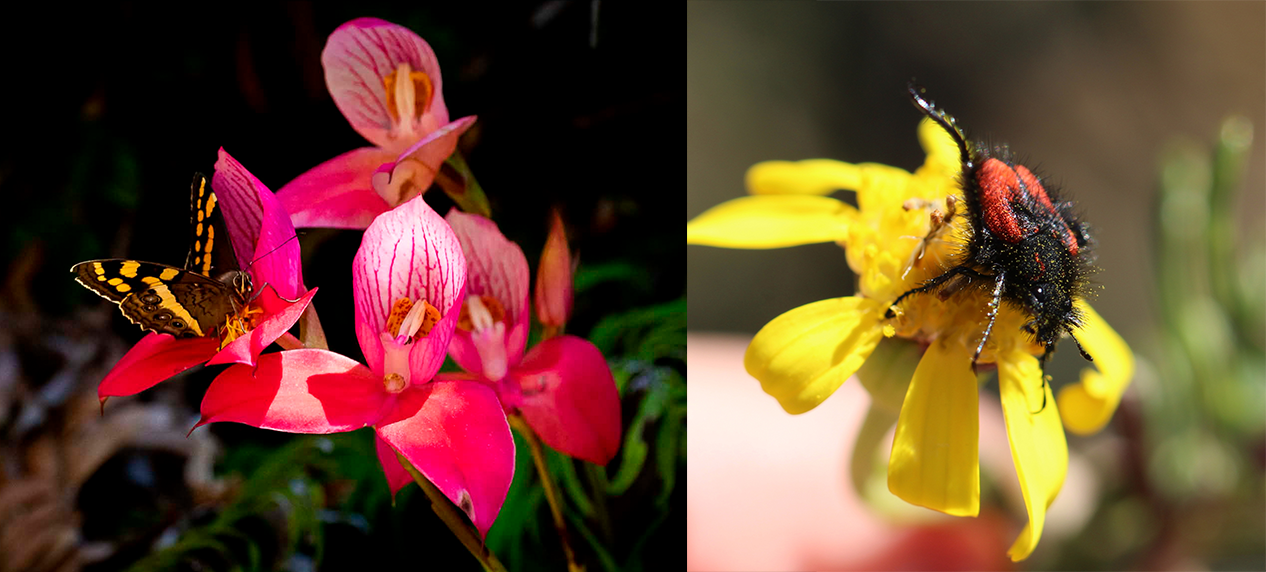
Left: Red Disa butterfly. Photo by Roy Glasspool. Right: Red Shaggy Monkey Beetle (Anisonyx militaris) pollinating a daisy in the Tankwa Karoo. Photo by Cecile Roux.
Interactions between plants and insects have evolved over the past 100 million years, resulting in the most fascinating and bizarre adaptations by both parties.
Across South Africa, these intricate relationships play out every day, often unnoticed beneath our feet or high above our heads. From beetles crawling through ancient flowers to flies carrying pollen between mountain peaks, pollination is one of nature’s most important ecological processes and underpins the survival of countless plant and animal species.
When most people think of pollination, they immediately picture the honeybee. While honeybees are undoubtedly important pollinators and contribute significantly to agriculture, they represent only a small fraction of the diversity of pollinating insects. Focusing solely on honeybee’s risks overlooking the thousands of native pollinator species that sustain South Africa’s remarkable biodiversity.
Pollination occurs when pollen is transferred from the male part of a flower to the female part, allowing fertilisation and seed production. While wind and water can move pollen in some plant species, insects are responsible for 70% of pollination events in South Africa’s flowering plants. Without pollinators, many of our wildflowers, fruit-bearing plants and agricultural crops would struggle to reproduce.
South Africa is renowned as one of the world’s biodiversity hotspots, particularly within the Cape Floristic Region. This extraordinary plant diversity is matched by an equally impressive diversity of pollinators. Bees, flies, beetles, butterflies, moths, wasps, ants, and even some insects not traditionally associated with pollination, all contribute to the movement of pollen between flowers.
Among the most fascinating examples of specialised pollination are the oil-collecting bees of the genus Rediviva. Found only in southern Africa, these remarkable bees have evolved an extraordinary relationship with flowers that produce oils rather than nectar. Female Rediviva bees use specially adapted hairs on their legs to collect floral oils, which are used to feed their larvae and line their nests. Some species possess exceptionally long front legs that perfectly match the long floral spurs of their host plants. The flowers, in turn, have evolved spur lengths that correspond closely with the leg lengths of their pollinators. This evolutionary “arms race” has produced one of the most striking examples of co-evolution anywhere in the world.
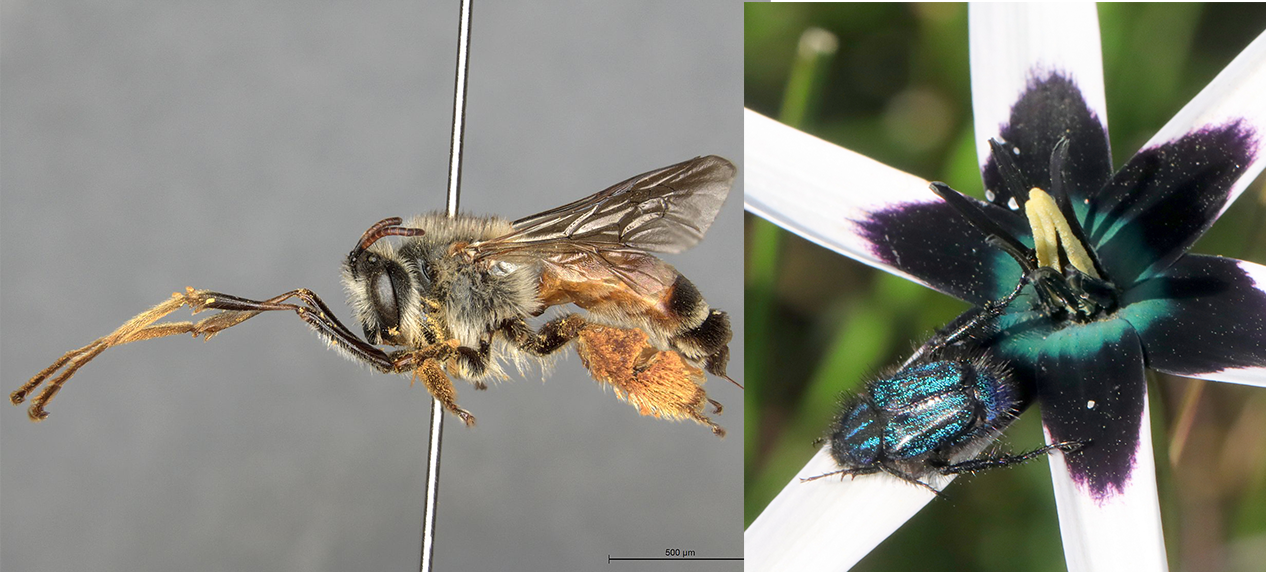
Left: Female Oil-collecting bee (Rediviva emdeom), showing the unusally long front legs. Photo by Simon van Noort (WaspWeb). Right: Glittering Monkey Beetle (Anisonyx ditus) on a Peacock Flower (Pauridia capensis). Photo by Cecile Roux.
Equally fascinating are South Africa’s long-proboscid flies in the familiy Nemestrinidae. Species such as the Mega-proboscid Tangle-veined Fly (Moegistorhynchus longirostris) possess mouthparts that are four times the length of their bodies! These flies visit flowers with extremely long nectar tubes that few other insects can access. As they feed, pollen is deposited onto specific parts of their bodies, ensuring effective pollination. Some of these plant-pollinator relationships are so specialised that the disappearance of either the plant or the fly could threaten the survival of the other.
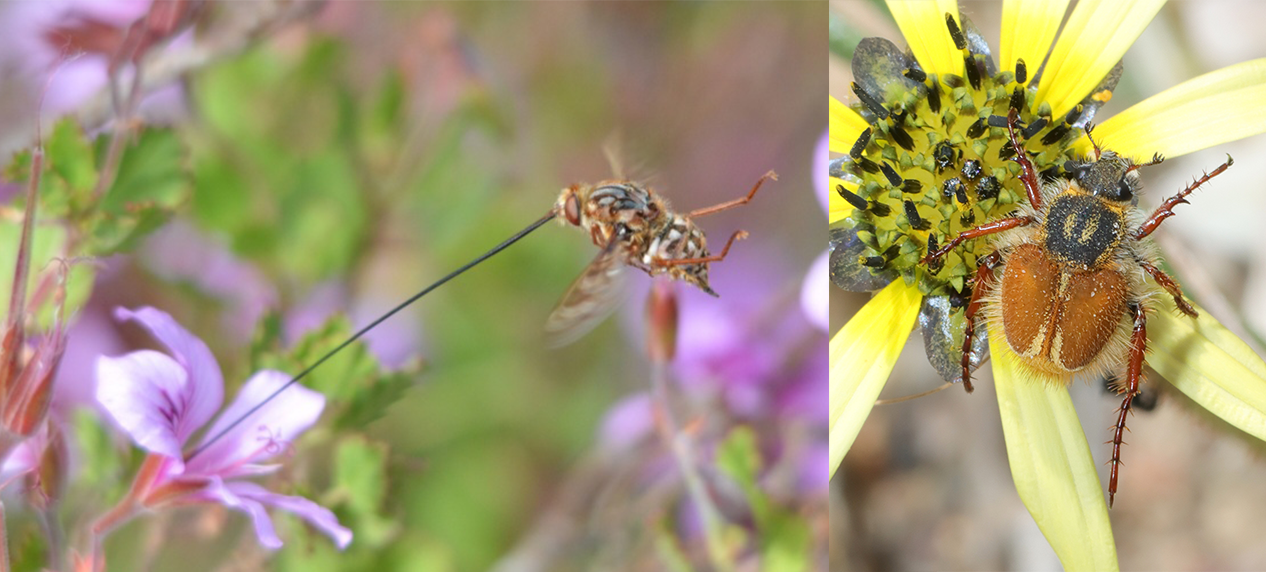
Left: A Mega-proboscid Tangle-veined Fly (Moegistorhynchus longirostris) drinking nectar from aStorksbill flower (Pelargonium sp.) Photo by Louis van Wyk. Right: Spider Monkey Beetle (Lepithrix pseudolineata) on a daisy on the West Coast. Photo by Cecile Roux.
Beetles are among the oldest pollinators on Earth and continue to play a significant role today. Before bees became dominant pollinators, many flowering plants relied on beetles for pollen transfer. Beetle-pollinated flowers are often large, robust and strongly scented, producing abundant pollen as a reward. South Africa’s proteas, water lilies and various succulent species all benefit from beetle visitation. Although beetles may appear clumsy compared to bees, their contribution to pollination should not be underestimated. One of the most important groups of pollinating beetles are the Monkey Beetles (Scarabaeidae: Hopliinae). With over 1000 species in South Africa, these small scarabs pollinate a wide range of flowers, especially daisies, mainly in the arid and semi-arid regions of the country.
Butterflies and moths also contribute significantly to pollination. Butterflies are generally active during the day, while many moths take over the night shift. Their long proboscides allow them to access nectar deep within tubular flowers. Several South African plants produce pale, strongly scented flowers that open at night specifically to attract moth pollinators. Most plants with red flowers are pollinated by birds, but the Table Mountain Beauty Butterfly (Aeropethes tulbaghia), however, is the only pollinator known to pollinate the Red Disa (Disa uniflora).
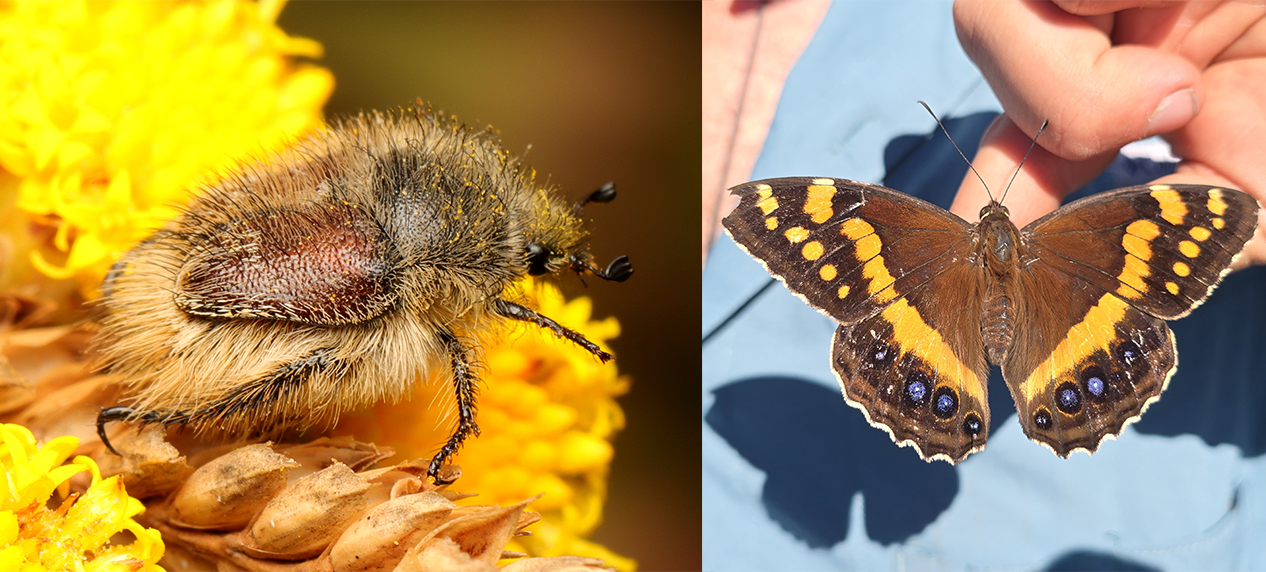
Left: Shaggy Monkey Beetle (Anisonyx species) on a daisy. Photo by Cecile Roux. Right: Table Mounain Beauty (Aeropetes tulbaghia).
Wasps, often feared for their stings, are also valuable pollinators. Many species visit flowers regularly for nectar and inadvertently transfer pollen as they move between plants. Some orchids have evolved astonishing methods of attracting male wasps by mimicking the scent and appearance of female insects, tricking the males into attempting to mate with the flower and thereby transferring pollen.
World Pollinator Week in June provided an opportunity not only to celebrate pollinators, but also to reconsider which species deserve our attention. Honeybees have become the flagship species for pollinator conservation, yet many native pollinators face far greater threats while receiving far less recognition. Native bees, flies, beetles and other insects often have specialised relationships with indigenous plants that honeybees cannot replace. If these native pollinators disappear, entire ecological networks may unravel.
Habitat loss, pesticide use, invasive species and climate change are placing increasing pressure on pollinator populations. Conserving natural habitats, planting indigenous flowering plants and reducing unnecessary pesticide use can all help support pollinator communities. Importantly, conservation efforts should aim to protect the full diversity of pollinators rather than focusing exclusively on a single species.
The story of pollination in South Africa is far richer and more complex than the familiar image of a honeybee visiting a flower. It is a story of ancient partnerships, extraordinary adaptations and intricate ecological connections that have developed over millions of years.