
DNA HAS ITS SAY:Â COLOPHON BEETLE POPULATIONS MORE WIDESPREAD
By Samantha Theron, Conservation Researcher at the EWT
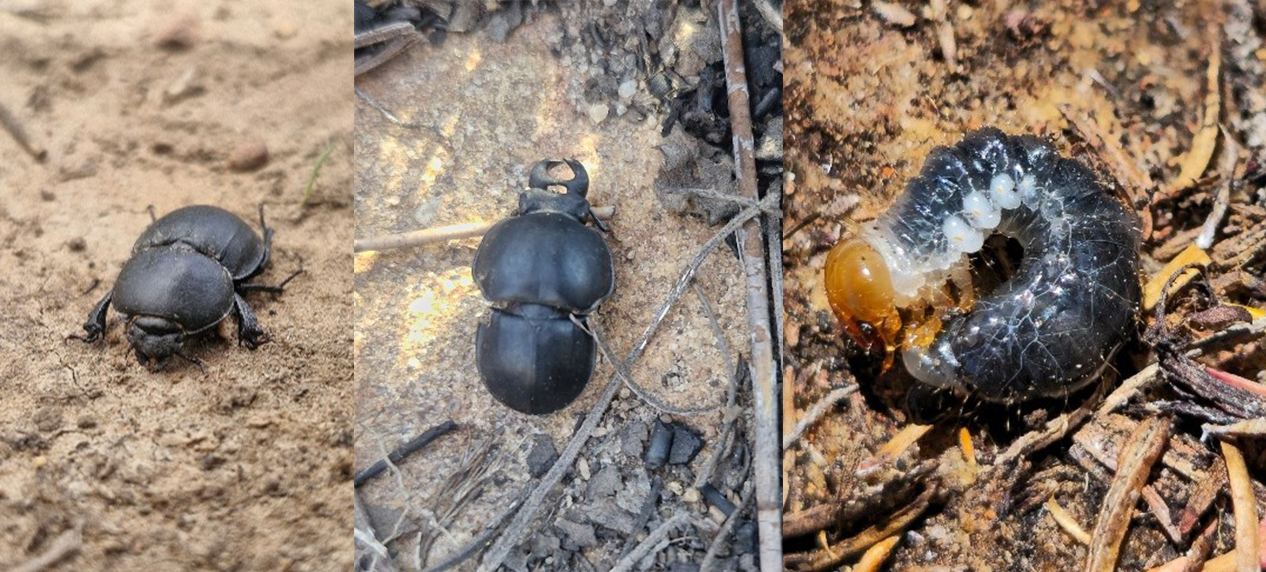
Left: Intact Colophon beetle remains found on the second survey. Center: Colophon fragments found on the third survey. Right: Live Colophon larvae found on the first survey.
Good news for a Critically Endangered Cape Stag Beetle: Recent DNA analyses of specimens from our high-altitude surveys of Cape Stag Beetles reveal that Nagai’s Cape Stag Beetle (Colophon nagai), is more widespread than we previously thought. This means that the threat of extinction may not be quite as imminent for this species as we had feared.
Over the past two years (2025 and 2026), the EWT’s Drylands Conservation team has conducted multiple field surveys across several mountain peaks in search of two species of Cape Stag Beetles (Colophon eastmani and C. nagaii) that are threatened by climate change, wildfires, and illegal collection. Cape Stag Beetles are high-altitude specialists and can serve as flagship species for high-altitude ecosystems, highlighting the challenges faced by organisms that have been driven upslope in response to changing environmental conditions. As climate change continues to alter these environments, mountaintop habitats – or “islands in the sky†– may shrink even further, increasing the risk of extinction for these high-altitude specialists. Furthermore, hotter, drier conditions resulting from climate change have resulted in an overall increase in the frequency and intensity of wildfires.
As soil dwellers, Colophon beetles are able, in some instances, to survive devastating fires. But, altered fire regimes, such as climate change- and human-induced changes in the frequency and intensity of fires, may pose significant threats to their existence. This year, our project aimed to investigate the impact of altered fire regimes on Cape Stag Beetles, while extending our search for Colophon nagai eastwards from the historical site. Ultimately, our aim has been to improve fire management plans and response protocols to protect Colophon habitat by mitigating the threat of human-induced changes in fire regimes.
Our 2025 surveys revealed multiple new sites for Colophon eastmani, and we were able to update the distribution of the species and conduct a threat assessment for the IUCN Red List, listing this species as Endangered. However, for Colophon nagaii we found nothing but a few beetle remains at the historical site, also known as the type locality – the only location from which the species is known. Thus, we feared the species may already be extinct, with one plausible explanation being that a 2017 wildfire may have wiped out this population. We drafted the first IUCN Red List assessment for Colophon nagaii, listing it as Critically Endangered.
Last year, our surveys included two helicopter-assisted survey expeditions, in which Ross Air flew us to various previously unsurveyed and otherwise inaccessible mountain peaks to search for these beetles. We found the use of the helicopter extremely beneficial to the efficiency and feasibility of the surveys. Thus the reason for ensuring the use of the helicopter again this year.

The expedition team camped at the top of the mountain range.
We conducted three field surveys. The first was a five-day expedition, in which three members of our team went up in a helicopter, along with food and camping gear, and continued on foot to survey five mountain peaks along a 20km stretch of the mountain range throughout the five-day period. These peaks represented five of the eight peaks we had set out to survey this year. The helicopter further assisted with moving us and our camping gear to a new camping spot on the third day, collecting us again on the last day. During this trip, we found evidence of Colophon in the form of beetle remains/fragments at multiple sites, as well as live Colophon larvae at two sites, indicating that the population is still viable.
On the second survey, we visited two peaks, one of which represents the historical C. nagai site. We had aimed to visit this site in the beetle’s active season (November – March), as our previous survey did not take place during this period, which could explain why we had previously failed to detect recent signs of Colophon at the historical site. This time we found multiple Colophon beetle fragments, at least one of which was still perfectly intact and exposed on the surface of the ground. We suspect that we arrived just at the tail-end of the beetles’ active season, as we did not encounter any live beetles. We also found beetle fragments on the second peak, which is adjacent to the type locality and approximately 2 km further along the mountain range.
A third survey was conducted at the last of the eight peaks we had set out to survey this year. We had initially planned to survey this peak during the first helicopter-assisted survey, but were unable to due to poor weather conditions on the last day. This final survey also revealed evidence of Colophon presence in the form of beetle remains near the peak.
During this survey, we collected beetle fragments from two sites for genetic-based species identification. In addition, Colophon fragments that were collected last year, on a peak that lies roughly midway between the two species’ (C. nagai and C. eastmani) known distributions, and for which the species’ identity was unknown, were also genetically analysed for species identification.
The results revealed that the fragments from both sites to the east of the historical C. nagai site, as well as those from the unknown site to the west (midway between the two species), represent C. nagai. This is an indication that the species is in fact more widespread than we previously thought.
In May this year, we hosted a workshop in Montagu, inviting landowners and representatives of the local Fire Protection Agency to discuss Cape Stag Beetle conservation and stewardship options and assess fire management plans and response protocols. Looking ahead, we will be distributing new fire management guidelines, specifically focussed on safeguarding key habitats for the species, to all relevant stakeholders. Two of the landowners have indicated their willingness to declare formal protection of Cape Stag Beetles on their properties, and we will be initiating these processes in due course. Protecting these remarkable and elusive insects and the habitats they depend on is essential, not only for their long-term survival, but also for advancing research on the impacts of climate change on species across the Karoo and Fynbos biomes.
The EWT thanks the Mohamed Bin Zayed Species Conservation Fund, Mapula Trust, Ross Air and the landowners for their support in this project.