Beyond Fences: How Vulture Safe Zone Alliance may be the missing piece to halting the rapid decline of Africa’s vulture populations
Danielle du Toit, Field Officer for the Birds of Prey Unit
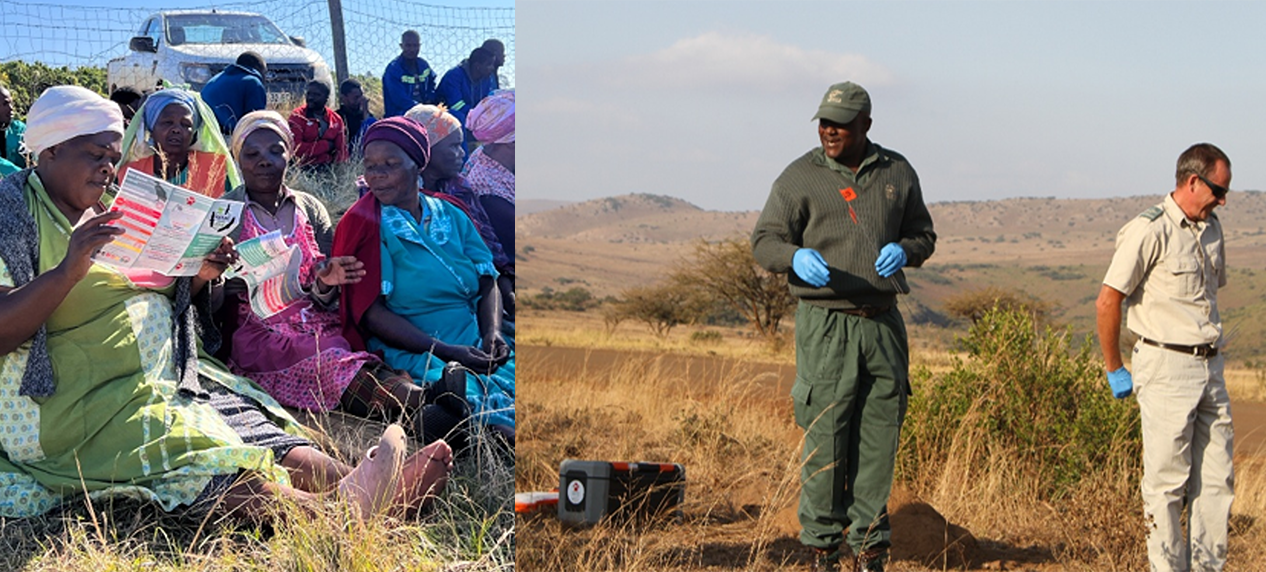
left: The EWT’s Ronelle Visagie handing over VSZ signboards
The image conjured up of nature conservation in Africa usually includes a reserve, fences, and rangers in camouflage uniforms. Powerful as that may be, Africa’s vultures need more.
Vulture populations across the continent have declined drastically over the last three decades, and several of these species are on the brink of extinction. The leading driver of these declines is poisoning, both direct and indirect. Poisons laid out on a carcass for various reasons can kill dozens, if not hundreds, of birds in a single feeding event. Add electrocution and collisions on power lines, drowning in cement reservoirs, unintentional poisoning through lead ammunition or veterinary drug contamination in carcasses, and the loss of nesting habitat, and what arises is an array of threats that turn up, either in total or individually on any type of land across Southern Africa.
The problem is that vultures on the wing can cover hundreds of kilometres in a day. They may roost on a power line on one property, bathe in a dam on another, and feed on a carcass on a third, crossing communal land, commercial farms, formally protected areas and even country borders. The fences between these properties play no role in where they decide to go, and yet, most of our approaches use protected areas as a core principle in the conservation of these species.
As such, conservationists need to address threats to these vultures at a transboundary landscape level to truly halt their declines, which has felt like an impossible task. Until now.
Vulture Safe Zones: They answer to landscape level threat reduction
A Vulture Safe Zone (VSZ) is an appropriately sized area where targeted conservation measures deal with the key threats facing the vulture species associated with that area. The goal is to support the survival of wild populations, by reducing threats, thus creating a landscape in which their numbers are sustained and, ultimately, increase.
The concept arose to address the Non-Steroidal Anti-Inflammatory Drug (NSAID) poisoning which caused the Asian Vulture Crisis. The foundational principles of these VSZs were to reduce the threat of NSAID poisoning in vultures through regional bans of vulture-toxic NSAIDs and shifts to safer alternatives. However, the threats to African Vultures are varied and require different mitigation approaches.
The requirements for the African context are:
- The area must be poison-free, and carcasses must not contain harmful contaminants like veterinary drugs or lead;
- Power lines and associated infrastructure must be retrofitted to reduce collision and electrocution risk;
- Reservoirs are covered or modified so birds, and other wildlife can’t fall in and drown and;
- Breeding and roosting sites are protected from disturbance.
The core feature of a VSZ is that it isn’t defined by land tenure. A protected area like a national park or a private reserve can be a VSZ, but so can a patchwork of livestock farms, or tracts of communal grazing land. What counts is whether the threats are being dealt with. More than two million hectares of southern Africa are now covered by VSZs, and yet the approach remains one of the most overlooked tools we have.
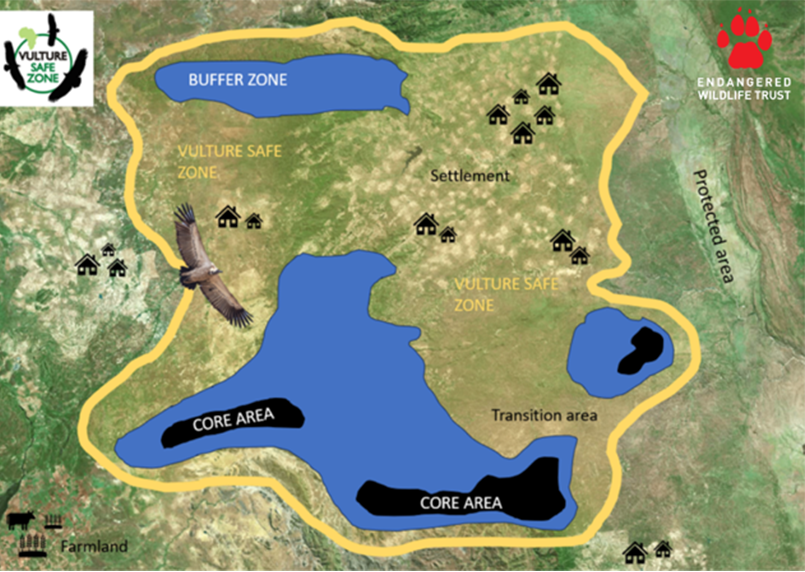
This image shows the spatial layout of VSZs. Black = Areas of high vulture importance (breeding or roosting sites) where formal protection to reduce risk of habitat disturbance or unsustainable development could be applied. Blue = Surrounding spaces where targeted threat mitigation must be prioritised and reduce likelihood of disturbances that can leak into core areas, but don’t necessarily require formal protection. Yellow = general demarcated area for VSZ certification under varying land use types. Threats should be identified and addressed as needed.
The EWT is among a small group of NGOs that have spearheaded VSZs in South Africa, and our two flagship zones show how the approach works. The Karoo Vulture Safe Zone Project has more than 730,000 ha committed to becoming Vulture Safe, including three national parks and the Mountain Zebra Camdeboo Protected Environment. The Karoo VSZ has been built farm by farm as more and more landowners commit to reducing threats on their own land.
The Kalahari VSZ covers more than 271,000 ha of Vulture Safe land and monitoring there suggests that the African White-backed Vulture breeding numbers in the area are increasing. At the beginning of 2026, years of work with SANParks culminated in Mokala National Park being certified the first South African national park as a Vulture Safe Zone. In partnership with Eskom, we have ensured that power lines in the conservation area are safe, while SANParks Honorary Rangers has donated nets to cover dams and prevent drownings.
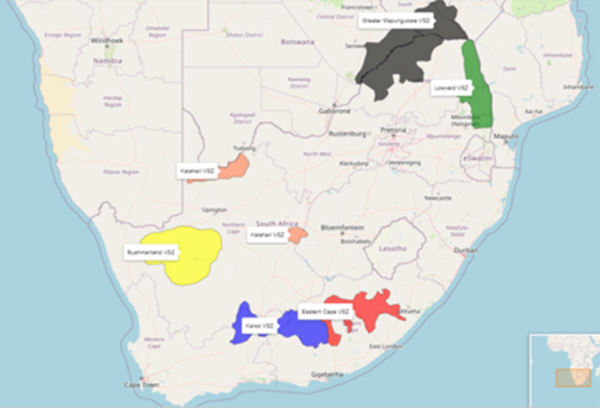
The EWT Karoo & Kalahari VSZs, and other areas intended as future VSZs.
The lesson from this is simple: vultures are conserved by relationships as much as they are by science.
Threats are reduced when farmers agree to cover farm dams or stop using poisons for predator control, when park management mitigates unsafe infrastructure, utility companies commit to retrofit powerlines to reduce collision or electrocution risk, or when communities report poaching or illegal activities. Science tells us where and what the threats are, but it is the actions by the people on the ground that actively reduce them and support the populations of vultures there.
The Vulture Safe Zone Alliance models the kind of collaboration that can achieve the landscape level threat mitigation needed to conserve vultures across the region.
The protected area model asks the question of how to safeguard a portion of land to conserve the species and processes that depend on it, but vultures force us to change our approach towards making a whole landscape survivable. A bird that ranges across dozens of properties can’t be saved by one well-managed reserve if it is poisoned, electrocuted or drowned the moment it leaves. Conserving vultures means tackling threats wherever they occur, whoever owns the land and however it is used.
Until recently, VSZs across the region were implemented by different organisations, each with its own approach. That flexibility drove innovation, but it also raised fair questions in conservation circles about what makes a safe zone genuinely safe, and whether zones are large enough to matter. This is where the Vulture Safe Zone Alliance (VSZA) comes in.
The EWT is one of nine organisations from six countries that have joined forces to solidify VSZs as the foundational approach to conserving our continents vultures. The VSZA’s first major product is a set of shared Vulture Safe Zone Guidelines, giving the region a common framework for identifying, establishing and monitoring these areas.
The members of the Alliance all agree that our conservation actions need to be aligned with the spatial utilisation of these birds and not driven by boundaries on the ground, and that can only happen through connected efforts, sharing what works (or what doesn’t), and linking safe spaces across large landscapes.
Vultures do not distinguish between protected or unprotected land, and neither should conservation. This reframing is what makes VSZs powerful, and the Alliance is what lets them scale. It treats farmers, communities and land managers as partners in conservation rather than obstacles to it. It gives every zone a shared standard, so results can be compared and trusted. And by linking zones, it starts building corridors of safety that match the spatial movements and land use of vultures, rather than cornering off certain areas in the hopes they might remain there.
It is not a silver bullet. Intentional sentinel and belief-based poisoning remain a serious problem in parts of the region, and no zone can fully stop a determined poisoner, because the sad reality is that all illegal activities continue despite the existence of the law. But the alternative, protecting isolated pockets of land while the spaces between them stay riddled with threats, is not working.
What does this Alliance mean for the public?
Vultures do work that people rarely notice. They clear carcasses quickly, helping to limit the spread of disease and the risks that decaying carcasses pose to livestock and communities. A BirdLife study valued the ecosystem services vultures provide in southern Africa at about $1.8 billion a year. When vultures disappear, someone pays the bill.
You can help by:
- Reporting suspected poisonings and injured birds your local provincial conservation authority or the EWT.
- If you own or manage land: cover reservoirs, use lead-free ammunition and make sure carcasses are free of contaminants and harmful drugs.
- If you own property or farm in areas where vultures frequent, talk to our Birds of Prey team about getting involved in our VSZ projects by contacting danielled@ewt.org
- Report injuries or mortalities caused by powerlines to our Wildlife and Infrastructure Unit at wep@ewt.org
The Alliance won’t turn the tide overnight. But for the first time, the region has a shared plan, a common standard and a growing network built on what the species needs to survive.