
Focus on Wildlife in Nature
As Africa’s energy needs increase, and the continent embraces the growth and implementation of green energy, a number of innovative methods have had to be developed to reduce the negative interactions between wildlife and infrastructure.
The Endangered Wildlife Trust’s Wildlife and Infrastructure  Unit, has developed numerous innovative methods to reduce these interactions, work to positively influence utilities’ wildlife management policies, and ultimately phase out problematic processes and hardware. Through adaptive management and the development of pioneering and innovative techniques, South Africa is now recognised as a world leader in managing the burden of wildlife damage on electrical infrastructure while addressing the threats to wildlife.
In the second article in a series of three about the work being done by the EWT to mitigate the effect of power lines on wildlife, particular birds.
Planning for Flight Paths: Bird Monitoring at Energy Infrastructure
By Hennie de Beer, Tamanna Patel, Matt Pretorius, Oscar Mohale, Kish Chetty
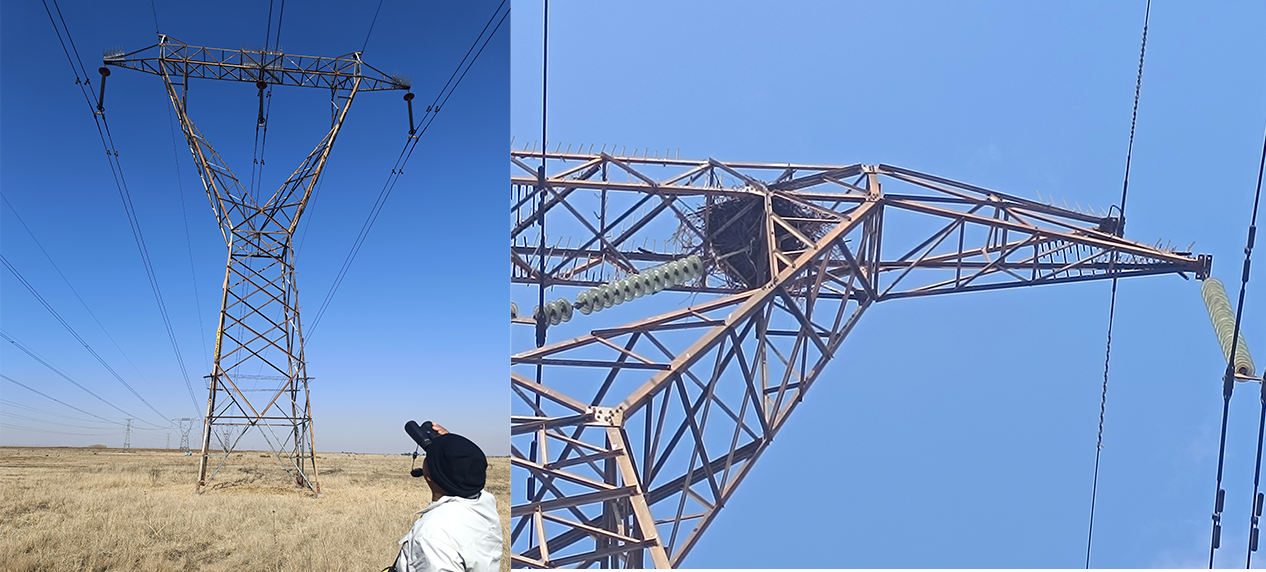
Pre-construction monitoring cannot predict everything. Once infrastructure is operating, post-construction monitoring tracks what happens and adaptive management responds. Addressing problems during operation is almost always more costly than getting the planning right from the start, but some risks only become visible during operation. This article looks at what South African monitoring reveals, how adaptive management responds when problems emerge, and the interventions that are saving birds’ lives as a result.
What post-construction monitoring involves
Trained observers conduct regular carcass searches beneath turbines and along power lines, with results adjusted for scavenger removal (the proportion of collision fatalities removed by scavengers before carcass searchers can detect them) and searcher efficiency (the proportion of fatalities found versus missed by carcass searchers). Where overhead power lines are part of a wind farm, the same specialist teams extend their searches to those lines. Beyond a wind energy facility (WEF)’s footprint, no structured monitoring programme exists for power lines.
Monitoring relies on incident-based reporting through the Eskom and Endangered Wildlife Trust Central Incident Register, and on incidental discovery and ad hoc annual power line patrols. For power lines in sensitive areas, a structured monitoring and adaptive management plan must be part of the Environmental Management Programme (EMPr), something to extend and learn from the wind energy sector. Monitoring results feed into formal reports submitted to regulators every six months. This work is not simply counting; it is a verification process that compares actual outcomes with predictions, identifies what was missed, and triggers mitigation before losses accumulate.
What monitoring reveals
A recent analysis of post-construction data by BirdLife South Africa from 33 South African wind farms has produced results that challenged pre-construction predictions. Pre-construction surveys missed raptors nesting very close to turbines; this only became clear once carcasses were found.
Verreaux’s Eagle deaths peak between April and August, driven by the demands of the breeding season. Dassie colonies have also played a role, drawing hunting eagles toward turbines at some sites. New above-ground power lines brought a secondary hazard: in open landscapes where perching structures were scarce, freshly installed pylons attracted raptors to infrastructure that posed electrocution risks.
Success stories: when monitoring drives results
Landowner engagement for vulture-friendly farming has roots in power line conservation work that predates the wind energy sector. Wind farm operators have since adopted and expanded this approach through vulture food management programmes, using dedicated patrol teams to remove any dead animals promptly and reduce the food-related draw on turbine areas.
At one Eastern Cape wind farm, this reduced the Cape Vulture fatality rate from 0.07 to 0.02 vultures per turbine per year, a reduction of more than 70 percent sustained over six years. The same principle continues to be extended to power lines, pairing vulture-friendly farming practices with diverter installation on high-risk spans.
Shutdown on Demand places trained observers (Observer-led SDoD) at vantage points to watch for priority species approaching turbines, halting the relevant turbines within seconds of detection. By mid-2024, Observer-led SDoD programmes had been established at five South African wind farms: Dorper, Excelsior, Jeffreys Bay, Golden Valley and Roggeveld.
At a Western Cape site near the Potberg Cape Vulture colony, this prevented an estimated 7 to 19 Cape Vulture and one to four Black Harrier fatalities in a single year. The Black Harrier faces a zero-fatality threshold: the species cannot sustain any further mortality at all, making every fatality avoided critical at the population level. Weather, human error, and communication delays constrain its reliability. At Excelsior Wind Farm near Swellendam, Observer-led SDoD caused just over 56 hours of downtime in almost three years of operation, equating to less than one per cent of revenue lost, directly addressing concerns about implementation cost. Automated detection systems (technology-driven SDoD) combining cameras and artificial intelligence must be more widely tested as a complement to human observers if Shutdown on Demand is to scale effectively across the sector.
Blade patterning works by painting one blade to break the motion smear that makes rotating turbines effectively invisible to approaching birds. In Smøla, Norway, a single black blade reduced eagle fatalities by 100 % relative to unpainted controls over 10 years. At Umoya Wind Farm near Hopefield, South Africa, a trial using single red-striped blades on four turbines produced preliminary but promising results, recording zero raptor fatalities in the 16 months following patterning, compared with seven in the equivalent pre-treatment period. From at least two experiments conducted globally to date, further testing across different species and environments remains critical.
Securing approval to paint turbines blades a colour other than white required a coordinated push from South African Wind Energy Association (SAWEA), BirdLife SA and the Birds and Renewable Energy Specialist Group (BARESG) to obtain a Civil Aviation Authority blanket permit in January 2024, as existing regulations required blades to be white. Avifaunal specialists recommending this mitigation should consult the SAWEA/BirdLife SA/BARESG Blade Patterning Guidelines 2024 to ensure optimal design, colour and treatment coverage.
Post-construction monitoring at two Northern Cape wind farms over five years identified 12 Verreaux’s Eagles and 3 Martial Eagles electrocuted on above-ground collector lines. Wooden perches were installed to draw birds away from energised components, and insulation of the most dangerous structures was recommended. Underground burial of collector lines should be standard practice at all new wind farms where site conditions allow.
Getting mitigation selection right
Proving whether a measure is effective requires more than watching fatalities fall after it is introduced, since rates vary naturally from year to year. The most reliable evidence comes from Before-After-Control-Impact (BACI) designs that retain a comparison group.
This is not without controversy: the idea of deliberately leaving some turbines unpainted or some spans unmarked while bird fatalities continue is difficult to defend on conservation grounds alone. But without controls, background fatality rates are difficult to determine, and any observed improvement cannot be confidently attributed to the intervention. The practical solution is deliberate zoning: designating certain turbines or line sections as study controls while fully marking those nearest to sensitive areas or known breeding sites.
Bird flight diverters (BFDs) are devices attached to power line cables at regular intervals to increase their visibility to birds in flight, reducing collision risk. The choice of diverter design matters as much as the decision to mark a line. Most diverters are designed around daytime-active species, but cranes, bustards, and flamingos are also active in low-light conditions, and a diverter without features suited to be effective during periods of reduced visibility offers little practical protection. Recommending that every span (line section between two towers) be marked from the outset, while well-intentioned, can also preclude measuring whether the chosen design works for the relevant species. Proving BFD effectiveness through BACI studies requires that collision rates are comparable across treatment and control spans before marking begins, a condition that is more complex to meet on power lines than at turbines and demands careful study design from the outset. Article 3 examines this in more detail.
A long-term commitment
Monitoring and mitigation continue for as long as a facility operates. Wind farms have an operational life of approximately 20 years; power lines can remain in service for 50 years or more. These are operating costs, not construction costs, and should be planned and budgeted from the outset, not treated as afterthoughts once infrastructure is commissioned. For power lines, the difficult question is whether mitigation implementation is built into asset management plans that span half a century, or whether it disappears once construction is complete. Developers, regulators, avifaunal specialists, and the governments and development banks financing South Africa’s energy expansion all have a role in ensuring this commitment is sustained.
When knowledge saves lives
Post-construction monitoring creates a learning loop: every discovery feeds into adaptive management and improves how future projects are designed. Vulture food management, Shutdown on Demand, blade patterning, and infrastructure retrofits all demonstrate what that loop achieves. But it only works for infrastructure that is being watched.
The Endangered Wildlife Trust is in the early stages of developing guidelines for power line bird mitigation in South Africa, a development that will give practitioners the standardised framework the sector currently lacks. Article 3 turns to the power lines with no scheduled monitoring, the species whose behaviour we still do not fully understand, and the path to closing these gaps.
Further reading
- BirdLife South Africa 2025. Summary Bird Monitoring Reports from Operational Wind Energy Facilities in South Africa. BirdLife South Africa Occasional Report Series No. 3. BirdLife South Africa, Johannesburg, South Africa. https://www.birdlife.org.za/wp-content/uploads/2025/02/Summary-of-Bird-Monitoring-Reports-Final-Version.pdf
- SAWEA, BirdLife South Africa and Birds and Renewable Energy Specialist Group (BARESG). 2024. Blade Patterning Guidelines for Avian Specialists. South African Wind Energy Association and BirdLife South Africa. https://www.birdlife.org.za/wp-content/uploads/2024/10/SAWEA-BLSA-Blade-Patterning-Guidelines-2024.pdf
- May, R., Nygård, T., Falkdalen, U., Åström, J., Hamre, Ø., and Stokke, B.G. 2020. Paint it black: Efficacy of increased wind turbine rotor blade visibility to reduce avian fatalities. Ecology and Evolution. 2020:1–9. https://doi.org/10.1002/ece3.6592
- Stokke, B.G., Nygård, T., Hamre, Ø., and May, R. 2024. NINA Report 2333. Norwegian Institute for Nature Research, Norway.
- Smallie, J., Froneman, A., Smith, D.L., and Mulvaney, J.M. 2024. Shutdown on Demand for the mitigation of bird collision risk at onshore wind farms in South Africa. BirdLife South Africa, Johannesburg, South Africa.