
Discovering species in the unforgiving Orange River—Karoo Conservation Area of Namibia
By Ruan Stander of the Threatened Endemic Species team and Renier Basson of the Drylands Strategic Conservation Landscape
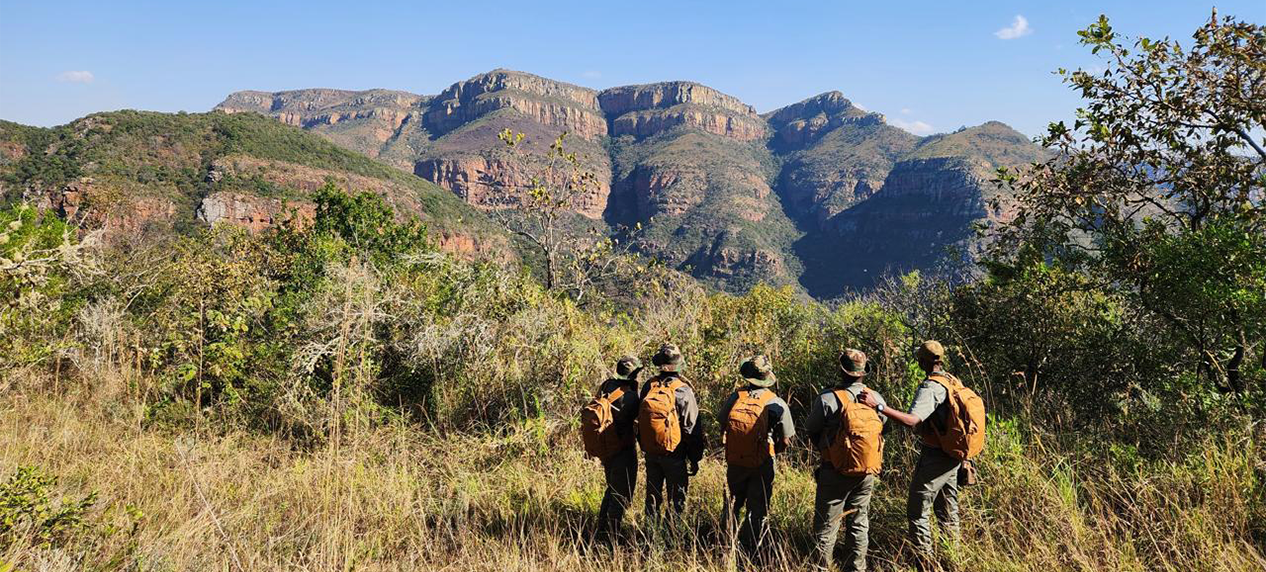
left: Ptenopus kenkenses (Photo: RI Stander)
A recent BioBlitz survey in a landscape that appears sparse and devoid of life delivered exceptional results with the discovery of one unresolved species and several undocumented species.
We spent more than a week in an 8,500 ha portion of the Orange River – Karoo Conservation Area (ORKCA) of southern Namibia’s ÇKharas Region targeting small mammals, invertebrates and herpetofauna, species the EWT team are primarily responsible for.
For those alarmed by or unfamiliar with the word ‘herpetofauna’, the term refers to reptiles and amphibians and is derived from the classical Greek ‘herpeto’ [εÏπετό] – ‘creeper/crawler ie., to crawl/creep’ – the root of the Greek word for reptile. Herpetology is thus the branch of zoology that studies reptiles and amphibians, and the term ‘herping’ is used to describe the act of searching for herpetofauna, i.e. an equivalent to ‘birding’. Birders bird and herpers herp.
The relatively recent rainfall had left the landscape lush with greenery and flowers, which initially suggested that insect activity would be high. Unfortunately, the weather was not in our favour, with daytime temperatures rarely exceeding 16 °C. The first week was windy and overcast, with slightly higher temperatures, whereas the second week was sunny and calm but considerably colder.
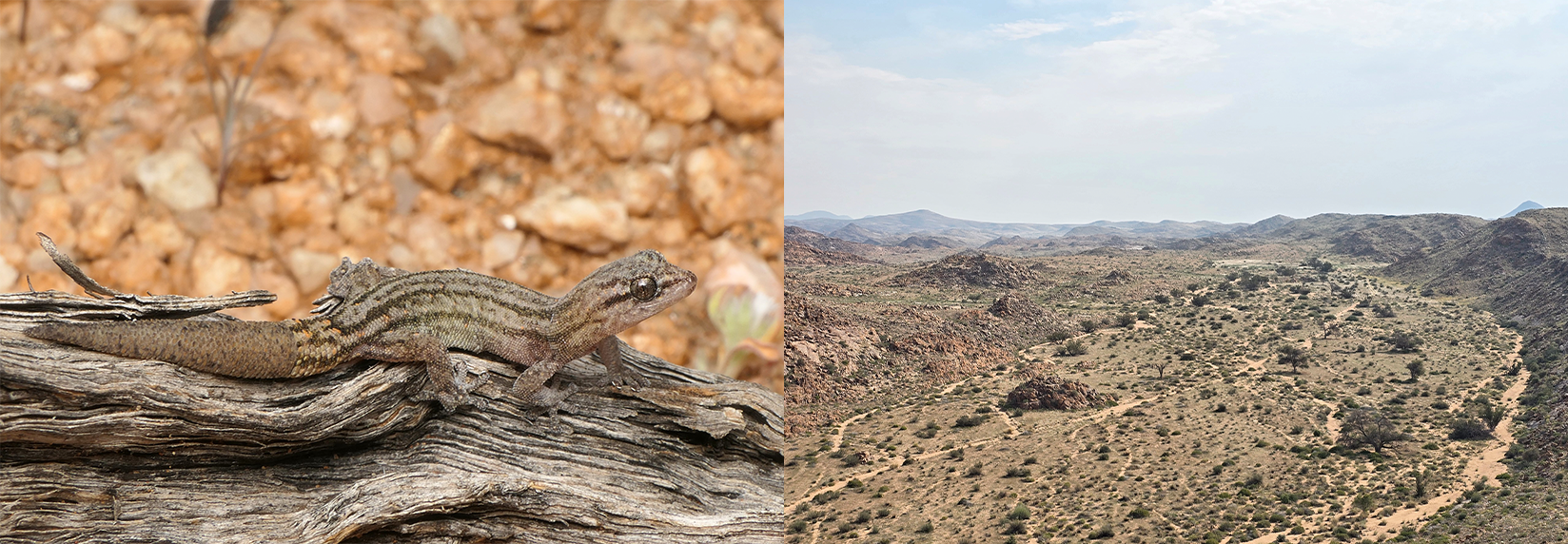
Left: Goggia lineata_RI Stander.
As a result of these unfavourable conditions, insect activity was much lower than anticipated. Evening light trapping using a UV light and white sheet proved to be the most effective sampling method, yielding the highest diversity of species, particularly inconspicuous Karoo moths and aquatic insects. In addition, the pitfall and funnel traps deployed in the drift fence trap arrays for the reptile survey captured a wide variety of interesting ground-dwelling invertebrates. Reptile activity on the other hand was higher than expected, but extremely localised and limited to diminutive species that can rapidly thermoregulate. Only three individuals representing three species were captured in the trap arrays, while all other reptiles were found by actively searching for them where they sheltered from the cold.
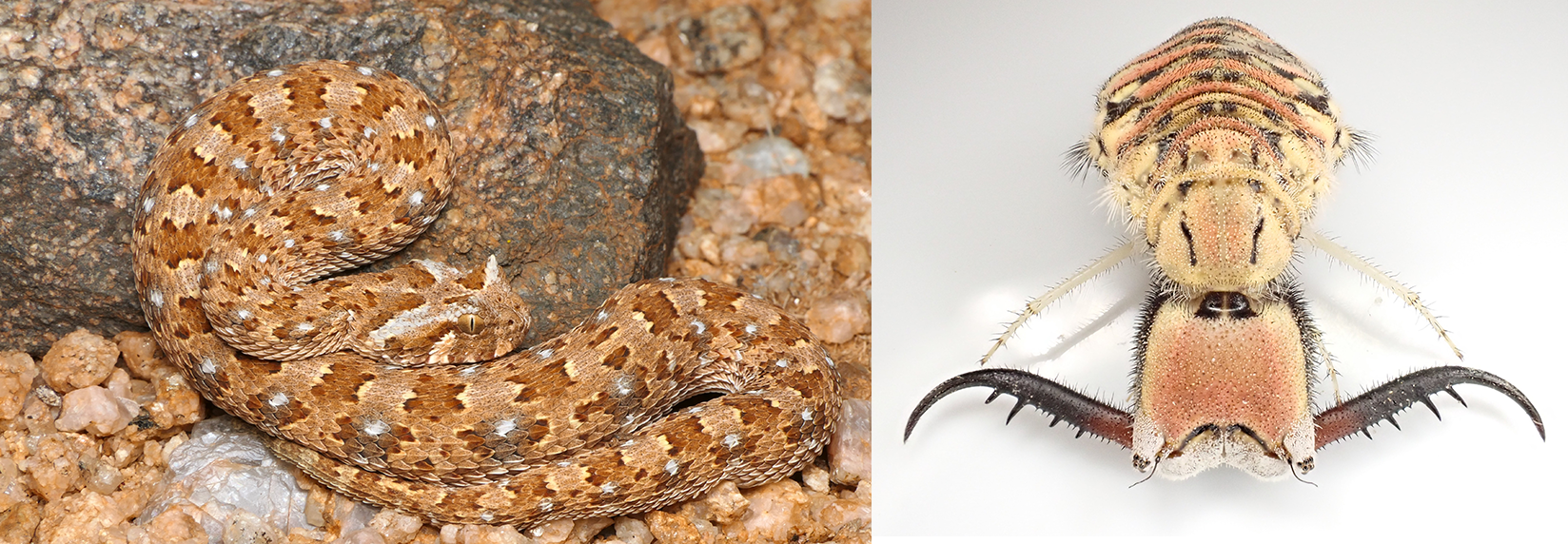
Left: Bitis caudalis_RI Stander. Right: Giant Antlion larva (Palpares immensus)._RJ Basson
Our survey added 10 reptile taxa to the ORKCA species list, bringing the total number of species known from the conservation area to 41. Of the 28 reptile species (24 lizards and four snakes) documented in this survey, two represented significant eastward range extensions (Goggia lineata – Striped Pygmy Gecko and Platysaurus attenboroughi – Attenborough’s Flat Lizard) and at least five filled an important genetic sampling gap (G. lineata, Acontias lineatus – Striped Legless Skink, Bitis caudalis – Horned Adder, Ptenopus kenkenses – Nama Barking Gecko and Platysaurus broadleyi – Augrabies Flat Lizard). This marks one of the first occasions on which P. broadleyi has been reported in Namibia, and is the first documented case of sympatric occurrence between it and P. attenboroughi. One amphibian species was also observed.
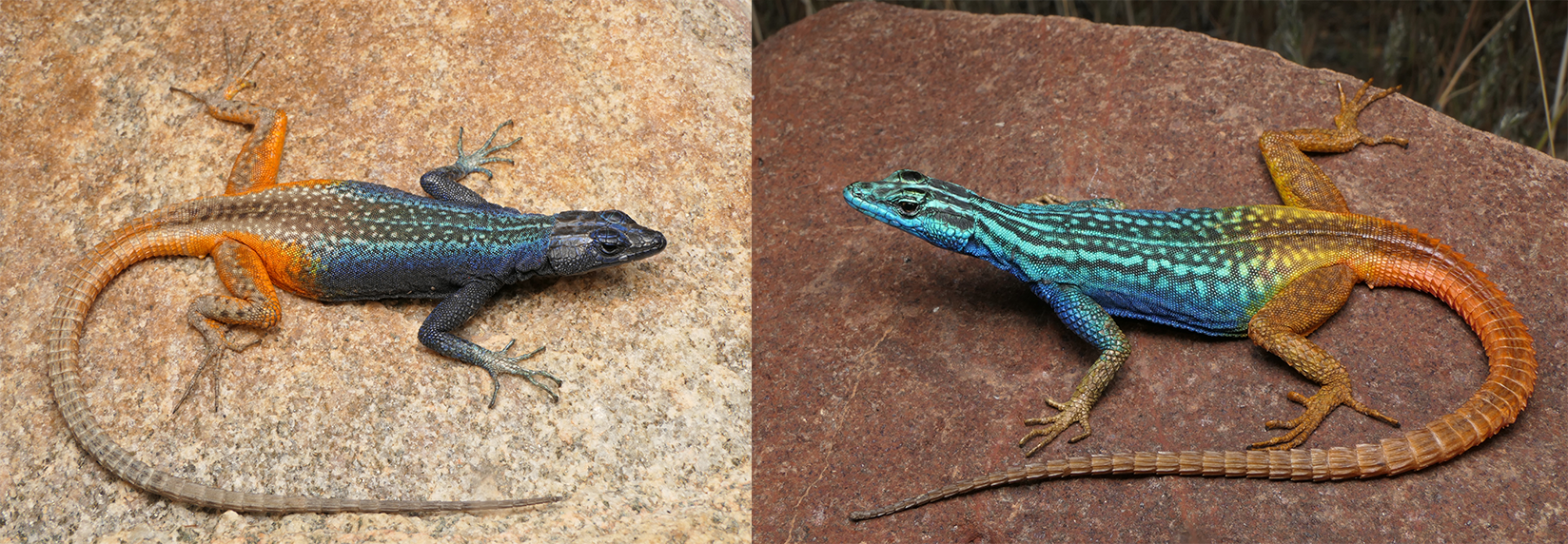
Left: Platysaurus broadleyi (RI Stander). Right: Platysaurus attenboroughi (RI Stander)
Thirteen small mammal taxa were recorded and one of the unexpected highlights was the Reddish-grey Musk Shrew (Crocidura cyanea). This genus is taxonomically cryptic and unresolved, and our survey has therefore contributed meaningfully towards future studies of the group.
Approximately 177 insect species were documented, representing 51 families and 11 orders. Beetles (Coleoptera) were by far the most species-rich group, with 65 species (37% of all recorded insects), including 30 species of darkling beetles (Tenebrionidae). An interesting darkling beetle belonging to the genus Machla was collected and is likely to represent an undescribed species. Most beetles were captured in pitfall and funnel traps.
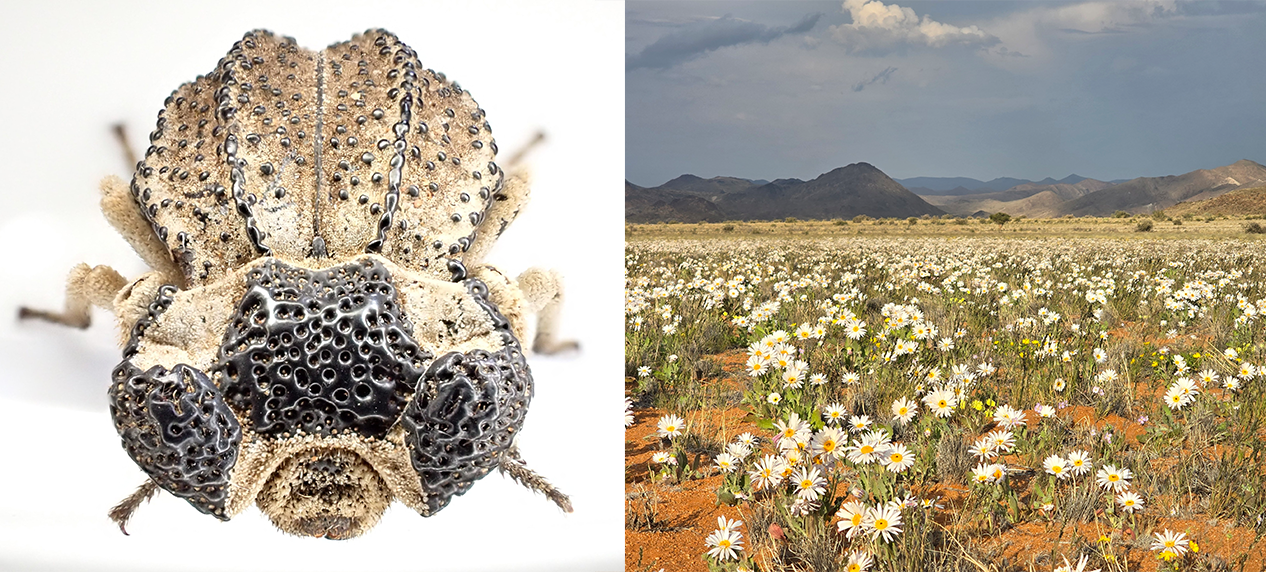
Left: A potentially undescribed Darkling Beetle (Machla sp.)_RJ Basson
A particular focus of the survey was Rock Hyrax (Dassie) middens in rocky outcrops, where we searched for beetles associated with dung, particularly members of the Scarabaeidae. Remains of three fruit chafer species (Cetoniinae) were found in middens: Rhabdotis albonotata and Leucocelis franki in Dassie middens, and Anoplocheilus namibicus in a Klipspringer midden. The records of Rhabdotis albonotata (chafer beetles) represent the first observations of this species on iNaturalist. Remains of the Dassie midden-specialist dung beetle, Onthophagus semigraniger, were also recorded. These represent the southwestern-most records of this Namibian endemic.
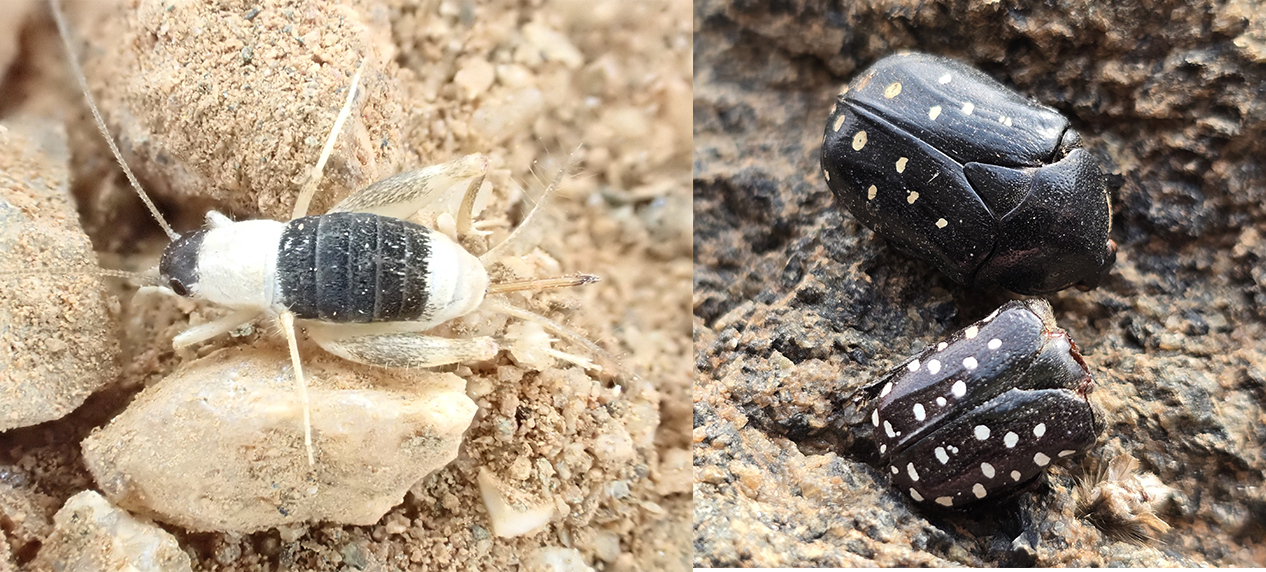
Left: One of three potentially undescribed scale crickets (Mogoplistidae)._RJ Basson. Right: Remains of the Fruit Chafer Rhabdotis albonotata from a Dassie midden – the first records of this species on iNaturalist._RJ Basson
Lepidoptera (butterflies) was the second-most species-rich order, accounting for approximately one-third of all insect species recorded. Unfortunately, most specimens could only be identified to family level. Giant Antlion larvae (Myrmeleontidae: Palpares immensus) were also recorded, incidentally, as these are free-living and not pit-building like most other antlions.
Other notable discoveries included several undescribed species of scale crickets (Mogoplistidae). These tiny, wingless crickets were captured in pitfall traps, and three of the four recorded species are potentially new to science.
Heelwalkers (Mantophasmatodea) were also collected and are likely to represent additional undescribed species. Heelwalkers are often referred to as “living fossils”, as fossil specimens have been discovered in amber dating back approximately 45 million years. Although their evolutionary lineage is ancient, the order itself was only formally described in 2002, making it the most recently-described order of insects. There are currently 14 described species, the majority of which occur in the arid southwestern regions of southern Africa.
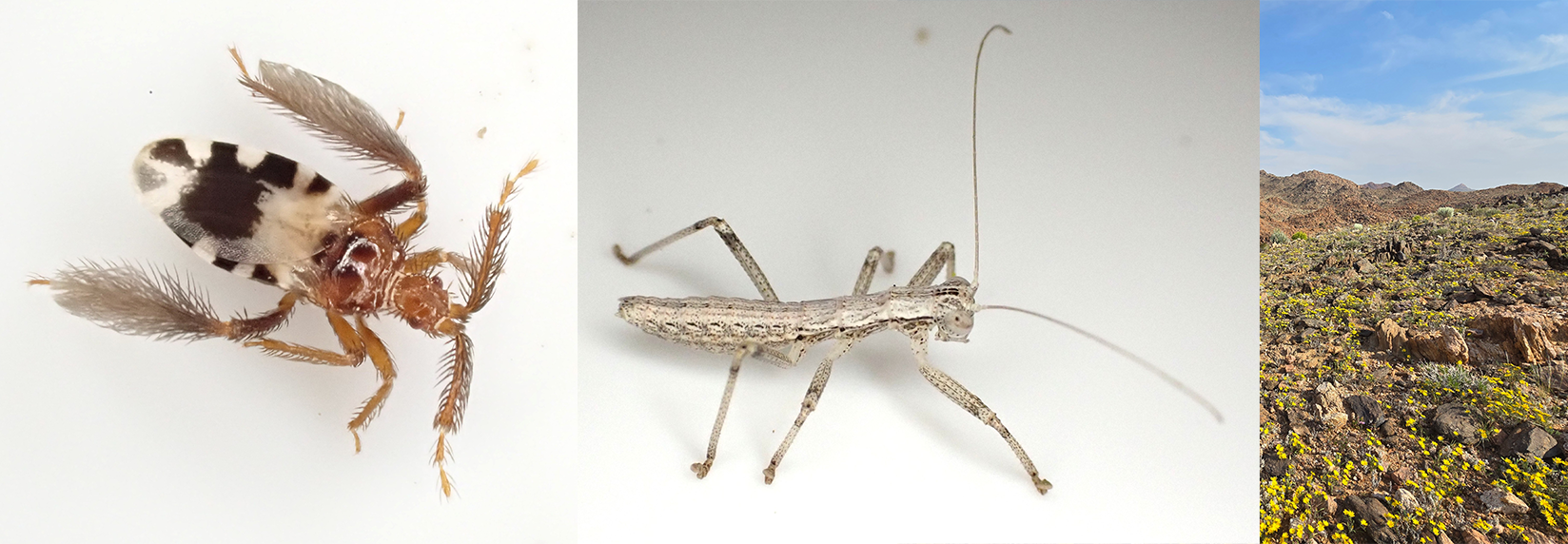
Left: A Feather-legged Bug (Dasycnemus thomseni), found in a termite nest. This is the first photo of a live specimen._RJ Basson. Center: A Heelwalker in the order Mantophasmatodea – likely a new species._RJ Basson
A very interesting and tiny feather-legged bug, known as Dasycnemus thomseni, was found in the nest of Northern Harvester Termites. This is the only record of the species on iNaturalist, and the first photos of a live specimen.
Other invertebrates recorded during the survey included scorpions, spiders, crustaceans, ticks, and mites. A total of nine scorpion species, 13 spider species, two crustacean species, two tick species, and one mite species were documented. This brings the total invertebrate species list to approximately 204 species, of which at least six are likely undescribed.
The south of Namibia remains comparatively poorly sampled and surveyed, and our BioBlitz has thus contributed tremendously both to species occurrence datasets and future taxonomic and phylogenetic studies.
Â
This project was supported by the Orange River – Karoo Conservation Area