
Visiting Mozambique’s youngest national park
By Darren Pietersen, EWT Threatened and Endemic Species project management
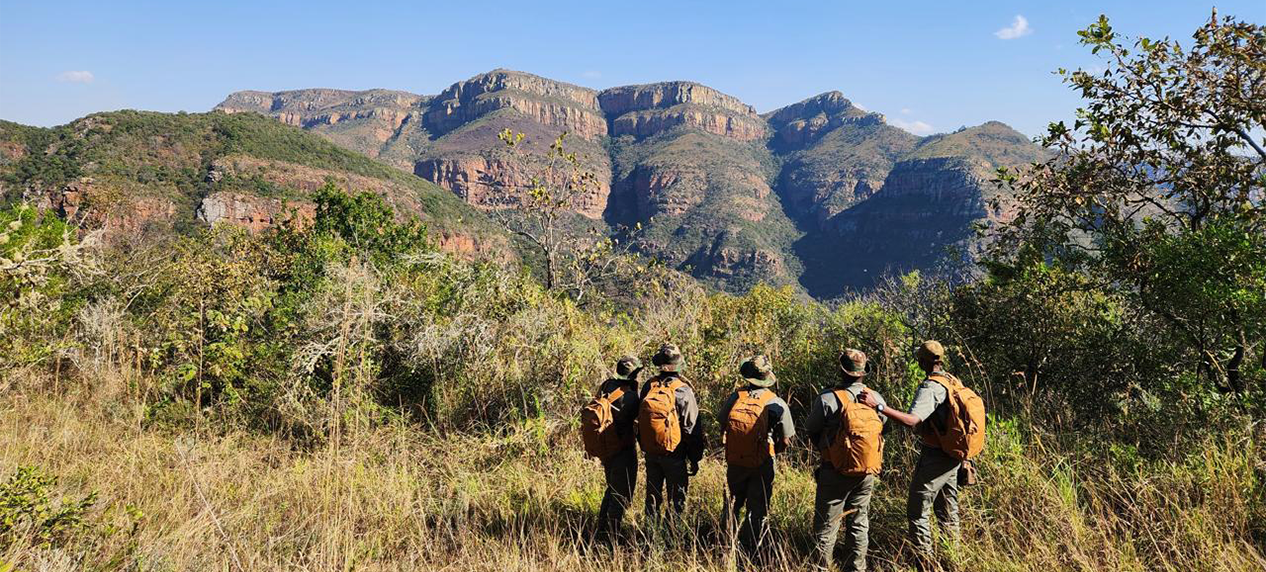
From mid-June to late-July 2026, the Endangered Wildlife Trust’s Carnivore Conservation Unit, together with representatives from Catawba University in the United States, paid a three-week visit to Mágoè National Park in Mozambique. The primary goal was to determine whether large predators (particularly African lions) persisted in the landscape, although the opportunity was taken to conduct a general, rapid biodiversity survey at the same time.
After three days of travel by road, I met the rest of the team at Tete International Airport, and after the usual delays at customs, the team set out for Mágoè National Park (250 km and seven police roadblocks later).
Mágoè is Mozambique’s youngest national park and is nestled on the southern banks of Lake Cahora Bassa, between the Zimbabwean border and the town of Songo where the Cahora Bassa Hydro-electric power station is located. Named after the nearby town, Mágoè National Park was established in 2013 and encompasses approximately 3 559 km2 of largely unspoilt Zambezi Valley bushveld.
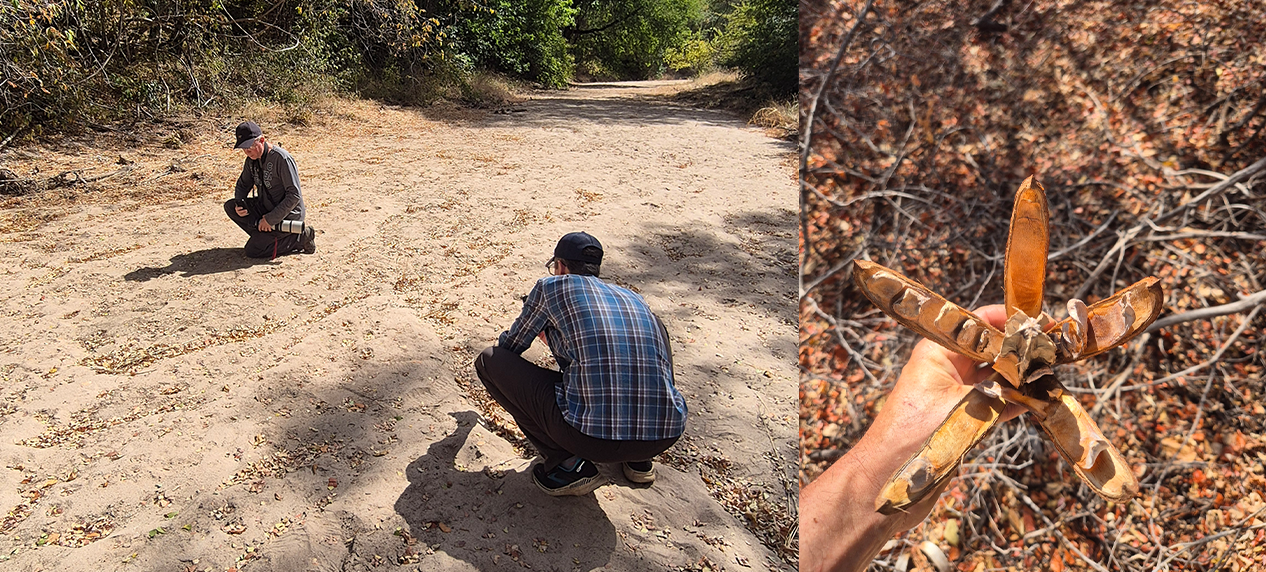
Right: Caprivi Wooden-Banana Entandrophragma caudatum
Prior to being declared a national park, this was previously the Tshuma Tchato community conservation area which was mostly leased as hunting concessions to Mozambican or foreign safari companies.
As is typical of most of the Zambezi Valley, Mágoè National Park is dominated by tall Mopane woodland, with a few low rocky ridges. One outstanding feature of the park is Serra Comboio – a large (roughly 25 x 7 km) sandveld plateau rising about 300 m above the surrounding plains. At the time of our visit the area was in its third consecutive year of drought, and the low lake levels resulted in a wide, short grassy plain extending up to 3 km from the lakeshore treeline to the current lakeshore. The effects of the drought were further manifested in the many fishing villages that had been temporarily abandoned, and a concomitant number of temporary abodes that had been erected much nearer the current shoreline. This national park hosts a significant human population, with most people living along its shored relying on these waters for protein, in the form of the innumerable fish that are harvested each day.
The generally uniform vegetation, which is predominantly dry Mopane Woodland, resulted in a relatively low recorded species diversity, although the prevailing drought and the season (winter) did not aid the general biodiversity survey either despite this being the ideal time to survey large carnivores.
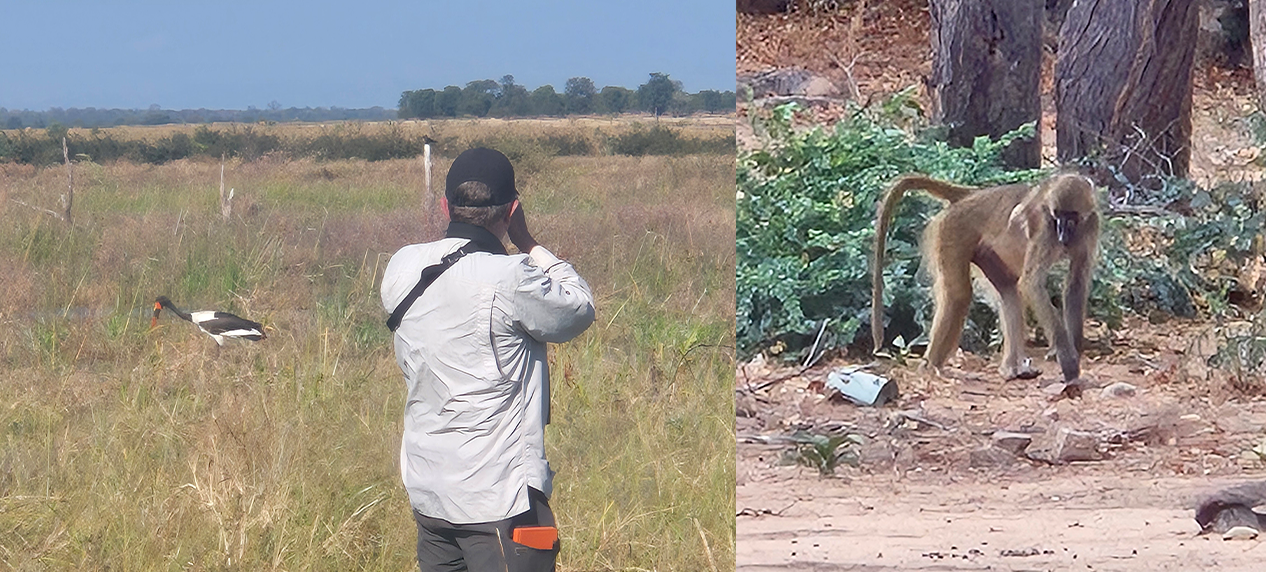
Right: Grayfoot Chacma Baboon Papio ursinus ssp. griseipes
Nonetheless, we recorded 208 bird species, submitted 18 Full Protocol cards across 16 pentads to the Second Southern Africa Bird Atlas Project (SABAP2), and 14 pentads of which had not been surveyed since the inception of the project in 2006 (so-called virgin pentads). We also submitted incidental bird sightings for an additional 22 virgin pentads. The bird highlights included recording a Lesser Black-backed Gull which is a rarity in southern Africa, and being awakened each morning by the raucous calls of Grey-necked and Meyers Parrots, as well as Lillian’s Lovebirds. Waterbirds were numerous, with egrets and herons of every shape and size, including the presence of Black Herons with their characteristic ‘umbrella’ hunting technique.
Because of the relatively high human density along the lakeshore, the waterbirds were also generally trusting – certainly a lot more so than is typical. We saw several flocks of Banded Martins – an intra-African migrant to southern Africa in the Austral summer – that should have been on their wintering grounds in Central and East Africa already. The number of martins recorded, and the time of year, could suggest that this species overwinters along Lake Cahora Bassa, or may even be resident here, although much more data needs to be gathered to ascertain the status of this population.
The Mucumbura River Floodplain in the west of the park has a high likelihood of hosting regional rarities and vagrants, especially in summer. Even during our visit, we recorded White-browed Coucal, Dwarf and Little Bittern, Lesser Moorhen and Orange-breasted Waxbills here. Across the park we also recorded 37 mammal species, 33 reptile species, two amphibian species and 51 invertebrate species which included 23 butterfly species, five of which were Charaxes species – not bad for a mid-winter survey!
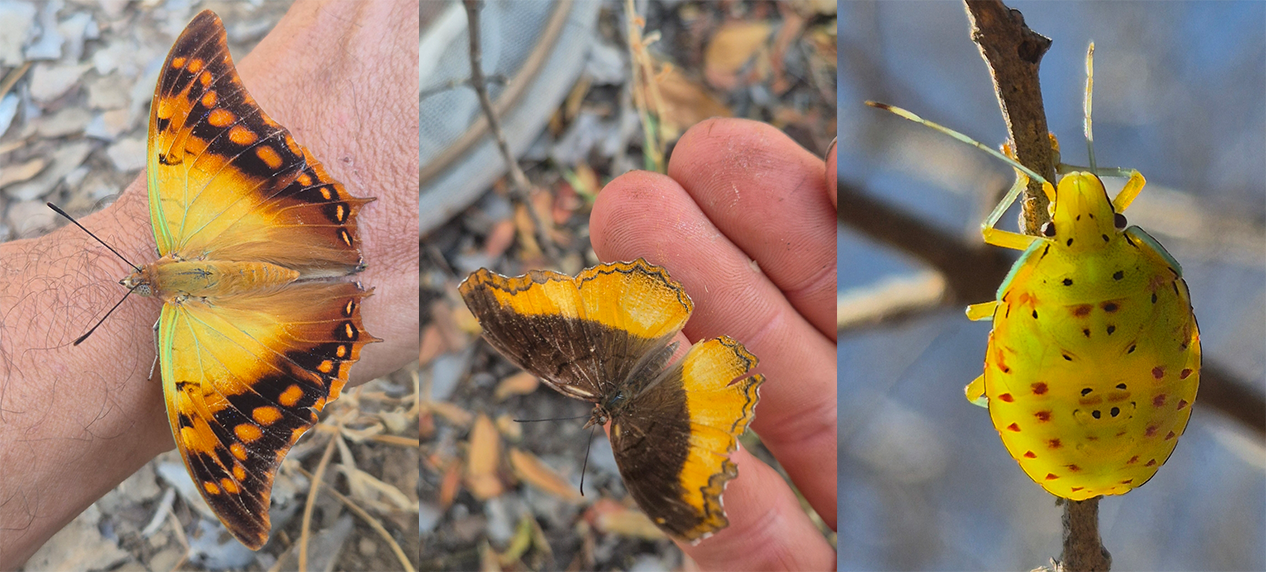
Left: Green-veined Emperor Charaxes candiope. Centre: Southern Golden Piper Eurytela dryope ssp. angulata. Right: Two-spotted Stinkbug Bathycoelia distincta.
And the carnivores? We did not record any evidence of lions, although that does not mean that they do not occur in the area. The Carnivore Conservation Unit’s Osvaldo Abrão placed 40 trail cameras that were left in-situ for two months, passively recording mammals well after the survey team had left. These cameras will be lifted in early September, and will give the team a better idea of what mammal species really occur in the area. Who knows – perhaps they will reveal one or more images of lions after all.
We did, however, record Spotted Hyena during our trip, as well as leopard, Black-Backed and Side-Striped Jackal, Caracal and numerous civets, genets and other smaller carnivores. We also recorded a lot of African Elephant activity, as well as Cape Buffalo and varying levels of plains game, particularly in the western section of the park.
Being a relatively new national park, Mágoè still has a lot of room to grow, and with the keen management at the helm (and perhaps with a little outside support from a suitable funder and advisor), it will be interesting to see how the park develops further in the coming years.
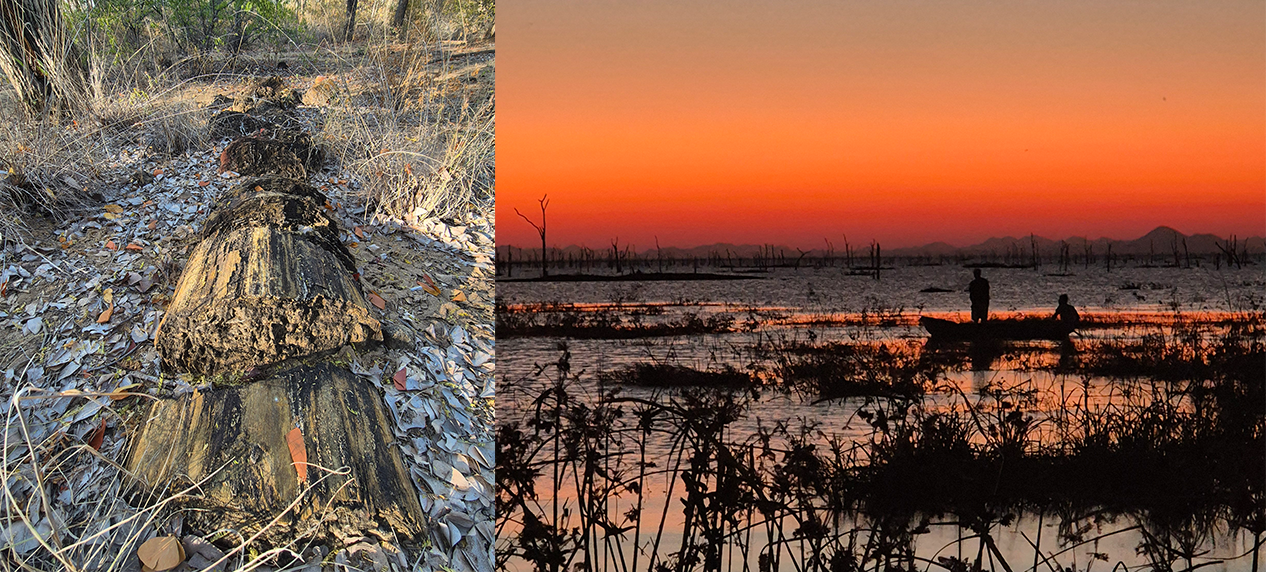
Left: Petrified log. Right: Sunset over Cahora Bassa.
** This work has been made possible by the Oak Foundation