
Science Snippet:
The Perfect Patch: Decoding African Grass Owl Nest Selection
By: Erin Adams and Lizanne Roxburgh. EWT Conservation Planning and Science Unit
Habitat loss and degradation are among the greatest threats facing wildlife today. This is especially true for bird species that depend on specific environmental conditions for breeding.
Understanding where birds choose to breed and forage is therefore essential for effective conservation planning. When selecting a nesting site, birds consider factors at different scales. At the local scale, they may respond to conditions such as temperature, food availability, and protection from predators. At a broader landscape scale, factors such as vegetation type, habitat size, and the surrounding environment become important. For species that do not build their own nests, finding a suitable breeding site can be even more challenging.
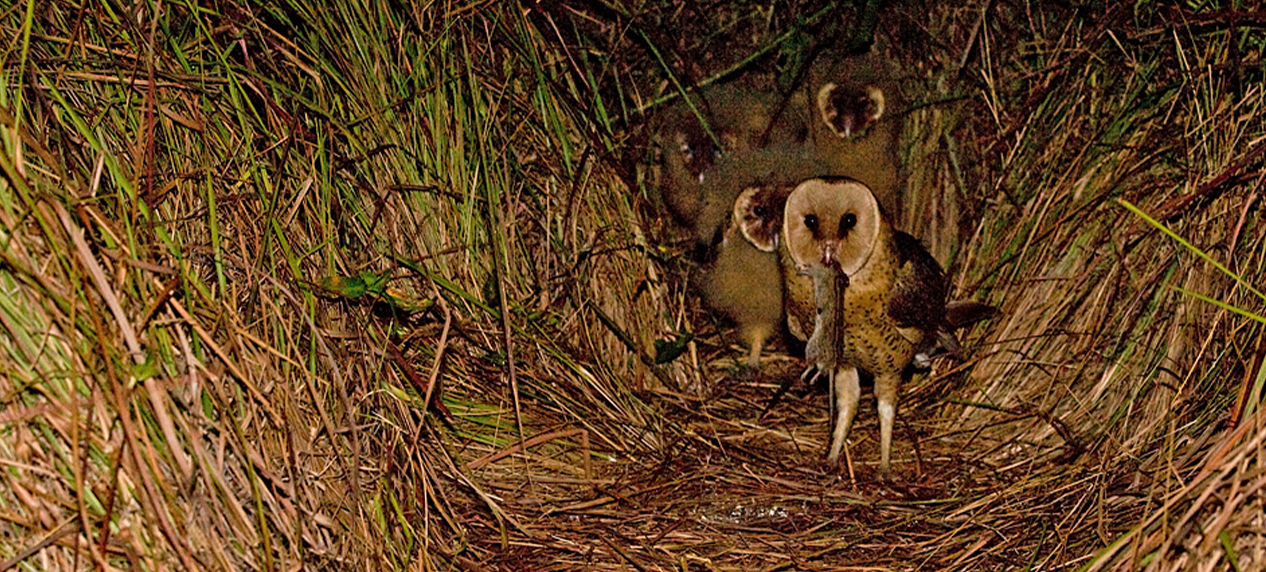
The African Grass Owl is one of only two owl species in South Africa that lays its eggs on the ground, using nests concealed within dense grass or sedges. Despite this unique nesting behaviour, relatively little is known about how these owls choose their breeding sites. In a recent publication co-authored by EWT scientists*, researchers investigated which habitat features are most important in nest site selection by African Grass Owls.
African Grass Owls inhabit moist grasslands in South Africa. Because they do not construct their own nests and breed directly on the ground, suitable nesting habitat is critical to their survival. To better understand their nesting preferences, researchers tracked seven breeding females and monitored 41 nests in Gauteng and Mpumalanga between 2009 and 2017. By comparing nesting locations with the surrounding landscape, they were able to identify the characteristics that influence nest site selection.
The study revealed that African Grass Owls are extremely selective when choosing breeding sites. Within their entire home range, there may be only one location that meets all the requirements for successful nesting. Researchers also found that breeding pairs often return to previously used nest sites when suitable conditions remain unchanged.
One of the most important factors influencing nest selection was the presence of Imperata cylindrica, a grass species found at 88% of the monitored nests. The owls showed a strong preference for this grass over other available species and were observed leaving their territories if this particular species is not available. Imperata cylindrica is also highly susceptible to fire, which could further limit nesting.
The researchers also found that nests were most commonly oriented towards the east-southeast, with an average orientation of 102.16°. In addition, Grass Owls showed a strong preference for nesting near wetlands while avoiding developed areas. Avoiding developed areas may help reduce the risk of predation from domestic and feral cats and dogs, which pose a significant threat to ground-nesting birds. The owls also avoided cultivated fields, possibly because these areas support different prey species.
Agricultural fields are typically dominated by gerbils and other seed-eating rodents, whereas wetlands provide habitat for larger herbivorous rodents such as the vlei rat, one of the Grass Owl’s preferred prey species. Finally, the owls were found to avoid woodlands, mining areas, and urban environments. This behaviour may help reduce competition or conflict with other owl species, including the Barn Owl.
This study provides valuable insight into the breeding habitat requirements of the African Grass Owl, a species currently listed as Vulnerable on the IUCN Red List. The findings highlight the importance of conserving suitable nesting habitat if populations are to persist into the future.
Based on their results, the researchers recommend maintaining a mosaic of wetlands and moist grasslands that includes extensive stands of Imperata cylindrica. These areas should be protected through the use of firebreaks, while controlled burns should be conducted every three to six years to maintain suitable habitat. Ideally, a secondary patch of Imperata cylindrica should be managed alongside the main nesting area and burned on an alternating schedule to ensure that suitable nesting habitat is always available. The researchers also recommend limiting development within Grass Owl home ranges, excluding livestock from key breeding areas, and controlling invasive alien plants such as pom-pom weed. Together, these measures could help protect and restore the specialised habitats that African Grass Owls depend on for survival.
* Pretorius, M. D., Malan, G., Rachuene, T., Tate, G. J., Botha, A., Van Niekerk, A., Chetty, K. & Durgapersad, K. (2026). African Grass Owl nest site use and nest survival in fragmented grassland landscapes. African Journal of Wildlife Research, 56(1). https://doi.org/10.3957/056.056.0110