
Focus on Wildlife in Nature
As Africa’s energy needs increase, and the continent embraces the growth and implementation of green energy, a number of innovative methods have had to be developed to reduce the negative interactions between wildlife and infrastructure.
The Endangered Wildlife Trust’s Wildlife and Infrastructure (WIN) Unit, has developed numerous innovative methods to reduce these interactions, work to positively influence utilities’ wildlife management policies, and ultimately phase out problematic processes and hardware. Through adaptive management and the development of pioneering and innovative techniques, South Africa is now recognised as a world leader in managing the burden of wildlife damage on electrical infrastructure while addressing the threats to wildlife.
In the final article of the three-part series, the WIN team discusses the monitoring of bird species before and after the construction of energy facilities.
Planning for Flight Paths: Bird Monitoring at Energy Infrastructure
By Hennie de Beer, Tamanna Patel, Matt Pretorius, Oscar Mohale, Kish Chetty
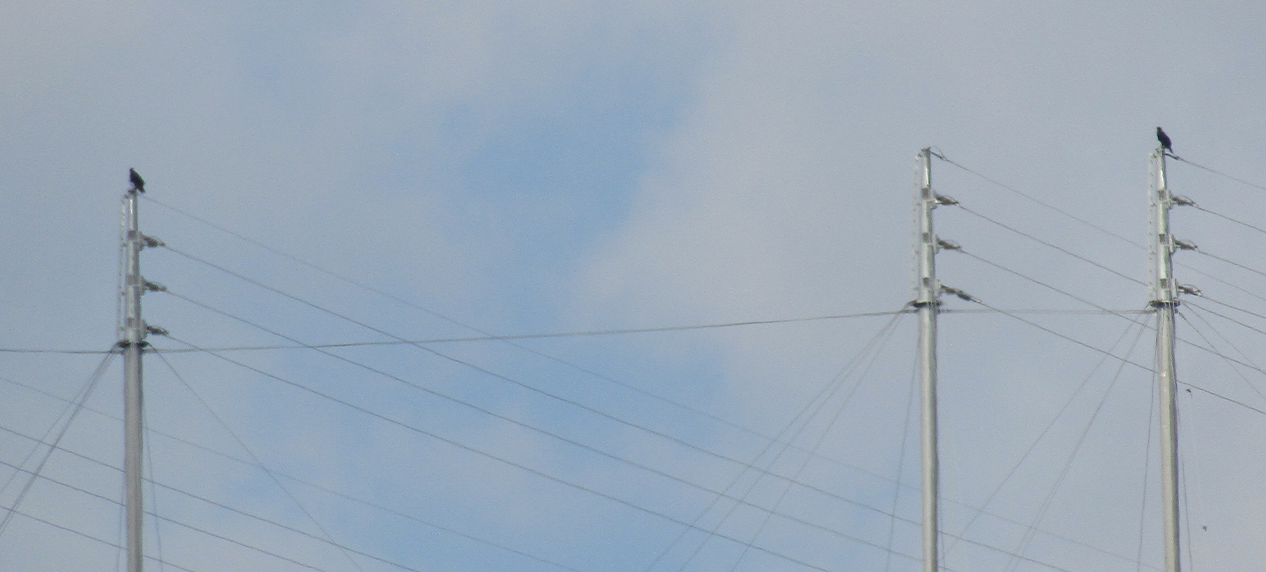
South Africa’s Wind Energy Facilities (WEF) track bird activities closely, before and after construction. Power lines get no such attention once they run beyond a facility’s own footprint. This article explains why that gap persists and what it would take to close it.
The line that goes unwatched
Wind energy has benefited from a decade of increasingly refined monitoring protocols. Power lines have not. Guidance does exist, including the World Bank’s overhead-line survey methods, but it was designed mainly for lines associated with a WEF, not for the thousands of kilometres of transmission and distribution corridors that cross the country independently. For overhead lines outside a WEF, the guidance itself acknowledges that there is no standard method; monitoring is left to case-by-case judgement based on line length, risk and available resources.
Northern Cape wind farms uncovered electrocution risk on their own above-ground collector lines because those lines sat within a monitored WEF footprint. Beyond that footprint, two forms of monitoring exist, but neither systematically catches bird fatalities. Eskom carries out annual/biannual line inspections, carried out by technical staff as part of routine hardware checks, regularly pick up wildlife mortalities, and flag structures that pose a collision or electrocution risk, feeding into the Eskom and Endangered Wildlife Trust Strategic Partnership’s hotspot identification and structure reconfiguration work.
Certain recent lines have monitoring built into their Environmental Management Programme (EMPr), where the Environmental Impact Assessment (EIA) process identified them as crossing sensitive areas under the National Screening Tool and DFFE Powerlines Strategic Environmental Assessments (SEAs). The opportunity is to build on that foundation, not to start from nothing. Folding a short wildlife checklist into the hardware inspections technical staff already carry out, rather than treating bird monitoring as a separate exercise, could extend coverage across the network at a fraction of the cost of a standalone programme. The same logic applies to lines built before the National Screening Tool existed: routine inspections could flag them for a one-off risk review rather than requiring a wholesale audit of the older network.
Species we still do not understand well enough
Some species remain difficult to protect because the available data is still limited. The Black Harrier (Circus maurus) is an exception. Near-endemic to southern Africa and listed as Endangered, it is one of the better-studied cases: its regional population is estimated at only 733 to 938 mature individuals and is declining by about 2.3% each year. Population viability modelling suggests that the species has a greater than 50% chance of extinction within 75 to 100 years if fatalities increase by only three to five adult birds per year above baseline mortality.
BirdLife South Africa’s 2025 Red Data Book assessment records at least 13 confirmed adult Black Harrier fatalities across South Africa’s 33 operational WEFs since 2014. Once under-detection is considered, the true number could be closer to double, leaving little margin before the population reaches the fatality threshold identified by modelling.
Bustards present a different kind of knowledge gap. Ludwig’s Bustard (Neotis ludwigii), which is Endangered and nomadic, and Denham’s Bustard (Neotis denhami), listed as Vulnerable, appear in national fatality records at turbines and along power lines. At turbines, Ludwig’s Bustard and Denham’s Bustard, the recorded numbers are still single digits, too few to reveal which routes, seasons or conditions carry the highest risk. The picture for power line fatalities is less settled: current published data understates the true toll, with more recent findings not yet in print suggesting the numbers are higher.
Verreaux’s Eagle (Aquila verreauxii) and Martial Eagle (Polemaetus bellicosus) face a related problem at a larger scale. Both are killed by turbine collision and by electrocution on power lines, but no single dataset currently combines turbine and power-line records to show the total pressure on either population.
Where the turbine solution runs out
Bird Flight Diverter (BFD) design must match a species’ activity pattern, and proving that a diverter works requires a genuine Before-After-Control-Impact (BACI) study, rather than simply observing a decline in fatalities. For turbines, the practical approach is deliberate zoning: selecting turbines with comparable pre-treatment collision rates, then leaving some unmarked controls while fitting the rest with diverters. Zoning by risk level and treating only the high-risk turbines would bias the comparison from the outset, since the control and treatment groups need equivalent baseline exposure for the before-after comparison to hold.
It is tempting to assume that the same model can be carried over to power lines. It cannot, at least not cleanly. BACI’s statistical strength depends on collision rates being comparable between control and treatment groups before mitigation begins. At a single WEF, turbines usually share broadly similar terrain, spacing and species exposure, making it relatively straightforward to identify suitable controls.
Power lines are different. A line can change character within only a few kilometres as span height, surrounding habitat and bird movement patterns shift from one section to the next. Treating an unmarked span as a control without first confirming that its pre-mitigation collision rate resembles that of the marked span is not a genuine comparison. A BACI study based on that assumption may look rigorous while producing unreliable conclusions.
The answer is not to delay mitigation until a perfect study becomes possible. Developers often have to prioritise immediate risk reduction over years of pre-marking baseline data collection because installation costs and project timelines do not disappear. The more practical solution is to design comparability into BFD rollouts from the outset, so that marking a line and evaluating whether the marking works are not treated as competing objectives.
Turning gaps into a plan
None of this erases what the first two articles in this series documented: pre-construction surveys can shape turbine layouts, post-construction monitoring can identify what those surveys missed, and adaptive management can measurably reduce fatalities. It does mean that the next phase of work has a clear focus:
- Develop standardised guidelines for power-line monitoring, built for linear corridors rather than adapted point-based turbine protocols.
- Extend post-construction monitoring requirements further along transmission and distribution networks, instead of stopping at WEF boundaries.
- Build secondary ecological effects, such as those exposed in the Northern Cape case, into monitoring protocols from the start.
- Use GPS tracking studies and updated distribution mapping to close data gaps for bustards, eagles and the Black Harrier.
- Feed post-construction fatality data back into pre-construction collision-risk models, for both WEF and power lines, so each new and existing project improves on the predictions of earlier ones.
- Use automated detection systems, including cameras and radar, to complement Shutdown on Demand where fast response is needed.
- Create a shared industry database of collision and electrocution records so new projects can learn from the full evidence base, not only from site-specific reports.
- Design BACI studies for power lines only where comparability between control and treatment spans is established before marking begins.
South Africa’s wind sector has spent a decade building the monitoring culture described in this series. Applying the same investment to power lines is within reach. It begins by treating these gaps not as a verdict on work already done, but as the next items on a practical working list.
Further reading
- BirdLife South Africa. 2025. Summary Bird Monitoring Reports from Operational Wind Energy Facilities in South Africa. BirdLife South Africa Occasional Report Series No. 3. BirdLife South Africa, Johannesburg, South Africa.
- https://www.birdlife.org.za/wp-content/uploads/2025/02/Summary-of-Bird-Monitoring-Reports-Final-Version.pdf
- Cervantes, F., Martins, M., and Simmons, R.E. 2022. Population viability assessment of an endangered raptor using detection/non-detection data reveals susceptibility to anthropogenic impacts. Royal Society Open Science 9: 220043.
- International Finance Corporation, European Bank for Reconstruction and Development, and Kreditanstalt für Wiederaufbau. 2023. Post-Construction Bird and Bat Fatality Monitoring for Onshore Wind Energy Facilities in Emerging Market Countries: Good Practice Handbook and Decision Support Tool. Washington, DC: International Finance Corporation.
- Lee, A.T.K., Rose, S., Banda, S., Bezeng, S.B., Maphalala, M.I., Maphisa, D.H., and Smit-Robinson, H.A. (eds). 2025. The 2025 Red Data Book of Birds of South Africa, Lesotho and Eswatini. Johannesburg, South Africa: BirdLife South Africa.
- Smallie, J., Froneman, A., Smith, D.L., and Mulvaney, J.M. 2024. Shutdown on Demand for the mitigation of bird collision risk at onshore wind farms in South Africa. BirdLife South Africa, Johannesburg, South Africa.