
Small Bodies, Big Impact: The Blue-footed Baboon Spider and the Illegal Wildlife Trade in Smaller Species
By Sibongakonke Ngogodo, Wildlife in Trade legal officer
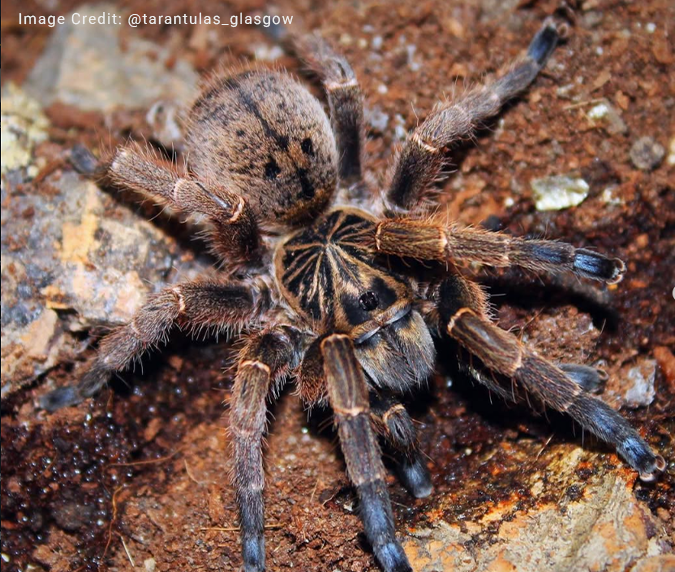
Image Credit: @tarantulas_glasgow Instagram
Conservation stories on the illegal wildlife trade often focus on the animals everyone already knows: rhinos, elephants, pangolins, big cats and vultures. And while these species deserve attention, many of South African’s lesser-known creatures are equally targeted.
Beneath rocks, inside silk-lined burrows and across small patches of specialised habitat, smaller species are also being collected, traded and overlooked. The Blue-footed Baboon Spider (Idiothele mira) is one of those species. The species is a member of the Theraphosidae family and is endemic to South Africa. It spends much of its life in or near a burrow and although it is small and rarely seen due to its restricted range, its striking blue colouring and trapdoor-burrow behaviour makes it attractive to collectors in the global exotic pet trade.
Baboon spiders are ground-dwelling African tarantulas. South Africa has a rich diversity of these spiders, with SANBI noting eight genera and 44 species, many of which are endemic. The Blue-footed Baboon Spider can be recognised by the sky-blue colour on the upper surface of the end segments of its legs. Unlike many animals that move widely through the landscape, baboon spiders are generally sedentary. They spend most of their time inside their burrows and do not usually move far from them. This behaviour makes them difficult to detect, but it also makes local populations vulnerable when collectors target known sites.
Wildlife trade is often discussed through the lens of megafauna or charismatic species. This can create the impression that illegal or unsustainable trade is mainly a problem for animals with tusks, horns, scales or feathers. In reality, smaller species such as spiders, scorpions, reptiles, amphibians and insects can also be targeted because they are rare, colourful, unusual or difficult to obtain. Baboon spiders illustrate this.
Baboon spiders are also threatened by habitat loss and conservation responses are limited by gaps in knowledge about their ecology and distribution. These gaps matter because authorities cannot manage a species which they do not understand. For the Blue-footed Baboon Spider, the challenge is not only that it is small. It is also quiet, cryptic and habitat-specific. These traits allow species to disappear from a locality long before anyone realizes there was a conservation concern.
SANBI’s reports that Blue-footed Baboon Spiders appear in the international exotic pet trade with some regularity, although current rates of exploitation remain unknown. This uncertainty is important, because where exploitation levels are unknown, a precautionary approach is needed, especially for species that are slow to recover. When breeding individuals or immature individuals are permanently removed from the wild, the population’s chance of recovery after collection is poor.
Although baboon spiders, and spiders in general, may be misunderstood, they play an important role in functioning ecosystems. They are nocturnal sit-and-wait predators that feed on small invertebrates such as beetles, grasshoppers, millipedes, cockroaches, crickets and other spiders. In this way, they contribute to regulating invertebrate populations and maintaining ecological balance. Their presence also illuminates habitat quality. Their silk-lined burrow in undisturbed ground points to soil structure, shelter, prey availability and a functioning microhabitat. When these sites are disturbed or individuals are removed, the ecosystem is impacted.
The species has not been formally assessed for the International Union for the Conservation of Nature Red List of Threatened Species, which means its global conservation status is unknown. It is illegal to capture, possess or trade in the species without a permit. Enjoying these species by viewing them in their natural habitat (if you are lucky enough to spot them) is therefore encouraged, but should be done responsibly. Sharing exact locations of rare or desirable species can unintentionally lure collectors. If you do happen to spot one of these spiders in the wild, you could contribute to further research by taking a photo of the species and sending it to SANBI or the Endangered Wildlife Trust.
The blue-footed baboon spider occupies an uncomfortable conservation position, too small for public attention, too obscure for most to recognise, yet ecologically significant and facing mounting pressures. Its plight exemplifies a broader challenge – the exploitation of species so understudied that their disappearance could go unnoticed. Yet ecosystem science demonstrates that the smallest threads are often the most critical.
Protecting species like the Blue-Footed Baboon Spider requires more than just legal listing. It requires better distribution data, responsible citizen science, careful handling of locality information, stronger awareness among the public, and continued enforcement against unlawful collection and trade. If conservation is to protect entire ecosystems, it must look beyond the animals that dominate headlines. The smallest species may be the easiest to overlook, but they are often among the clearest indicators of how much biodiversity remains hidden, vulnerable and in need of protection.