Help African Wild Dogs 

Donate today  

The Endangered Wildlife Trusts Commits to the future as it ends its 50th anniversary celebration under African skies

The Endangered Wildlife Trusts Commits to the future as it ends its 50th anniversary celebration under African skies

The Endangered Wildlife Trusts Commits to the future as it ends its 50th anniversary celebration under African skies

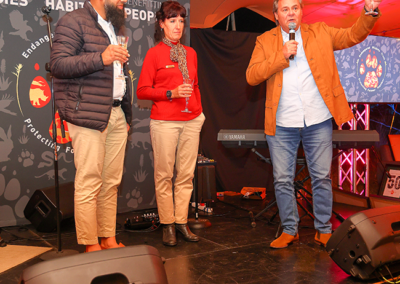
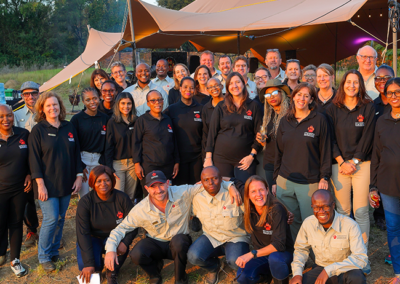
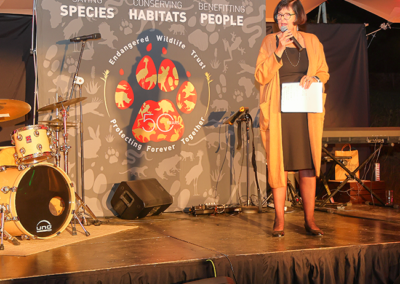
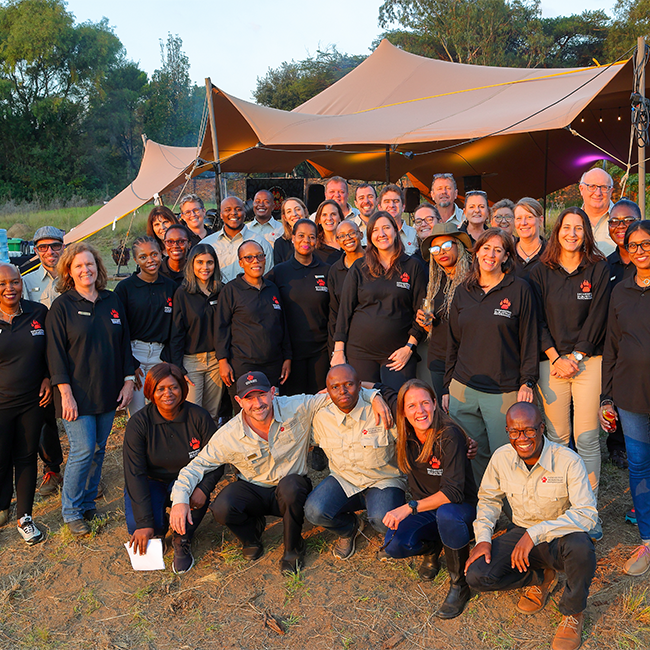
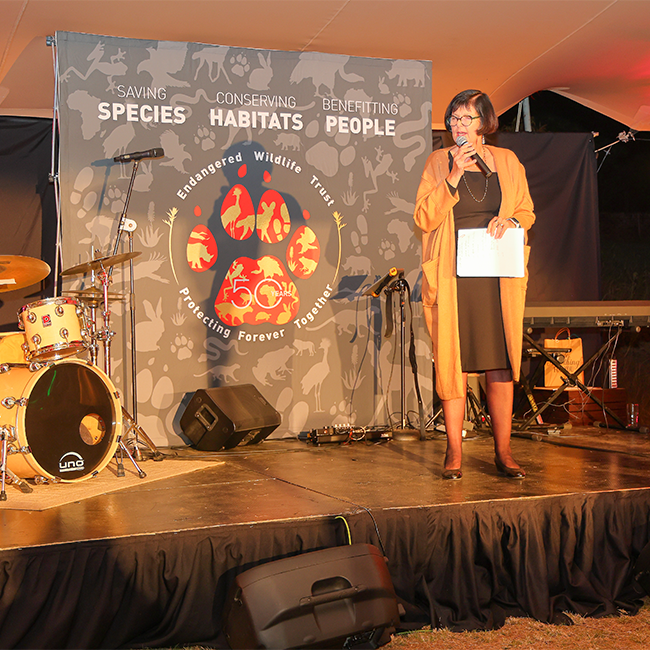
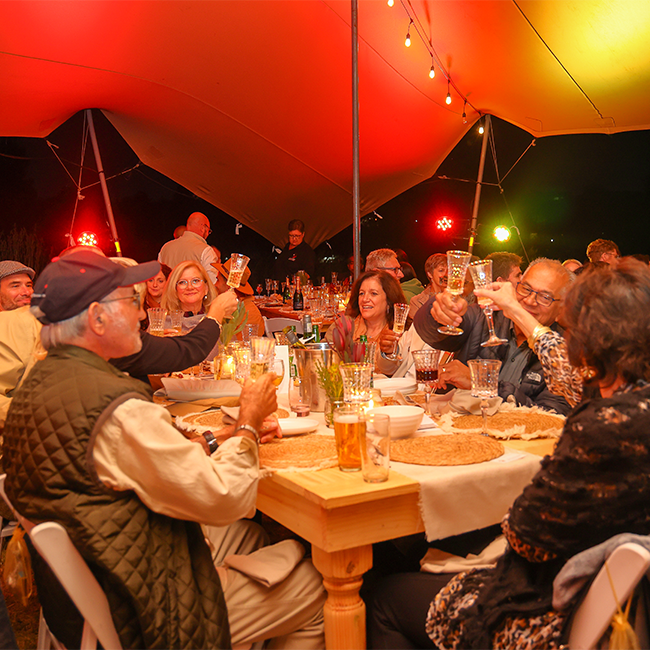
The Endangered Wildlife Trust ended its 50th anniversary with a gala event on 18 April 2024.


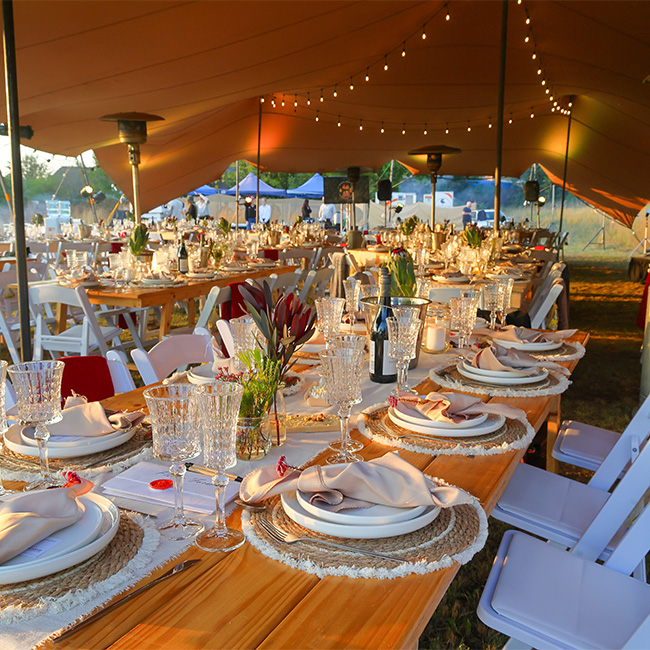
The earth-friendly event, with solar power and repurposed, natural and recyclable décor was held as a bush banquet under African stars at our Conservation Campus in Midrand, Gauteng. On arrival, guests were able to take a walk through the one-of-a-kind gardens that depict the ecosystems that the EWT works in.

We were honoured to share the evening with two of our founders, Clive Walker and James Clarke, former CEO’s, John Ledger and Nick King, present and past Trustees of the EWT Board, present EWT Board Chair Muhammed Seedat and the EWT’s CEO Yolan Friedmann.

During the evening of celebration, Yolan stated that the EWT’s 50th anniversary may not be a celebration of a “coming of age, but is one of a youthful spirit, blended with wisdom, a touch of maturity, a dash of streetsmarts, a helping of hope and a lot of energy still to be spent to realise dreams that are still big enough to scare us, in the words of Ellen Johnson Sirleaf.”

As the country’s longest-serving female CEO of a conservation organisation, Yolan said the EWT prides itself on instilling hope and not a sense of fear, loss or hopelessness when talking about our natural world.

“Instead, we prefer to show, with evidence, the difference we can all make when we work together,” said Yolan. “For 50 years, we have pushing back the tide and finding solutions; this is the thread that binds us and which continues to blur the generational lines, to form one united EWT”.

Forestry, Fisheries and the Environment Minister Barbara Creecy said during her keynote address that non-governmental and non-profit organisations, such as the EWT, play an important role in securing the future of not only our country’s rich biodiversity and conservation, but also in ensuring that communities living with wildlife outside conservation areas are able to share in the benefits of the environment.

In reference to the country’s commitment to achieving the Global Biodiversity Framework’s goal of conserving 30% of land and 30% of the sea by 2030, Creecy pointed out that South Africa may only achieve this target between 2036 to 2040, adding it may take longer in the marine environment which was less well researched and documented.

Achieving this objective created new challenges for all involved in the biodiversity and conservation fields, particularly important organisations such as the EWT which, in celebrating its 50 years of work, would be posing the question of what the fundamental issues will be in conservation in the next half a century, she said.

Addressing the issue of land restoration, transformation of the biodiversity sector, unemployment and community beneficiation – all areas which impact on the conservation estate — would require support from NGOs “because sometimes government is too big and too far away to undertake those processes properly”.

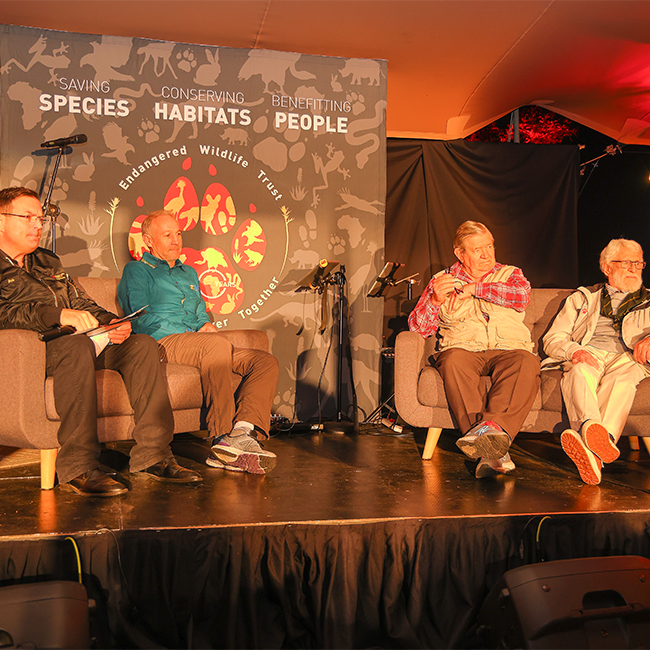
Guests were honoured with an inciteful Founders Forum facilitated by MC and radio personality Rob Vega, during which Clive Walker, John Ledger, James Clarke and Nick King shared their experiences and insights, providing all with a glimpse into the founding and growth of the EWT.

When the EWT was founded in 1973, biodiversity and conservation were not household issues, said John, who added during the discussion that biodiversity, wildlife and all components of ecosystems are outside protected areas.

Clive said it was after a hike with John that he came to realise that all people play a role in conservation.

His entry to conservation and the ultimate establishment of the EWT came about through Ian Player’s Wilderness Leadership School. “I went on a five-day walk….and realised that I would like to do something like this”.

Speaking to all who support the work of the EWT, Clive said: “All of us play a role in conservation…. Never ever underestimate the work that you do”.

Nick reminded all the conservation is not just about animals. Environment is not a fad issue; it is fundamental, and it is life, he said.

Reminiscing about his tenure as CEO of the EWT, Nick told of how the organisation has grown from a staff complement of about 40 in 2003 to more than 120 today under Yolan’s guidance.

The EWT, he said, has turned around from an organisation conserving species in the seventies to focusing on a better and healthier environment for people and everything else, which the EWT has shown is possible.

James said after witnessing the changes that have taken place in the past 50 years, “when I came here, I was overwhelmed by what I saw”.

The Minister said in a country where there are enormous demands on the fiscus and where the economy is not growing, there is a need to find a way in which conservation can be self-sustaining and self-financing, and where “developed countries, which created the climate crisis which is threatening all our well-being, must come to the party and must support developing countries, who own most of the conservation estate in the world, in our conservation objectives better”.

Referring to the issue of climate depression, she said it was when one comes to event such as the EWT’s 50th anniversary celebration and where “one sits with many, many people who have dedicated their entire lives to promoting conservation and biodiversity objectives in our country; who have made sure that endangered species have not gone extinct – in fact, on the contrary have thrived and multiplied – one realises that what this journey requires is willpower, human willpower, to make sure that the very precious, God-given environment that we have, is not destroyed and can benefit current and future generations”.

“Let me take this opportunity to say thank you for the relationship that we have enjoyed and thank you for the contribution that the EWT is making, and I have no doubt will continue to make to government’s policy and to our common struggles. I hope we will continue to work for the better of our country and for biodiversity and conservation,” she said.

Casting an eye to the future, Yolan said in 50 years the world will not be an easier place for much of the planet’s human and wildlife populations.

Because of this, the EWT needs to write a new chapter, and this book will come with new challenges and opportunities. “We owe it to the next generations of brilliant EWTers to continue in the footsteps of our giant founders and to stay connected to the dreams of what we know can be achieved tomorrow, as we sit here tonight”.

Through the launch of our Fund for the Future in our 50th year we aim to secure the EWT, our people and our impact, for the wildlife and the communities that they will serve, for decades to still come and for generations not yet born.

“This strategy will ensure that we channel our efforts into achieving targets that stretch us and will achieve high impact; that will galvanise cohesive, collective action towards achieving global, and national conservation priorities and which will benefit a maximum range of species, and humans, realistically,” she said.

Read Yolan’s address here

** The EWT would like to thank Painted Wolf Wines for their kind support in hosting our 50th anniversary gala event.


How Cheetahs got their spot in the EWT’s history

How Cheetahs got their spot in the EWT’s history

How Cheetahs got their spot in the EWT’s history

Emily Taylor


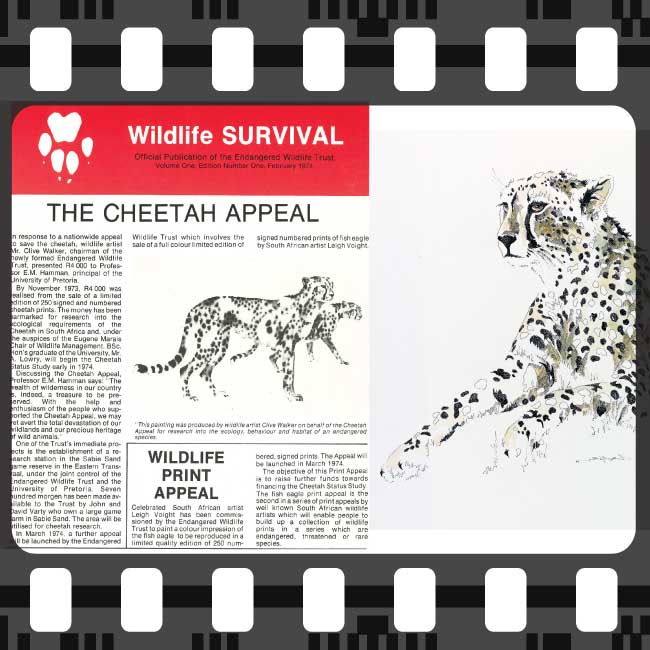
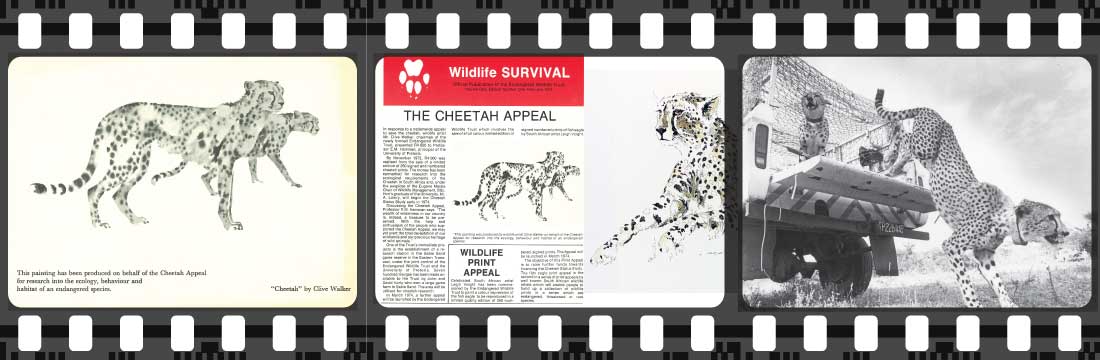
When Clive Walker raised funds for Cheetah conservation through the sale of his painting of two Cheetahs, he asked Koos Bothma, then associate professor of the Eugene Marais Chair of Wildlife Management at the University of Pretoria, if he would like to use the money for a Cheetah study. In 1973, the species was recognised as Endangered, both locally and internationally, and Koos quickly accepted. Clive was happy that the money could be channelled into a recognised institution.

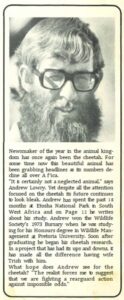
Profile of Andrew Lowry

Profile on Andrew Lowry featured on the contents page of an article about his research in African Wildlife, Volume 30, No. 6

Andrew Lowry was born and raised in Cape Town, South Africa. Having completed his BSc in Botany and Zoology at the University of Cape Town, Andrew went north to study for his Honour’s degree in Wildlife Management at Pretoria University, during which he won the Wildlife Society’s 1973 Bursary. Andrew was itching to get out into the bush and work with wildlife. He was available and in need of a research project, describing himself as a “spare” – someone without a specific project to focus on and thus available for any assignment by the department. Thus, the “spare” student was the perfect choice to be dispatched to Namibia for Cheetah research sponsored by the fledgling EWT.

At first, there was no specific location or Cheetah population to be prioritised for research. Andrew initially focused on farmland in Namibia where Cheetahs and other stock-raiding predators were being captured or killed. A game capture operator who was often called to remove Cheetahs from farms offered to share the information about where each Cheetah had come from. Andrew could then conduct Cheetah surveys in areas where Cheetahs were regularly seen. However, because farmers persecuted these predators, they were highly mobile and travelled large distances by night. It was also difficult for Andrew to cover the whole of Namibia on his own. In the three months that Andrew spent there, he saw not a single Cheetah and sought advice from James Clarke, co-founder of the EWT and wildlife expert, saying that the study was not viable, and he had nothing to show for his time and efforts. Instead, Andrew proposed a Cheetah study in Etosha National Park in Namibia. He had recently visited the park and seen Cheetahs as close as 300 metres from the gate. Etosha boasted the world’s largest free-living Cheetah population, and the then South West African (Namibian) Division of Nature Conservation and Tourism was eager to maintain this population and welcomed a formal research study in the park. Predator conservation is no easy task in a stock farming country like Namibia. Still, the awareness and concern of the authorities, coupled with information from field investigations such as this one, can help to ensure these animals’ survival. And so Andrew was tasked with conducting a census of the Cheetahs in the park, and in his words: “I rode through the gates of Etosha, and I landed in Paradise”.

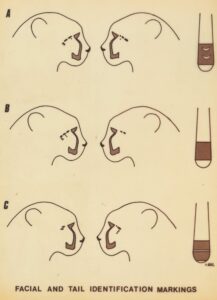
For an accurate census, the first thing to do is to develop a reliable way to ensure that, when counting individual animals, you only count them once. Fortunately, each Cheetah’s spots are unique – like a human fingerprint, and once you have a record of their coat pattern, you can avoid recounting them. It is also a good way to identify animals when studying their behaviour and genetic diversity. Once an animal’s markings had been recorded, Andrew created the identity kit featured in Figure 1 to differentiate between individual animals. The EWT and other organisations still use similar methods to identify Cheetahs today. However, photos of animals are now run through software called Wildbook, ensuring identification is even more accurate than a human eye can achieve.

A cheetah identikit

An identikit used by Andrew Lowry in his Cheetah study in Etosha in 1974-1976


Wildlife researchers are often advised not to give study animals names to maintain a level of objectivity. While this may work in theory, we often get attached to some or all of our subjects when we follow their lives so intimately. Andrew cheated a little. He did name each of the Cheetahs that he followed using a letter of the alphabet but then gave them names starting with these letters. In an article he wrote for the Wildlife Society of Southern Africa publication at the time, African Wildlife, Volume 30, No. 6, he explained: “For ease of recording in the field, I have allocated each animal a letter of the alphabet and have then given them a name meaning Cheetah, which begins with the same letter. Duma is the Swahili word for Cheetah. Others are Chita (the original Hindu word meaning “spotted one”), Etotongwe (Ovambo), Hlosi (Zulu), and Jubatus (the Latin species name). And let’s not forget Intermedius. Acinonyx intermedius is an extinct species of Cheetah which ranged in Europe and Asia during the middle Pleistocene.”.

In addition to his investigations and observations, Andrew appealed to visitors to the park to complete surveys describing any Cheetahs they came across and where in the park they were seen (Figure 2). This information supplemented his findings when he was unable to monitor the whole park. The appeal, in the form of a pamphlet visitors received at the entrance to the park, also served as an education and awareness-raising tool. The pamphlet provided some key facts about Cheetahs and sparked a new level of engagement among visitors – enriching their experience of the wildlife they came across. The use of non-scientists to collect data is more common now than it was then. Still, it has always been a valuable tool when conducting studies like Andrew’s. The Cheetah and Wild Dog Censuses that the EWT runs in the Kruger National Park, for example, are only made possible with the help of citizen scientists.

Pamphlet and survey form visitors received at the entrance to the park to provide additional data for the Cheetah study in Etosha National Park

During his two-year study of Cheetahs in Etosha, Andrew Lowry was immersed in their world, and when speaking of his time there, much of his focus, fascination, and awe was on the role of the female animal. She faces tremendous pressure alone once mating has taken place, and the male Cheetah leaves her to fend for herself and for her helpless cubs when they are born. Not only must she provide for them – she is responsible for teaching them to hunt and survive in treacherous surroundings. One female in Etosha, named Duma, impressed Andrew above others. In his article, Andrew writes:

Duma has proved to be an exemplary mother. Not only does the survival rate of her litters appear higher than the Etosha average, but her offspring are capable hunters on parting company with her. We watched Acinonyx and her two brothers from shortly after they left Duma. If one of these Cheetahs began to initiate a hunt, the other two would perform outflanking stalks on either side of the potential prey animal. A more efficient trio I have yet to watch.”

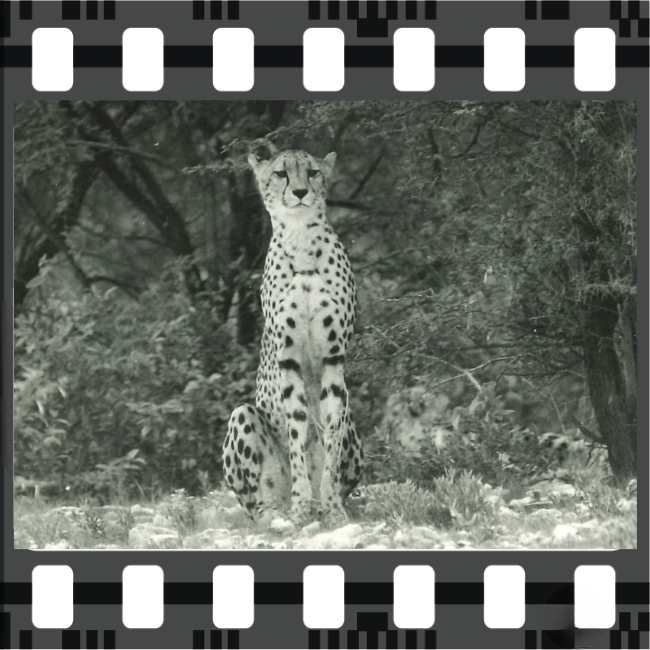
Cheetah sitting black and white

Duma, a particularly effective Cheetah mother studied by Andrew Lowry in Etosha in 1974 and 75

Read more about these cats in the full article here.

Learning much about Etosha’s Cheetahs, Andrew agrees with carnivore expert Dr R F Ewer that studies of predators are often only relevant to the time and place in which they occurred. He believes that studies of predators are usually only relevant to the time and place in which they occur and advised that the Cheetah numbers in the park were optimal at between 50 and 100 and that the low-density population would not benefit from further reintroductions – reiterating the original consensus that one of the largest remaining strongholds for Cheetahs in southern Africa should not be interfered with.

By the end of the study, the EWT had expanded. It was focused on rhino and elephant conservation while supporting other organisations also working on Cheetah conservation, such as the De Wildt Cheetah Centre. Andrew had for some time been increasingly concerned about the larger issues at play that were endangering all species, including humans. He knew where a difference needed to be made and went on to do so in the lecture halls of the Tshwane University of Technology. For 30 years, Andrew taught 21 subjects to around 3,000 students, six of whom currently work for the EWT, with many more doing so in the past. I was one of these students, inspired to work for the organisation within a month of my first year because Andrew believed in the work the EWT does so much that he included it in his coursework.

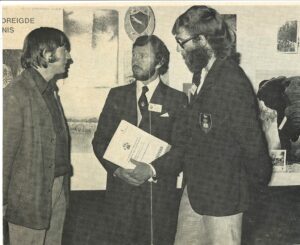
Clive Walker (centre), founder of the EWT, speaking to EWT carnivore researchers Gus Mills (left) and Andrew Lowry (right)

Now retired, Andrew makes an effort to follow the careers and personal journeys of his students, whom he considers family and fondly speaks of with pride. Refusing to have a cell phone, Andrew checks Facebook regularly, wishing students well in their personal and professional milestones. He was excited to hear from us and to visit the EWT Conservation Campus and tell us his story and catch up with those whose lives he touched so profoundly. A two-year study of a single population of Cheetahs in Etosha may not have had a significant short-term conservation impact, but it led both Andrew and the EWT to make unmeasurable and invaluable conservation impacts through their cultivation of countless conservationists who have and will still protect forever, together.


People behind the paw: Clive Walker

People behind the paw: Clive Walker

People behind the paw: Clive Walker

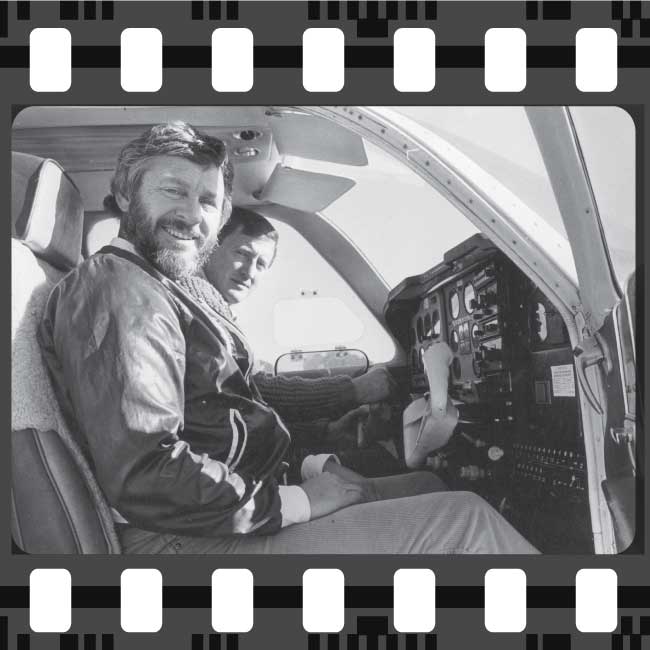
Clive Walker in a helicopter

Clive Walker in a helicopter

Clive Walker, Founder

My wildlife journey commenced as a teenager with my mother and aunt Peggy taking my brother Barrie, three cousins, and myself to the Johannesburg Zoo more than 76 years ago. My cousin Elizabeth and I were old enough to ride on the back of an Indian (Asian) Elephant. The zoo later stopped offering elephant rides, but I never got over the experience of riding on one of these amazing animals.

A few years later, after my mother purchased a 1948 Chevrolet 4-door sedan, I saw elephants and baobab trees in the Kruger National Park, both of which fascinated me and filled me with awe. My mother, grandmother, and aunt Francis, who was an ambulance driver in the Western Desert during World War II, accompanied us to the Kruger every winter for a week, camping in cottage tents with iron beds, water pitchers, iron chairs with wooden slats, and bathrooms we would have to find with a paraffin lantern in the evenings. The start of a long African safari.

Elephants and rhinos have occupied much of my time throughout my life. In the case of elephants, I have ridden them, painted them (simply awful), witnessed them being hunted and culled, tracked them on foot as a ranger and a guide, fled from many, researched them, counted them, photographed them and in time painted better pictures of them, and devoted much energy to conserving them. My original journey into the realm of elephants commenced in the mid-1950s at the age of 21 when I accompanied my mentor and old enough to be my father, Hans Bufe, a South African of German descent on a safari into Portuguese East Africa (Mozambique) to hunt elephants. Yes, you read correctly. Over the next three years, I focused mainly on hunting and collecting – not only trophies but ‘knowledge’ gained from our Shangaan trackers, who knew even more than Uncle Hans. This knowledge proved invaluable when I was a ranger in Bechuanaland and later a ‘wilderness’ guide in elephant and lion country. The conservation world of today is not the world I grew up in, although most of my friends and my mother thought I was insane at the time and that I stood a good chance of being killed which bothered them more than my desire to shoot an elephant. Today’s world is very aware of the decline in the continent’s elephants and wildlife in general. The irony is that today we have far more elephants across Southern Africa than we ever had in the 1950s. In fact, by the turn of the 19th century, very few elephants survived outside of the Kruger National Park, which had few elephants to speak of.

When I stood in the great hall of the Natural History Museum in London one summer day in 1959 and gazed upon a fully mounted family group of elephants, a strange feeling of remorse came over me. What possessed me to think I wanted to kill one of these animals? I never again felt the urge to do so. The walking trails among elephants I led over the 20-odd years that followed were successful largely due to the knowledge I gained from my Shangaan trackers in Portuguese East Africa. I never once got into a situation where I had to kill an elephant or any other dangerous game in self-defence.

From London, I returned to Africa down the East Coast in January 1960 and realised a long-held desire to visit Kenya and, in particular, to view Mount Kilimanjaro, which I and four other shipboard companions did while staying in the Tsavo National Park. Around a million elephants still existed in Africa, and perhaps 100,000 rhinos. Twenty years later, I returned to the same park as the Director of the EWT, and it was an entirely different story I was to encounter. The park once held some 9,000 black rhinos, and all had died from drought and heavy poaching. They had become extinct, and I was devastated.

My conservation journey commenced as it did from my first ever five-day walking trail in the iMfolozi wilderness in 1972, which was to lead to a total change in my life’s direction and led to the founding of the Endangered Wildlife Trust in 1973.

On the edge of the ledge

On the edge of the ledge

The edge of the ledge – don’t look down!

Clive Walker, Founder

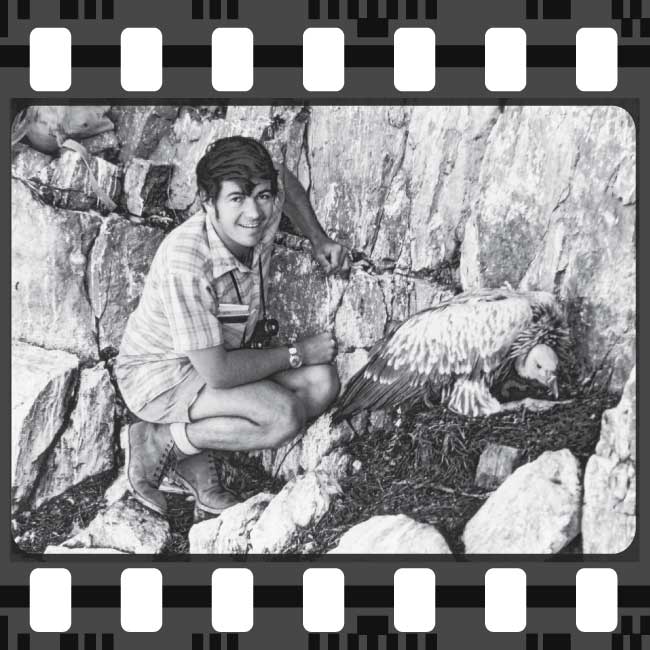
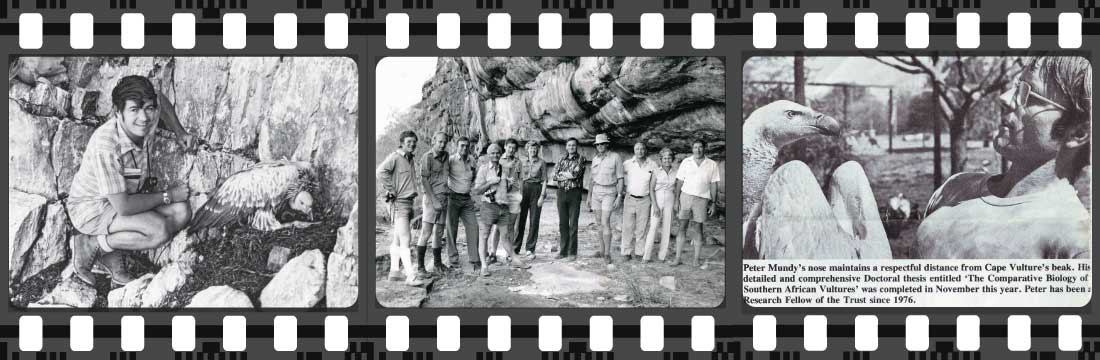
My entry into the world of vultures was at the invitation by John for me to spend a Saturday morning with the group in the Magaliesberg to the north of Johannesburg. My hosts were businessman Russel Friedman and a well-known ornithologist called Dr Peter Mundy. I had no idea what I was in for. Upon arrival at a private farm, I found a group with binoculars and telescopes sitting in deck chairs, scanning a rugged mountain landscape. Waiting for me was Russel Friedman, who was to escort me to the cliff face. I had not planned on climbing anywhere, and Russel looked like one of those disaster volunteers who rescued people in distress. I was about to be a victim. We headed to base, with me now wearing a helmet and beginning to feel I had shown too much enthusiasm.

What began as a gentle walk soon became an increasingly steep climb through grass and stunted bush, which turned into a rock face. Eventually, we reached a high running ledge with incredible views of Johannesburg in the distance and a man clad in a helmet with metres of rope wrapped around his neck. It was none other than Dr Mundy, doyen of the vulture world. Sitting on a narrow ledge flying vultures could be seen up close as they wheeled on spectacular widespread wings, and I knew then why these volunteers risked life and limb for them. However, when a large chick was pointed out to me, and I looked down, I realised, with horror, how high up we were and that the only way down was using the rope around Peter’s neck. I felt instantly ill and grateful that I wasn’t one of those volunteers.

Suffice it to say I never accepted another invitation from Dr Ledger, but after witnessing such passion and commitment from a group of volunteers for wildlife, I could not wait to get back down to earth and urge the board to support the Vulture Study Group. The board agreed, and a long and fruitful relationship took flight.


Filmstrip of members of the vulture study group in 1976

The brave volunteers of the Vulture Study Group. 1976

Why the Cheetah?

Why the Cheetah?

Why the Cheetah Paw?

Clive Walker, Founder of the EWT


Cheetah (Acinonyx jubatus)

“An Endangered species which has declined through loss of range, the insidious fur trade and shooting due to stock predation.”

The choice of the Cheetah as the EWT’s logo was an obvious one for me. My first encounter with this graceful, swift feline was as a game ranger in Bechuanaland in 1966. I came across a young, tame female in the garden of a farmer. Her mother had been killed because of predation on the farmer’s sheep before he realised she had a young cub with her. The cheetah was on a chain attached to a long wire, and she had the run of the large lawn. I got right up close to her and was deeply struck by the beautiful large eyes and the continuous purring sound.

My next encounter was after visiting the Africana Library on Diagonal Street in downtown Johannesburg one Saturday afternoon in 1972. I was horrified to spot cheetah skins hanging like washing on a line in a ‘muthi’ shop. Even more so when the owner was happy to sell me one and advised me he could get more. The memory of it was etched in my brain as I thought back to my first encounter in Bechuanaland. I continued to prepare for an exhibition scheduled for October of the same year and included in my subjects a pair of cheetahs with the objective of following David Shepherd’s idea of a print appeal and at my own cost had 250 prints produced and announced as a CHEETAH APPEAL as James Clarke of the STAR newspaper opened the exhibition at the Lister Art Gallery in Bree street, Johannesburg on 1 October 1973. James was later to become a founding trustee of the Endangered Wildlife Trust. All numbered prints were sold at R20.00 each. After printing expenses, the appeal raised a nice sum of R4,500 to be donated for cheetah conservation.

As I write this today, in 2023, the cheetah is considered vulnerable, and with the transformation of the wildlife industry, it is in a far better position today than back in 1973, thanks in no small part to the work of the EWT and private landowners.

The original logo was adapted from the publication by the Late Dr Rheay Smithers, Mammals of Southern and Northern Rhodesia. Whilst accurate in dimension, the original paw lacked the small indentation between the back pad. This was rectified during Dr Ledger’s time after I retired in 1985.

Filmstrip with EWT logos over 50 years
The historical role of women in the ewt

The historical role of women in the ewt

Celebrating women in conservation

National Women’s Day draws attention to the challenges African women still face but also the ever-increasing opportunities for them to empower themselves.

In South Africa, August (Women’s Month) acknowledges these challenges and celebrates the many achievements of women in South Africa. It encourages others to learn from those who came before them and how they overcame the limitations they encountered.  Women now have louder and more powerful voices, playing a necessary role in highlighting many issues, including environmental degradation, women and child abuse, unequal pay, lack of good education for their children, and many more.

During this Women’s Month, the EWT pays homage to women in the conservation space who do their bit to save species, conserve habitats, and benefit people.

Meet these amazing women here and on social media under #EWTWomanCrushWednesday.

The historical role of women in the EWT

Clive Walker, Founder and Former Director of the EWT

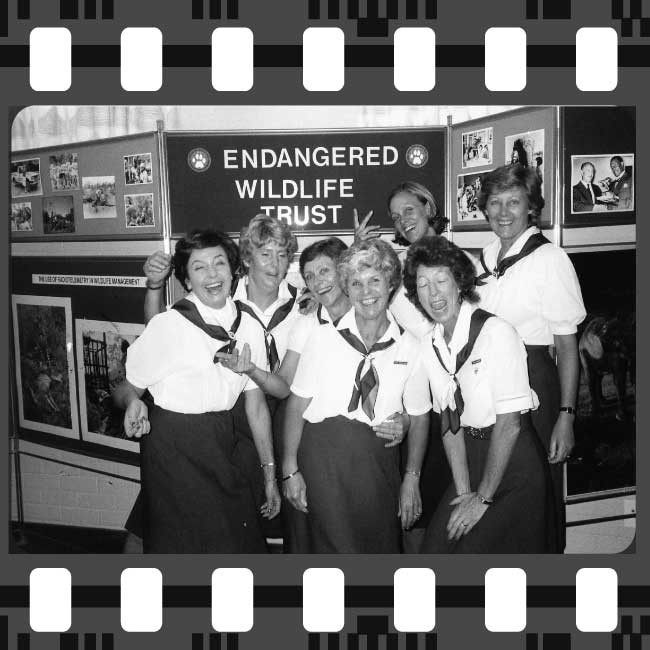
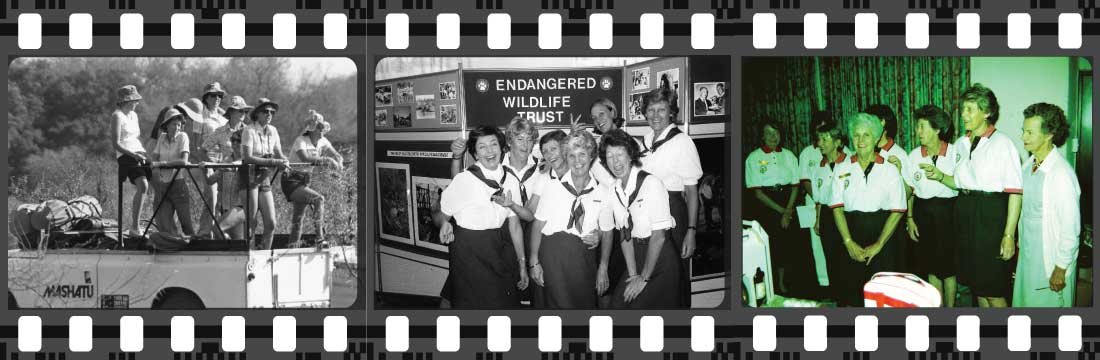
In 1975, I took a group of eight women on a walking trail in the Mashatu Game Reserve in northeastern Botswana. They had told their husbands they were off to the bush for five days, and their husbands had to take care of their kids while on ‘trail’. Among them were Wendy Farrant, whose husband was an EWT trustee, and her friend Joy Cowan. Both husbands were accountants who made up a number of the professionals who made up the board of directors. The very first afternoon, we encountered on foot some 100 elephants standing in the dry Shashe river bed that borders Zimbabwe. One can only imagine the experiences that were to follow over the next four days. On the last night around our campfire, a number asked what they could do to help the EWT as they had become so fired up by their experiences, and my response was why don’t we form a ‘ladies’ committee’ and, after discussing it with the board, we did just that. The committee consisted of Wendy Farrant, Jill Morrison, Felicity Street, Joy Cowan, Maureen McCall, Jenny Doak, and Conita Walker. As volunteers, they contributed 100s of hours in administration work, ran all the fundraising functions, organised three symposiums and various workshops during my tenure and became the flag bearers of the Trust’s work. I must commend my secretary, the late Petra Mengal, who ran the zoo office, and my PA, Jane Zimmerman, who were the only two permanently employed staff and were a tower of strength to the organisation.


Ladies accompanying Clive Walker on a wilderness trail in the Mashatu Game Reserve in northeastern Botswana in 1975 (Left) and The Endangered Wildlife Trust’s Ladies Committee , formed in 1975. As volunteers, they contributed hundreds of hours in administration work, ran all the fundraising functions, organised three symposiums and various workshops, and became the flag bearers of the Trust (Right).

FAST FORWARD TO 1999

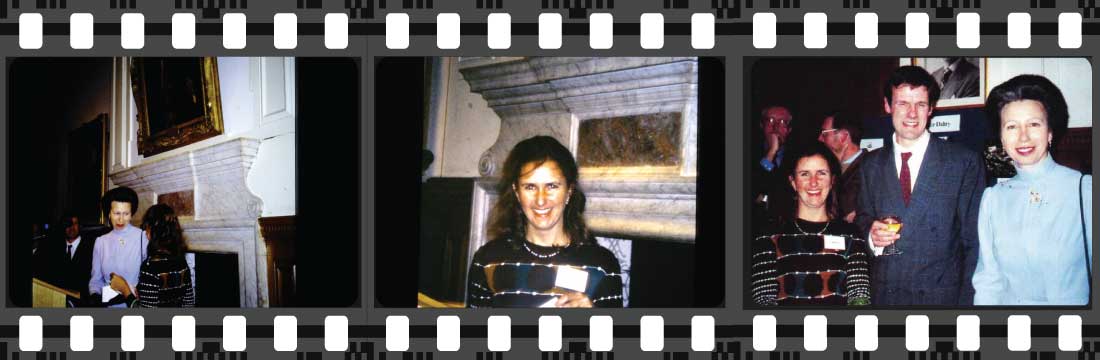
Twenty years later, another woman was trailblazing through conservation – the conservation of cranes in particular. Lindy Rodwell cofounded the EWT’s  South African Crane Working Group (SACWG) with Kevin McCann, having established and grown the Highlands Crane Group two years prior. The SACWG was formed to coordinate all crane conservation efforts across South Africa. In 1999, Lindy was the first person from the EWT, and from South Africa, to win the Whitley Award, often referred to as the ‘Green Oscars’. The award is awarded annually to individuals from the Global South by UK-based conservation charity the Whitley Fund for Nature.


Lindy Rodwell, Edward Whitley Junior, and HRH Princess Anne at the 1999 Whitley Awards at the Geographical Society in London. Lindy won a Whitely Award for her work conserving cranes.