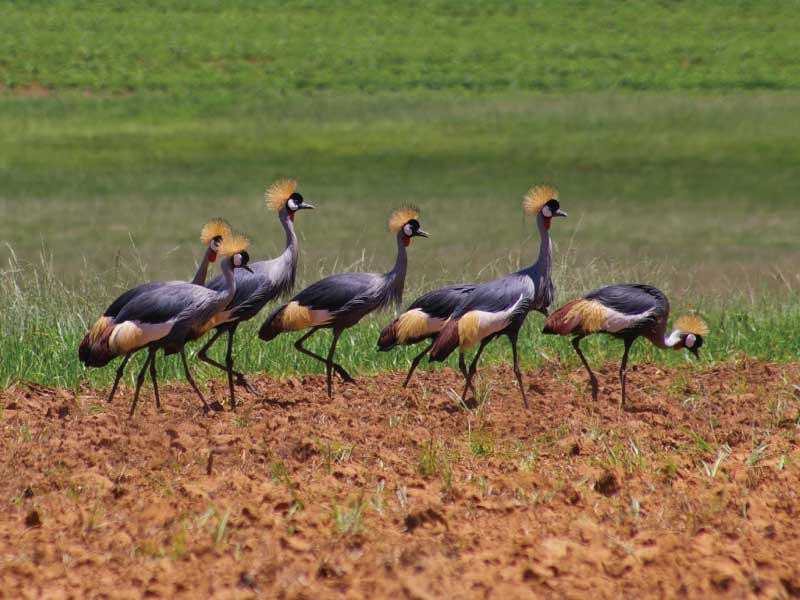
Climate change has manifested in erratic weather patterns and significantly prolonged drought seasons in Southcentral Uganda. The drought hit the Lwengo region in one of Uganda’s cattle corridors particularly hard. Farmers in Lwengo have suffered serious losses over the dry season; their crops dried up and withered over the harvest period. Maise, beans, peas, and other cash crops have also done poorly during the dry planting season. The water sources in most villages and part of the Kiyanja-Kaku wetland (a precious wetland conserved by the ICF/EWT projects) have dried up, and animals and households no longer have enough water to drink and use for domestic purposes. The dry season also affected irrigation projects, rendering irrigation impossible at the household level and reduced food security and the general well-being of the communities. The Kiyanja-Kaku wetland and its catchment also provide breeding and flocking habitat for the Endangered Grey Crowned Crane – one of Uganda’s iconic wetland species.
Unfortunately, cranes are eating more of the crops due to shortages in natural food sources, feeding on germinating seedlings and mature crops, eating all the corn, and leaving empty combs. The most affected crops in the area included maize, beans, and ground nuts. On top of the drought and deflating market prices, this has caused significant losses to the farmers, and they have resorted to poisoning cranes – 118 poisoned to date this season.
What are we doing to help communities weather the storm?
The ICF/EWT’s crane and wetlands conservation project supports some communities in establishing crane deterrent measures in various homesteads to address food insecurity caused by cranes and climate change. The measures range from the erection of human-mimicking scarecrows to the use of reflective materials, usually from non-recyclable waste products, around the crops. The measures have proven successful as there have since been no crane sightings in these areas, and crop damage has reduced to some extent.
Next steps
Since the project has established an integrated approach of deterrent measures, effectively preventing cranes from damaging crops, we need to upscale the deterrent measures and extend the approach to all affected villages. This way, we will keep crops and cranes safe. The project continues to engage farmers in establishing interventions that can also address the impacts of climate change on food security.
Cameron Cormac, PhD Candidate with the EWT’s Wildlife and Transport Programme, ctcormac@gmail.com
I am Cameron Cormac, a PhD candidate in my second year of study at the University of KwaZulu-Natal – on my way to a career in conservation. I work with the EWT’s Wildlife and Transport Programme and Ezemvelo KZN Wildlife, researching the effects of linear infrastructure on vertebrates in Hluhluwe-Imfolozi Park and northern Zululand.
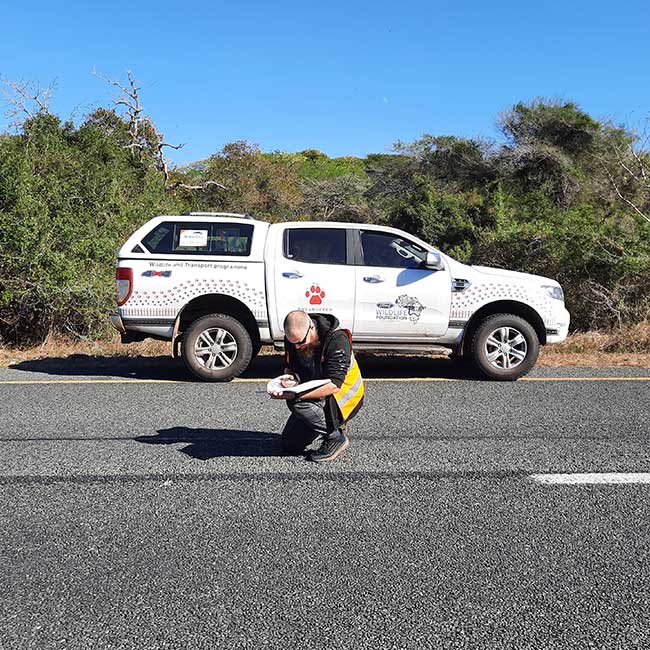
A typical day for me depends on which of the two study sites I am stationed at when I’m not back in Pietermaritzburg doing data analysis, lab work, or writing up my thesis chapters. When in Hluhluwe-Imfolozi Park, I focus on the R618, which bisects the park. My day begins an hour and a half before sunrise in the research camp near Hilltop resort, typically in pitch darkness surrounded by nothing but the sound of nocturnal insects and a light breeze blowing through the trees. A banana and a low-sugar or sugar-free energy drink help me wake up and give me some quick sustenance before I head out for an hour’s drive at 40 km/h through empty park roads. I pass through the gates of Nqumneni ranger camp before taking air and road surface temperature readings at one of three control points.
My morning survey starts after taking the temperatures at the control point on the Hlabisa side of the survey area. I spend two hours driving at 40 km/h looking for carcasses of animals killed along the 18 km survey area. A typical session sees me both trying to find carcasses for my data collection and not wanting to find too many dead animals. I usually find between three and seven carcasses. However, there are times when I don’t find any carcasses and others when there are more than 20. But every day, we are greeted by the fantastic sunrises of Zululand’s Lebombo mountains and often encounter elephants strolling down the road.
Morning sessions end with another hour’s drive back to base camp or a two-hour drive to Hluhluwe town while passing through South Africa’s oldest protected area. We’ll get several sightings of some of South Africa’s iconic animals if we’re lucky.
The rest of my days are spent doing data entry, reading linear infrastructure articles, handling project admin, preparing for nocturnal sessions, and preparing food. Meals usually consist of a light breakfast, yoghurt bowls or eggs and avocado on toast, some form of sandwich at midday and a hearty meal for dinner.
Juvenile Southern African python (Python natalensis) found crossing dirt road near Nqumeni ranger camp
My days end with a nocturnal session, typically after dinner, depending on the time of sunset, which is a rinse and repeat of the morning survey. The only difference is that nocturnal sessions provide exquisite visuals of the setting sun. Nocturnal surveys also usually give us a few very welcome, very much alive herpetofauna (amphibians and reptiles) trying to cross the road. I am a herpetologist, so this gives me great joy. These records fall into another of my data chapters aimed at identifying reptile species likely to cross my survey roads successfully. My favourite kind of bedtime story!
I sincerely thank my sponsor, the Ford Wildlife Foundation, who supplies the vehicle I use to conduct my surveys. Without their generous donation, this project would not be possible.
The world’s road networks are highly disturbed and fragmented areas that negatively affect many animals. Wildlife-vehicle collisions are one of the more visible effects of road, estimated to be the second-largest cause of human-related deaths in animals. One of the by-products of the Covid-19 pandemic was much lower levels of human activity related to lockdowns enforced in many countries to reduce the spread of the disease. This decrease in human activity has been named the “anthropause”, which was at its peak in April 2020. With the anthropause came a large decrease in vehicle traffic. The impact of the anthropause, particularly of decreased traffic, on species, was examined in a recent publication co-authored by EWT scientists*. With worldwide travel restrictions in full effect from April 2020, vehicle use dropped by over 50% in many countries. During this same period, scientists found a significant drop in wildlife-vehicle collisions, with as much as a 48% reduction recorded in some countries. The absence of traffic also likely brought about behavioural changes in wildlife and could have had various other ecological effects not yet documented. Some possible changes include animals being able to move more freely between fragmented landscape patches, increases in survival and population sizes, and less spreading of invasive species along roads (see figure below, from Perkins et al. 2022, which illustrates some of the possible impacts of a reduction in traffic).
Traffic noise was another aspect reviewed in this study. Researchers found that animals were less fearful with reduced traffic noise over the lockdown period. Furthermore, they noted that there were localised changes in animal distributions. For example, large animals were spotted moving through urban areas. The lowered volume of traffic noise also resulted in some birds changing their tune. For example, urban birds have been observed to alter the frequency of their song as they no longer had to compete with traffic noise. While lockdowns provided temporary relief, allowing wildlife to thrive again, human activity is recovering to pre-pandemic levels. This brief pause has allowed us to gain new insights into the impact of traffic on wildlife. The return of traffic highlights the need to have proper surveillance measures in place to help document, explain, and reduce the effects of roads on wildlife and critically evaluate the impacts of this widespread human activity on wildlife. *Perkins, S. E., Shilling, F., & Collinson, W. (2022). Anthropause opportunities: Experimental perturbation of road traffic and the potential effects on wildlife. Frontiers in Ecology and Evolution, 192.**The EWT has a road watch app for you to record any roadkill sightings, helping us to identify hotspot areas and the species most at risk. Search for Road Watch on the Google Play Store to download the app!
Wendy Collinson, EWT’s Wildlife in Transport Manager, wendyc@ewt.org.za
In my previous life, I was a physical education teacher at the Robert Clack School in the east end of London, United Kingdom, for 15 years. But I knew I needed a change and had dreams of working in Africa. And so, in 2005, I left to pursue a change of career in South Africa. A whole 17 years later, I am still living my African dream.
After some travelling, I spent six years working with large carnivores in the South African bush, firstly through Global Vision International (www.gvi.co.uk) and then with the Endangered Wildlife Trust. I worked alongside other researchers on carnivore species fitted with radio-tracking collars, which allowed us to follow them closely from the safety of our vehicle. Our goal was to better understand the animals’ movements and behaviour. A typical day would start just before dawn when we would start to track one of the collared animals until we found them. In some cases, this could go on well into the night if they were in hard-to-reach areas.
After six years of being involved full-time with carnivore research, I moved on to a new project in which I examined animal roadkill rates and the effects of road mortality on biodiversity in the Greater Mapungubwe Transfrontier Conservation Area (northern Limpopo). Studying roadkill might not sound very appealing (OK, at all appealing), but it’s important to know which species are getting killed on our roads and in what numbers. This project led me to a Master’s degree in Zoology through Rhodes University (based in Grahamstown, in the Eastern Cape, South Africa). A far cry from my previous degree in Education, with Dance and Art as my two main subjects!
I am now employed by the EWT’s Wildlife and Transport Programme, whose headquarters is in Johannesburg. I live near Durban but travel to Johannesburg to check in with the head office once every few months. The Wildlife and Transport programme looks not just at the impacts of roads on wildlife, but the whole transport sector – bird strikes at airports, increasing human safety, and train collisions with wildlife on the railway lines.
Thabo Hlatshwayo, Wildlife and Transport Programme Intern, thaboh@ewt.org.za
The N3 Toll Route (N3) passes through landscapes of grasslands, freshwater ecosystems and wetlands, which attract animals, bringing them close to the road. Land used for cultivating maise and other grain crops closer to the highway also increases bird and small mammal activity in the area, resulting in increased wildlife-vehicle collisions (i.e., roadkill). The N3 Toll Route comprises road features such as road signage, guideposts, safety barriers, boundary fence, and raised road markers. These objects are installed on the road to control traffic and improve road safety. However, numerous owl species use these road structures during the evenings to perch on while hunting for prey, such as rodents and squirrels attracted to crops and food deposited by passing vehicles. Unfortunately, this increases the risk to the birds of being struck by vehicles.
Through the strategic partnership work undertaken by the EWT and the N3TC since 2014, robust data on the incidences of roadkill have been recorded. The existing EWT-N3TC database shows that owls are the most common bird killed by vehicles on specific sections of the highway. To respond to this, the EWT recommended the installation of owl perches within the hotspot areas but away from the road, creating safe perching spots from which owls and other birds of prey can hunt safely.
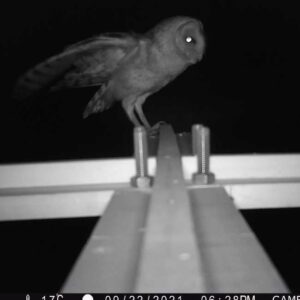
We installed camera traps on the EWT-N3TC owl perch to see if birds would use these perches. Our camera traps revealed increasing birds of prey activity on the perch. Barn Owls, Black-shouldered Kites, and some falcon species have used it as their feeding restaurant. Interestingly, other wading birds like the Black-Headed Heron and passerine bird species (Stonechats and Pied Starling) have also been observed enjoying a rest on the owl perch.
Camera traps such as this are invaluable for increasing our understanding of animals’ interactions with roads – particularly what attracts them to roads. In this case, it is clear that structures similar to these perches erected on roadsides are at least in some part used for resting and feeding purposes and that by providing alternatives, we might be able to reduce the time birds spend on or near roads. We expect to learn more from these camera traps and hope you’ll stay tuned to catch rare glimpses into the daily lives of our raptors.