
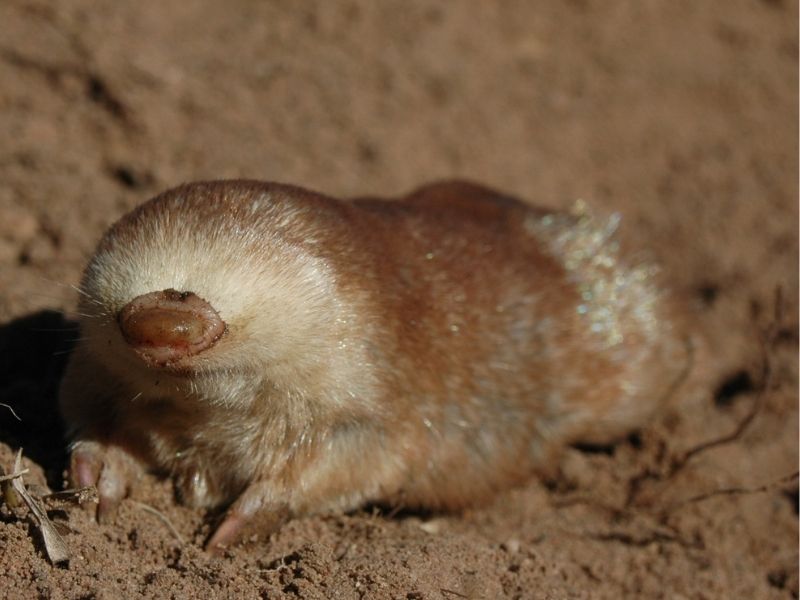
Juliana’s Golden Mole
Neamblysomus julianae

2025 Red list status
Endangered

Regional Population Trend
Unknown

Change compared
to 2016
No Change
Overview
Neamblysomus julianae – (Meester, 1972)
ANIMALIA – CHORDATA – MAMMALIA – AFROSORICIDA – CHRYSOCHLORIDAE – Neamblysomus – julianae
Common Names: Juliana’s Golden Mole (English), Juliana se Gouemol (Afrikaans)
Synonyms: Amblysomus julianae Meester, 1972
Taxonomic Note:
Assigned to the genus Neamblysomus by Bronner (1995). Consistent colour, dental and DNA differences exist between subpopulations from the eastern and western geographical extremes of its distributional range suggest that it may include two taxa (Bronner 1990, 1995). Ongoing molecular research suggests pronounced genetic partitioning between the Kruger National Park (KNP) and the other two subpopulations (Maree et al. 2003; Jackson et al. 2007a; unpublished data). More specimens from KNP area are urgently needed to clarify the taxonomic status of this subpopulation. The outcome could have profound implications for the conservation status of the species.
Red List Status: EN – Endangered, B2ab(iii) (IUCN version 3.1)
Assessment Information
Assessors: Patel, T.1 & da Silva, J.2
Reviewers: Mynhardt, S.1
Institutions: 1Endangered Wildlife Trust, 2South African National Biodiversity Institute
Previous Assessor: Maree, S.
Previous Reviewers: Bennett, N.C. & Taylor, A.
Previous Contributor: Bronner, G.
Assessment Rationale
In 2008 the species was listed as Vulnerable in view of estimated area of occupancy (AOO) (less than 2,000 km²). New information led to more accurate calculations of AOO (140 km2) and confirmed that the population is severely fragmented. It is known from only three isolated and range-restricted subpopulations in South Africa; two of which occur within protected areas; there are no intermediate distribution records suggesting gene flow between them. Only a small part of the range of the subpopulation occurring in and around Nylsvley Provincial Nature Reserve (Modimolle district, Limpopo Province) falls within this protected area, the rest being in adjoining farmlands where suitable habitat is subject to severe alteration, degradation and fragmentation. Although almost the entire range of the Kruger National Park subpopulation (Mpumalanga Province) is protected in the southwestern section of the park, road infrastructure may form barriers that impede golden mole movements. For these reasons the species is listed as Endangered.
The Bronberg Ridge subpopulation in eastern Tshwane (Gauteng) is not at all protected within a provincial or national reserve, and persistent quartzite mining, rapid urbanisation and expansion of suburbs east of Tshwane are causing severe transformation, degradation and loss of remaining intact natural habitat within its very restricted distributional range on the ridge. Hence, the Bronberg Ridge subpopulation, while included here, warrants a different status and is also being assessed separately.
Reasons for Change
Reason(s) for Change in Red List Category from the Previous Assessment: No change
Red List Index
Red List Index: No change
Recommended citation: Patel T & da Silva JM. 2025. A conservation assessment of Neamblysomus julianae. In Patel T, Smith C, Roxburgh L, da Silva JM & Raimondo D, editors. The Red List of Mammals of South Africa, Eswatini and Lesotho. South African National Biodiversity Institute and Endangered Wildlife Trust, South Africa.
Regional Distribution and occurrence
Geographic Range
Three geographically separated subpopulations documented: 1) The Bronberg Ridge east of Tshwane (Pretoria), Gauteng. Confirmed records from the Willows (type locality), Wapadrand, Shere and Tierpoort on the northern side, and Olympus and Zwavelpoort on the southern side of the ridge; 2) Nylsvley flood plain, Modimolle district, Limpopo Province. Recorded from Nylsvley Provincial Nature Reserve and surrounding farms to the south, south-east and southwest of it (Jackson et al. 2007a, Jackson and Robertson 2011); 3) Numbi Gate, Pretoriuskop and Matjulwana districts of the southwestern Kruger National Park, in the Lowveld of Mpumalanga Province.
The very restricted ranges of these subpopulations are possibly insufficient to ensure the long-term persistence of the species (Jackson & Robertson 2011). A Species Distribution Model (SDM) compiled for all three populations using ecological niche modelling identified limited potentially suitable habitat for the species and enabled identification of two previously unrecorded localities in the Modimolle area (Jackson and Robertson 2011). The first site was c. 20 km due south of the town of Modimolle and the second site was c. 80 km south east of Modimolle; and are further than 35 km and 24 km respectively from the nearest known occurrence of the species. This confirms previous suggestions of a wider distribution in the Modimolle area based on skull fragments identified from owl pellets at Witkoppen Cave, ca 25 km east of Nylsvley NR (Bronner 2008). No new populations were found in Gauteng.
Number of locations: 10. The Bronberg Ridge sites are considered to represent one location as habitat alteration is rapidly affecting this subpopulation.
Elevation / Depth / Depth Zones
Elevation Lower Limit (in metres above sea level): (Not specified)
Elevation Upper Limit (in metres above sea level): (Not specified)
Depth Lower Limit (in metres below sea level): (Not specified)
Depth Upper Limit (in metres below sea level): (Not specified)
Depth Zone: (Not specified)
Map
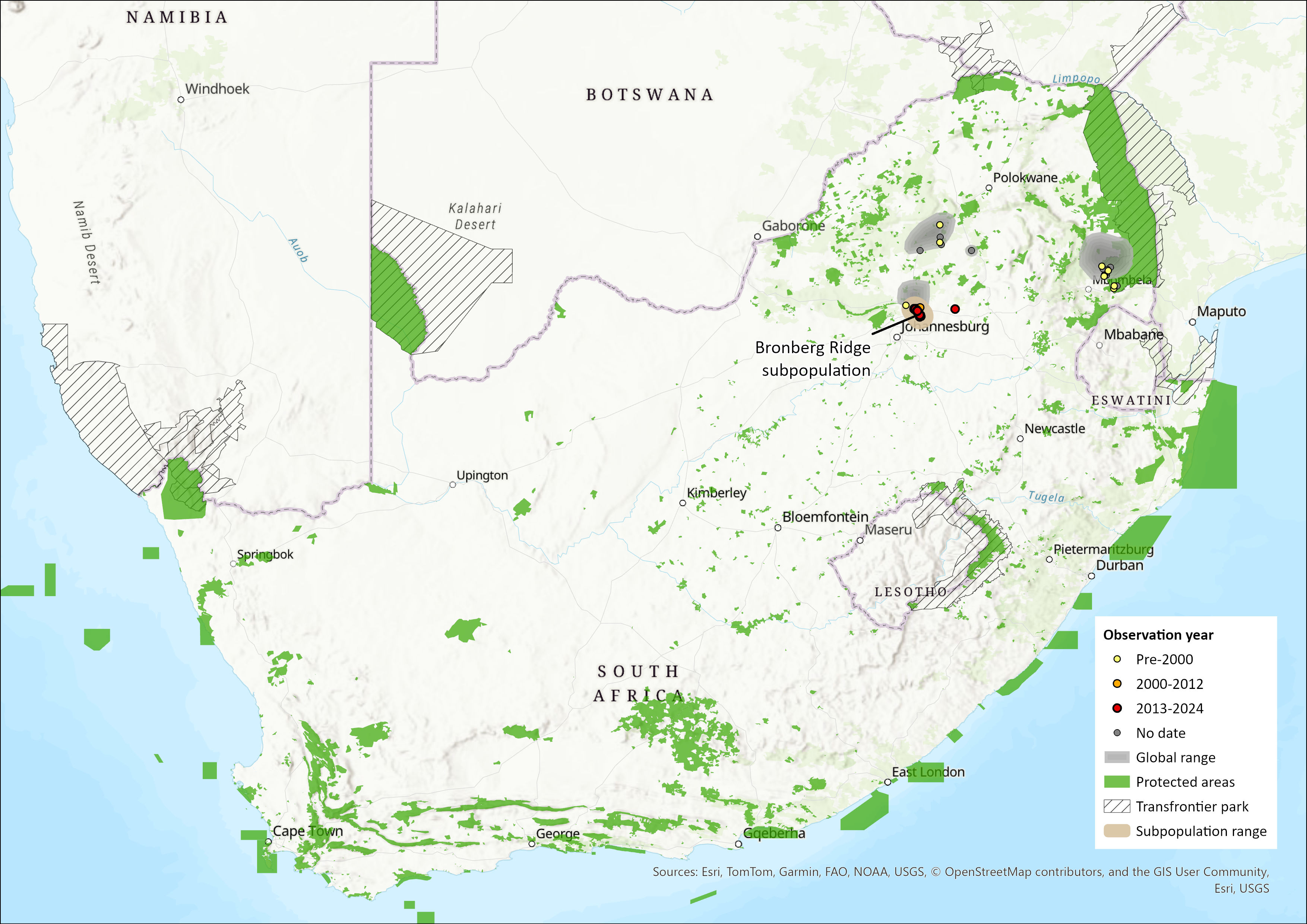
Figure 1. Distribution records for Juliana’s Golden Mole (Neamblysomus julianae) within the assessment region (South Africa, Eswatini and Lesotho). Note that distribution data is obtained from multiple sources and records have not all been individually verified.
Biogeographic Realms
Biogeographic Realm: Afrotropical
Occurrence
Countries of Occurrence
| Country | Presence | Origin | Formerly Bred | Seasonality |
| South Africa | Extant | Native | – | Resident |
| South Africa -> Gauteng | Extant | Native | – | Resident |
| South Africa -> Limpopo Province | Extant | Native | – | Resident |
| South Africa -> Mpumalanga | Extant | Native | – | Resident |
Large Marine Ecosystems (LME) Occurrence
Large Marine Ecosystems: (Not specified)
FAO Area Occurrence
FAO Marine Areas: (Not specified)
Climate change
Although the potential impacts of climate change on this species have not been directly assessed, climate change is expected to impact most golden mole species. Since these subterranean animals are restricted to soft soils for burrowing, and have very low vagility, their ability to migrate or shift their distribution ranges in response to climate change is very limited. Climate change is likely to impact golden moles through changes in vegetation type, soil moisture and prey availability.
Population information
Locally common, with 2-3 individuals/ha in prime habitat. However, dispersion is patchy and clumped within each subpopulation owing to specialized habitat requirements (e.g. soil characteristics, Jackson et al. 2007b).
Current population trend: Unknown (N. julianae); declining (N. julianae Bronberg Ridge subpopulation)
Continuing decline in mature individuals: Unknown (N. julianae); yes (N. julianae Bronberg Ridge subpopulation)
Number of mature individuals in population: Unknown
Number of mature individuals in largest subpopulation: Unknown
Number of subpopulations: Three
Severely fragmented: Yes, this species is only recorded from three geographically isolated subpopulations in South Africa
Extreme fluctuations in the number of subpopulations: No
Continuing decline in number of subpopulations: No
All individuals in one subpopulation: No
| Extreme fluctuations in the number of subpopulations | Justification |
| No | – |
| Continuing decline in number of subpopulations | Qualifier | Justification |
| No | Observed | – |
All individuals in one subpopulation: No
Quantitative Analysis
Probability of extinction in the wild within 3 generations or 10 years, whichever is longer, maximum 100 years: (Not specified)
Probability of extinction in the wild within 5 generations or 20 years, whichever is longer, maximum 100 years: (Not specified)
Probability of extinction in the wild within 100 years: (Not specified)
Population genetics
No population genetic studies have been undertaken on this species; however it is thought to exists as three geographically isolated and hence genetically distinct subpopulations, which in themselves exist as separate metapopulations owing to the patchy distribution of their habitats.
Based on density estimates and an AOO of 140 km2, and acknowledging that the Bronberg subpopulation is estimated at 12 km2 leaving approximately 128 km2 to be shared between the other two subpopulations, it is projected that the species population size is between 25,600 and 38,400 individuals, with the Bronberg subpopulation containing between 2,400 and 3,600 animals. This leaves the remaining subpopulations with approximately 12,800 and 19,200 animals each. Assuming a Ne/Nc conversion ratio of 0.1-0.3, the effective population size of the Bronberg subpopulation may be at or under the Ne 500 threshold; whereas the other two subpopulations are expected to exceed it.is Several assumptions were made to approximate Ne, including uniform density across the species distribution between subpopulations, and equal area sizes within two or the three subpopulations. Acquiring more accurate metrics are recommended through the use of fine scale nuclear markers.
Habitats and ecology
This species is confined to sandy soils, often pockets of weathered sandstone associated with rocky ridges, in the Savanna biome of South Africa, and marginally into the Grassland biome in the Tshwane district (Gauteng). The subpopulation on Nylsvley floodplain occurs in Clay Thorn Bushveld, the Bronberg Ridge subpopulation east of Tshwane in Rocky Highveld Grassland, whereas the Kruger National Park locations occur in Sour Lowveld Bushveld. Common in well-irrigated suburban and rural gardens. Absent from grasslands on the heavier soils of the Mpumalanga escarpment where the larger-sized A. septentrionalis and A. robustus instead occur.
The species’ presence is positively correlated with soil features (poorly graded size distribution of sand particles) that determine soil density, drainage, compatibility, and texture and penetration resistance. These influence energy expenditure of these golden moles during sand swimming/tunnelling (Jackson et al. 2007b). Subsurface foraging tunnels are visible as broken ridges on the soil surface; most foraging activity occur within the upper layer (10–20 mm; Bronner and Bennett 2005). Contrary to earlier reports of strictly nocturnal activity regimes, bimodal (but flexible) diurnal/nocturnal activity patterns were recently documented (Jackson et al. 2007a, 2009; radio-telemetry tracking of one specimen for six days in Nylsvley Nature Reserve). Activity patterns primarily dependent on ambient soil temperatures (Ta), the same resting site were consistently used. Body temperature fluctuated according to Ta and bouts of shallow torpor were recorded during periods of low soil Ta (Jackson et al. 2009).
Ecosystem and cultural services: Not known to provide any ecosystem services, but this may simply reflect the paucity of information available for this poorly known species.
IUCN Habitats Classification Scheme
| Habitat | Season | Suitability | Major Importance? |
| 2.1. Savanna -> Savanna – Dry | Resident | Suitable | Yes |
| 4.5. Grassland -> Grassland – Subtropical/Tropical Dry | Resident | Suitable | No |
| 14.1. Artificial/Terrestrial -> Artificial/Terrestrial – Arable Land | Resident | Suitable | No |
| 14.2. Artificial/Terrestrial -> Artificial/Terrestrial – Pastureland | Resident | Suitable | No |
| 14.3. Artificial/Terrestrial -> Artificial/Terrestrial – Plantations | Resident | Marginal | – |
| 14.4. Artificial/Terrestrial -> Artificial/Terrestrial – Rural Gardens | Resident | Suitable | No |
| 14.5. Artificial/Terrestrial -> Artificial/Terrestrial – Urban Areas | Resident | Marginal | – |
Life History
Generation Length: (Not specified)
Age at Maturity: Female or unspecified: (Not specified)
Age at Maturity: Male: (Not specified)
Size at Maturity (in cms): Female: 9-11
Size at Maturity (in cms): Male: 9-11
Longevity: (Not specified)
Average Reproductive Age: (Not specified)
Maximum Size (in cms): (Not specified)
Size at Birth (in cms): (Not specified)
Gestation Time: (Not specified)
Reproductive Periodicity: Aseasonally polyoestrous
Average Annual Fecundity or Litter Size: Litter size 2
Natural Mortality: (Not specified)
Breeding Strategy
Does the species lay eggs? No
Does the species give birth to live young? Yes
Does the species exhibit parthenogenesis? No
Does the species have a free-living larval stage? No
Does the species require water for breeding? No
Movement Patterns
Movement Patterns: Not a Migrant
Congregatory: (Not specified)
Systems
System: Terrestrial
General Use and Trade Information
General notes regarding trade and use of this species: This species is not known to be utilised or traded in any form.
Local Livelihood: (Not specified)
National Commercial Value: (Not specified)
International Commercial Value: (Not specified)
End Use: (Not specified)
Is there harvest from captive/cultivated sources of this species? (Not specified)
Harvest Trend Comments: (Not specified)
Threats
Inferred major threats are habitat loss, modification and fragmentation as a result of anthropogenic activities. In the former Transvaal Province (South Africa), this species was given the highest regional priority score for mammals (Freitag and van Jaarsveld 1997). The type population on Bronberg Ridge (Gauteng) is severely impacted by degradation, fragmentation and loss of its natural soil habitat owing to intensive urbanisation and an expanding quartzite mining operation within its highly restricted range (hence this subpopulation is also assessed separately).
While the other two subpopulations (Modimolle district and southwestern Kruger National Park) occur within protected areas, there are no intermediate distribution records suggesting gene flow between them. Agricultural practices on farms surrounding the subpopulation from the vicinity of Nylsvley Provincial Nature Reserve are altering and degrading patches of suitable habitats on farms (Jackson et al. 2007a, 2007b), and could be reducing numbers at some locations of the Modimolle subpopulation. Road infrastructure in Kruger National Park (soil compaction) may create barriers for golden mole movement. The direct and indirect impacts of various land uses on the species and its natural habitat may be poorly understood, but the effects of habitat fragmentation (especially in range-restricted taxa) causing obstructions to animal movement (≈ gene flow), increased inbreeding potential, reduced genetic variability and an increased risk of extinction.
The species’ elusive habits often obscure signs of its presence. Developers committed to follow recommendations of Environmental Management Plans (EMP) and Requirements of Development (RoD) are reliant on golden mole specialists for guidance in respect of minimising impacts on the species. If genetic clarification reveal that two taxa exist within the current extent of occurrence (see Taxonomic Note), adequate measures to protect the reduced distributional ranges of each taxon would be all the more important.
Inferred minor threats are predation by domestic pets, persecution by gardeners and land owners.
Habitat trend: Declining in area and quality. In Mpumalanga, 40% of the grassland vegetation types are listed as threatened and only 51% of the grasslands are still natural and previously not ploughed (MTPA 2014). The Mpumalanga Parks and Tourism Agency (MTPA) mapped all development applications received at a cadastral scale over a 14-year period (2000–2014) and showed that greatest pressure for land-use change has come from prospecting applications (54% of the land surface area of Mpumalanga) and mining (25% of land surface area). The province can anticipate much greater expansion in the mining sector than ever before (MTPA 2014). In Gauteng, there has been a 13% loss of natural habitat between 1995 and 2009 (Driver et al. 2012). Much suitable habitat remaining within their very limited range along the Bronberg Ridge is undergoing severe transformation and fragmentation as a result of urbanisation and quartzite mining. The size and connectedness of the remaining patches of suitable habitat will define if they can sustain golden moles (Jackson 2007; Jackson et al. 2007; Jackson & Robertson 2011).
Conservation
Two of the three known subpopulations are protected within the Kruger National Park (south-western Pretoriuskop, Matjulwana and Numbi gate areas) and Nylsvley Provincial Nature Reserve, but the most threatened Bronberg Ridge subpopulation is unprotected (see separate subpopulation assessment).
In the former Transvaal Province (South Africa), this species was given the highest regional conservation priority score for mammals based on regional occupancy, relative taxonomic distinctiveness, endemism and vulnerability (Freitag and van Jaarsveld 1997). It was listed as Vulnerable under the Threatened or Protected Species (ToPS) Regulations of the National Environmental Management: Biodiversity Act of 2004 (NEMBA 2004), but will no longer be protected by ToPS as it was suggested that the species is not directly utilized by humans.
No Biodiversity Management Plan exists for the entire species. However, a multifaceted approach will be required to successfully conserve the species for future generations. In the short term, it is imperative that current attempts to integrate the available scientific data on the species with policy and legislation persists. This will require concerted efforts including legal intervention, commenting on biodiversity policy and legislation drafts, increased pressure from non-governmental conservation organisations, residents associations and the general public to ensure that laws, policies and regulations warranting its protection is enforced. Provincial and national regulatory bodies should be informed of the severe threats facing this ancient and biologically unique species.
In the long term, many aspects of its distribution, general biology, ecology, physiology, population trends, taxonomy and population genetics require further investigation to achieve effective conservation management strategies for the future. However, these should build on foundations already set (Bronner 1995a,b, 2013; Bronner and Jenkins 2005; Maree et al. 2003; Jackson 2007; Jackson et al. 2007a,b, 2008, 2009; Jackson and Robertson 2011). Current research on the systematics status of subpopulations should be concluded and expanded to assess genetic differentiation at a regional and local scale. A thorough risk assessment should be done for each population to determine the effects of multiple land uses on the suitable habitat remaining in its distributional range.
Bibliography
Afrotheria Specialist Group. 2014. Specialist Group website. Available at: http://www.afrotheria.net/index.php.
Bronner, G.N. 1990. New distribution records for four mammal species, with notes on their taxonomy and ecology. Koedoe 33: 1-7.
Bronner, G.N. 1995. Cytogenetic properties of nine species of golden moles (Insectivora: Chrysochloridae). Journal of Mammalogy 76: 957-971.
Bronner, G.N. 1995. Systematic revision of the golden mole genera Amblysomus, Chlorotalpa and Calcochloris (Insectivora: Chrysochloromorpha; Chrysochloridae). Ph.D. Thesis, University of Natal.
Bronner, G.N. 2013. Neamblysomus julianae. In: J. Kingdon, D. Happold, T. Butynski, M. Hoffmann, M. Happold and J. Kalina (eds), Mammals of Africa, Volume I: Introductory Chapters and Afrotheria, pp. 253-254. Bloomsbury Publishing, London.
Bronner, G.N. and Bennett, N.C. 2005. Order Afrosoricida. In: J.D. Skinner and C.T. Chimimba (eds), The Mammals of the Southern African Subregion, 3rd edn, Cambridge University Press, Cambridge.
Bronner, G.N. and Jenkins, P.D. 2005. Order Afrosoricida. In: D.E. Wilson and D.M. Reeder (eds), Mammal Species of the World, pp. 70-81. The Johns Hopkins University Press, Baltimore, MD, USA.
IUCN. 2015. The IUCN Red List of Threatened Species. Version 2015.2. Available at: www.iucnredlist.org. (Accessed: 23 June 2015).
Jackson, C.R. 2007. The ecology and conservation of Juliana’s golden mole (Neamblysomus julianae) . University of Pretoria.
Jackson, C.R. and Robertson, M.P. 2011. Predicting the potential distribution of an endangered cryptic subterranean mammal from few occurrence records. Journal for Nature Conservation 19: 87-94.
Jackson, C.R., Lubbe, N.R., Robertson, M.P., Setsaas, T.H., van der Waals, J. and Bennett, N.C. 2007. Soil properties and the distribution of the endangered Juliana’s golden mole. Journal of Zoology 274: 13-17.
Jackson, C.R., Maree, S., Robertson, M.P., Bloomer, P., Bennett, N.C. and Bronner, G.N. 2007. A Conservation Assessment of Juliana’s Golden Mole (Neamblysomus julianae) on the Bronberg Ridge, Gauteng, South Africa. Technical report compiled for Gauteng Provincial Government, Department of Agriculture, Conservation and Environment.
Jackson, C.R., Setsaas T.H., Robertson M.P., Scantlebury M. and Bennett N.C. 2009. Insights into torpor and behavioural thermoregulation of the endangered Juliana’s golden mole. Journal of Zoology 278: 299–307.
Jackson, C.R., Setsaas, T. H., Robertson, M.P. and Bennett, N.C. 2008. Ecological variables governing habitat quality and the distribution of the endangered Juliana’s golden mole. African Zoology 43: 245-255.
Maree, S., Bronner, G.N., Jackson, CR. and Bennett, N.C. 2003. The conservation of golden moles (Afrosoricida; Chrysochloridae) with emphasis on the status of Neamblysomus julianae in South Africa. IUCN Afrotheria Specialist Group Newsletter 2: 4-6.
Meester, J.A.J. 1972. A new golden mole from the Transvaal (Mammalia: Chrysochloridae). Annals of the Transvaal Museum 28: 35-46.
Pfab, M. 2002. The quartzite ridges of Gauteng. Veld & Flora: 56–59.