MARKING POWER LINES IN BHUTAN FOR BLACK-NECKED CRANES
Ndzalama Chauke, Junior Field Officer, EWT Wildlife and Energy Programme
ndzalamac@ewt.org.za
The EWT’s Wildlife and Energy Programme was recently able to assist the Royal Society for Protection of Nature (RSPN), an NGO in Bhutan, to mark power lines to reduce potential crane collisions. Lourens Leeuwner, the Wildlife and Energy Programme manager, held a webinar with members of the RSPN, explaining a solution used in South Africa, as part of our strategic partnership with local power utility, Eskom. He also provided the supplier’s details and advised on how to fit the product. The Eskom/EWT partnership has been testing the effectiveness and durability of bird flight diverters, including the Eberhardt Martin Bird Flapper, for over nine years in the Karoo. Results have indicated that the device will reduce collision incidents of crane species by 90%. The team at RSPN elaborates:
“We are writing to update you on exciting new project developments. We suspect much of your work amidst the current COVID-19 pandemic has changed. The current circumstances have barred most of our work as well, especially given our focus on direct community engagement. However, since the situation in Bhutan is relatively stable, we have been able to carry out field work that does not require large gatherings. One important activity has been the marking of key power lines to reduce potential crane collisions. This is the first time such an endeavour has been attempted in Bhutan, and the initial pilot phase looks very promising.
The proactive burying of power lines in Phobjikha, which hosts the largest wintering population in the country (approximately 490 in the winter of 2019-2020), has proved beneficial for cranes as well as the local communities. However, in other wintering habitats, overland power line systems were already laid out. In recent years, we have received a few reports of crane collisions, especially in the central winter habitat of Bumthang. While this habitat only receives a few wintering Black-necked Cranes (5 – 11) annually, it represents how human pressure, and development can displace wildlife from historically important areas. According to community elders, Bumthang used to receive more than 100 Black-necked Cranes in the past.
To ensure a safe environment for the cranes in this area, we have been working with the local community and government stakeholders to consider innovative approaches to conservation and management. For the installation of flight diverters in Tang and Chumey (Bumthang), where power lines are in close proximity to Black-necked Crane roosting sites, we partnered with the Bhutan Power Corporation (BPC), the responsible agency for power line distribution in the country. As recommended by experts from South Africa/ICF, we used Eberhardt Martin Bird Flappers.
We installed 47 diverters in total, with two alternating colours (Yellow and Black with glowing yellow stickers in the centre) at 2.5 m apart. A hot stick was used to install the diverters with help from RSPN and BPC staff. For lines higher than 45-50 feet, the hot stick was not rigid enough to hang the diverters in the right position. For the higher tensioned power lines, a crane would be needed for installation, though the cost for operation would increase. These efforts represent the pilot phase of a long-term project to safeguard Bhutan’s wintering crane populations by mitigating the impact of energy development and distribution in-country. Our team intends to keep a close eye on these sites in the fall to assess the efficacy of these early efforts. RSPN and BPC are presently discussing plans to scale up these initial efforts in additional habitats. We are also considering the use of this technology in the riverine territories of the critically endangered, White-bellied Heron, a species that is arguably more vulnerable to power line collisions and the impacts of energy development.
RABBIT IN THE HEADLIGHTS
Innocent Buthelezi, Field Officer, EWT Wildlife and Transport Programme
innocentb@ewt.org.za
Have you ever wondered what the difference is between a rabbit and a hare?
Many people often get confused between rabbits and hares, or simply refer to them all as ‘bunnies’. In South Africa, we have three hare species – the Scrub Hare, Cape Hare and African Savannah Hare, and several rabbit species; these include a number of Rock Rabbit species and the Critically Endangered Riverine Rabbit, which the EWT’s Drylands Conservation Programme is working to conserve. Despite its name, the Spring Hare is not in the ‘bunny’ family but is more related to rodents!
Facts about South Africa’s best-known bunny
Hares are much larger than rabbits, with longer hind legs and ears. The Scrub Hare has a distinct colouration, with a white stomach and a brown-grey back with black-flecks, giving the coat a grizzled appearance. Its tail is like that of a typical bunny – a fluffy marshmallow look, which is black on top and white underneath. Probably its most distinguishing feature is its enormous doe-like eyes and long, pointy ears. And you see them everywhere – they are found all over the country.
To see them, you have to be out at night, as they are nocturnal. They also prefer open areas so they can spot potential predators. They are very good at hiding from predators during the day and often create a small dent in the ground and lie flat in a motionless form, with their ears tucked back to their shoulders. If they remain motionless, predators cannot detect them because their coloration blends in with the scrubland and vegetation. A big difference between rabbits and hares is that rabbits nest in burrows, underground, whilst hares nest above ground.
What’s a baby bunny called?
Baby rabbits are called kittens or bunnies whilst baby hares are called leverets – and a female can have between 1-3 per litter as many as four times a year. In general, you will only ever see them alone, except during the breeding period between September and February.
Favourite food
Just like your pet bunny, Scrub Hares are herbivores, but they don’t live on lettuce! They prefer green grass. They also practice coprophagia, which is the consumption of dung and helps them maximise digestion. It doesn’t sound very tasty!
Bunny abundance and threats
According to the IUCN Red List, the total population of Scrub Hares is more than 10,000 individuals. That’s a lot of bunnies although some experts say their numbers are dropping. As with many wildlife species, this is mainly due to habitat fragmentation, commercial plantations, hunting (for traditional medicines, bushmeat and for fur) and roads.
Scrub Hares are renowned for running onto the road at night, and then when they see the headlights of a vehicle – they treat it like a predator. They zig-zag as they run to try and escape into the shadows, or stand still, startled and blinded by the headlights – this is often to their demise, and eventually the vehicle runs them down, and they become roadkill.
The EWT’s Wildlife and Transport Programme has been recording animal road mortalities since 2011, and the Scrub Hare is by far the most common roadkill, with almost 1,000 reported by members of the public and toll concessionaire companies Bakwena, N3TC and TRAC N4 over a three year period. Due to their abundance, it is often challenging to obtain support to reduce the threats from roads to this humble species – but they can cause damage to vehicles when hit, as well as cause secondary roadkill to larger species who may come onto the road to scavenge on them. Therefore, it is critical that we make an effort now to prevent their demise on roads through creating safe crossing points and utilising the culverts underneath the road.
‘You can’t shut the stable door after the horse has bolted’ – so whilst the Scrub Hare seems to be flourishing at the moment, there may come a day when unlawful hunting, the loss of natural areas, and roadkill will place them alongside the Critically Endangered Riverine Rabbit.
Please report any roadkill sightings to roads@ewt.org.za or download our app, EWT Road Watch, from Google Play.
The core supporters of the Wildlife and Transport Programme are Bakwena Platinum Corridor Concessionaire, De Beers Group of Companies, Ford Wildlife Foundation, N3 Toll Concession and TRAC N4, dedicated to minimising the negative interactions between wildlife and transport infrastructure.
GIVING TUESDAY NOW
The EWT is excited to be participating in Giving Tuesday Now, a new global day of giving and unity that will take place on 5 May 2020 – in addition to the regularly scheduled 1 December 2020 Giving Tuesday – as an emergency response to the unprecedented need caused by COVID-19. Giving Tuesday Now is an opportunity for people around the world to stand together in unity – to use their individual power of generosity to remain connected and heal. During these unprecedented times, when we are all experiencing the pandemic, generosity is what brings us together, and allows us to stay connected through kindness, even as we are physically apart.
We are living through history, and the only thing one can be certain of right now is that change will continue to define our lives for the foreseeable future. It is safe to say that the world will never be as we knew it to be just a few months ago. In itself, this may not be a bad thing and we have a unique opportunity to rewrite the story of humankind’s modern colonisation of Planet Earth, and to redefine what it means to live in harmony with each other and sustainably with Mother Nature, going forward.
Conservation and wildlife protection are deemed essential services under the current lockdown regulations, which has allowed the EWT to continue undertaking critical conservation work in the interests of saving some of our most threatened species. In recent weeks, our team members have continued to work tirelessly to relocate Cheetahs and Wild Dogs, and respond to calls for animals in distress such as injured raptors, cranes and snared Wild Dogs.
The EWT’s continued fight to save our wildlife does not just benefit those species. We are working tirelessly to support our rural communities whose livelihoods have been suspended, through the provision of skills development and training resources, online capacity building courses, water provision and even food parcel delivery. Many of our staff members are contributing, in their personal capacity, to food provision for the most vulnerable, and the spirit of Ubuntu runs deep in our culture.
We’re sharing the stories of a few of the Conservation Champions who have made a difference to the EWT in the past.
Conservation Champions Mandy Quin and Stephen Tregoning from Quinn Real Estate in Bedfordview have always been avid fans of our Country Club talks and supporters of the EWT especially our work on carnivore conservation. We caught up with them to find out more about why they choose to give to the EWT:
“We are thankful to be in a position to contribute, and give because of our passion for wildlife. We choose to support the EWT because of their tireless commitment to the conservation and preservation of Africa’s wildlife. Knowing that our contribution may make even a small difference to the conservation and preservation of wildlife is very meaningful. Our top tip for others who wish to make a difference is that you shouldn’t think your contribution is small – it could be the difference that could offer the support required.”
Conservation Champion Shaun Schneier, a philanthropist living in Cape Town, is a long-time supporter of the EWT. Shaun’s background is marine environmental science and coastal management as well as environmental economics. We caught up with him to find out more about why he chooses to give to the EWT:
“I believe their mission is vitally important and that the EWT selects important projects and is professionally and competently run as an organisation. This makes it gratifying to assist the EWT by giving in order for them to keep protecting endangered species. If you are considering becoming a donor, my top tip is to choose an organisation with sound objectives, that has a proven track record, issues tax certificates and has professional and competent staff.”
Want to be a Conservation Champion too? There are so many ways to make a difference. You could make a donation, no matter the size, towards our Giving Tuesday Now target of R50,000 at https://www.givengain.com/cc/help-us-to-help-them-during-the-fight-against-covid19/ or you could start an online fundraiser and encourage all your friends to get involved! To find out more, contact Tammy Baker at TammyB@ewt.org.za
[vc_row][vc_column][vc_row_inner css=”.vc_custom_1564132218313{margin-right: 2% !important;margin-left: 2% !important;}”][vc_column_inner width=”2/3″ css=”.vc_custom_1564134365074{padding-right: 8% !important;padding-left: 8% !important;}”][vc_column_text]
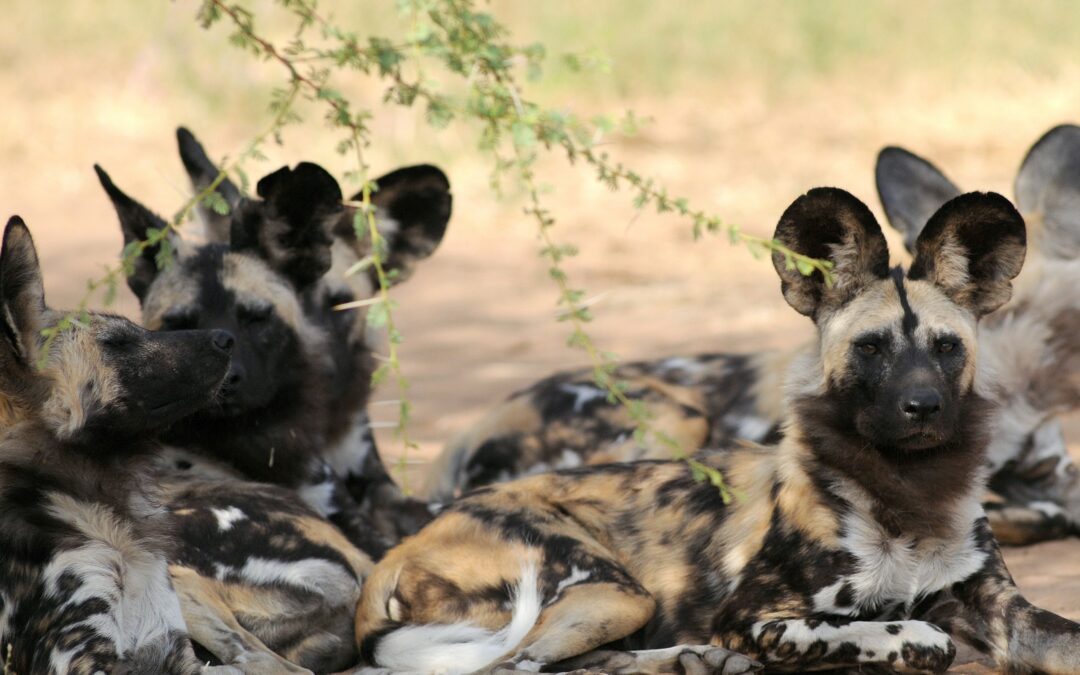
SCIENCE SNIPPET: WILD DOGS – SOUTH AFRICA’S MOST ENDANGERED CARNIVORE
[/vc_column_text][vc_single_image image=”5468″ img_size=”full” alignment=”center”][vc_column_text]Samantha Nicholson, Science Officer and African Lion Database Coordinator, EWT Conservation Science Unit
SamanthaN@ewt.org.za
[/vc_column_text][vc_column_text]Across Africa, there are only an estimated 6,600 Wild Dogs that occur in the wild, making them the continent’s 2nd most Endangered carnivore behind the Ethiopian Wolf. In Africa, Wild Dogs inhabit only 14 of the 39 countries where they historically occurred, having lost approximately 93% of their historic range due to habitat loss and a rapidly expanding human population. Sadly, this species faces many other threats such as loss of prey, conflict-related killings, snaring and roadkill incidents.
In a recent published study (Nicholson, S. K., Marneweck, D. G., Lindsey, P. A., Marnewick, K. & Davies-Mostert, H. T. 2020. A 20-year review of the status and distribution of African Wild Dogs (Lycaon pictus) in South Africa. African Journal of Wildlife Research 50: 8-19.), we completed a national assessment of the status and distribution of South Africa’s population of Wild Dogs – the country’s most Endangered carnivore. We looked at two decades of population and distribution data for the species, from 1998 to 2017, and found some interesting results.
South Africa is considered to have three subpopulations of Wild Dogs:
1) The Kruger National Park
2) A managed metapopulation that has been established through reintroductions into isolated, fenced reserves across the country
3) A free-roaming population that occurs naturally outside protected areas – predominantly in KwaZulu-Natal, Limpopo and Mpumalanga provinces.
For the study period, the Kruger population has generally averaged 163 adults and yearlings and although the population growth has declined slightly, the population has remained stable through the years. Kruger has consistently supported the highest proportion of the national population of Wild Dogs over the last two decades.
South Africa’s managed metapopulation is made up of a series of individual reserves with intensive management among the reserves, to ensure that there is genetic flow between them. This subpopulation is managed by the Endangered Wildlife Trust and the Wild Dog Advisory Group (WAG). The number of metapopulation reserves has increased over the years, and the average annual population is 108 adults and yearlings. The metapopulation is the only subpopulation that has increased significantly over time and this is due to intensive conservation efforts and the reintroduction of Wild Dogs into 15 additional reserves since 1998. The contribution of the metapopulation to South Africa’s national population has increased significantly over time.
Free-roaming Wild Dogs make up the smallest subpopulation in the country with an average annual population of approximately 79 adults and yearlings. This subpopulation faces the largest number of threats as it is largely unprotected and generally outside of protected areas.
The overall South African population of Wild Dogs has remained stable for our study period and while it is a small population (< 500 individuals), the good news is that it is increasing.[/vc_column_text][vc_single_image image=”5469″ img_size=”large” add_caption=”yes”][vc_single_image image=”5470″ img_size=”large” add_caption=”yes”][/vc_column_inner][vc_column_inner width=”1/3″][vc_column_text css=”.vc_custom_1566891493571{margin-top: 8px !important;border-bottom-width: 6px !important;}”]
LATEST STORIES
[/vc_column_text][vc_widget_sidebar sidebar_id=”cs-1″][/vc_column_inner][/vc_row_inner][/vc_column][/vc_row][vc_row][vc_column width=”1/3″][vc_googleplus][/vc_column][vc_column width=”1/3″][vc_facebook][/vc_column][vc_column width=”1/3″][vc_tweetmeme][/vc_column][/vc_row]
GRASS-OWL SURVEYS PUT ON HOLD
Rebothile Rachuene, African Grass-owl Project Field Officer, EWT Birds of Prey Programme
TselaneR@ewt.org.za
The African Grass-owl Project has recently done its first pre-season nest check survey in the Mpumalanga province. Amidst the coronavirus pandemic, the project field officer, Rebotile Rachuene, was well prepared and took all the precautions to perform this much-needed survey at this time – the species’ peak breeding period. He was joined by the Wildlife and Transport Programme field officer, Innocent Buthelezi, who helped to look for the active nests in the thick, tall and dense grasses around the wetlands/vleis/water streams. A total of four key known breeding sites were targeted and searched intensively, looking for the nests. After a few hours of searching in these dense grasses, the team discovered two nests from two different territories. The first active nest to be discovered was from the 1km-long grass site which had one freshly laid egg of about four days old. The second, 4-egg nest was discovered from a separate territory and was estimated to be about ten days old. This is a very good start for the project for this season, with most known breeding sites being in a suitable condition to support nesting requirements. Apart from these exciting results from the survey, the team also observed around 20 Marsh Owl individuals in total from all four Grass-owl breeding sites. These are indeed the most critical sites for these two ground nesting owl species within the fragmented landscape of Mpumalanga province. For this season, the project is focusing on implementing its conservation measures which are driven by over a decade research data. Our main objective is to protect all the known breeding habitats against anthropogenic activities such farming, mining and development. A number of strategies to achieve this are planned, such as fire break maintenance around these habitats, offering protection against the fires which are often destroying over 60% of them. We are also aiming to trial the restoration of the African Grass-owl habitats which were lost through the land changes caused by opencast mining in the Mpumalanga province. For us to achieve most of these objectives, we will be engaging with lots of partners and stakeholders such as landowners and communities around these areas. While we will be working towards achieving this goal, we are monitoring approximately ten key breeding sites which have been secured for nesting for the past 3-6 years for the owls. We will also continue to monitor the breeding pairs, ring the fledglings for a dispersal study, and educate the communities about the importance of protecting these habitats for the benefit of the ecosystem and human beings. However, the current global COVID-19 situation and national lockdown has put our fieldwork on hold at this time, when the owls are actively nesting.
COLLABORATIVE CONSERVATION
Dr Joseph Mwangi, Kenya Country Coordinator, EWT African Crane Conservation Programme
JosephM@ewt.org.za
The African Crane Conservation Programme (ACCP) under the ICF/ EWT partnership, recently formalised their conservation partnership with local communities by signing conservation agreements. A conservation agreement is a formal voluntary partnership between conservation bodies and local communities geared towards conserving biodiversity while improving the quality of life for local communities. Grey Crowned Cranes in Kenya are predominantly found outside protected areas in wetlands surrounded by community lands. These community wetlands are critical habitats for Grey Crowned Crane survival, especially for breeding, but communities are also dependent on the ecosystem goods and services offered by these wetlands for their livelihoods.
The ACCP, in partnership with community members, is working to maintain the ecological integrity of wetlands in western Kenya as Grey Crowned Crane habitats, as well as contribute to communities’ wellbeing. Through this initiative, we aim to reverse the downward population trend in Grey Crowned Cranes, a species currently Endangered with a population that has declined by over 50% in 19 years (BirdLife International 2020). By signing the agreements, the ACCP, through its local Kenyan partner organisations Kipsaina Crane and Wetland Conservation Group and Community Action for Nature Conservation (CANCO) committed to assist the community groups establish income-generating alternative resilient livelihood options to reduce over reliance on wetlands as their main source of livelihoods.This was a culmination of a long community-led initiative facilitated by the ACCP to identify priority livelihood projects that can improve the economic wellbeing of the communities, and consequently decrease reliance on the wetlands. Identification of alternative livelihoods was through a community participatory process, with the ACCP only providing guidance and facilitation. All the projects were identified by community members and endorsed by conservation stakeholders in the region of implementation, local and national government. The ACCP signed conservation agreements with community groups neighbouring three key wetlands in Kenya of King’wal, Saiwa and Sio Siteko. These brought together 11 community groups with a total membership of 199 members (67 male and 132 females).
Through the partnership, community groups made conservation commitments to refrain from farming in the wetlands, report capture of Grey Crowned Cranes, and create a buffer zone between their farms and the wetland boundary by planting indigenous trees and other wetland friendly vegetation, while acting as crane ambassadors in their areas to educate others on the importance of wetlands and the threats facing Grey Crowned Cranes. In return, the ACCP agreed to:
- Assist three self-help groups located in Lower part of King’wal wetland in Nandi County start up a tea and tree nursery livelihood business,
- Assist four groups in upper King’wal wetland located in Nandi County and one group neighbouring Saiwa wetland in Trans Nzoia County start up beekeeping businesses, and
- Assist one community group bordering Aaiwa wetland, Trans Nzoia County and two groups neighbouring Sio Siteko wetland, Busia County to start up poultry keeping businesses.
The partnership is already showing results, with increased reporting of crane sightings and breeding records by local community members, cutting down of Eucalyptus trees along wetland boundaries and planting of Indigenous trees, and reporting of poaching incidences by community members.
