A boost to law enforcement against poaching rekindles hope in the Kafue Flats
Kelvin Steven Floyd, International Crane Foundation And Endangered Wildlife Trust Partnership, African Crane Conservation Program, Restoration Ecologist, Kafue Flats Restoration Partnership (KFRP), floyds@ewt.org.za
The Kafue Flats in southern Zambia is a wetland of international importance. It is a valuable ecosystem facing extreme pressure. Excessive poaching in and around the Kafue Flats wetlands is driving massive wildlife declines, particularly of large herbivores. One of these, the endemic Kafue Lechwe (Kobus leche kafuensis), was once widespread on the flats, with more than 80,000 individuals recorded during the 1980s. But aerial surveys recorded only 28,000 Kafue Lechwe in 2015 and less than 23,000 in 2018.
Our surveys also show declines in other large mammal populations, including Plains Zebra, African Buffalo, Oribi, and Blue Wildebeest. The latter is actually now locally extinct. But poaching on the Kafue Flats is not restricted to large herbivores. Livestock herders on the flats also poach Endangered cranes and other waterbirds. The poachers hunt the adult birds illegally and collect the eggs for food. But park management faces a major challenge with limited capacity available for wildlife protection.
What’s the problem?
Despite being a wetland of local and international importance, and the most important wetland for Wattled Cranes and Kafue Lechwe in Africa, the number of wildlife police officers (WPOs) available is half what is required to protect the 6,500 km2 Kafue Flats against poaching. The area includes the Lochinvar, Blue Lagoon National Park, and the surrounding buffer zone (the Kafue Flats Game Management Area). Low patrol efforts, low coverage, and ineffective management leave this critical wetland vulnerable to degradation and plunder.
Stepping in to help combat poaching and restore the Kafue Flats
The International Crane Foundation and Endangered Wildlife Trust Partnership (ICF/EWT) is addressing these issues to conserve wildlife populations. To do this, we have committed to five pillars of action. These include law enforcement, community engagement, ecological management, research and monitoring, and advocacy/education. Furthermore, we have entered a 20-year co-management agreement with the Zambian Department of National Parks and Wildlife (DNPW). In 2017, we started a community habitat restoration project to control the alien invasive plant, Mimosa pigra. The plant had taken over and degraded critical wildlife habitat. By 2020, we had cleared and restored about 2,350 ha of wetlands for wildlife.
Why law enforcement?
Strengthening law enforcement to stop poaching on the Kafue Flats is a top priority. And so we must recruit and deploy fully equipped, trained, and motivated personnel for targeted anti-poaching patrols. By supplementing government law enforcement capacity in this way, we will reduce the impact of poaching and reverse the decline of wildlife populations.
We must support law enforcement as well as community livelihoods if we are to save the Lechwe Antelope, buffalo, zebra, hippo, and others from poaching on the Kafue Flats. While this might seem off-mission for a crane conservation organisation, cranes and other threatened species depend on the Kafue Flats for grazing. Unfortunately, without big mammals like the Lechwe, the government won’t support the conservation of the Flats. They will consider them better used for growing crops or grazing cattle. This would be catastrophic for the Flats’ crane populations.
Wildlife heroes in the making
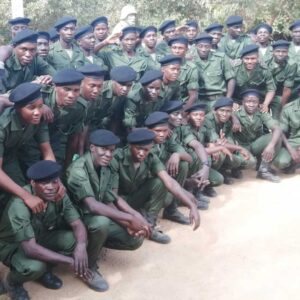
In February 2022, we worked with Community Resource Boards from Lochinvar and Blue Lagoon National Parks to train 55 community scouts. The scouts underwent three months of intense training at the Department of National Parks and Wildlife’s Chunga Training School in the Kafue National Park. On 7 June 2022, the scouts proudly graduated and will be deployed alongside the DNPW Wildlife Police Officers to combat poaching on the Kafue Flats. To complement their training and ensure the effectiveness of patrols, we are giving the scouts access to technology such as the Spatial Monitoring and Reporting Tool (SMART), CYBERTRACKER, and Earth Ranger.
The ICF President and CEO, Rich Beilfuss, represented the partnership and delivered the commencement address to the scouts. The ICF/EWT’s Kim Boardman, Mwape Sichilongo, Kerryn Morrison, Lourens Leeuwner, and other employees attended the colourful graduation ceremony. Two traditional leaders also graced the proceedings to show community support of the project.
The graduating community scouts (above). ICF President and CEO Rich Beilfuss delivering the commencement address (Below right).
The deployment of these scouts is a critical component of our holistic conservation approach to protecting critical habitat for the Endangered Wattled Crane and restoring vital grazing grounds and wildlife habitat while generating local employment and income through community involvement in the scouts programme and alien invasive plant control. The project will increase government capacity to manage and protect Zambian floodplains and advance global understanding of large-scale mimosa control methods and their measurable impact on biodiversity and livelihoods.
Celebrated annually on 2 February, World Wetlands Day aims to raise global awareness about the vital role of wetlands for people and the planet. Wetlands are declining three times faster than forests the world over, so there is a need to sound the drums of warning against their unsustainable abuse.
The global theme for World Wetlands Day 2020 was Wetlands and Biodiversity, while in Uganda, a national theme of Life thrives in wetlands; protect them was selected, offering an opportunity to highlight both the unique biodiversity found in these ecosystems, and the need to reduce human dependence on wetland-based resources which could negatively impact this biodiversity. In Uganda, the African Crane Conservation Programme (ACCP) is using the Grey Crowned Crane as a flagship species to raise awareness for wetlands. The team was thrilled to participate in a World Wetlands Day event in Bushenyi on 7 February 2020, highlighting the crane and wetlands conservation work being implemented by the Endangered Wildlife Trust/International Crane Foundation/Nature Uganda partnership. Members of the community were also present to showcase how they conserve wetlands and the biodiversity found in these habitats, and to learn from their counterparts involved in similar work elsewhere in the country.
The team braved the hot sun, displaying their messages of enhancing the protection of the Grey Crowned Crane on a 1.5 km march from Nyaruzinga wetland to the exhibition grounds, where they then set up an exhibit showcasing the economic value of wetlands. The role of Conservation Agreements in ensuring community buy-in for this work was also highlighted. Of course, Uganda was not the only place the ACCP celebrated World Wetlands Day. The ACCP across Africa celebrated by participating in indabas, presentations, radio talk shows, clean up campaigns, restoration work, crane monitoring, community outreach and education and sharing the crane message. Activities included:
South Africa
Participated in the Edendale Mall Mini Wetland Indaba held in KwaZulu-Natal (KZN), a busy mall situated adjacent to a wetland, which is set in an urban area with high density of people adjacent. This indaba focused on learning from one another, sharing successes and failures and networking.
Hosted a stand at the 6th Provincial World Wetland Day in Matatiele, Eastern Cape. This event had over 500 participants from local schools, community members, municipality through to government officials and the MEC.
Launched a community giving back campaign in the Mqatsheni area in Underberg, KZN. The aim of the campaign is for local community members to assist the local high school in any way they possibly can either through extra lessons, training, support, or being a mentor.
Started an Eco Brick project in the Mqatsheni area to showcase the various uses of the bricks, with the aim of building a house in the area and showing what residents can do with their waste instead of just dumping it into the streams and wetlands.
Gave a talk at Kwachibikhulu Primary School, which included a wetland clean up in Chrisiesmeer Protected Environment.
Senegal
Celebrated World Wetlands Day in Koussabel with 20 primary school teachers, showing them around the project area, the resident cranes, and highlighting the importance of the ACCP project in the area.
Conducted Black Crowned Crane nest surveys in Koussabel islands and Baila river and wetlands with the ACCP trained Eco Rangers to record all the nest sites in the area.
Zambia
Officially launched the 2018 Kafue Flats Aerial Survey Report which draws attention to the Kafue Flats Restoration Programme in Zambia.
Acted as part of the organising committee for the World Wetlands Day celebration festival, which was held in the Lochinvar National Park in Zambia. Our team hosted the Minister of Lands and Natural Resources, Hon. Jean Kapata MP, who officiated at the official celebration with the team moderating the discussions and highlighted the Kafue Flats Restoration Programme as contributing to the Wetlands Policy.
Kenya
Took part in interviews on a local Kenyan radio station, speaking about the importance of wetlands, why we need to celebrate them, and the work that the ACCP is doing in Kenya to protect our wetlands and the birds who are dependent on them.
AndreB@ewt.org.za[/vc_column_text][vc_column_text]A two-week field trip to Zambia during August 2019 provided the EWT’s Vultures for Africa Programme an opportunity to conduct the first Wildlife Poisoning Response Training workshop in the North Luangwa National Park to train rangers and other staff of the Park to effectively identify and respond to wildlife poisoning incidents when they happen in this part of the Luangwa Valley. The area has been identified as a wildlife poisoning hotspot following a number of wildlife poisoning events since 2013. The largest of these events happened when a poached elephant carcass was poisoned and killed 302 vultures in October 2013. The workshop also provided an opportunity to initiate the training of three BirdWatch Zambia staff members Chaona Phiri, Mary Malasa and Kelvin Mkandawire as facilitators of possible future workshops in Zambia as part of the EWT-Hawk Conservancy-University of Reading partnership’s project supported by the US-FWS.
In the week preceding the training at North Luangwa, BirdWatch staff decided to do an assessment of the availability and accessibility of the range of pesticides commonly used in wildlife poisoning on the streets of Lusaka. A few hours of shopping confirmed that there are many dealers stocking these products and that purchasing any product is as simple as asking for it and handing over the cash. Dealers seldom bothered to enquire what the pesticides were being purchased for and no record was kept of the transactions that were concluded. Within no time, they were able to purchase substantial quantities of highly toxic chemicals such as Carbofuran (one of the most widely used pesticides in wildlife poisoning globally), Monocrotophos and Endosulfan (both banned in South Africa since the early 2010s) at very affordable prices. One kilogramme of Carbofuran was bought for a mere ZMW76,00 or R88,00.[/vc_column_text][vc_single_image image=”4267″ img_size=”large” add_caption=”yes” alignment=”center”][vc_single_image image=”4268″ img_size=”large” add_caption=”yes” alignment=”center”][vc_column_text]We were able to repeat this assessment in the eastern Zambian city of Chipata when travelling back from North Luangwa National Park a few days after training. It was hardly surprising that we were able to acquire a similar range of substances from various suppliers at affordable prices, again with little or no questions asked about our intended use thereof. Substances easily acquired included Chlorpyrifos, another pesticide banned in South Africa in 2011. It was noticeable that people of varying ages, including children, were able to walk into a store, ask for and purchase a range of chemicals and veterinary medicines in Chipata without much scrutiny or any record-keeping processes as required by law being followed. It is hardly surprising that these substances are often used in the killing of wildlife.[/vc_column_text][vc_single_image image=”4270″ img_size=”large” add_caption=”yes” alignment=”center”][vc_column_text]From Chipata we travelled to the Munyamadzi Game Reserve passing villages such as Chiabala and Chilye where we noticed small groups of young males selling large quantities of roasted rodents on sticks to passing travellers. This reminded me of a conversation during a training workshop in nearby Malawi the year before when one of the rangers shared the fact that the preferred method of killing rodents in the area was the use of Aldicarb (Temik) which killed large numbers of these animals during outbreaks. Another “advantage” associated with the use of this highly toxic pesticide was that the rodents died at or near the poisoned baits, something which does not occur with commercially available rodenticides that normally take longer to kill animals that consume them and whose victims are seldom found near where the baits have placed. The use of Aldicarb therefor makes animals killed by this means easier to collect, cook and sell to consumers as a source of protein. Consumers of animals killed in this manner seem to be oblivious to the potential risk of this practice.
The situation in Zambia is certainly not unique and we have encountered similar circumstances in most SADC and east African countries over the last few years where, even if adequate legislation and guidelines with regard to the use of highly toxic pesticides are in place, enforcement of laws and control of these substances are often poor or non-existent. This also applies to South Africa where pesticides such as Aldicarb (Temik) are the most widely used substances in the illegal poisoning of wildlife and domestic animals and can be easily obtained at minimal cost and effort in many informal markets across the country, despite being withdrawn from formal trade in 2011 and being banned since 2014.