Yolan Friedmann, CEO
As we mark Women’s Month in South Africa, with Women’s Day being celebrated on 9 August annually, it is worrying that a 2022 report by the UN states that gender disparities are, in fact, worsening globally and that it will take nearly 300 years to achieve gender parity at the current rate of global gender transformation. Despite efforts by NGOs, community groups and government agencies around the globe, drivers that have amplified this negative trend include the COVID-19 pandemic, conflict, climate change and a backlash against the rights of women to own and manage their own reproductive health. As a result, most countries stand no chance of achieving the targets set under SDG (Sustainable Development Goal) number 5 by its 2030 deadline.
In many countries, there are not even laws that ban violence against women or protect their rights in marriage, and it is feared that this may continue to exist for generations to come. The UN warns that at the current rate of progress, it will take up to 286 years to close gaps in legal protection and remove discriminatory laws, 140 years for women to achieve equal representation in leadership positions in the workplace, and 40 years for the same to happen in national parliaments. Instead of seeing a rapid and meaningful decline in poverty and poor education of girl children, by 2030, it is estimated that more women and girls in sub-Saharan Africa will live in extreme poverty than today.
One of the tools that needs urgent and focused attention with significantly increased resource allocation is, of course, education. Each additional year of schooling can increase a girl’s future earnings by up to 20%, according to the report, with further impacts on poverty reduction, better maternal health, lower child mortality, greater HIV prevention and reduced violence against women. A study in 2013 on education and fertility in Ethiopia estimated that an additional year of schooling in Ethiopia would lead to a 7% reduction in the probability of teenage birth and a 6% decrease in the probability of marriage. Furthermore, the same study showed that 61% of women with no schooling have a child before turning 20 compared to 16% of women with eight years of schooling.
Additionally, women with eight years of schooling would have a fertility rate 53% lower than those without schooling at all, and female education has a greater impact on the age of marriage and delayed fertility than male education.
The EWT has a range of initiatives aimed at empowering and supporting women and girls to own their own bodies, own their own lives and own their own futures. The ICF-EWT Partnership has constructed private, dignified girls-only toilets in communities in Uganda, thus supporting girl children to attend school when they have their periods. It has also handed out hundreds of environmentally sustainable sanitary ware products to girls in rural communities in Limpopo with the same objective. We run several projects to train and empower women to earn their own livings and feed and support their own families. Across many of our programmes, gender equality is supported through workshops, education drives and awareness programmes that empower girls, offering them opportunities for further education and development. We are proud that we are one of the few female-headed conservation NGOs in the country and have a ratio of 50:50 women to men in the organisation.
However, we also recognise the startling fact that this is not enough and that more needs to be done if society is to make inroads towards gender balance and the promotion of the equitable and just treatment of women. Even when women are empowered to take their rightful places in society in business, politics and academia, they remain more likely to be the subject of cyberbullying, workplace harassment, discrimination, violence, and hostility, even as educated, empowered members of society.
During Women’s Month 2023, the EWT pledges to do more to promote the fair, equitable and dignified treatment of all women. And of all men. This goes for our staff, volunteers, communities, colleagues, partners, and everyone we interact with. We pledge to do this every day and for every year hereafter, for until we have a world that values and respects all human forms of life, we cannot ever expect or hope to achieve this for our wildlife and animal counterparts.
#TheNextFifty
Yolan Friedmann
A WORD FROM THE CEO
Women’s Month – a month of Gold
Yolan Friedmann, EWT CEO
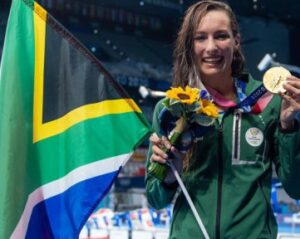
yolanf@ewt.org.za What better way to kick off Women’s Month in South Africa than with outstanding performances of our lady Olympians Tatjana Schoenmaker (swimming) and Bianca Buitendag (surfing), who racked up the first South African medals of the Games, with Tatjana setting a new world record! The Olympics provide a unique and magical platform where the world comes together to recognise and celebrate extraordinary feats of human brilliance, underpinned by unfathomable dedication, commitment, hard work, and unwavering vision. And in a world shaken by the Covid-19 pandemic, the Tokyo Olympic Games also symbolise hope, triumph, and perseverance for millions of people around the globe. To add to the inspiration offered by any athlete on the start line is the number of athletes this year that are mothers, with Canadian basketball player Kim Boucher even having her three months old infant with her at the Games whom she is still breastfeeding. With 49% of the athletes in this year’s Games being women, the Tokyo Olympics claims to be the most gender-balanced Games of all times, and features nine more mixed events than at Rio 2016, raising the overall number to 18. Progress of gender equity and the rights of women in many respects.
Back home, South Africa has a very long way to go before women can not only feel equal to men in our society (in terms of pay, equity in the workplace, a voice in the media, and more) but can feel safe and free, in our country and our homes. We wish that days and months dedicated to empowering women and raising the profile of the challenges they face would not be necessary but, given that they are, that they will result in immediate, measurable, and impactful change, not just rhetoric clever campaigns. The EWT is a gender-balanced organisation with a ratio of 50:50 men to women and is one of the few in our sector that is female lead. We believe firmly in the role that women play in building not only a resilient, nurturing and compassionate society, but we also embrace and hold dear the value of the female of the species in bringing all these qualities and more to the EWT and conservation in general. The EWT’s ladies are mothers, academics, scientists, field workers, caregivers, teachers, wives, daughters, and leaders, often all in one. Importantly, we are also blessed to work with men who give high regard to the role of the ladies in their personal and professional lives and who are fundamental to creating a society that is empowering and respectful of women.
This Women’s Month, I wish that all the ladies in the EWT know how valued they are, how much they contribute, and how much impact they have on conservation, the EWT, their families, and society. It is equally my wish that all the men in the EWT also know how important they are, how invaluable is their contribution and how irreplaceable their roles as fathers, brothers, colleagues, and friends are. From all at the EWT, may you spend this Women’s month celebrating each and every woman in your life, and the many good men too, and make the changes that are necessary for a long lasting impact to come from this August that will empower and keep safe ALL the ladies in our country. May we all work this month and every month to create an equitable, safe, just and celebratory society of the gold that exists in all of us.
LATEST STORIES
A WORD FROM THE CEO: AN INTERVIEW WITH OUR LEADING LADY, YOLAN FRIEDMANN
Yolan Friedmann, EWT CEO
yolanf@ewt.org.za
With all the challenges facing our country, and our environment, which ones keep you awake at night and why?
South Africa is faced with massive challenges generally and despite some of those not emanating from the environmental sector, they do spill over. So the issue of corruption means that there is less money to be spent on environmental issues and so our planet suffers; with escalating crime, our staff and colleagues are exposed to risk whilst they do their work in remote areas, or the travel, or even in their personal lives. I have seen first-hand the stress that this puts them under and the costs associated with paying for increased safety and protection. The loss of critical skills with young people emigrating also effects our sector severely and we have lost too many talented people to other countries as a result of crime in South Africa. Our future as a stable, thriving society and economy keeps me awake at night.
What unique strengths and characteristics do you believe women have, that add value to being a person of influence in the environmental sector?
By nature, women tend to be more consultative and like to work in teams. We can lead, and we can also follow, and we generally know when to do either or both. We are able and willing to ask for help and to admit when we don’t know the answers, and to show strength and leadership in finding them, together. I think that this creates a more dialogue-based approach to finding solutions, which is vital in the highly complex world of conservation. Nothing in the conservation sector can be solved with linear thinking, and one must integrate social, economic, environmental, political, cultural and ecological imperatives with science and compassion and sensitivity, and this requires continual juggling and consultation. Women tend to be better jugglers, in my opinion, and understand the need to balance shifting priorities – we tend to be able to lead from the front as well as the back. Our sector has also required massive skills and capacity development over the past years, with the need for human development being at the core of increasing environmental awareness and action. Women have thrived in this environment which is evident by the increasing number of civil society action groups caring for the earth, in almost all neighbourhoods these days, which are mostly lead by women.
Are there any women in conservation who inspire you?
They all do! Every one of them is drawn to our sector because they are passionate, want to make a difference, are willing to work long hours and sacrifice a lot personally, and care for the earth and all its inhabitants so yes, they ALL inspire me!
Do you have a female role model?
These change all the time as one learns from different people as you develop and events in your life require adaptation and growth. But I always admire my female friends that are entrepreneurs, who create jobs, who create beautiful things and change the lives of their employees and friends; who are selfless and caring and never falter; who are strong and compassionate and honest and flawed and always wonderful! They know who they are 😊
What advice would you give to young women of today?
Be willing to do anything that is required of you to make your first job really count. Don’t be stuck on what role you believe you should play and what your qualifications have prepared you to do. In today’s competitive market employers are looking for team members who are willing and able to dive in and do anything that is required and who add value to the organisation as a whole. If you add value, you will have a thriving career. Today I see too many young people asking what is in it for them, and this puts employers off. Post-COVID, we are also going to see the end of the silo employment position and the emergence of more circular, integrated roles that continually shift and form part of different teams. You must, therefore be willing to be flexible, and you must add value as a person before you can rely on your skills set alone. Other people have the same qualifications as you do so you need to offer a lot more than just your degree. In an interview, how about asking the employer what THEY need and how YOU can add value to them?
What has your time working with the EWT taught you?
Way too much to write here… I have worked in every role in the EWT – from volunteer to CEO, so every position has taught me different things. But from where I sit today I would say that I have learned to work with (and not hide) many female traits that I often used to think would work against me as a female leader in a very male-dominated sector (at the time). These traits include compassion, humility,; consultation, teamwork, the ability to lead from behind and not be ego-driven, being just as happy, if not more so, when your staff are in the limelight and get all the accolades, admitting when you are wrong, and owning up when you don’t have all the answers. I have surrounded myself with people who all know more than I do and my greatest lessons have come from working with them, listening to them, seeing things through their eyes, making them better at their jobs and serving them, and knowing that as their leader, that is my role.
Can you share a bit about what you do? What does a typical workday look like for you?
These days it’s 12 hours on a laptop, like everyone else I suppose. Under ‘normal’ conditions, I still spend a lot of time on emails and in meetings, writing documents and approving things like marketing and fundraising material, budgets, contracts etc. My role is mostly on corporate governance and strategic development, but I do get to interact with my conservation teams every day, which is good for my soul! I get into the field a few times a year, but it is never enough, but again, my role is to facilitate my staff getting to do the fieldwork as they are the experts. I come from a strong field and technical background, so I miss getting my hands dirty! I also spend a lot of time liaising with the media, our partners, stakeholders and supporters. I like to be creative, so I work closely with my fundraising and communications teams. I work closely with my Board of Trustees and am ultimately responsible for ensuring that our strategy is sound, meaningful, and implemented as planned. My role is to find the resources to get the work done, establish the partnerships that make us effective and empower the team to make the magic happen.
A WORD FROM THE CEO: AN INTERVIEW WITH OUR LEADING LADY, YOLAN FRIEDMANN
Yolan Friedmann, EWT CEO
yolanf@ewt.org.za
With all the challenges facing our country, and our environment, which ones keep you awake at night and why?
South Africa is faced with massive challenges generally and despite some of those not emanating from the environmental sector, they do spill over. So the issue of corruption means that there is less money to be spent on environmental issues and so our planet suffers; with escalating crime, our staff and colleagues are exposed to risk whilst they do their work in remote areas, or the travel, or even in their personal lives. I have seen first-hand the stress that this puts them under and the costs associated with paying for increased safety and protection. The loss of critical skills with young people emigrating also effects our sector severely and we have lost too many talented people to other countries as a result of crime in South Africa. Our future as a stable, thriving society and economy keeps me awake at night.
What unique strengths and characteristics do you believe women have, that add value to being a person of influence in the environmental sector?
By nature, women tend to be more consultative and like to work in teams. We can lead, and we can also follow, and we generally know when to do either or both. We are able and willing to ask for help and to admit when we don’t know the answers, and to show strength and leadership in finding them, together. I think that this creates a more dialogue-based approach to finding solutions, which is vital in the highly complex world of conservation. Nothing in the conservation sector can be solved with linear thinking, and one must integrate social, economic, environmental, political, cultural and ecological imperatives with science and compassion and sensitivity, and this requires continual juggling and consultation. Women tend to be better jugglers, in my opinion, and understand the need to balance shifting priorities – we tend to be able to lead from the front as well as the back. Our sector has also required massive skills and capacity development over the past years, with the need for human development being at the core of increasing environmental awareness and action. Women have thrived in this environment which is evident by the increasing number of civil society action groups caring for the earth, in almost all neighbourhoods these days, which are mostly lead by women.
Are there any women in conservation who inspire you?
They all do! Every one of them is drawn to our sector because they are passionate, want to make a difference, are willing to work long hours and sacrifice a lot personally, and care for the earth and all its inhabitants so yes, they ALL inspire me!
Do you have a female role model?
These change all the time as one learns from different people as you develop and events in your life require adaptation and growth. But I always admire my female friends that are entrepreneurs, who create jobs, who create beautiful things and change the lives of their employees and friends; who are selfless and caring and never falter; who are strong and compassionate and honest and flawed and always wonderful! They know who they are 😊
What advice would you give to young women of today?
Be willing to do anything that is required of you to make your first job really count. Don’t be stuck on what role you believe you should play and what your qualifications have prepared you to do. In today’s competitive market employers are looking for team members who are willing and able to dive in and do anything that is required and who add value to the organisation as a whole. If you add value, you will have a thriving career. Today I see too many young people asking what is in it for them, and this puts employers off. Post-COVID, we are also going to see the end of the silo employment position and the emergence of more circular, integrated roles that continually shift and form part of different teams. You must, therefore be willing to be flexible, and you must add value as a person before you can rely on your skills set alone. Other people have the same qualifications as you do so you need to offer a lot more than just your degree. In an interview, how about asking the employer what THEY need and how YOU can add value to them?
What has your time working with the EWT taught you?
Way too much to write here… I have worked in every role in the EWT – from volunteer to CEO, so every position has taught me different things. But from where I sit today I would say that I have learned to work with (and not hide) many female traits that I often used to think would work against me as a female leader in a very male-dominated sector (at the time). These traits include compassion, humility,; consultation, teamwork, the ability to lead from behind and not be ego-driven, being just as happy, if not more so, when your staff are in the limelight and get all the accolades, admitting when you are wrong, and owning up when you don’t have all the answers. I have surrounded myself with people who all know more than I do and my greatest lessons have come from working with them, listening to them, seeing things through their eyes, making them better at their jobs and serving them, and knowing that as their leader, that is my role.
Can you share a bit about what you do? What does a typical workday look like for you?
These days it’s 12 hours on a laptop, like everyone else I suppose. Under ‘normal’ conditions, I still spend a lot of time on emails and in meetings, writing documents and approving things like marketing and fundraising material, budgets, contracts etc. My role is mostly on corporate governance and strategic development, but I do get to interact with my conservation teams every day, which is good for my soul! I get into the field a few times a year, but it is never enough, but again, my role is to facilitate my staff getting to do the fieldwork as they are the experts. I come from a strong field and technical background, so I miss getting my hands dirty! I also spend a lot of time liaising with the media, our partners, stakeholders and supporters. I like to be creative, so I work closely with my fundraising and communications teams. I work closely with my Board of Trustees and am ultimately responsible for ensuring that our strategy is sound, meaningful, and implemented as planned. My role is to find the resources to get the work done, establish the partnerships that make us effective and empower the team to make the magic happen.
WOMEN’S MONTH INTERVIEW WITH HONOURABLE MINISTER BARBARA CREECY
Megan Murison, EWT Communications Officer, meganm@ewt.org.za The EWT had the privilege of chatting to the Minister of Environment, Forestry, and Fisheries, Barbara Creecy, for our Women’s Month campaign, highlighting strong female role models and the critical roles women play in building a resilient and equitable society. Honourable Minister Creecy spoke to EWT CEO Yolan Friedmann and Field Officer for the Wildlife and Energy Programme Ndzalama Chauke.
Minister Creecy was appointed to President Ramoposa’s cabinet approximately a year ago and has been working in the governmental space since 1994. Minister Creecy spoke to the impact of environmental degradation and how it is the most vulnerable communities who are most harshly impacted. Since becoming a mother, she is more conscious of and concerned by the threats facing the future of our planet.
Please see the full interview to hear the fascinating perspectives shared by one of our leading ladies.
It is necessary to highlight the profiles of women in positions of power as role models for the youth, particularly young women.
