Period Poverty is real. Period equity should be too
Period Poverty is real. Period equity should be too
Dr Jenny Botha, the EWT’s People in Conservation Programme Manager
Despite the progress made in making menstrual products available to school-going girls, approximately seven million girls in South Africa still suffer from what has been coined “period poverty”, as they don’t have access to enough menstrual products each month, according to Candice Chirwa, a prominent South African gender advisor.
Sanitary pads are expensive and can be difficult to access, particularly in remote rural areas. Under these circumstances, girls often have to make do with pads made from material or cloth, tissues or toilet paper, and other materials, many of which are not hygienic and cause the girls embarrassment and a loss of dignity and confidence. Some girls may avoid attending school on days they have their periods, hampering their education and limiting future economic prospects¹. In addition, despite efforts by educators and the Dept of Basic Education to address this, many girls still also lack access to crucial information about their bodies and women’s hygiene and health, including the types of menstrual products that they could potentially choose from. Ending period poverty and ensuring girls have access to the information they need is an important step towards achieving gender equity.
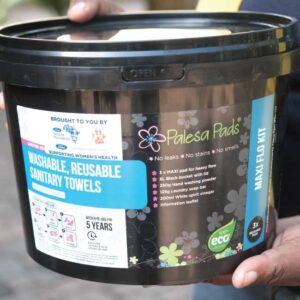
Palesa Pads Menstruation Kit containing three reusable sanitary pads, a bucket, washing powder, and other cleaning materials
In May 2023, the Endangered Wildlife Trust (EWT) held awareness sessions on women’s health together with educators from two secondary schools in Kutama, Limpopo Province and, through the generous support of the Ford Motor Company Fund and the Ford Wildlife Fund, provided 635 girls with sanitary health kits. Each kit included three reusable sanitary pads, a bucket, washing powder, and other cleaning materials. In addition, thanks to generous sponsors like EMLife and Palesa Pads, we gave twenty women working at the schools packs of three reusable sanitary pads each.
Apart from the emotional and psychological difficulties experienced by girls unable to cope with their periods, the environmental impacts of single-use sanitary products are high. In the United Kingdom, an estimated 3.3 billion single-use sanitary products (pads or tampons) are used each year, resulting in 28,114 tonnes of waste², most of which is disposed of in landfills, with the remainder being flushed into sewage systems, often causing blockages. Although there is a move towards more sustainable multi-use, organic products, most still contain plastic or rayon and use harsh chemicals during manufacturing.
In South Africa, girls often have difficulties disposing of single-use pads, and resource-poor schools frequently struggle with a lack of facilities, particularly in rural areas. If incinerators are provided, learners may be reluctant to use them, or they may not work, particularly during power outages. Disposing of sanitary products such as one-use pads and nappies in the environment has become a major cause for concern in under-served communities across South Africa, potentially increasing risks to human health and undermining the environment and biodiversity. Although the latter risk may appear relatively unimportant in light of the other substantial challenges facing South Africa and the world, the severity and impacts of biodiversity loss and potential ecosystem collapse are high and thankfully becoming increasingly recognised as a global threat. In the World Economic Forum’s 2023 Global Risk Assessment, biodiversity and ecosystem loss was ranked as the fourth most severe risk facing society over the next ten years.
Specific impacts of our recent Women’s Health project
The average woman who uses single-use sanitary products will go through between 11,000 and 17,000 sanitary pads or other disposable sanitary products in their lifetime at a cost of between R27,500 and R42,500 at current prices in South Africa. In contrast, reusable sanitary pads last 3-5 years and cost R50 each, depending on the make. The reusable sanitary pads we provided the girls in Kutama can be used up to 200 times if adequately cared for³. This means that the three pads given to each girl replace 600 single-use disposable pads that would otherwise have been disposed of in toilets, domestic waste, or the environment, equating to 471,000 single-use pads (if each of the 785 girls uses them). In addition, the girls from both schools also received two reusable pads in 2021, meaning that the majority received five pads each. In the 2021 women’s health project, over 90% of the 71 girls who gave us feedback through an anonymous and voluntary survey reported using the pads.
In August 2023, we will be providing an additional 150 girls from a third Kutama school with reusable sanitary pads, and we are going to expand the project to different areas in South Africa, including some of the most remote and under-served communities the EWT works with through our different programmes. More exciting activities are planned for the project, so keep an eye on our platforms for more on how we hope to contribute to period equity.
Thank you to the Ford Motor Company Fund, the Ford Wildlife Foundation, EMLife, and Palesa Pads for supporting the project.
[1] Crankshaw T.L., Strauss M. and Gumede B. 2020. Menstrual health management and schooling experience amongst female learners in Gauteng, South Africa: a mixed method study. Reproductive Health 17:48 p.15.
[2] Panell A.G. Blair, Y. Bajón -fernández, R. Villa. 2022. An exploratory study of the impact and potential of menstrual hygiene management waste in the U.K. Cleaner Engineering and Technology 7: p7.
[3] https://www.iol.co.za/business-report/entrepreneurs/washable-reusable-pads-keep-thousands-of-girls-in-school-14fecafb-fdc3-4ca1-937e-d72e1fcef9d4