FOUND: Iridescent blind mole with super-hearing powers rediscovered ‘swimming’ through sand dunes of South Africa
FOUND: Iridescent blind mole with super-hearing powers rediscovered ‘swimming’ through sand dunes of South Africa
e-DNA helped confirm De Winton’ s golden mole still lives on beaches in Port Nolloth
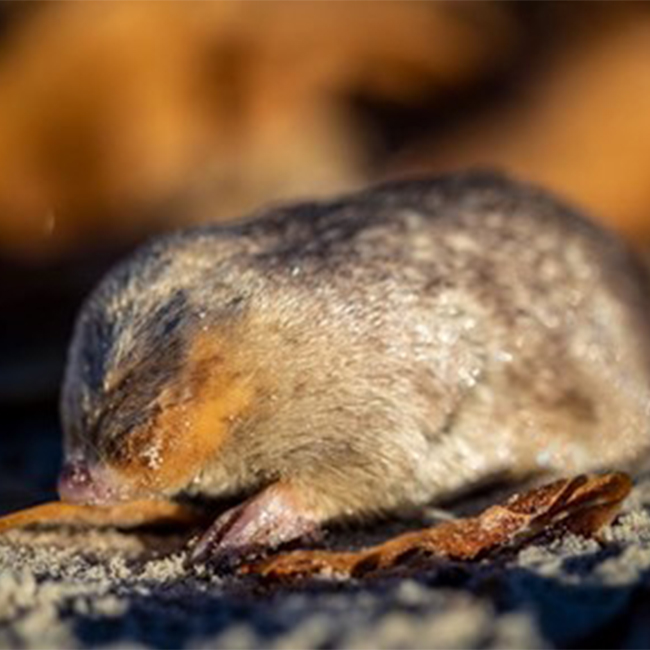
A blind mole with an iridescent coat sheen that ‘swims’ through sand and has been lost to science since 1936 is lost no longer, thanks to a team of conservationists and geneticists from the Endangered Wildlife Trust (EWT) and the University of Pretoria. The rediscovered De Winton’ s golden mole–which is from South Africa–is the 11th of the world’ s most wanted lost species to be rediscovered since the Search for Lost Species launched in 2017. A research paper, “Environmental DNA from soil reveals the presence of a ‘lost’ Afrotherian species,” published Nov. 24, in the scientific journal Biodiversity and Conservation, describes the incredible lengths the team went to in order to rediscover the species.
“It was a very exciting project with many challenges,” said Esther Matthew, senior field officer with Endangered Wildlife Trust. “Luckily we had a fantastic team full of enthusiasm and innovative ideas. Which is exactly what you need when you have to survey up to 18 kilometers [11.2 miles] of dune habitat in a day.”
The EWT-led team used a burgeoning technique never used before to detect golden moles: environmental DNA (eDNA), which is the DNA that animals shed as they move through the environment, typically in the form of skin cells, hair and bodily excretions. In addition to living in largely inaccessible burrows, golden moles have extremely sensitive hearing and can detect vibrations from movement above ground, which helps them avoid being seen from the surface. They also rarely leave tunnels behind that are visible from the surface as they move under the sand.
“Extracting DNA from soil is not without its challenges, but we have been honing our skills and refining our techniques—even before this project—and we were fairly confident that if De Winton’ s golden mole was in the environment, we would be able to detect it by finding and sequencing its DNA,” said Samantha Mynhardt, conservation geneticist with the Endangered Wildlife Trust and Stellenbosch University.
After collecting more than 100 soil samples in June 2021 from beaches and dunes on the northwest coast of South Africa—including Port Nolloth beach, the only place where De Winton’ s golden mole had ever been found—and conducting a complex and comprehensive genetic analysis of each sample, the team determined that there were several species of golden mole living in the sand along the stretch of coast.
Two more common species—Cape golden mole and Grant’ s golden mole—were found, as well as a third species, Van Zyl’ s golden mole, which is endangered and rare. The fourth species the team found was De Winton’ s golden mole, but it took almost another year to definitively prove that. Since De Winton’ s golden mole is genetically very similar to Van Zyl’ s golden mole, the team needed more genetic information about De Winton’ s golden mole to confidently identify it using eDNA.
At the time, there was only one De Winton’ s golden mole reference DNA sequence available. That DNA sequence represents a nuclear gene that has limited variation between De Winton’ s and Van Zyl’ s golden mole, meaning the team couldn’ t confidently assign the fourth species to De Winton’ s at that time.
Nearly a year later, the search team found exactly the information they needed to finally solve the case. A second gene sequence for a De Winton’ s golden mole specimen (now housed at the Iziko South African Museum in Cape Town) became publicly available in January 2022. It was a mitochondrial gene—from a much more variable part of the genome that has much higher levels of variation between De Winton’ s and Van Zyl’ s. When the team compared their eDNA sequences from Port Nolloth beach to the new reference sequence, it was a clear match to De Winton’ s golden mole.
“Though many people doubted that De Winton’ s golden mole was still out there, I had good faith that the species had not yet gone extinct,” said Cobus Theron, senior conservation manager for EWT and a member of the search team. “I was convinced it would just take the right detection method, the proper timing, and a team passionate about finding it. Now not only have we solved the riddle, but we have tapped into this eDNA frontier where there is a huge amount of opportunity not only for moles, but for other lost or imperiled species.” [Read more about the exciting rediscovery of De Winton’ s Golden Mole.]
The Endangered Wildlife Trust has been working to rediscover De Winton’ s golden mole for more than two years. They began by identifying areas in South Africa where it was possible the species was living undetected and by interviewing people from local communities.
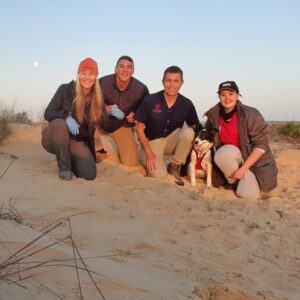
At each search site they used several different tools to locate golden moles and traces of them. A scent-detection border collie specially trained to sniff out golden moles, accompanied the team and helped lead them to trails left behind by the animals.
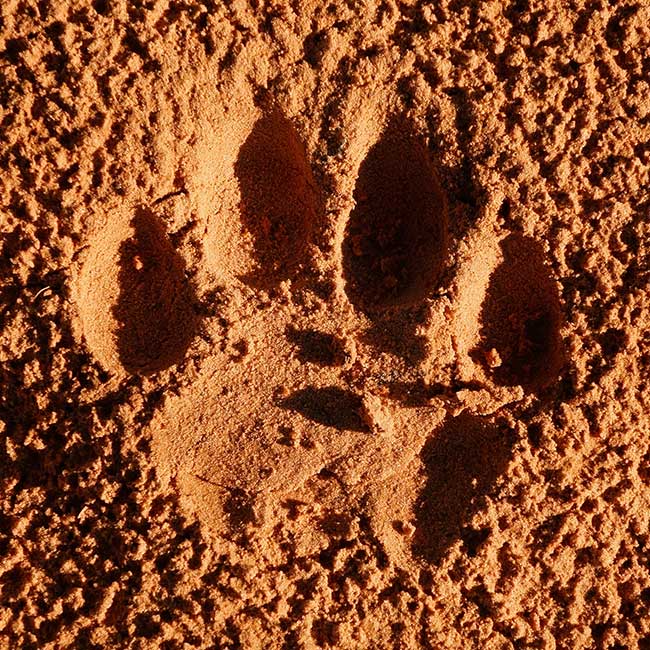
When the team arrived on the beach in Port Nolloth there were fresh golden mole trails in the sand, made more visible by recent rain. However, it can be very difficult to identify a species of golden mole from its physical characteristics alone, so despite seeing golden moles, they also collected soil samples for eDNA analysis to accurately determine the species that left the trails.
Since the expedition in 2021, EWT has identified four additional De Winton’ s golden mole populations. They are working to protect the moles and learn more about the species with the support of the National Research Foundation’ s Foundational Biodiversity Information Programme (FBIP) in South Africa, Rainforest Trust, and Prince Bernhard Nature Fund.
In addition to the De Winton’ s golden mole, Re:wild, working with partners across the globe, has confirmed the rediscovery of Jackson’ s climbing salamander in Guatemala, both Wallace’ s giant bee and the velvet pitcher plant in Indonesia, the silver-backed chevrotain in Vietnam, the Somali sengi in Djibouti, the Voeltzkow’ s chameleon in Madagascar, Fernandina giant tortoise in the Galápagos, Sierra Leone crab in Sierra Leone, the Pernambuco holly tree in Brazil and Attenborough’ s long-beaked echidna in Indonesia.
Christina Biggs, manager for the Search for Lost Species, Re:wild
“The search for De Winton’ s golden mole was not easy by any means, and it really speaks to how persistent, thorough and resourceful the EWT team was in the field. They left no sandhill unturned and now it’ s possible to protect the areas where these threatened and rare moles live. The successful use of the eDNA technique is now a case study on how such forward-thinking technologies can be utilized to find other lost species.”