Help African Wild Dogs 

Donate today  

World Environment Day 2024

World Environment Day 2024

World Environment Day 2024: Restoring Land and Securing Our Future

World Environment Day 2024 marks a pivotal moment to reflect on the urgent need for ecosystem restoration. On 5 June, the Endangered Wildlife Trust (EWT) joined millions worldwide in raising awareness about land rehabilitation, desertification prevention, and drought resilience.

This year’s theme, “Our Land. Our Future,” highlights the critical role of conservation. Moreover, it aligns with the United Nations Decade on Ecosystem Restoration’s #GenerationRestoration movement, which seeks to reverse environmental damage by 2030.

The Global Crisis of Land Degradation

Recent findings from the United Nations’ Global Land Outlook Thematic Report on Rangelands and Pastoralists reveal alarming statistics—nearly 50% of the world’s rangelands face degradation due to overuse, climate change, and biodiversity loss. In South Africa, afforestation, mining, and land conversion contribute significantly to this crisis.

The EWT has taken proactive steps, establishing over 100,000 hectares of protected areas and clearing invasive species to restore vital water catchment zones. These efforts improve ecosystem services, particularly in climate-sensitive regions. However, a nationwide shift in natural resource management is essential to meet Sustainable Development Goals on land degradation neutrality.

The Human and Economic Impact of Environmental Decline

According to the United Nations Environment Programme (UNEP), over two billion hectares of land—more than 20% of the Earth’s surface—are degraded. This affects 3.2 billion people, disproportionately harming Indigenous communities, small-scale farmers, and rural populations. Droughts alone impact 55 million people annually, threatening food security and livelihoods.

If left unchecked, land degradation could reduce global food productivity by 12%, driving food prices up by 30% by 2040. Africa holds significant restoration potential, with over 720 million hectares that could be rehabilitated. The Pan-African Ecosystem Restoration Action Agenda aims to restore 200 million hectares by 2030.

World Environment Day 2024

World Environment Day 2024

Innovative Solutions for a Sustainable Future

The EWT’s Drylands Conservation Programme addresses climate change and unsustainable land use in southern Africa. By promoting eco-tourism and supporting local enterprises, the initiative fosters economic resilience while preserving ecosystems.

Governments and financial institutions must also play a role. Redirecting agricultural subsidies towards regenerative farming and small-scale producers can enhance food security without compromising ecosystems. UNEP estimates that investments in nature-based solutions must double to $542 billion by 2030 to meet global climate and biodiversity targets.

The Path Forward: Policy and Collaboration

With the Convention on Biological Diversity’s 16th Conference of the Parties (COP16) approaching in October 2024, nations must reaffirm their commitments under the Kunming-Montreal Global Biodiversity Framework. Adequate funding, particularly for developing nations, is critical to implementing National Biodiversity Strategies and Action Plans (NBSAPs).

In South Africa, collaboration between government, businesses, and communities is vital. The EWT’s carbon trading agreements in the Free State grasslands demonstrate how sustainable practices can generate revenue while protecting biodiversity.

A Call to Action for World Environment Day 2024

World Environment Day 2024 reminds us that healthy land is as vital as clean air and water. By restoring degraded ecosystems, we safeguard food security, biodiversity, and human well-being. Every stakeholder—from policymakers to private citizens—must contribute to this collective mission.

The time to act is now. Together, we can secure a sustainable future for generations to come.

Going, going… Gone…  EWT working to reverse habitat loss in South Africa’s drylands

Going, going… Gone… EWT working to reverse habitat loss in South Africa’s drylands

Going, going… Gone… EWT working to reverse habitat loss in South Africa’s drylands

By Zanne Brink, Drylands Conservation Programme Manager


“The eye of the beholder” has always been an interesting emotional sense that has dictated a person’s view or outlook on the Dry Lands of South Africa, and further afield.  Those individuals drawn to vast open spaces with its unique endemic biodiversity and specialist species, versus those individuals who dread the “nothingness”.

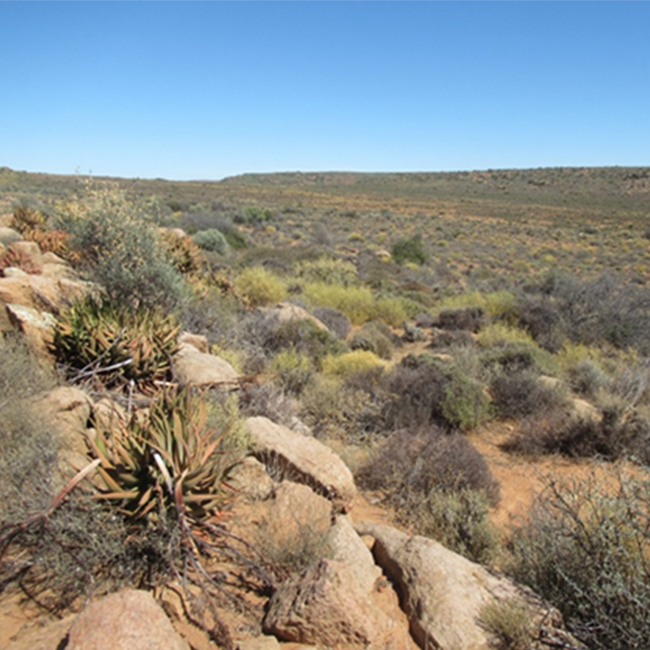
For the most part, “arid”, or “dry” areas are characterised by limited natural water resources and, to the layman, large open areas with plants growing relatively low to the ground, and very little cellphone reception. These arid areas receive on average between 50 to 300 mm of rain per annum, making the arid regions very sensitive to climate variability with big impacts on endemic plants and animals adapted to this environment. Survival is dependant on evading drought or harsh periods through migration or endurance in the form of soil, water and vegetation management.  No matter how you look at it, the arid areas are exposed to extreme weather and climatic occurrences, such as droughts and heatwaves. This results in these landscapes being vulnerable to rapid and devastating environmental change and land degradation.

The vast open landscapes of southern Namibia, the Western and the Northern Cape Provinces of South Africa are home to three significant arid biomes: the Namib Desert, Nama Karoo, and the Succulent Karoo. Despite the harsh conditions experienced in these biomes, it is a fact that not only species, but biodiversity, and dare I say communities living in these biomes, are highly adapted and diverse.

In arid environments, mobility is the most important adaptation to extreme conditions. Animals and people can move from one area to another when plants do not spread fast enough. Increasing temperatures, shifting rainfall patterns, and more frequent extreme weather events are altering ecosystems and placing additional stress on already vulnerable ecosystems and communities. Temperatures in southern Africa are expected to rise at a rate 1.5 to 2 times that of the rest of the world, exacerbating the possibility of biodiversity loss and climate change challenges for communities.  Arid areas are also known as the most sparsely populated areas of South Africa, and in recent years these communities have been shrinking due to socio-economic drivers.

Ongoing research allows us to understand these changes brought on by both short-term droughts and climate-induced shifts. This is very important, as natural and social responses to an ever-increasing changing environment due to increased frequencies in drought occurrences is vital.  South Africa’s meat and wool ‘breadbasket’ depends on changes implemented at a farm level and through legislation, to include a different style of farming to adapt to less water and increased temperatures over extended periods.

But, it must also be understood that arid regions have a slow response rate, with long-term monitoring over several years needed to understand impacts on fauna, flora, avians and invertebrates.  Even with stringent monitoring, it does not provide answers to feed into the need for livelihood protection for communities and biodiversity.  With growing economic needs, the search for renewable energies have started focussing on areas seen as low productivity areas, and slowly started desertification through development-related damage in a sensitive landscape.


Traditionally, small livestock farming was the most widespread economic opportunity in the arid areas. However, rampant overgrazing in some areas has caused severe land degradation, leading to a compromise in the ecological resilience of the areas. Poor rural communities in these areas have a particularly high dependency on well-functioning ecosystems, and currently, their resilience to climate change impacts is very low. A recent surge in renewable energy production has fuelled development across much of the landscape, which, in most cases, has left a shameful legacy of environmental degradation in the form of vegetation clearing, water abstraction and pollution, soil compaction and road development, all in the name of growth.

There is an urgent need to manage the arid regions of South Africa more effectively, to benefit both the landscape and people living off it. This includes injecting much-needed support for ecologically based adaptation (EbA), sustainable land management (SLM) and climate-smart agricultural practices, while tackling the negative impacts of land degradation.

The EWT Drylands Conservation Programme is working with landowners to champion the conservation of this spectacular landscape. We collaborate with all stakeholders to promote alternative economies and sustainable agriculture over unsustainable developments, such as hydraulic fracturing and uranium mining.  We focus on enhancing habitat protection and improvement, and driving innovative research, to better understand the unique species in the Karoo. This has allowed us to “rediscover” lost species such as De Winton’s Golden Mole (Cryptochloris wintoni).

Through our work, it allows us to collaborate with the communities within the landscape and to undertake activities that achieve specific conservation goals in each of these. By providing guidance in Sustainable Land Management (SLM), the EWT ensures that communities in landscapes benefit along with the ecosystems and wildlife that share these spaces through the responsible use of the available natural resources.  The Karoo Forever website was developed for the Drylands of South Africa to provide a knowledge-sharing platform with downloadable resources focused on sustainable land management (Welcome to Karoo Forever).

It is not all doom and gloom, but a realistic look at our beloved fragile arid environments is crucial to allow for a united focus on how to balance nature and development.  As financial constraints impede the application and implementation of ecological practices across this arid landscape, industry and conservation along with all communities and stakeholders need to find common ground to benefit man and environment.

The need, and the potential to do things better, must be emphasised.  This can only be done through our own actions and allowing locally led research to show the way to sustainability, allowing nature to benefit, and does not limit people’s wellbeing.  We, as a community, must make climate change and associated concerns a part of our day to day thinking and planning to build resilience in livelihoods and economies, to reduce our vulnerabilities, and the associated conflict.

Give our arid regions a chance and break the cycle of nature loss. We do have huge potential to enable nature and people to thrive together in a changing climate.


TORTOISE CONSERVATION – A RACE AGAINST TIME

TORTOISE CONSERVATION – A RACE AGAINST TIME

TORTOISE CONSERVATION – A RACE AGAINST TIME

Bonnie Schumann, Nama Karoo Coordinator

Note: Chelonians includes all tortoise, turtle, and terrapin species. For the purposes of this article, we will use the term “tortoises”.

South Africa is one of the most biodiversity-rich countries in the world and is home to no less than two of the world’s most well-known botanical biodiversity hotspots, the Succulent Karoo and Fynbos Biomes. However, few people are aware that South Africa also holds the title as the tortoise capital of the world. The country is home to no less than 13 tortoise species, most of which are endemic.

Tortoises in one form or another have been around pretty much forever if you consider that the earliest known turtle lived 260 million years ago. This little lizard-like creature had a unique characteristic: its ribs curved backwards and were exceptionally thick, forming an armoured dome under its skin. Eunotosaurus was to become the ancestor of all tortoises, turtles and terrapins. Scientists put their secret to outliving even the dinosaurs, which disappeared approximately 65 million years ago, to their conservative morphology and time-tested adaptations.

Incredibly, despite their over 200-million-year track-record of survival, globally tortoises are struggling to persist in the modern world under mankind’s relatively short but deadly reign. The statistics are damning, showing that over 60% of the 357 recognised species have either become extinct or are threatened. Approximately 52% of all assessed tortoise taxa have been classified as Critically Endangered, Endangered or Extinct.

What is driving this global spiral to extinction? Here there are no surprises. The litany of causes is familiar: habitat loss and importantly the degradation of remaining habitat, the impacts of climate change, illegal trade, and a few more locally specific ones, such as uncontrolled fires and electric fencing. However, a relatively new threat that has emerged globally is that of hyperpredation by airborne predators, primarily crows and ravens (part of a group collectively known as corvids).

A recent article by Patrick Moldowan, published in Herpetological Monographs (2023), chronicles the impact of corvid hyperpredation on tortoises globally. Unfortunately, this impact has been poorly documented in many countries, but the evidence is mounting rapidly to demonstrate that without interventions, we will see the extinction of many more tortoise species within our lifetime.

Crows are extremely intelligent, highly adaptable and will eat virtually anything. Crows and ravens have joined the ranks of what are known as subsidised species. Simply put, they are thriving globally on the wide selection of resources human activity has inadvertently provided for them. Their populations are increasing exponentially and expanding into new areas, where they become native invaders.

Hyperpredation occurs when subsidised species exert excessive pressure on prey populations. This effect has been particularly catastrophic for tortoises for several reasons. They are very long-lived but grow and mature slowly and reproduce at a slow rate. Smaller species, like the dwarf tortoises, produce only 1 – 3 eggs a year from the age of around twelve. For a population to remain stable, mature individuals need to reproduce for decades to produce enough offspring that survive to adulthood.

When it comes to crow predation, size matters, as in the case of dwarf tortoises where even adult tortoises are highly vulnerable to crow predation. Crows use their powerful bills to peck through the shells of young tortoises and can fly up with adult dwarf tortoises and drop them onto rocks to break their shells open. The loss of adult tortoises makes the recovery efforts of dwindling populations that much more challenging.

The Endangered Wildlife Trust (EWT), in partnership with Dwarf Tortoise Conservation (DTC) and the Turtle Conservancy (TC) launched a dwarf tortoise project two years ago to locate viable populations and implement conservation action for two species of dwarf tortoises in the Karoo.

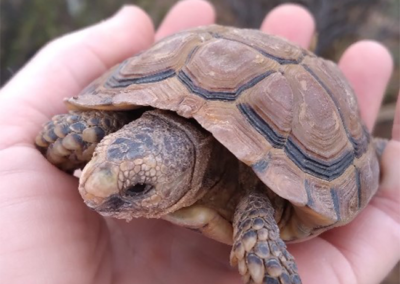
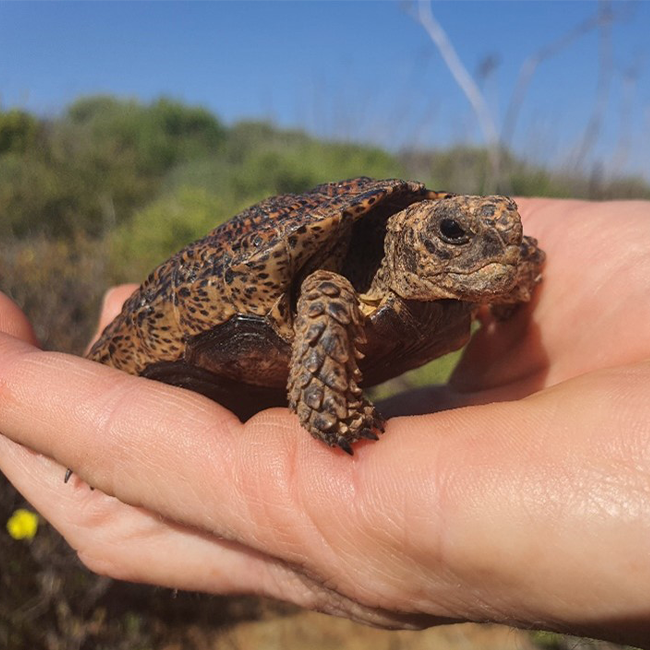
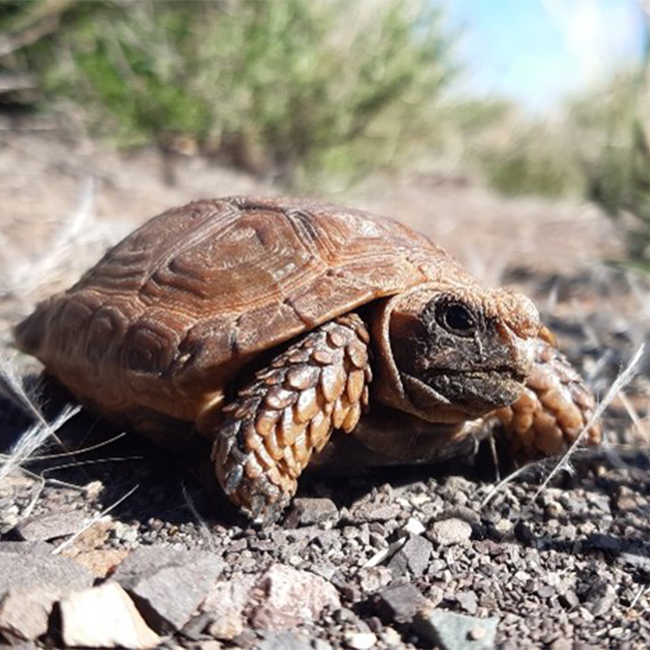
The Karoo is home to nine of the 13 tortoise species found in South Africa. There are five species of dwarf tortoise globally, four of which occur in the South African Karoo and one in Namibia. As their name implies, dwarf tortoises rank amongst the smallest of the tortoise species. In fact, the Speckled Dwarf Tortoise (Chersobius signatus), endemic to Namaqualand, is the world’s smallest tortoise species, reaching a maximum length of about 10cm. Dwarf tortoise conservation champion and researcher Victor Loehr has spent most of his life unravelling the secret life of these diminutive reptiles, contributing much of what is known about them to the scientific world. Up to 20 years ago scientists regularly surveyed tortoise populations and during Victor’s early work on Speckled Dwarf Tortoises, they were abundant. However, follow-up work at his study sites 10 years later and his most recent research on the Karoo Dwarf Tortoise (Chersobius boulengeri) has demonstrated an alarming decline in population numbers for both species.

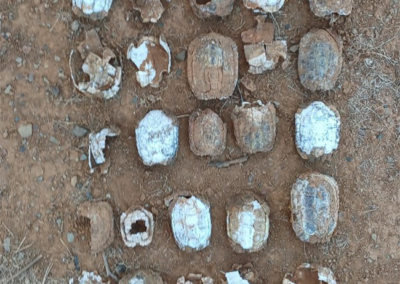
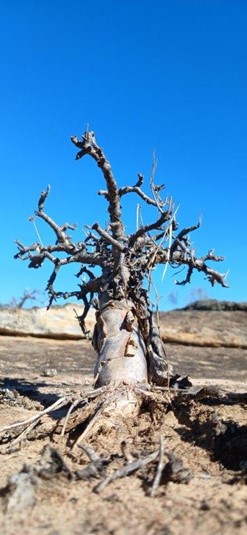
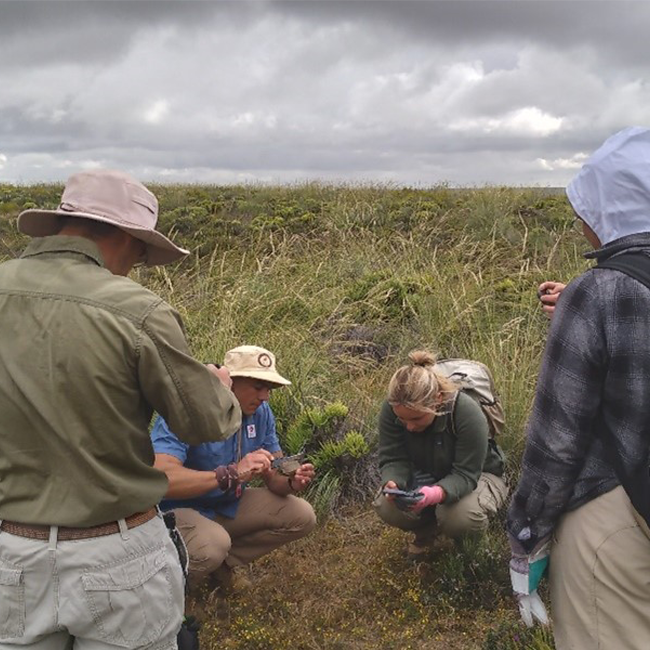
Certainly, the EWT team has struggled to find a single viable population of the Karoo or the Speckled Dwarf Tortoise over the last two years of extensive surveys; these two species are the focus of the initial conservation project. Over 20 surveys have yielded depressingly few live animals; in most cases only shell fragments are to be found. During the most recent survey near Calvinia in April this year, the EWT team recorded the largest number of dead Speckled Dwarf Tortoises at a single location. A total of 45 carcasses were documented under and around a crow’s nest in a dead tree, with another 10 carcasses recorded on the adjacent slope. Five more were recorded elsewhere on the property, bringing the total to 60 dead Speckled Dwarf Tortoises on one property, many of which were mature tortoises. In stark contrast the team found only two live tortoises. It is important to understand that although tortoises occur in some of South Africa’s protected areas, this does not mean we can pack up and go home. If the causes of decline, including hyperpredation by crows, are not clearly understood and addressed, their survival in protected areas is not guaranteed and may have already been compromised.

Currently the only species of tortoise in South Africa with a dedicated conservation project is the Critically Endangered Geometric Tortoise (Psammobates geometricus). We urgently need to implement concerted conservation efforts for the other tortoise species, including all the dwarf tortoise species and other relatively small species such as the tent tortoises. The outlook for all these species is grim without specific conservation interventions. The EWT is collaborating closely with local and international tortoise experts, landowners, and provincial conservation authorities, in a race against time to come up with a strategy to protect South Africa’s remaining dwarf tortoise populations. 20 Years of research in the Mohave Desert, aimed at understanding the raven-tortoise conflict, and to come up with innovative solutions, is helping inform the way forward in South Africa. What is clear though, is that time is running out fast and we cannot afford to be timid in our approach. Tough decisions are going to need to be made when it comes to protecting tortoises from crow predation and any further loss of habitat.

The EWT tortoise conservation work is supported by Turtle Conservancy, Dwarf Tortoise Conservation, Rainforest Trust and the IUCN NL. A special word of thanks to the tortoise survey volunteers, especially the Conservation Biology students from the University of Western Cape and UNISA, and the Ford Wildlife Foundation.

How you can help:

  • Manage grazing responsibly.
  • Include the ecology of sensitive species in your fire management plan.
  • Deter crows; remove unused windmills and telephone poles.
  • Raise electric strands at least 25cm above ground, switch power off during the day and install offset wire for larger tortoise spp.
  • Drive with care, especially when in the veld.
  • Combat wildlife crime by reporting suspicious persons.
  • Verify people claiming to do research with the organization the claim to be from.
  • Support local conservation initiatives.

All tortoises are protected species and listed under the Convention on International Trade in Endangered Species (CITES) as well as provincial legislation, such as the CapeNature Conservation ordinance of 1974 and National Environmental Management: Biodiversity Act 10 of 2004. It is illegal to collect any tortoise species in South Africa, and they may not be kept as pets without a permit.


Tales from the Field: Dropping in on the eastern Riverine Rabbit population

Tales from the Field: Dropping in on the eastern Riverine Rabbit population

Dropping in on the Eastern Riverine Rabbit population

Dr Samantha Mynhardt and Esther Matthew, the EWT’s DRYLANDS CONSERVATION PROGRAMME
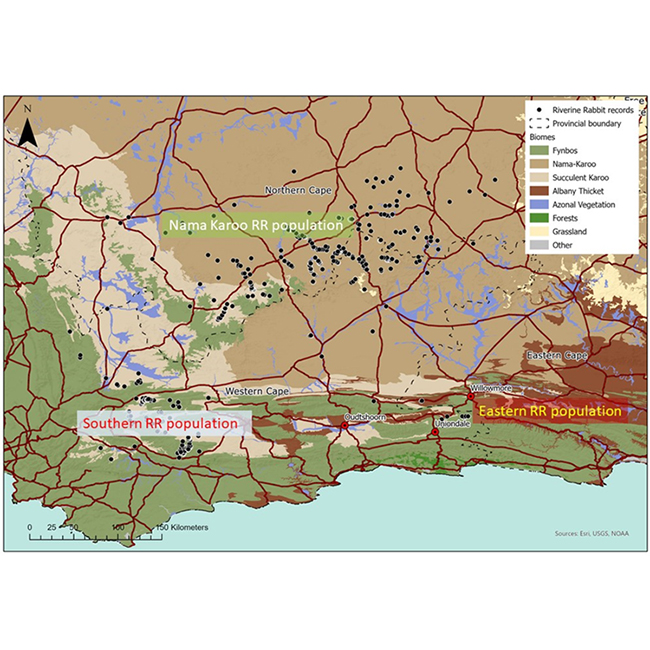
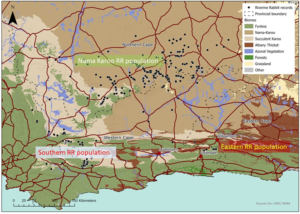
  •  The Critically Endangered Riverine Rabbit is regarded as one of Africa’s most endangered mammals, threatened predominantly by habitat transformation across the Karoo, resulting in a limited geographical distribution and seemingly small population size. The species is known from two populations: one in the Nama Karoo, where it was first discovered near Richmond in 1902, and one near Touwsriver in the Succulent Karoo, where the second population was discovered in 2003 (Figure 1). However, more recently in 2018, yet another, third population of these rabbits was discovered (through the correct identification of a roadkill specimen) just west of the Baviaanskloof, approximately 250 kilometres east of the known distribution. Research on the first two populations has been ongoing, however little to nothing is known about the third, most recently discovered population.
  • The Endangered Wildlife Trust’s Drylands Conservation Programme has been working on Riverine Rabbit conservation for over 20 years and has initiated a concerted effort to better understand this newly discovered population. Our aim is to investigate the geographic distribution of the species and any possible geographic links to the other two populations, and to gather genetic material to investigate genetic connectivity between the populations.


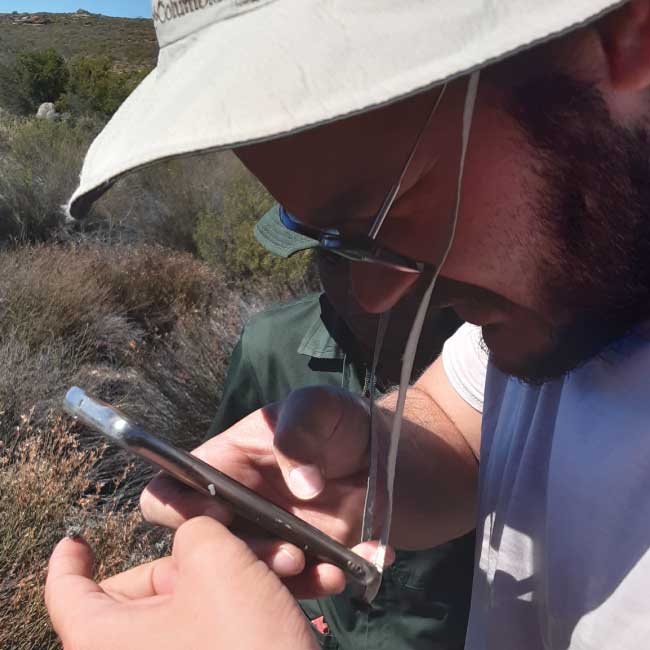
  • Earlier this month, three members of our team embarked on a field trip to collect Riverine Rabbit samples for this purpose. Dr Samantha Mynhardt is sampling rabbit scat (droppings) from all three populations for DNA sequence analysis, in order to map distributions and understand genetic connectivity, while Esther Matthew and her trained scent-detection dog, Delta, are assisting with establishing connections with farmers in the area, accessing properties, and locating (sniffing out) scat in the field. Delta, a two year old Border collie, is being trained to help us distinguish between the scat of different lagomorph species (hares and rabbits) in the field, to help increase efficiency.

Figure 1: Map illustrating the known extent of the three Riverine Rabbit populations occurring in three biomes across two provinces.

The Eastern population is located roughly between Uniondale and Willowmore, west of the Baviaanskloof. The species was described in 1902 from Nama Karoo specimens (northern population). The southern population was discovered in 2003 and the eastern population in 2018.

  • We surveyed four properties where our camera traps have detected Riverine Rabbits over the past couple of years, as well as an additional site, where the team spotted a live rabbit in the road. Rabbit scat was found at all the sites, in varying levels of abundance, and a total of 41 samples was collected from the five properties (eight distinct geographic sites). Samantha will extract DNA from a selected subset of these samples for genetic analysis. The DNA sequences will allow us to identify species, i.e. verify that the droppings are those of Riverine Rabbits, map geographic distributions, and investigate genetic connectivity between these samples and those of the other two populations.


  • Ultimately, the insights we gain from the population genetic analyses of these samples, regarding genetic connectivity of subpopulations, genetic diversity of the population as a whole, and of the subpopulations, and potentially also population size estimation, will help to inform and guide conservation management of the species. Perhaps the genetics will also unlock some of the secrets of the past distribution and origins of the populations.


  • This project is supported by our longest standing funder for Riverine Rabbit conservation work, the Zoological Society for the Conservation of Species and Populations (Zoologische Gesellschaft für Arten- und Populationsschutz – ZGAP). The team’s transport to sites is made possible by Ford Wildlife Foundation.


Documenting all the Biodiversity on Papkuilsfontein

Documenting all the Biodiversity on Papkuilsfontein

Mission (im)possible: Documenting all the Biodiversity on Papkuilsfontein

Bonnie Schumann, the EWT’s Dryland Conservation Programme Senior Field Officer

The Endangered Wildlife Trust recently conducted a comprehensive biodiversity survey on the Papkuilsfontein proposed Protected Environment. Papkuilsfontein is situated near Nieuwoudtville in the Northern Cape in a region known for its rich and unique biodiversity. However, the official list of species recorded on this property contains less than 300 species, and hence our mission was to rectify this and kick-start building a list that would accurately represent the incredible biodiversity found on this property.

Papkuilsfontein, owned by the Van Wyk family, is currently being declared as a formally Protected Environment in collaboration with the EWT and the Department of Agriculture, Environment, Land Reform, and Rural Development (DAERL). Following the survey, the species list now stands at over 1,300 species, and this is just the beginning!

The Bokkeveld Plateau is an area where three biomes meet, the Fynbos, the Succulent Karoo, and the Hantam Karoo. Combined with the variation in altitude, topography, and geology, this creates ideal conditions for the incredible evolution of species and diversity in the region. Nieuwoudtville is world-famous for its bulb plant diversity and density, with over 20,000 bulbs recorded per square meter. Research on the array of invertebrates associated with plant diversity has only started to scratch the surface. So the task of recording all things great and small over approximately 7,000 ha was a formidable one and will take several years to come close to accomplishing!

The EWT enlisted the help of a group of volunteers passionate about conservation to tackle this enormous task. The Custodians of Rare and Endangered Wildflowers, ably led by Ismail Ibrahim and comprising a team of students from the University of Stellenbosch Botanical Gardens, answered the call. Retired small mammal expert, Dr Guy Palmer, was put back to work, while Handré Basson was persuaded to abandon his studies for a few days and join us, bringing his passion for invertebrates and skill at finding them to the team. We were privileged to have had Dr Michael Kuhlmann, a world-renowned expert on solitary bees, join us for two days. Thanks to Dr Kuhlmann’s dedicated work on the plateau over the years, we know that Papkuilsfontein alone has an impressive list of over 100 species of solitary bees. Many of these are not yet described, and new species are still waiting to be discovered!

The EWT supplied the transport, and the Papkuilsfontein hospitality staff kept the team well-fed on some of the best hearty farm-style meals in the Karoo. Teams worked from dawn to dusk, scouring the rugged terrain and photographing and recording as much as possible. A camera trap survey was also conducted for six weeks, and tiny amounts of soil were collected for researchers to examine for environmental DNA later. Observation gathered from all three methodologies will contribute to a comprehensive understanding of the biodiversity present on the property.

The DAERL Stewardship Unit was instrumental in making the survey a success. A member of the unit, and ex-EWT staff member, JP le Roux, set up an iNaturalist project for the study and continues to work hard in the field to make sure the list of species keeps growing. iNaturalist is an online social network platform where people interested in biodiversity can share information. Anyone who sees an interesting plant or animal can photograph and upload the sighting to the platform, and a range of specialists are available to help identify the sighting. By setting up a project on the platform, all sightings made on the property can be collated, and species lists can be exported. The four-day survey provides just a glimpse of what is on the property. By having visitors and landowners take part in recording biodiversity using iNaturalist, we can ensure that a range of wildlife is captured, including plants and invertebrates, some of which may only make their appearance briefly every few years when conditions are just right for them. This makes recording the full spectrum of biodiversity at any location more achievable.

The region is special in terms of biodiversity and natural beauty. The EWT would like to thank all the landowners on the Bokkeveld Plateau who have a long-term vision to protect these features by declaring their properties as protected areas. This requires a high level of dedication at a very personal level in a day and age where talk is often cheap. Remember that Papkuilsfontein is not just an outstanding guest farm but is also a small commercial stock and rooibos tea producer. This conservation initiative is a great example of what can be achieved when the agricultural sector joins with the conservation sector to protect our natural resources at all levels.

The work on Papkuilsfontein was made possible with generous support from the Table Mountain Fund.


 For more information: