

Spiny Mouse
Acomys selousi

2025 Red list status
Least Concern

Regional Population Trend
Stable

Change compared
to 2016
No Change
Overview
Acomys selousi – De Winton, 1896
ANIMALIA – CHORDATA – MAMMALIA – RODENTIA – MURIDAE – Acomys – selousi
Common Names: Spiny Mouse, Southern African Spiny Mouse (English), Stekelmuis (Afrikaans), Zwergstachelmaus (German)
Synonyms: Acomys spinosisismus (Peters 1852); Acomys transvaalensis (Roberts 1926)
Taxonomic Note: Acomys selousi was initially considered as part of A. spinosissimus while others considered it a subspecies of A. cahirinus. The species has recently been shown to comprise a species complex including A. selousi, A. spinosissimu, A. muzei and A. ngurui (Verheyen et al. 2011). According to craniometric analyses by Verheyen et al. (2011), A. selousi from South Africa (also eastern Botswana, southern parts of Zimbabwe and Mozambique) is distinct from A. spinosissimus, which occurs further north (restricted between the Zambezi and Limpopo Rivers). The reinstated A. selousi (synonomys with A. transvaalensis) occurs further to the south with the northern limit just north of the Limpopo River). Monadjem et al. (2015) also described A. selousi separately from A. spinosisimus. More recently, a study investigating multiple radiations of Spiny Mice indicated that genetic data from the southern part of the distribution indicated that the taxonomy and distribution of A. selousi and A. spinosissimus should be further explored (Aghová et al. 2019).
Red List Status: LC – Least Concern
Assessment Information
Assessors: Russo, I.M.1 & da Silva, J.M.2
Reviewer: Patel, T.3& Kraai, M.4
Institutions:1Cardiff University, 2South African National Biodiversity Institute,3Endangered Wildlife Trust,4Sol Plaatje University, South Africa
Previous Assessor: MacFadyen, D.
Previous Reviewer: Medger, K.
Previous Contributors: Avenant, N., Avery, M., Baxter, R., Monadjem, A., Palmer, G., Taylor, P. & Wilson, B.
Assessment Rationale
This species is listed as Least Concern because of its wide distribution within the assessment region and its presence in major protected areas, including Kruger National Park and several private conservation areas. There are currently no major identified threats that could cause overall population decline. It inhabits rocky areas which are less likely to be transformed.
Regional population effects: Dispersal is possible across regions when rocky areas are connected by suitable habitat corridors. For example, Spiny Mice have been recorded in a grassland saddle between sandstone outcrops (D. MacFadyen pers. obs.). However, as they are predominantly restricted to rocky habitats, and are not as numerous as other species (such as Micaelamys namaquensis), they may be relatively poor dispersers.
Red List Index
Red List Index: No change
Recommended Citation: Russo IM & da Silva JM. 2025. A conservation assessment of Acomys selousi. In Patel T, Smith C, Roxburgh L, da Silva JM & Raimondo D, editors. The Red List of Mammals of South Africa, Eswatini and Lesotho. South African National Biodiversity Institute and Endangered Wildlife Trust, South Africa.
Regional Distribution and occurrence
Geographic Range
Within the southern African sub-region, the species occurs widely across Zimbabwe and south of the Zambezi River in Mozambique, and marginally in eastern Botswana (Skinner & Chimimba 2005). Within the assessment region, it occurs throughout the Limpopo Province, and north-western parts of the North West Province, and into parts of the Gauteng and Mpumalanga Provinces. It is widespread but limited to areas with suitable rocky habitat and is not as uniformly spread as other rupicolous small mammal species. In the North West Province, it was captured in Pilanesberg National Park, Madikwe Game Reserve in the north (but not at Borakalalo), for the first time in the Enzelsberg and in the norite koppies at Bospoort Dam (Power 2014). It was not captured further south (for example, in the Magaliesberg), and thus, based on high sampling effort, it probably does not occur there. In the Gauteng and Mpumalanga Provinces, this species was readily recorded in the red sandstone areas of Ezemvelo Nature Reserve (Gauteng) and Telperion (Mpumalanga; MacFadyen 2014).
Elevation / Depth / Depth Zones
Elevation Lower Limit (in metres above sea level): (Not specified)
Elevation Upper Limit (in metres above sea level): 1800
Depth Lower Limit (in metres below sea level): (Not specified)
Depth Upper Limit (in metres below sea level): (Not specified)
Depth Zone: (Not specified)
Map
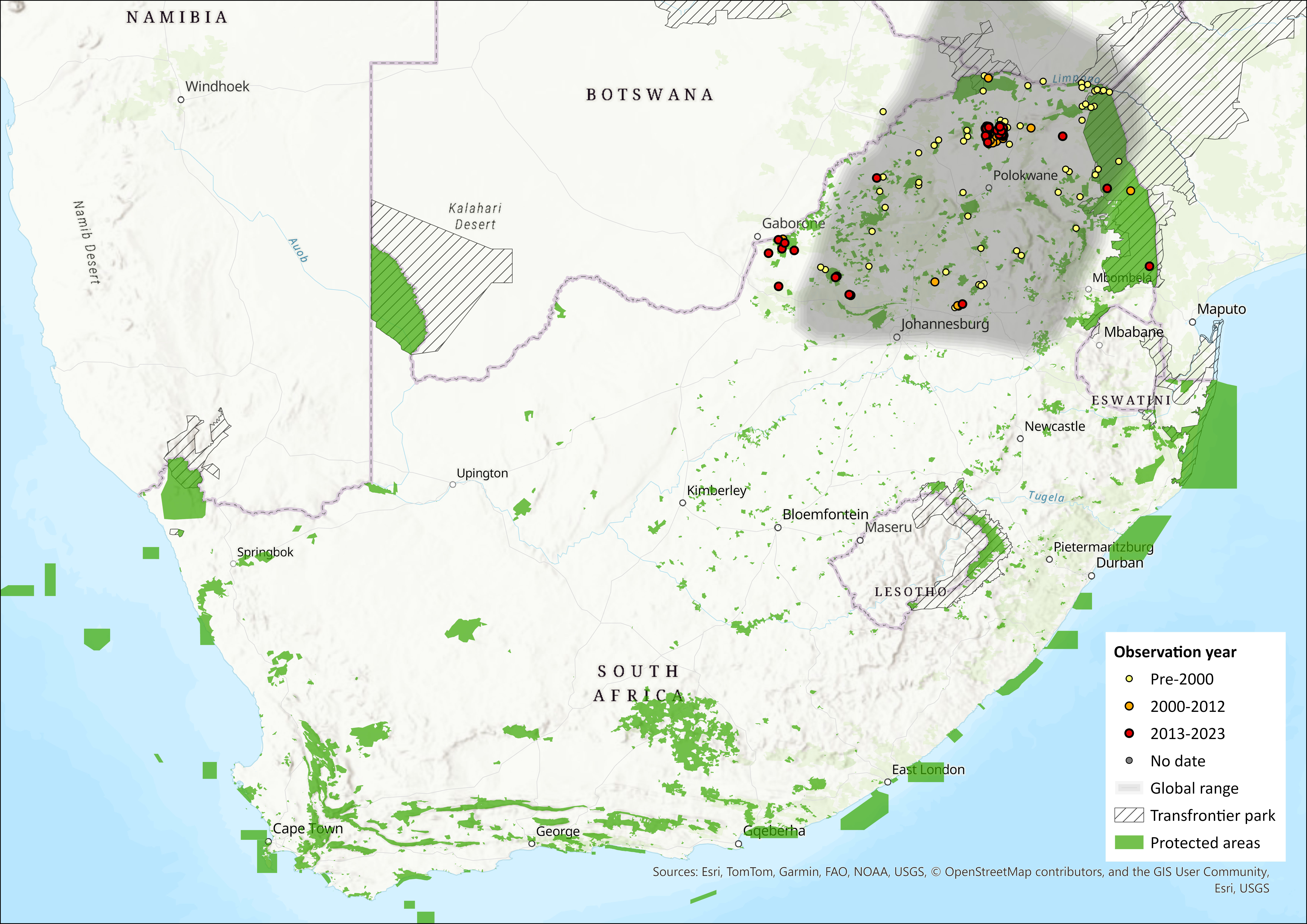
Figure 1. Distribution records for Spiny Mouse (Acomys selousi) within the assessment region (South Africa, Eswatini and Lesotho). Note that distribution data is obtained from multiple sources and records have not all been individually verified.
Biogeographic Realms
Biogeographic Realm: Afrotropical
Occurrence
Countries of Occurrence
| Country | Presence | Origin | Formerly Bred | Seasonality |
| Botswana | Extant | Native | – | – |
| Congo, The Democratic Republic of the | Extant | Native | – | – |
| Malawi | Extant | Native | – | – |
| Mozambique | Extant | Native | – | – |
| South Africa | Extant | Native | – | – |
| Tanzania, United Republic of | Extant | Native | – | – |
| Zambia | Extant | Native | – | – |
| Zimbabwe | Extant | Native | – | – |
Large Marine Ecosystems (LME) Occurrence
Large Marine Ecosystems: (Not specified)
FAO Area Occurrence
FAO Marine Areas: (Not specified)
Climate change
This species occurs in the Gauteng, North West, Limpopo, and Mpumalanga Provinces, South Africa. There is a possibility that it might be affected by the 1.5-4°C increase in temperature predicted under various climate change scenarios (Engelbrecht et al. 2024). Rainfall is predicted to decrease in its range. These decreases will result in a more arid and drought-prone habitat which could affect food availability for the species.
Population Information
This species is common but seldom seen unless actively trapped in the right habitat and is not suspected to be declining, although its rocky habitat is naturally fragmented. At Telperion Nature Reserve in Mpumalanga, the mean minimum density of the species was 5 individuals/ha and total subpopulation size was thus estimated at 9,840 individuals (MacFadyen 2014). The species is usually solitary, in pairs or small family groups, so is never recorded in large numbers. Population numbers also tend to fluctuate seasonally, becoming more abundant in autumn (MacFadyen 2014).
Population Information
Current population trend: Stable
Continuing decline in mature individuals? Unknown
Number of mature individuals in population: Unknown
Number of mature individuals in largest subpopulation: Unknown
Number of Subpopulations: Unknown
Severely fragmented: Naturally fragmented
Extreme fluctuations in the number of subpopulations: (Not specified)
Continuing decline in number of subpopulations: (Not specified)
All individuals in one subpopulation: (Not specified)
Quantitative Analysis
Probability of extinction in the wild within 3 generations or 10 years, whichever is longer, maximum 100 years: (Not specified)
Probability of extinction in the wild within 5 generations or 20 years, whichever is longer, maximum 100 years: (Not specified)
Probability of extinction in the wild within 100 years: (Not specified)
Population Genetics
While a phylogenetic study has been undertaken incorporating A. selousi from the assessment region (Aghova et al. 2019), no population genetic study has been undertaken. Given that dispersal is possible across regions when rocky areas are connected by suitable habitat corridors, it is possible the species exists as a metapopulation within the region. However, their dispersal capabilities are poorly known; hence it is possible that distinct genetic subpopulations exist. Based on the metapopulation scenario, the Convention on Biological Diversity’s complementary genetic indicator – proportion of populations maintained (PM) – would receive a value of 1.0 (1/1 population remains). Even if more genetic subpopulations are identified, no extirpations are known, hence the indicator value would not change.
Given the estimated population size from one locality is close to 10,000 individuals (MacFadyen 2014), it is highly likely that the overall metapopulation exceeds this. Applying an Ne/Nc conversion ratio of 0.1-0.3, the effective population size for the population can be estimated at over 1000-3000 individuals. This exceeds the Ne 500 threshold typically representing a healthy and stable population. Hence, the GBF’s headline indicator – proportion of species/populations with an effective population size (Ne) greater than 50o – would receive a value of 1.o (1/1 populations with Ne > 500). It is highly recommended that a population genetic study be undertaken to better understand the population genetic structure and diversity within the species to more accurately quantify the estimated indicator values.
Habitats and ecology
The species is largely associated with rocky terrain and usually found living under and among boulders in rocky habitat, favouring sheltered overhanging rocks and exfoliated pieces of rock, occasionally using holes in termite mounds or tree roots (Skinner & Chimimba 2005). It is sometimes recorded in areas with scattered rocks and scree fields. In the Gauteng and Mpumalanga Provinces, they have been regularly recorded in grassy saddles between rocky areas (MacFadyen 2014). It is not known if the species can persist in disturbed or modified habitats.
Spiny Mice are largely nocturnal and terrestrial in habits (Hoole et al. 2012; MacFadyen 2014), although they may show some crepuscular activity, especially on overcast days. It reproduces seasonally during the South African spring and summer months (Medger et al. 2010, 2012; MacFadyen 2014), and has a litter size of two to four. Its diet consists predominantly of grass seeds and the seeds of other herbaceous plants, although they have been recorded to feed on termites and other insects, including millipedes, spiders and small snails (Vesey-Fitzgerald 1966).
The colloquial name for A. selousi refers to the spiny pelage, which is not soft as in other species of murids but has a prickly appearance. The tail of the Spiny Mouse is sparsely bristled and darker above than below. Its skin is very thin and tears easily. Additionally, the skin around the tail is easily lost resulting in the loss of that part or the entire tail. Both are predator defence strategies, which confuse the attacker and enable the mouse to escape. Although the skin on the body grows back (Seifert et al. 2012), the tail is permanently lost. Individuals without tails are found frequently, which suggests that tail loss is not detrimental to their survival. Care needs to be taken when handling individuals.
Ecosystem and cultural services: Similar to other small mammals, this species probably plays a role in regulating invertebrate numbers (and thus pest outbreaks), being an important forage species for predators (including felids, jackals, mongooses, genets, snakes and owls) in rocky areas, and breaking down vegetation for nest materials.
IUCN Habitats Classification Scheme
| Habitat | Season | Suitability | Major Importance? |
| 2.2. Savanna -> Savanna – Moist | – | Suitable | – |
| 6. Rocky areas (e.g. inland cliffs, mountain peaks) | – | Suitable | – |
Life History
Generation Length: (Not specified)
Age at maturity: female or unspecified: (Not specified)
Age at Maturity: Male: (Not specified)
Size at Maturity (in cms): Female: (Not specified)
Size at Maturity (in cms): Male: (Not specified)
Longevity: (Not specified)
Average Reproductive Age: (Not specified)
Maximum Size (in cms): (Not specified)
Size at Birth (in cms): (Not specified)
Gestation Time: (Not specified)
Reproductive Periodicity: (Not specified)
Average Annual Fecundity or Litter Size: (Not specified)
Natural Mortality: (Not specified)
Does the species lay eggs? (Not specified)
Does the species give birth to live young: (Not specified)
Does the species exhibit parthenogenesis: (Not specified)
Does the species have a free-living larval stage? (Not specified)
Does the species require water for breeding? (Not specified)
Movement Patterns
Movement Patterns: (Not specified)
Congregatory: (Not specified)
Systems
System: Terrestrial
General Use and Trade Information
This species is utilised for ecological research purposes and museum records in small numbers. It is not traded or utilised otherwise.
Local Livelihood: (Not specified)
National Commercial Value: (Not specified)
International Commercial Value: (Not specified)
End Use: (Not specified)
Is there harvest from captive/cultivated sources of this species? (Not specified)
Harvest Trend Comments: (Not specified)
Threats
There are no major threats to this species as it occupies largely inaccessible rocky areas that are unsuitable for agriculture, livestock production and forestry. However, mining for gravel and rock (specifically granite) could lead to localised habitat loss and subpopulation decline.
Habitat trend: The mining sector is suspected to be expanding rapidly in Limpopo, Mpumalanga and North West Provinces (NW READ 2014; Desmet & Schaller 2015), but the extent of impacts from this sector isy poorly known (V. Egan pers. comm. 2015; Lötter 2015).
Conservation
The Spiny Mouse occurs in many protected areas across its range in South Africa, including Kruger National Park and several provincial and private protected areas for example, Ezemvelo Nature Reserve (Gauteng Province), Telperion Nature Reserve (Mpumalanga Province), Mapungubwe National Park, De Beers Venetia Limpopo Nature Reserve, Blouberg Nature Reserve and Musina Nature Reserve (Limpopo Province). Large numbers are found in the Soutpansberg region. The Soutpansberg and the Blouberg ranges are separated from other suitable habitats and thus may contain genetically distinct subpopulations. Another key site may include the Waterberg region. Protected area expansion should thus prioritise the Soutpansberg and Waterberg regions, as they encompass large areas with suitable habitat and potentially distinct subpopulations.
No specific interventions are currently necessary. However, legislation regarding the protection of habitat from mining rock (especially granite) and mitigating rock crushing in Limpopo, Mpumalanga and North West Provinces would benefit this species.
Recommendations for land managers and practitioners:
- No specific management plan is necessary.
Research priorities:
- Taxonomic resolution: the taxonomy and distribution of A. selousi and A. spinosissimus should be further explored, potentially using a molecular method.
- Assessment of species abundance and habitat preference in all provinces.
Encouraged citizen actions:
- Report sightings on virtual museum platforms (for example, iNaturalist and MammalMAP). This species is distinctive and easily identifiable as it looks like a small hedgehog.
- Become more aware of habitat destruction and protest mining applications in sensitive areas.
- Avoid using harmful chemicals and insecticides.
- For people who live near rocky areas, specifically koppies, build rock gardens with lots of crevices to create suitable habitat patches.
- Learn about the importance of small mammals in a healthy, balanced environment.
Bibliography
Aghová, T., Palupčíková, K., Šumbera, R., Frynta, D., Lavrenchenko, L.A., Meheretu, Y., Sádlová, J., Votýpka, J., Mbau, J.S., Modrý, D. and Bryja, J. 2019. Multiple radiations of spiny mice (Rodentia: Acomys) in dry open habitats of Afro-Arabia: evidence from a multi-locus phylogeny. BMC Evolutionary Biology, 19, pp.1-22.
Desmet PG, Schaller R. 2015. North West Biodiversity Sector Plan Technical Report. North West Department of Rural, Environment and Agricultural Development, Mahikeng, South Africa.
Hoole C, Oosthuizen MK, Chimimba CT, Bennett NC. 2012. The locomotory activity rhythm of the spiny mouse, Acomys spinosissimus from southern Africa: light entrainment and endogenous circadian rhythms. Journal of Zoology 288: 93-102.
Lötter, M.C. 2015. Technical Report for the Mpumalanga Biodiversity Sector Plan – MBSP. Mpumalanga Tourism & Parks Agency, Mbombela.
MacFadyen DN. 2014. The dynamics of small mammal populations in Rocky Highveld Grassland, Telperion, South Africa. Ph.D. Thesis. University of Pretoria, Pretoria, South Africa.
Medger, K., Chimimba, C.T. and Bennett, N.C. 2010. Seasonal reproduction in the female spiny mouse from South Africa. Journal of Zoology 282: 163-170.
Medger, K., Chimimba, C.T. and Bennett, N.C. 2012. Seasonal changes in reproductive development in male spiny mice (Acomys spinosissimus) from South Africa. Mammalian Biology-Zeitschrift für Säugetierkunde 77: 153-159.
Monadjem, A., Taylor, P.J., Denys, C. and Cotterill, F.P.D. 2015. Rodents of sub-Saharan Africa: a biogeographic and taxonomic synthesis. De Gruyter, Berlin, Germany.
NW READ. 2014. North West Environment Outlook Report 2013. North West Provincial Government, Mahikeng, South Africa.
Power, R.J. 2014. The distribution and status of mammals in the North West Province. Department of Economic Development, Environment, Conservation & Tourism, North West Provincial Government, Mahikeng.
Seifert AW, Kiama SG, Seifert MG, Goheen JR, Palmer TM, Maden M. 2012. Skin shedding and tissue regeneration in African spiny mice (Acomys). Nature 489: 561-565.
Skinner, J.D. and Chimimba, C.T. (eds). 2005. The Mammals of the Southern African Subregion. Cambridge University Press, United Kingdom, Cambridge.
Verheyen W, Hulselmans J, Wendelen W, Leirs H, Corti M. 2011. Contribution to the systematics and zoogeography of the East-African Acomys. Zootaxa 3059: 1-35.
Vesey-Fitzgerald DF. 1966. The habits and habitats of small rodents in the Congo River catchment region of Zambia and Tanzania. Zoologica Africana 2: 111-122.