

Shortridge’s Rat
Thallomys shortridgei

2025 Red list status
Endangered

Regional Population Trend
Unknown

Change compared
to 2016
New Assessment
Overview
Thallomys shortridgei – Thomas & Hinton, 1923
ANIMALIA – CHORDATA – MAMMALIA – RODENTIA – MURIDAE – Thallomys – shortridgei
Common Names: Shortridge’s Rat, Shortridge’s Acacia Rat, Shortridge’s Thallomys (English)
Synonyms: No Synonyms
Taxonomic Note: The taxonomic status of this poorly known species requires further molecular examination and morphometric analysis of specimens (Monadjem et al. 2015). It has previously been included within Thallomys paedulcus and T. nigricauda (Ellerman et al. 1953). While it is currently recognised as a distinct species (Bronner et al. 2003, Musser and Carleton 2005, Skinner and Chimimba 2005), its relationship with other species of this genus has not been fully resolved (Monadjem et al. 2015). It can be distinguished from T. nigricauda by its smaller bullae and indistinct black facial mask (Monadjem et al. 2015).
Red List Status: EN – Endangered
Assessment Information
Assessor: Taylor, P.1
Reviewer: Kennerley, R.2
Contributor: Patel, T.3
Institutions:1 University of the Free State,2IUCN SSC Small Mammal Specialist Group,3Endangered Wildlife Trust
Previous Assessors: Taylor, P. & Relton, C.
Previous Reviewer: Child, M.F.
Previous Contributors: Avenant, N., Avery, M., Baxter, R., MacFadyen, D., Monadjem, A., Wilson, B., Palmer, G. & Boitani, L.
Assessment Rationale
Thallomys shortridgei is listed as Endangered under the B criterion as its extent of occurrence is estimated to be <5,000 km2. Despite recent field surveys, there are no current occurrence data, which may be a cause for concern. It is recommended that further field surveys are conducted to verify the continued existence, geographical extent and validity of the species.
Red List Index
Red List Index: New Assessment
Recommended Citation: Taylor P. 2025. A conservation assessment of Thallomys shortridgei. In Patel T, Smith C, Roxburgh L, da Silva JM & Raimondo D, editors. The Red List of Mammals of South Africa, Eswatini and Lesotho. South African National Biodiversity Institute and Endangered Wildlife Trust, South Africa.
Regional Distribution and occurrence
Geographic Range
Shortridge’s Rat has only been recorded in South Africa (Nel 2013), where it has been collected from the south bank of the Orange (Gariep) River in the Northern Cape. Its current recognised range extends from Upington westwards to Goodhouse (Skinner and Chimimba 2005, Nel 2013), but it has only been identified from a few dispersed localities (Monadjem et al. 2015). Although a degree of uncertainty remains, Thallomys shortridgei and T. nigricauda are considered by some to be allopatric, with distributions divided by the Orange River (Monadjem et al. 2015). The estimated extent of occurrence using a minimum convex polygon based on existing records is 2,872 km2. An analysis of landcover change in a 2 km buffer along the Orange River in South Africa reveals a minimum of an 6.5% decline in natural habitat in the period 2014 to 2022 (calculated from landcover change data shared by Andrew Skowno, SANBI). This is likely an underestimate of the extent of transformation of the species’ preferred habitat, as the buffer includes areas unsuitable for this species, which are also less suitable for agriculture, and a more in-depth analysis is recommended. The habitat is also highly fragmented by agriculture, in particular by commercial vineyards.
Elevation / Depth / Depth Zones
Elevation Lower Limit (in metres above sea level): (Not specified)
Elevation Upper Limit (in metres above sea level): (Not specified)
Depth Lower Limit (in metres below sea level): (Not specified)
Depth Upper Limit (in metres below sea level): (Not specified)
Depth Zone: (Not specified)
Map
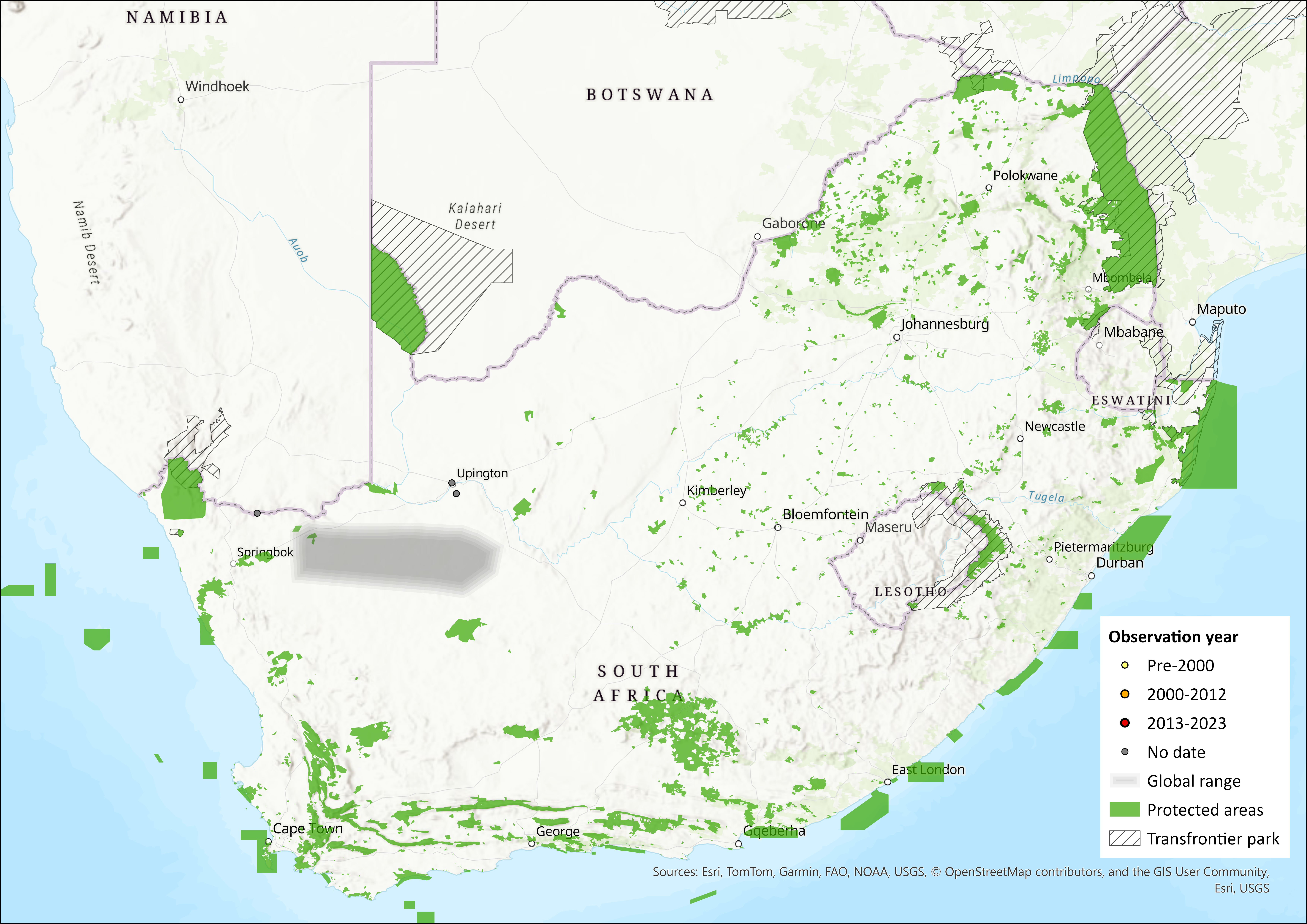
Figure 1. Distribution records for Shortridge’s Rat (Thallomys shortridgei) within the assessment region (South Africa, Eswatini and Lesotho). Note that distribution data is obtained from multiple sources and records have not all been individually verified.
Biogeographic Realms
Biogeographic Realm: Afrotropical
Occurrence
Countries of Occurrence
| Country | Presence | Origin | Formerly Bred | Seasonality |
| South Africa | Extant | Native | – | Resident |
| South Africa -> Northern Cape Province | Extant | Native | – | Resident |
Large Marine Ecosystems (LME) Occurrence
Large Marine Ecosystems: (Not specified)
FAO Area Occurrence
FAO Marine Areas: (Not specified)
Climate change
There is no information available on how climate change impacts this species.
Population information
The population abundance of this species is unknown (Nel 2013). Despite intensive trapping effort in and around its identified localities, no specimens have been collected since 1922 (N. Coetzee and P. Taylor unpublished data).
Population Information
Current population trend: Unknown
Continuing decline in mature individuals: Unknown
Number of mature individuals in population: Unknown
Number of mature individuals in largest subpopulation: Unknown
Number of subpopulations: Unknown
Severely fragmented: Yes
Quantitative Analysis
Probability of extinction in the wild within 3 generations or 10 years, whichever is longer, maximum 100 years: (Not specified)
Probability of extinction in the wild within 5 generations or 20 years, whichever is longer, maximum 100 years: (Not specified)
Probability of extinction in the wild within 100 years: (Not specified)
Population genetics
No population genetic study has been conducted of this species although such a study has been conducted in the related T. nigricauda (Meyer et al. 2009). While there is limited information on this species, its fairly small distribution could likely represent a single genetic population.
Given the difficulty in capturing specimens, terrestrial environmental DNA studies may prove beneficial in uncovering additional information on the distribution/range of the species.
Habitats and ecology
The ecology and life history of this species has not been established. However, like other species of the Thallomys genus, this species is expected to be arboreal, associated with Acacia (or Vachellia/Senegalia) trees and similar species. Nel (2013) describes the habitat as Acacia thornveld and scrub. Thallomys species build nests in woodland tree hollows and forks (Skinner and Chimimba 2005), generally requiring older wooded trees rather than shrubs. Thallomys species are also known to consume the fine young leaves, twigs and green outer coatings of seedpods from these thorn trees (Skinner and Chimimba 2005), and are considered predominantly vegetarian, although de Graaf (1981) did include insects in the diet of T. nigricauda.
Ecosystem and cultural services: No specific ecosystem or cultural services have been identified for this species.
IUCN Habitats Classification Scheme
|
Habitat |
Season |
Suitability |
Major Importance? |
|
2.1. Savanna -> Savanna – Dry |
– |
Unknown |
– |
Life History
Generation Length: (Not specified)
Age at maturity: female or unspecified: (Not specified)
Age at Maturity: Male: (Not specified)
Size at Maturity (in cms): Female: (Not specified)
Size at Maturity (in cms): Male: (Not specified)
Longevity: (Not specified)
Average Reproductive Age: (Not specified)
Maximum Size (in cms): (Not specified)
Size at Birth (in cms): (Not specified)
Gestation Time: (Not specified)
Reproductive Periodicity: (Not specified)
Average Annual Fecundity or Litter Size: (Not specified)
Natural Mortality: (Not specified)
Does the species lay eggs? (Not specified)
Does the species give birth to live young: (Not specified)
Does the species exhibit parthenogenesis: (Not specified)
Does the species have a free-living larval stage? (Not specified)
Does the species require water for breeding? (Not specified)
Movement Patterns
Movement Patterns: (Not specified)
Congregatory: (Not specified)
Systems
System: Terrestrial
General Use and Trade Information
This species is not known to be traded or utilised in any form.
Local Livelihood: (Not specified)
National Commercial Value: (Not specified)
International Commercial Value: (Not specified)
End Use: (Not specified)
Is there harvest from captive/cultivated sources of this species? (Not specified)
Harvest Trend Comments: (Not specified)
Threats
Generally, no threats have been identified for this species. They are, however, limited to woodland areas, and thus continued illegal harvesting of tall trees for firewood or charcoal may be causing a decline in habitat quality and quantity. However, the areas in which this species occurs may suffer less woodland loss than more densely populated parts of the country. Additionally, drought and alterations in the rainfall regime due to climate change, threatens to alter the community structure of vegetation by favouring short-lived species over perennial plants (Milton et al. 1995), which again may threaten the habitat availability of this arboreal species.
Current habitat trend: Declining along the Orange River in South Africa.
Conservation
No specific conservation interventions have been established for Thallomys shortridgei, and their presence within protected areas is unknown. Further field studies to locate additional populations are required both within its documented range, as well as within potential regions exhibiting a suitable habitat type outside of its recorded range. Additionally, research into the ecology, life history traits, current threats and population dynamics are necessary in order to determine relevant and effective conservation initiatives.
Recommendations for land managers and practitioners:
Systematic surveys needed to locate populations and gather information on population size, trend and distribution.
Research priorities
- Field surveys to determine the basic distribution and population dynamics of this species.
- A dedicated survey involving searches for these arboreal rodents in riverine woodland at the three sites where Shortridge collected them on the Orange River would be an urgent priority.
- Taxonomic resolution and investigation into the basic relationships between species of this genus.
- A proper taxonomic examination of the skin colour and skull morphology of the 13 specimens in the Amathole Museum, as well as the four type specimens in the Natural History Museum.
- Molecular analysis of skull or skin scrapings from some of the museum specimens would be important to verify the taxonomic validity of this species.
Encouraged citizen actions:
- Report sightings on virtual museum platforms (for example, iNaturalist and MammalMAP), especially outside protected areas.
- Landowners can preserve Acacia (now Vachellia) trees, both living and dead.
Bibliography
Bronner, G.N., Hoffman, M., Taylor, P.J., Chimimba, C.T., Best, P.B., Matthee, C.A. and Robinson, T.J. 2003. A revised systematic checklist of the extant mammals of the southern African subregion. Durban Museum Novitates 28: 56-106.
de Graaff, G. 1981. The Rodents of Southern Africa: Notes on their Identification, Distribution, Ecology, and Taxonomy. Butterworths, Durban, Pretoria, South Africa.
Ellerman, J.R., Morrison-Scott, T.C.S. and Hayman, R.W. 1953. Southern African Mammals 1758-1951: A reclassification. Trustees of the British Museum (Nat. Hist.), London, UK.
IUCN. 2019. The IUCN Red List of Threatened Species. Version 2019-1. Available at: www.iucnredlist.org. (Accessed: 21 March 2019).
Milton, S.J., Dean, W.R.J, Marincowitz, C.P. and Kerley, G.I.H. 1995. Effects of the 1990/91 drought on rangeland in the Steytlerville Karoo. South African Journal of Science 91: 78–84.
Monadjem, A., Taylor, P.J., Denys, C. and Cotterill, F.P.D. 2015. Rodents of sub-Saharan Africa: a biogeographic and taxonomic synthesis. De Gruyter, Berlin, Germany.
Musser, G.G. and Carleton, M.D. 2005. Superfamily Muroidea. In: D.E. Wilson and D.A. Reeder (eds), Mammal Species of the World: a geographic and taxonomic reference, pp. 894-1531. The John Hopkins University Press, Baltimore, USA.
Nel, J.A.J. 2013. Thallomys shortridgei Shortridge’s Acacia Rat (Shortridge’s Thallomys). In: D.C.D. Happold (ed.), Mammals of Africa. Volume III: Rodents, Hares and Rabbits, pp. 562–563. Bloomsbury Publishing, London.
Skinner, J.D. and Chimimba, C.T. (eds). 2005. The Mammals of the Southern African Subregion. Cambridge University Press, United Kingdom, Cambridge.
Taylor, P. J., Rautenbach, I. L., Gordon, D., Sink, K. and Lotter, P. 1995. Diagnostic morphometrics and southern African distribution of two sibling species of tree rat, Thallomys paedulcus and Thallomys nigricauda (Rodentia: Muridae). Durban Museum Novitates 20: 49-62.
Thomas, O. and Hinton, M.A.C. 1923. On mammals collected by Captain Shortridge during the Percy Sladen and Kaffrarian Museum Expeditions to the Orange River. Proceedings of the General Meetings for Scientific Business of the Zoological Society of London 1923: 483-499.