
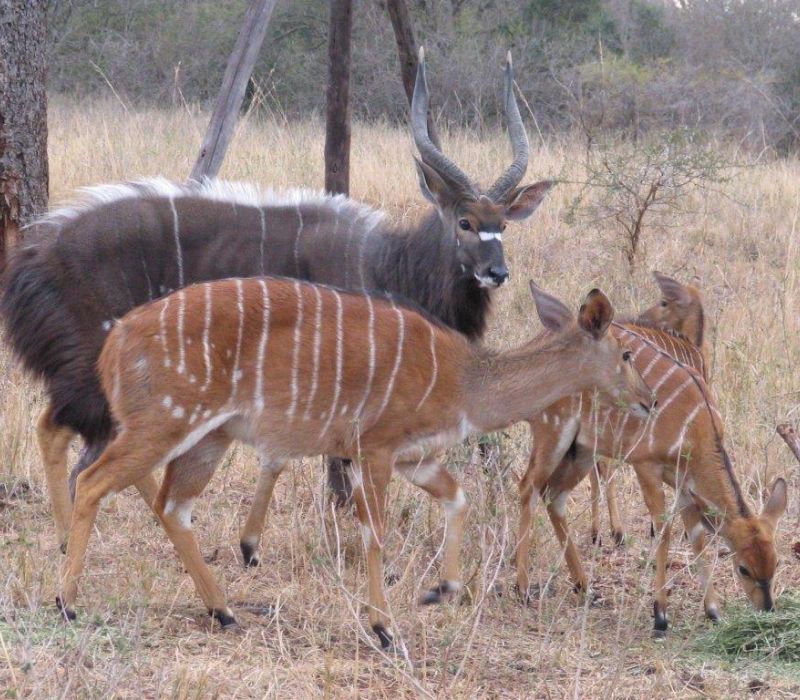
Nyala
Tragelaphus angasii

2025 Red list status
Least Concern

Regional Population Trend
Stable

change compared
to 2016
No Change
Overview
ANIMALIA – CHORDATA – MAMMALIA – ARTIODACTYLA – BOVIDAE – Tragelaphus – angasii
Common Names: Nyala (English, Sepedi, Venda), Njala (Afrikaans), iNyala (Ndebele, Swati, Xhosa, Zulu), Tsama (Setswana), Litagayezi (Swati), Imbala-intendi, Nyale (Tsonga), iNyala inxala (Zulu)
Synonyms: No Synonyms
Taxonomic Note:
No subspecies are recognised.
Red List Status: LC – Least Concern
Assessment Information
Assessors: Smith, C.1 & da Silva, J.M.2
Reviewers: Mallon D.3 & Anderson, J.3,4
Institutions: 1Endangered Wildlife Trust, 2South African National Biodiversity Institute, 3IUCN SSC Antelope Specialist Group, 4International Conservation Services
Previous Assessors: Silke, P. & Anderson, J.
Previous Reviewer: Child, M.F.
Previous Contributor: Relton, C.
Assessment Rationale
Although Nyala populations declined substantially in the past, the most recent rough abundance estimate (2013/14 counts) within South Africa was 40,398 animals, and there are estimated to be another 1,000 in Eswatini. The mature population that exists broadly within the natural range was estimated to be 16,217–22,114 animals (assuming a 55–75% mature population structure) but needs further fine-scale analysis and verification. The population is suspected to have remained stable since then. Approximately 49% of the population occurs on private land in South Africa and their numbers are increasing due to it being a popular trophy-hunting and ecotourism species. However, many private subpopulations are intensively managed and may not be eligible for inclusion in the Red List. Including only formally protected areas within the natural distribution range yields a minimum mature population size of 11,213–15,291 animals, even though some privately held animals may be eligible for inclusion. There are no major threats to the species and subpopulations are considered to be stable or increasing, so the species is listed as Least Concern. Provided that effective management and protection is upheld, it is likely that Nyala numbers will continue to increase on private lands. It should continue to be sustainably utilised so that private landowners are incentivised to reintroduce this species into areas of its natural range. No immediate conservation interventions are necessary, but it can cause habitat degradation and lead to Bushbuck (Tragelaphus sylvaticus) declines in areas outside of its natural range, and thus regulations to prevent further introduction and naturalised subpopulations should be maintained.
Regional population effects: There is suspected to be dispersal along the northern border of South Africa between Botswana, Zimbabwe and Mozambique, through the Mapungubwe and Greater Limpopo Transfrontier areas and northeast KwaZulu-Natal. In Mozambique they are widespread south of the Zambezi with 50% in protected areas or hunting managed hunting reserves (coutadas).
Reasons for Change
Reason(s) for Change in Red List Category from the Previous Assessment: No change
Red List Index
Red List Index: No change
Recommended citation: Smith C & da Silva JM. 2025. A conservation assessment of Tragelaphus angasii. In Patel T, Smith C, Roxburgh L, da Silva JM & Raimondo D, editors. The Red List of Mammals of South Africa, Eswatini and Lesotho. South African National Biodiversity Institute and Endangered Wildlife Trust, South Africa.
Regional Distribution and occurrence
Nyala occur in subtropical/tropical areas with thickets or forests with a discontinuous natural distribution in southern Malawi (Lower Shire Valley), northern (Zambezi valley and Mana Pools National Park) and southern Zimbabwe, central and southern Mozambique, Eswatini and South Africa (including areas of the Limpopo, Mpumalanga and KwaZulu-Natal provinces). The populations in protected areas in Mozambique continue to increase, particularly in Gorongosa National Park and the Zambezi delta Coutadas or Hunting blocks. Nyala from Lengwe have been used to establish a viable population on Sucoma Estate in Malawi. Although the native population of Nyala went extinct in Eswatini by the 1950s, they have been reintroduced successfully onto reserves in the middleveld and lowveld (Skinner & Chimimba 2005). They were historically thought to have occurred as far south as the Hluhluwe River (Anderson 2013) and as far west as Ellisras in Limpopo (Rautenbach 1982). There is little record of the distribution of Nyala prior to the Rinderpest epizootic in 1890s and as the Tragelaphini were particularly hard hit, it can be speculated that their natural distribution could have been wider than early records show. Nyala are impacted by cold wet conditions (Anderson 1985) and all early records of their distribution showed that they were only found in hot, low-altitude habitats below the 18° isotherm (Anderson 1976).
Since the early 1960s, animals have been translocated from game reserves in KwaZulu-Natal to other protected areas and ranches both within and significantly outside its natural range within South Africa, as well as in northern Namibia in the farming districts (Anderson 2013). Additionally, habitat change brought about by the impacts of livestock and the control of fires has favoured woody plant encroachment and the development of Nyala habitat beyond their historical range, which has allowed landowners to introduce this species. They are generally well adapted to artificial range expansion (especially if supplementary feed is provided), as long as the habitats are suitable and do not experience wet winters or extended days of frost (Anderson 2013). In the North West Province, historical accounts give the distribution as far as about Stockpoort, Limpopo River (Rautenbach 1978), which means that they conceivably could have followed the Limpopo River, and entered the North West up a fork of the Marico River, given suitable conditions, but since this evidence is lacking, they remain an extra-limital species in the province. Additionally, the species was discovered on camera traps outside of game farms in the Mositha area, which suggests that escapees have naturalised in many areas (Power 2014). This has led to animals from the North West having spread into neighbouring parts of Botswana, such as the Tuli Block (Anderson 2013).
Elevation / Depth / Depth Zones
Elevation Lower Limit (in metres above sea level): (Not specified)
Elevation Upper Limit (in metres above sea level): (Not specified)
Depth Lower Limit (in metres below sea level): (Not specified)
Depth Upper Limit (in metres below sea level): (Not specified)
Depth Zone: (Not specified)
Map
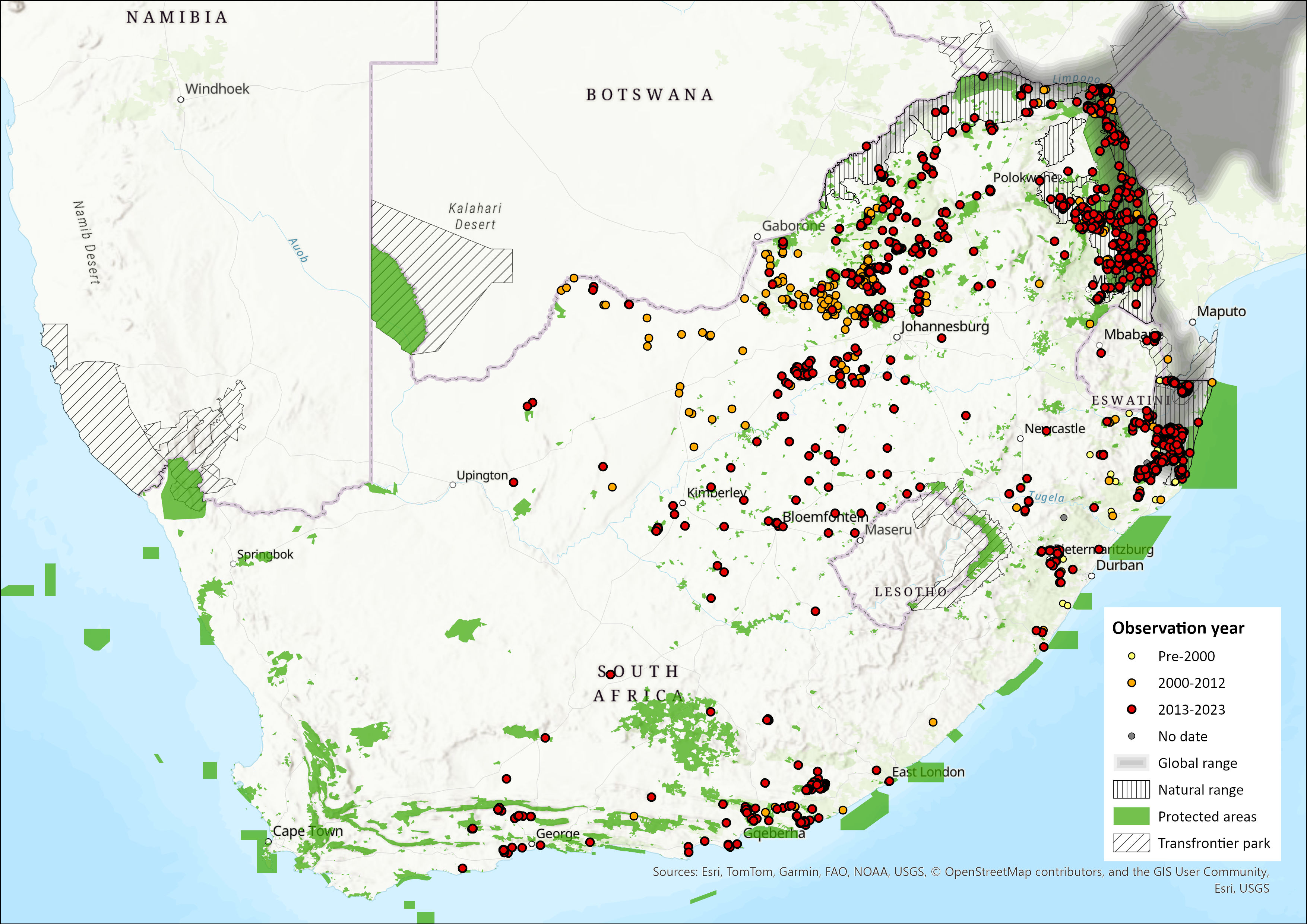
Figure 1. Distribution records for Nyala (Tragelaphus angasii) within the assessment region (South Africa, Eswatini and Lesotho). Note that distribution data is obtained from multiple sources and records have not all been individually verified.
Biogeographic Realms
Biogeographic Realm: Afrotropical
Occurrence
Countries of Occurrence
| Country | Presence | Origin | Formerly Bred | Seasonality |
| Botswana | Extant | Introduced | – | – |
| Eswatini | Extant | Reintroduced | – | – |
| Malawi | Extant | Native | – | – |
| Mozambique | Extant | Native | – | – |
| Namibia | Extant | Introduced | – | – |
| South Africa | Extant | Native | – | – |
| Zimbabwe | Extant | Native | – | – |
Large Marine Ecosystems (LME) Occurrence
Large Marine Ecosystems: (Not specified)
FAO Area Occurrence
FAO Marine Areas: (Not specified)
Climate change
No recent research or literature has focused on how climate change might affect this species in the future, but it is likely that warmer winters will favor the distribution of the species.
Population information
The global population of Nyala was estimated at over 32,000 individuals by East (1999). The current global population is estimated at c. 36,500 with population trends generally stable or increasing (IUCN SSC Antelope Specialist Group 2016). Recent rough estimates suggest that the abundance of Nyala in South Africa may be at least 30,000, with the majority (~25,000) occurring in KwaZulu-Natal (Anderson 2013). The largest localities are as follows: Ndumo (4,000), Mkhuze and iSimangaliso Wetland Park Wetland Park (127,000) (B. Church 2025 pers. comm.), Hluhluwe iMfolozi (7,000) (Rowe-Rowe 1994); and greater Kruger National Park (3,000) (Anderson 2013). The Eswatini population numbers around 1,000 animals on protected areas and ranches after successful reintroduction (Monadjem 1998). Using available population estimates from both protected areas and ranchlands across the country we estimate the (2013–2014 counts) population size to be at least 40,398 on 417 properties, which equates to 41,398 if the Eswatini population is included. Of these, formally protected areas constitute 20,683 animals on 56 reserves (of which 20,388 animals on 43 properties occur within the natural range), which means the private sector accounts for c. 49% of the total population. The genetic data suggests two lineages (Limpopo and KwaZulu-Natal) plus Eswatini with an estimated 29,485 animals in 122 sites. However, further scrutiny of whether such sites truly occur within the natural range and whether most private sites/farms qualify as wild and free roaming (not captive bred) is necessary for a more accurate population estimate. Using a mature population structure of 55–75%, the current mature population size within the natural range is thus estimated to be 16,217–22,114 animals. Generation length is estimated to be 5.5 years (IUCN SSC Antelope Specialist Group 2016), yielding a three-generation period of c. 16 years (1999–2015). No reliable long-term subpopulation data are available to measure national population trend, but we suspect the population is stable or increasing.
In southern Africa, Zimbabwe has more than 1,000 animals (Anderson 2013), while numbers in Malawi have declined from 3,000 (East 1999) to about 1,500, most notably in the population in Lengwe National Park (which was originally created especially for this species). While still widespread in Mozambique, hunting pressure has probably reduced the population to around 3,000 (Anderson 2013). The recent rehabilitation of Goronogoza National Park and Maputo Special Reserve and the protection offered in the Coutadas has resulted in the Mozambique populations increasing in these areas. Extra-limital to the species’ natural range, Namibia has about 250 individuals, all on private ranches. Overall, the population is suspected to be stable or increasing within the assessment region, especially on private land.
Population Information
Continuing decline in mature individuals? No
Extreme fluctuations in the number of subpopulations: (Not specified)
Continuing decline in number of subpopulations: (Not specified)
All individuals in one subpopulation: (Not specified)
Number of mature individuals in largest subpopulation: 12,000 in Mkuze/iSimangaliso Wetland Park
Number of subpopulations: 2
Quantitative Analysis
Probability of extinction in the wild within 3 generations or 10 years, whichever is longer, maximum 100 years: Nil
Probability of extinction in the wild within 5 generations or 20 years, whichever is longer, maximum 100 years: Very low probability
Probability of extinction in the wild within 100 years: (Not specified)
Population genetics
No comprehensive population genetic study has been conducted on this species; however, an exploratory study incorporating microsatellite, allozyme and mitochondrial data found significant differences between animals from KwaZulu-Natal, Limpopo and Malawi (Grobler et al. 2005). The study concluded that geographic variation in the species is probably a function of a distribution pattern stemming from habitat specificity. Consequently, at least two subpopulations are deemed to be present within the assessment region. Further research is needed to understand whether these clades could be evolutionary significant units, and whether additional substructure exists. The study should incorporate more widespread sampling and utilise nuclear genomic markers.
Based on the census/survey (Nc) estimates provided and a Nc/Ne conversion ratio of 0.1-.3, the effective population sizes (Ne) for the two subpopulations are estimated at a minimum of 2,500-7,500 for KwaZulu-Natal, and 1,400-4,200 for Limpopo. Accordingly, both subpopulations are thought to be genetically stable. However, it would be beneficial to have this verified through the population genomic study suggested above.
Based on the available evidence, it has been recommended that translocations among geographically distant regional populations be discouraged pending a more elaborate investigation (Grobler et al. 2005).
Habitats and ecology
This species is commonly associated with dense thickets and open thicket woodland mosaics in savannah woodland habitats or dry forests and thickets in riverine woodlands. Generally, home ranges occur near water, and may expand into open grasslands, floodplains or vleis (Skinner & Chimimba 2005). When disturbed, Nyala will retreat to the cover of dense thickets, and, in particularly vulnerable or disturbed environments, they will only roam into open areas at night (Skinner & Chimimba 2005). In KwaZulu-Natal, this species was traditionally restricted to coastal lowlands and riverine bushveld, up to altitudes of 200 m asl (Rowe-Rowe 1994).
This species is considered an intermediate mixed feeder (Anderson 1976, Hofmann 1988), consuming leaves, grasses (only when green and short), flowers, twigs, and fruits (Skinner & Chimimba 2005). The seasonal ratios of browse to grass in their diet in Ndumu Game reserve overlapped closely with that of impala (Anderson 1976). Nyala will drink water daily if available but can survive successfully in areas where no water is present for parts of the year (Anderson 2013). Following periods of rainfall, when grasses are most succulent, they constitute a large proportion of the Nyala’s diet (Van Rooyen 1990, 1992). The Fever Tree (Vachellia xanthophloea), the Mustard Tree (Salvadora persica), Tambotie (Spirostachys africana), the Monkey Orange (Strychnos spp.) and the Buffalo Thorn (Ziziphus mucronata) were listed as important food sources for Nyala in Mozambique (Tello & Van Gelder 1975). Important grass species include Digiteria eriantha, Panicum coloratum, P. maximum (until the late dry season, Roque et al. 2024) and Urochloa mosambicensis (Skinner & Chimimba 2005).
Although Nyala breed throughout the year, a major peak in birth rate occurs from August to December, and a minor peak takes place in May (Skinner & Chimimba 2005). Females reach sexual maturity after about 14 months, while males are only considered to be socially sexually mature at about five years of age (Skinner & Chimimba 2005). Following a gestation period of 220 days, a single calf is born (twins are rare) usually in the shelter of closed thickets and commonly weighs between 4.2 and 5.5 kg (Tello & Van Gelder 1975). Lactation continues for a period of about seven months (Anderson 1984). Predators include cheetahs (Acinonyx jubatus), African wild dogs (Lycaon pictus), lions (Panthera leo) and leopards (Panthera pardus), spotted hyaenas (Crocuta crocuta) (Marshal et al. 2021).
Ecosystem and cultural services: From a functional point of view, Nyala can be useful as browsers, as many farms have severe bush encroachment (Power 2014). It is a popular trophy hunting species, as well as being a visible and pretty game species for ecotourism. Nyala habituate to human activity and frequent rest camp lawns during the dry season in Mpumalanga.
IUCN Habitats Classification Scheme
| Habitat | Season | Suitability | Major Importance? |
| 1.5. Forest -> Forest – Subtropical/Tropical Dry | – | Suitable | – |
| 2.1. Savanna -> Savanna – Dry | – | Marginal | – |
| 3.5. Shrubland -> Shrubland – Subtropical/Tropical Dry | – | Suitable | – |
Life History
Generation Length: (Not specified)
Age at maturity: Female or unspecified: 14 months
Age at Maturity: Male: Spermatogenesis starts at 12 months and by 14 months all males show active spermatogenesis. Males probably only get to breed when they are about 5 years old
Size at Maturity (in cms and Kg): Female: Shoulder height 92 cm and 59 kg
Size at Maturity (in cms): Male: Shoulder height 106 cms and 127 Kg
Longevity: up to 19 years in captivity
Average Reproductive Age: (Not specified)
Maximum horn size (in cms): 83.8 cms
Size at Birth (in Kg): 5.6 Kg (Anderson 1976)
Gestation Time: 220 days
Reproductive Periodicity: Conceptions occur throughout the year with slight peaks in Autumn and Spring (Anderson 1979)
Average Annual Fecundity or Litter Size: Normally One. Twins recorded once in 217 pregnancies (J. Anderson 1984)
Natural Mortality: 34% calves die within the first six months in Ndumu (Anderson 1976)
Does the species lay eggs? No
Does the species give birth to live young: Yes
Does the species exhibit parthenogenesis: No
Does the species have a free-living larval stage? No
Does the species require water for breeding? No
Movement Patterns
Movement Patterns: Overlapping home ranges for each sex and non-migratory
Congregatory: Social grouping based on the family group of an adult female and he calves of different ages. Males occur in ephemeral male groups or alone.
Systems
System: Terrestrial
General Use and Trade Information
Nyala are subject to hunting for meat (bushmeat) and as trophies (IUCN SSC Antelope Specialist Group 2016). It is also traded at game auctions, and has a subsistence value as meat or for recreational biltong hunters. The Nyala has major national and international value as a trophy animal and possess considerable economic value. This demand (especially for adult males by trophy hunters) has led to the artificial dispersion of Nyala from game reserves in KwaZulu-Natal to other protected areas and private ranches in areas both within and outside of their former distribution (Anderson 2013). Thus, trophy-hunting has had no negative effect on the population as its value as a trophy animal ensured an increase in numbers due to reintroductions. The rapid increase in the market price of live animals has created an incentive for landowners to manage Nyala for both live sales and the trophy hunting market. Under good conditions they breed throughout the year and in Ndumu Game Reserve, were found to have a mean calving interval of 297 days (Anderson 1984). This and the robust prices for live and trophy animals makes them a sensible option for wildlife ranches with suitable habitat and climate parameters. The current trophy value (2014) of Nyala is R25,000 per head and the record auction price of R500,000. Additionally, there are many farmers breeding them commercially in camps, which includes selection of breeding males and other intensive management interventions.
Wildlife ranching has taken advantage of habitat changes brought about by woody plant encroachment – either as a result of overgrazing or a change in the veld burning regime. The increase in woody plants has created new habitats available for Nyala and landowners have adapted to this by the introduction of Nyala outside their historic range. Nyala can be kept on very small properties as long as there is enough feed and shelter. On many farms they are free–roaming but, especially where they are extra-limital, they are often kept in camps. The camps can be any size from ½ ha to 20 or 300 ha – depending on the vegetation type. Even if animals are bred in camps, males are often released onto bigger farms so that they can grow out and be hunted. Nyala are provided supplementary food on private properties, especially in winter – largely irrespective of whether it is their natural habitat or not. In the Mpumalanga Lowveld. Nyala are gradually increasing their distribution by dispersal from their original introduction sites. Being mixed feeders, they find conditions suitable and are tolerated on residential estates as they habituate readily to human activity.
|
Subsistence: |
Rationale: |
Local Commercial: |
Further detail including information on economic value if available: |
|
Yes |
Bushmeat |
Yes |
Meat, trophies and live animal sales |
National Commercial Value: Yes
International Commercial Value: Yes
|
End Use |
Subsistence |
National |
International |
Other (please specify) |
|
1. Food – human |
true |
true |
– |
– |
|
15. Sport hunting/specimen collecting |
– |
true |
true |
– |
Is there harvest from captive/cultivated sources of this species? Yes
Harvest Trend Comments: Meat, trophies and live animal sales.
Threats
Historically, overexploitation and diseases, such as Rinderpest, resulted in the extensive loss of Nyala throughout their native range. There also were game eradication schemes to control Nagana which would have contributed to historical Nyala declines. However, more recently, through reintroduction, introduction, and population recovery, this species is now considered stable/increasing both within and outside of its former distribution. Some threats to the Nyala population include poaching, habitat loss, agriculture, and cattle grazing (Khademi 2017). Within the assessment region, human settlement has reduced habitat availability in certain areas. However, wildlife ranching may be creating new habitats for this species. They are also subject to bushmeat poaching. For example, in Borakalalo National Park in North West (Nel 2015).
Conservation
Although having historically disappeared from parts of their former range, they continue to survive in on well-managed protected areas in South Africa and on private land. Within the assessment region, prominent successful subpopulations of Nyala occur within Ndumo Game Reserve, Mkhuze Game Reserve, Hluhluwe-iMfolozi Game Reserve, iSimangaliso Wetland Park and Kruger National Park (East 1999; Anderson 2013). While East (1999) estimated that more than 80% of the global population occurs within protected areas, half of the population exists on private land in South Africa and will continue to increase due to commercial demand by trophy hunters (Anderson 2013). As long as effective protection and management are maintained in the key protected areas for this species and its numbers continue to increase on private land, its status is unlikely to change (IUCN SSC Antelope Specialist Group 2016).
Nyala respond well to protection, to the point where overpopulation can become a management problem (IUCN SSC Antelope Specialist Group 2016). This is an opportunity to integrate the sustainable use of this species into wildlife-based, rural economies.
This species causes habitat degradation and competes with Bushbuck outside of its natural range. Thus, regulation of translocation is required to prevent extra-limital movement. For example, the suitable habitat of Borakalalo Nature Reserve in the North West Province has allowed this species to flourish, and the population should be removed to prevent negative impacts on local biodiversity (Power 2014).
Recommendations for land managers and practitioners:
- Develop this species as a keystone within the sustainable, wildlife-based rural economy. The government must establish a programme to ensure that when viable wildlife ranches are transferred to previously disadvantaged communities, they are planned, and that adequate training is provided to the new owners.
- Restrict movements within South Africa to those from the South African subpopulation.
- The wildlife industry and state conservation agencies must educate the general public about the benefits of sustainable utilisation of wildlife in conserving the country’s biodiversity.
- Encourage owners of communally managed rangelands with suitable habitat, such as the Ngonyama Trust, to stock nyala and other browsers.
Research priorities:
- Population genomic study to investigate genetic structure and diversity and to quantify genetic health of subpopulations.
- Effects of wildlife ranching on this species, and methods of creating wildlife-based economies.
- The effect of captive breeding for horn length on the overall fitness of the population. For example, it is well known in domestic animals that susceptibility to endoparasites is highly hereditary. Only selecting breeding animals for their colour, horn length and shape may reduce fitness for other positive attributes.
- Investigate the feasibility of integration Nyala into domestic livestock husbandry in communally managed rangelands such as those owned by the iNgonyama Trust.
Encouraged citizen actions:
- Landowners should create conservancies for this species and engage local stakeholders to create sustainable, wildlife-based rural economies.
- Report sightings on virtual museum platforms (for example, iNaturalist and MammalMAP), especially of free-roaming herds outside protected areas and private lands.
- Purchase and consume game meat.
Bibliography
Anderson J. 1997. Nyala Tragelaphus angasii. In: Mills G, Hes L (ed.), The Complete Book of Southern African Mammals, pp. 285. Struik Publishers, Cape Town, South Africa.
Anderson JL. 1976. Aspects of the ecology of the Nyala (Tragelaphus angasii Gray, 1849) in Zululand. Ph.D. Thesis. London University, London, UK.
Anderson, JL. 1979. Reproductive seasonality of the Nyala Tragelaphus angasi, the interaction of light, vegetation phenology, feeding style and reproductive physiology. Mammal Review. 9. 33-36
Anderson, JL, 1980 The social organization and aspects of behaviour of the Nyala (Tragelaphus angasi ) Gray 1849. Zeitschrift für Saugetierkunde 45. 90-123.
Anderson JL. 1984. Reproduction in the Nyala (Tragelaphus angasii) (Mammalia: Ungulata. Journal of Zoology 204: 129-142.
Anderson, J. 2013. Tragelaphus angasii. In: J. S. Kingdon and M. Hoffmann (eds), Mammals of Africa. VI. Pigs, Hippopotamuses, Chevrotain, Giraffes, Deer, and Bovids, Bloomsbury Publishing, London, UK.
Anderson, J.L. 1985. Condition and related mortality of nyala Tragelaphus angasii in Zululand, South Africa. Journal of Zoology 207: 371-380.
Coates GD, Downs CT. 2005. Survey of the status and management of sympatric bushbuck and nyala in KwaZulu-Natal, South Africa. South African Journal of Wildlife Research 35: 179.
East, R. (compiler). 1999. African Antelope Database 1998. IUCN, Gland, Switzerland and Cambridge, UK.
Hofmann RR. 1988. Morphophysiological evolutionary adaptations of the ruminant digestive system. In: Dobson A, Dobson M (ed.), Aspects of Digestive Physiology in Ruminants, pp. 1-20. Cornell University Press, Ithaca, New York, USA.
IUCN SSC Antelope Specialist Group. 2016. Tragelaphus angasii. The IUCN Red List of Threatened Species 2016: e.T22052A50196443.
Khademi, T.G., 2017. A re-evaluation of phylogenetic relationships within the tribe Tragelaphini (Bovinae: Bovidae), based on complete mitochondrial genomes. Flora, 33, p.34.
Monadjem, A. 1998. Mammals of Eswatini. The Conservation Trust of Eswatini and Big Game Parks.
Nel, P. 2015. Population estimates for large herbivores and predators in protected areas in the North West Parks Board November 2015. North West Parks Board.
Power, R.J. 2014. The distribution and status of mammals in the North West Province. Department of Economic Development, Environment, Conservation & Tourism, North West Provincial Government, Mahikeng.
Rautenbach, I. L. 1982. Mammals of the Transvaal. Ecoplan monograph, N.S. Supplemento 1: 111-211.
Rautenbach, I.L. 1978. Ecological distribution of the mammals of the Transvaal (Vertebrata: Mammalia). Annals of the Transvaal Museum 31: 131-156.
Roque, D.V., Göttert, T., Zeller, U. and Macandza, V.A., 2024. Modeling the drivers of large herbivore distribution in human‐dominated southern African savannas. Ecosphere, 15(2), p.e4770.
Rowe-Rowe, D. T. 1994. The ungulates of Natal. Natal Parks Board, Pietermaritzburg, South Africa.
Skinner, J.D. and Chimimba, C.T. (eds). 2005. The Mammals of the Southern African Subregion. Cambridge University Press, United Kingdom, Cambridge.
Skowno AL, Thompson MW, Hiestermann J, Ripley B, West AG, Bond WJ. 2016. Woodland expansion in South African grassy biomes based on satellite observations (1990–2013): general patterns and potential drivers. Global Change Biology : doi:10.1111/gcb.13529.
Tello JL, Van Gelder RG. 1975. The natural history of nyala (Tragelaphus angasii) in Mozambique. Bulletin of the American Museum of Natural History 155: 319-386.
van Rooyen AF. 1990. The diet, habitat selection and body condition of impala Aepyceros melampus and nyala Tragelaphus angasii in Zululand. M.Sc. Thesis. University of Pretoria, Pretoria, South Africa.
van Rooyen AF. 1992. Diets of impala and nyala in two game reserves in Natal, South Africa. South African Journal of Wildlife Research 22: 98-101.