
Blue Antelope
Hippotragus leucophaeus

2025 Red list status
Extinct
Overview
Hippotragus leucophaeus – (Pallas, 1766)
ANIMALIA – CHORDATA – MAMMALIA – ARTIODACTYLA – BOVIDAE – Hippotragus – leucophaeus
Common Names: Bluebuck, Blue Antelope (English), Blaubok (Afrikaans), Blaubock (German)
Synonyms: Antilope leucophaea Pallas, 1766
|
Red List Status |
|
EX – Extinct |
Assessment Information
Assessor: Kerley, G.I.H1
Reviewer: Hempel, E.2
Institutions: 1Nelson Mandela University; 2University of Potsdam, Museum für Naturkunde Berlin – Leibniz Institute for Evolution and Biodiversity Science
Previous Assessor: Child, M.F.
Previous Reviewer: Mallon, D.P.
Previous Contributor: Hoffmann, M.
Assessment Rationale
The last individual Blue Antelope was recorded around 1799/1800 (Lichtenstein 1811, 1814). It was the first African antelope species to be driven to extinction through the impact of European settlers (Harper 1945, Hempel et al. 2024).
Recommended citation: Kerley GIH. 2025. A conservation assessment of Hippotragus leucophaeus. In Patel T, Smith C, Roxburgh L, da Silva JM & Raimondo D, editors. The Red List of Mammals of South Africa, Eswatini and Lesotho. South African National Biodiversity Institute and Endangered Wildlife Trust, South Africa.
Regional Distribution and occurrence
Geographic Range
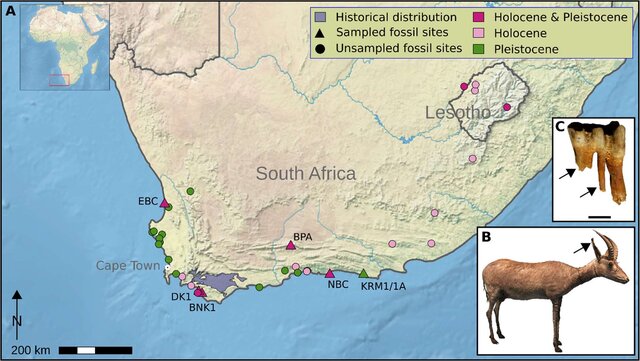
The Blue Antelope was endemic to southern Africa, where it was historically confined to a limited area of the southern Cape coastal plains, and where it was apparently uncommon. The species was first recorded in 1708 by Kolb (1719) and was described by Pallas in 1766 (Pallas 1766) from material of uncertain provenance (Rookmaaker 1989). Its historical distribution is thus based on few records, of which only two can be considered to be reasonably precise (Kerley et al. 2009): Thunberg on 20 January 1774 and Le Vaillant in March/April 1782. The latter animal was killed by a hunter employed by Le Vaillant (Glenn 2020, Le Vaillant 1790). An additional record in 1783 provided by Sparrman (1786) much further east at Krakeel River in the Langkloof may reflect a transported skin, given that this location is hundreds of kilometres east of other contemporary records. Unfortunately, the collection location records of the up to seven surviving historical museum specimens (three genetically confirmed horns or skeletal fragments, two genetically confirmed and two recognisable mounted skins Plaxton et al. 2023), are spatially imprecise – typically giving the collection location as being “Cape Colony” or “South Africa”.
However, archaeological evidence suggests a previously much wider distribution: early in the Last Glacial (ca 70,000–35,000 years before present (ybp)) it occurred on the grasslands of the Cape lowlands, south of the Cape Fold Belt from present day Makhande/Grahamstown (farm ‘‘Uniondale’’) in the east, to the vicinity of Saldanha Bay in the West. A similar distribution has been inferred for the early (ca 10,000 ybp) Holocene (Klein 1974, Cruz-Uribe et al. 2003). During the late Pleistocene (ca 18,000–10,000 ybp), archeological material show that the species occurred as far north as the eastern parts of South Africa’s Free State Province and the Kingdom of Lesotho (Loubser et al. 1990, Plug and Engela 1992, Avery 2019).
Elevation / Depth / Depth Zones
Elevation Lower Limit (in metres above sea level): (Not specified)
Elevation Upper Limit (in metres above sea level): (Not specified)
Depth Lower Limit (in metres below sea level): (Not specified)
Depth Upper Limit (in metres below sea level): (Not specified)
Depth Zone: (Not specified)
Biogeographic Realms
Biogeographic Realm: Afrotropical
Map
Figure 1: Blue antelope distribution and specimens. (A) Historical distribution (light purple at the southern tip) and Quaternary fossil occurrences of blue antelope (Skead 1980; Kerley et al. 2009; modified from Avery 2019). Fossil sites: EBC = Elands Bay Cave, DK1 = Die Kelders Cave 1, BNK1 = Byneskranskop 1, BPA = Boomplaas Cave, NBC = Nelson Bay Cave, KRM1/1A = Klasies River Mouth 1/1A (base map: https://www.naturalearthdata.com, prepared in QGIS v2.18 (https://qgis.org)). (B) Historical mounted skin of a young male blue antelope (Hippotragus leucophaeus) from the Swedish Museum of Natural History, Stockholm, Sweden (NRM 590107); arrow indicates area sampled for aDNA extraction (C) Fossil lower left deciduous fourth premolar (NBC RB4 D3) of a blue antelope from Nelson Bay Cave (curated at Iziko Museums of South Africa, Cape Town, South Africa); scale is one centimetre; arrows indicate areas sampled for aDNA extraction. Photo credits: NBC RB4 D3: J.T. Faith, courtesy: Archaeology Unit, Iziko Museums of South Africa; NRM 590107: Hempel et al. 2021a.
Countries of Occurrence
| Country | Presence | Origin | Formerly Bred | Seasonality |
| South Africa | Extinct Post-1500 | Native | Yes | Resident |
| South Africa -> Western Cape | Extinct Post-1500 | Native | Yes | Resident |
Large Marine Ecosystems (LME) Occurrence
Large Marine Ecosystems: (Not specified)
FAO Area Occurrence
FAO Marine Areas: (Not specified
Climate change
N/A
Population information
The last individual Blue Antelope was apparently recorded around 1799/1800; how the last individual met its end is unknown. Thus, the Blue Antelope is the first African large mammal species to become extinct in the historical period (Harper 1945).
Recent molecular analyses of material from a historical, mounted specimen provides unique insights into the long-term population history of the Blue Antelope prior to its extinction. Thus, Hempel et al. (2024) argue that the population was consistently limited in numbers for the last 400 000 years, and this population appeared to show a lack of inbreeding but high levels of purging of highly deleterious alleles. These features would serve as adaptations to the risks of low population size (Franklin 1980). In addition, Hempel et al. (2024) point out that there is no evidence for population fluctuations in relation to varying habitat availability during glacial cycles. Based on this, the Blue Antelope serves as another, valuable example of the occasional, long-term, persistence of small populations (Reed 2010).
Population Information
Continuing decline in mature individuals? Extinct
Extreme fluctuations in the number of subpopulations: (Not specified)
Continuing decline in number of subpopulations: (Not specified)
All individuals in one subpopulation: (Not specified)
Number of mature individuals in largest subpopulation: (Not specified)
Number of Subpopulations: (Not specified)
Quantitative Analysis
Probability of extinction in the wild within 3 generations or 10 years, whichever is longer, maximum 100 years: (Not specified)
Probability of extinction in the wild within 5 generations or 20 years, whichever is longer, maximum 100 years: (Not specified)
Probability of extinction in the wild within 100 years: (Not specified)
Population genetics
N/A
Habitats and ecology
Models based on estimated habitat suitability show that, before the colonists arrived, the range of the Blue Antelope was limited to a single suitable habitat; the Overberg Coastal Renosterveld, which covered ca 4,300 km² (Kerley et al. 2009). Although presently dominated by the unpalatable shrub renosterbos (Dicerothamnus rhinocerotis), this habitat would have possessed a high grass cover (Themeda triandra, Merxmuellera stricta) (Cowling and Heijnis 2001).
IUCN Habitats Classification Scheme
| Habitat | Season | Suitability | Major Importance? |
| 4.4. Grassland -> Grassland – Temperate | Resident | Suitable | – |
Life History
Generation Length: (Not specified)
Age at maturity: female or unspecified: (Not specified)
Age at Maturity: Male: (Not specified)
Size at Maturity (in cms): Female: (Not specified)
Size at Maturity (in cms): Male: (Not specified)
Longevity: (Not specified)
Average Reproductive Age: (Not specified)
Maximum Size (in cms): (Not specified)
Size at Birth (in cms): (Not specified)
Gestation Time: (Not specified)
Reproductive Periodicity: (Not specified)
Average Annual Fecundity or Litter Size: (Not specified)
Natural Mortality: (Not specified)
Does the species lay eggs? (Not specified)
Does the species give birth to live young: (Not specified)
Does the species exhibit parthenogenesis: (Not specified)
Does the species have a free-living larval stage? (Not specified)
Does the species require water for breeding? (Not specified)
Movement Patterns
Movement Patterns: The species is extinct, but fossil records suggest that it could have been migratory during the Pleistocene, moving west to winter-rainfall calving grounds during the winter, and eastwards to year-round rainfall areas in summer, both these movements would have provided access to seasonal grass resources (Faith and Thompson 2013). Rising sea levels appear to have disrupted this migration at the start of the Holocene, with access along the coastal plains to western, winter-rainfall calving grounds during the winter cut off (Faith and Thompson 2013). It is thus argued that the population was sedentary in the east of its previous range, through the Holocene. This accords with the few historical records (Skead 2011, Kerley et al. 2009).
Congregatory: (Not specified)
Systems
System: Terrestrial
General Use and Trade Information
General notes regarding trade and use of this species: (Not specified)
Local Livelihood: (Not specified)
National Commercial Value: (Not specified)
International Commercial Value: (Not specified)
End Use: (Not specified)
Is there harvest from captive/cultivated sources of this species? (Not specified)
Harvest Trend Comments: (Not specified)
Threats
Although the Blue Antelope had a single, small population with a very limited distribution at the start of its recorded history (Kerley et al. 2009), it had persisted with a low population size for around 400 000 years, showing high resilience (Hempel et al. 2024). Thus, habitat loss to livestock, land transformation and hunting with firearms and horses likely played proximate roles in the extinction of the species during the early colonial era (Klein 1974, Faith and Thompson 2013).
Conservation
This species is now Extinct.
Bibliography
Avery, DM. 2019. A fossil history of southern African land mammals. Cambridge University Press, Cambridge.
Cowling, R.M. and Heijnis, C.E. 2001. The identification of Broad Habitat Units as biodiversity entities for systematic conservation planning in the Cape Floristic Region. South African Journal of Botany 67: 15-38.
Cruz-Uribe, K., Klein, R.G., Avery, G., Avery, M., Halkett, D., Hart, T., Milo, R.G., Sampson, V.G. and Volman, T.P. 2003. Excavation of buried late Acheulean (mid-quaternary) land surfaces at Duinefontein 2, Western Cape Province, South Africa. Jounal of Archaeological Science 30: 559-575.
Faith, J.T. and Thompson, J.C. 2013. Fossil evidence for seasonal calving and migration of extinct blue antelope (Hippotragus leucophaeus) in southern Africa. Journal of Biogeography 40: 2108-2118.
Franklin, I.R. 1980. Evolutionary changes in small populations. In: Soulé, M.E., Wilcox, B.A. (ed.), Conservation Biology. An Evolutionary Ecological Perspective , pp. 135–150 . Sinauer Associates , Sunderland, MA.
Glenn I. 2020. The Paris bloubok (Hippotragus leucophaeus (Pallas, 1766) [Bovidae]) and its provenance. Zoosystema 42:77–84.
Harper, F. 1945. Blaauwbok; blue-buck. In Extinct and Vanishing Mammals of the Old World 698–700, Baltimore: The Lord Baltimore Press.
Hempel, E., Faith, J.T., Preick, M., de Jager, D., Barish, S., Hartmann, S., Grau,J.H., Moodley, Y., Gedman, G., Pirovich, K.M., Bibi, F. Kalthoff, D.C., Bocklandt, S., Lamm, B., Dalen, L., Westbury, M.V. and Hofreiter, M. 2024. Colonial-driven extinction of the blue antelope despite genomic adaptation to low population size. Current Biology 34: 2020-2029.
IUCN. 2017. The IUCN Red List of Threatened Species. Version 2017-2. Available at: https://url.za.m.mimecastprotect.com/s/iUpwC2Rr1kiLgMvc99HLF?domain=iucnredlist.org. (Accessed: 14 September 2017).
Kerley, G.I.H., Sims-Castley, R., Boshoff, A.F. and Cowling, R.M. 2009. Extinction of the blue antelope Hippotragus leucophaeus: modeling predicts non-viable global population size as the primary driver. Biodiversity and Conservation 18: 3235-3242.
Klein, R.G. 1974. On the taxonomic status, distribution and ecology of the blue antelope, Hippotragus leucophaeus (Pallas, 1766). Annals of the South African Museum 65: 99-143.
Kolb, P. 1719. Caput Bonae Spei hodiernum, Nürnberg: Peter Conrad Monath.
Le Vaillant F. 1790. Voyage de monsieur Le Vaillant dans l’intérieur de l’Afrique, par le Cap de Bonne-Espérance, dans les années 1780, 81, 82, 83, 84 & 85, Paris.
Lichtenstein, H. 1811. Reisen im südlichen Africa in den Jahren 1803, 1804, 1805 und 1806, Berlin: C. Salfeld.
Lichtenstein, H. Die Gattung Antilope. Ges. Naturf. Freunde Berlin Mag. neuesten Entdeck. gesammten Naturk. 6, 147–160, 163–182 (1814).
Loubser, J., Brink, J. and Laurens, G. 1990. Paintings of the extinct Blue Antelope Hippotragus leucophaeus in the Eastern Orange Free State. The South African Archaeological Bulletin 45: 106-111.
Pallas, P. S. 1766. Miscellanea Zoologica Quibus Novae Imprimis Atque obscurae Animalium Species Describuntur, Den Haag: Petrum van Cleef.
Plaxton, L., Hempel, E., Marsh, W.A., Portela Miguez, R., Waurick, I., Kitchener, A.C., Hofreiter, M., Lister, A.M., Zachos, F.E. and Brace, S. 2023. Assessing the identity of rare historical museum specimens of the extinct blue antelope (Hippotragus leucophaeus) using an ancient DNA approach. Mammalian Biology 103: 549-560.
Plug, I. and Engela, R. 1992. The macrofaunal remains from recent excavations at Rose Cottage Cave, Orange Free State. The South African Archaeological Bulletin 47: 16-25.
Reed, D. H. 2010 Albatrosses, eagles and newts, Oh My!: exceptions to the prevailing paradigm concerning genetic diversity and population viability? Animal Conservation 13: 448–457.
Rookmaaker, L.C. 1989. The zoological exploration of southern Africa, 1650-1970. Balkema, Rotterdam.
Skead, C.J. 2011. Historical incidence of the larger land mammals in the broader Western and Northern Cape. Eds: Boshoff, A.F., Kerley, G.I.H., Lloyd, P.H., Port Elizabeth: Centre for African Conservation Ecology, Nelson Mandela Metropolitan University.