
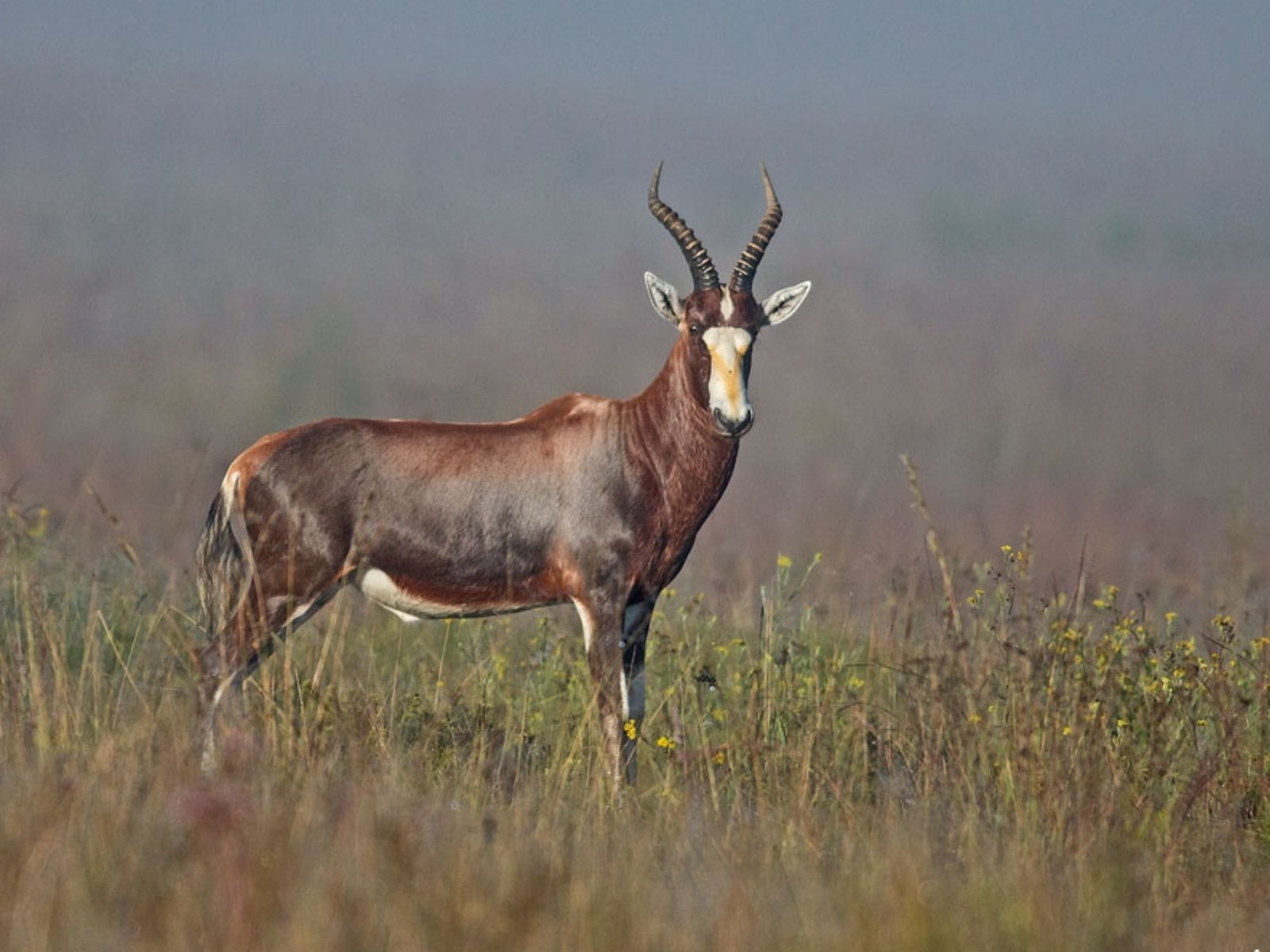
Blesbok
Damaliscus pygargus ssp. phillipsi

2025 Red list status
Least Concern

Regional Population Trend
Increasing

change compared
to 2016
No Change
Overview
Damaliscus pygargus ssp. phillipsi – Harper, 1939
ANIMALIA – CHORDATA – MAMMALIA – ARTIODACTYLA – BOVIDAE – Damaliscus – pygargus – phillipsi
Common Names: Blesbok (English, Afrikaans), Inoni (Ndebele), Nônê (Sepedi, Sesotho, Setswana), Nônô (Sesotho), Liloni (Swati), Noni (Tsonga), Ilinqua (Xhosa), Inoni (Zulu)
Synonyms: Damaliscus dorcas ssp. phillipsi Harper, 1939
Taxonomic Note:
Appeared in the 1996 IUCN Red List as Damaliscus dorcas phillipsi, but it is generally agreed that D. pygargus phillipsi is the correct name (see Grubb in Wilson and Reeder 1993). Although previously the Bontebok (D. p. pygargus) and the Blesbok were classified as separate species, these taxa are now recognised as subspecies of the same species, D. pygargus (Grubb 1993; Skinner & Chimimba 2005). These subspecies can be distinguished on the basis of their colour pattern (Fabricius et al. 1989). Hybridisation between these taxa threatens the genetic integrity of both subspecies (Skinner & Chimimba 2005).
| Red List Status |
| LC – Least Concern, (IUCN version 3.1) |
Assessment Information
Assessors: Patel, T.1 & da Silva, J.2
Reviewer: Mallon, D.3
Institutions: 1Endangered Wildlife Trust; 2South African National Biodiversity Institute; 3IUCN SSC Antelope Specialist Group
Previous Assessors: Dalton, D., Parrini, F., Viljoen, P., Gaylard, A. & Peinke, D.
Previous Reviewers: Mallon, D.P. & Child, M.F.
Previous Contributors: Relton, C., Selier, J. & Page-Nicholson, S.
Assessment Rationale
Listed as Least Concern, as Blesbok are abundant on both formally and privately protected land. According to the 2016 assessment, it was estimated a minimum mature population size of 54,426 individuals (using a 70% mature population structure) across 678 protected areas and wildlife ranches (counts between 2010 and 2016). There were at least an estimated 17,235 animals (counts between 2013 and 2016) on formally protected areas across the country, with the largest subpopulation occurring on Golden Gate Highlands National Park. The population increased significantly over three generations (1990-2015) in formally protected areas across its range and is similarly suspected to have increased on private lands. Recent data captured were not robust enough to update the population numbers from the 2016 assessment. However, there is no evidence to suggest a change in population size that would affect the conservation status of this species at present. Apart from hybridisation with Bontebok, there are currently no major threats to its long-term survival. Stricter translocation policies should be established to prevent the mixing of subspecies.
Reasons for Change
Reason(s) for Change in Red List Category from the Previous Assessment: No change
Red List Index
Red List Index: No change
Recommended citation: Patel T & da Silva JM. 2025. A conservation assessment of Damaliscus pygargus ssp phillipsi. In Patel T, Smith C, Roxburgh L, da Silva JM & Raimondo D, editors. The Red List of Mammals of South Africa, Eswatini and Lesotho. South African National Biodiversity Institute and Endangered Wildlife Trust, South Africa.
Regional Distribution and occurrence
Geographic Range
Historically, the Blesbok ranged across the Highveld grasslands of the Free State and Gauteng provinces, extending into northwestern KwaZulu-Natal, and through parts of the Karoo in the Eastern and Northern Cape. Over 300 km separated the Blesbok from the historical range of the closely-related Bontebok (previously restricted to the Western Cape) (Skinner and Chimimba 2005). Despite large populations in the Highveld, the Blesbok was heavily exploited for meat, and by the late 19th century, Blesbok were extinct from KwaZulu-Natal and only about 2,000 individuals remained in South Africa (Skinner and Chimimba 2005).
More recently, Blesbok populations have recovered remarkably, especially on private land, and have been relocated across South Africa to regions both within and outside of its native range (for example, Power 2014). Although formerly present in western Lesotho, Blesbok were hunted to extinction in the country before 1900 (Lynch 1994). Eswatini is outside of the native historical range of Blesbok, however, extralimital introductions have occurred in Malolotja Nature Reserve and Mlilwane Wildlife Sanctuary (Monadjem 1998). Similarly, this species has been introduced to private game farms outside of its range in Zimbabwe, Botswana and Namibia (East 1999).
Elevation / Depth / Depth Zones
Elevation Lower Limit (in metres above sea level): (Not specified)
Elevation Upper Limit (in metres above sea level): (Not specified)
Depth Lower Limit (in metres below sea level): (Not specified)
Depth Upper Limit (in metres below sea level): (Not specified)
Depth Zone: (Not specified)
Biogeographic Realms
Biogeographic Realm: Afrotropical
Map

Figure 1. Distribution records for Blesbok (Damaliscus pygargus ssp. phillipsi) within the assessment region (South Africa, Eswatini and Lesotho). Note that distribution data is obtained from multiple sources and records have not all been individually verified.
Countries of Occurrence
| Country | Presence | Origin | Formerly Bred | Seasonality |
| Botswana | Extant | Introduced | – | – |
| Eswatini | Extant | Introduced | – | – |
| Lesotho | Extinct Post-1500 | Native | – | – |
| Mozambique | Extant | Introduced | – | – |
| Namibia | Extant | Introduced | – | – |
| South Africa | Extant | Native | – | – |
| Zimbabwe | Extant | Introduced | – | – |
Large Marine Ecosystems (LME) Occurrence
Large Marine Ecosystems: (Not specified)
FAO Area Occurrence
FAO Marine Areas: (Not specified)
Climate change
There is no evidence that climate change affects this species currently, however, it may exacerbate changes in habitat quality and forage availability in the future, which may lead to local declines.
Population information
Recent data captured were not robust enough to update the population numbers from the 2016 assessment, which were based on 678 reserves or ranches. However, there is no evidence to suggest a change in population size that would affect the conservation status of this species at present.
Subpopulations are thriving in the various provinces where the species occurs. The total population was estimated to be at least 77,751 animals (2010–2016 counts) on both formally protected areas and wildlife ranches across the country (678 reserves or ranches). This equated to 54,426 mature individuals using a 70% mature population structure. On formally protected areas alone, there were at least 17,235 animals counted between 2013 and 2016 (EWT unpubl. data). Thus, there are well over 10,000 mature individuals in the assessment region with no expectations of major declines in the near future. However, subpopulations have declined sharply in areas outside of their distributional range (Mkhambithi, Nduli and Luchaba Nature Reserves) due to the removal of extra-limital species from these reserves. The total population estimate is lower than what East (1999) estimated: 235,000–240,000 animals, of which 97% were thought to be on private farms and 3% in protected areas (East 1999). While the latter is likely an overestimate, the true population size probably falls between the two estimates. There are certainly greater numbers on private land than formally protected areas. For example, in North West Province, there were an estimated 1,483 Blesbok in provincial parks, while around 9,874 occurred on private farms in 2010 (Power 2014). However, more field surveys are needed to determine which private subpopulations can be considered wild and free-roaming.
Generation length has been calculated as 8.4 years, yielding a three-generation window of 25 years (1990–2015). Over three generations, the population was estimated to have increased. For example: in Camdeboo National Park (Eastern Cape) the subpopulation increased from 67 in 1990 to 189 in 2015 (Gaylard unpubl. data) to 235 in 2020 (SANParks data); in Golden Gate Highlands National Park (Free State) the subpopulation increased from 451 in 1994 to 8,785 in 2016 (including the incorporation of QwaQwa National Park) (Bissett et al. 2016). This subpopulation has subsequently declined to 5081 in 2020 (SANParks data). In Bloemhof Dam Nature Reserve (North West) the subpopulation increased from 91 in 1999 to 919 in 2015 (Nel 2015) to 1529 in 2021 (North West Department of Economic Development, Environment, Conservation and Tourism). Other subpopulations on formally protected areas are mostly increasing or stable. For example, Suikerbosrand Nature Reserve in Gauteng has sustained a subpopulation of around 500 since 2004 (521, 466 and 546 individuals in 2004, 2014 and 2021 respectively), and has subsequently increased to 948 individuals in 2023 (GDARD: Gauteng Department of Agriculture and Rural Development).Over the past recent decade, subpopulations of Blesbok in provincial nature reserves in the Eastern Cape have been increasing (D. Peinke unpubl. data). In Free State Province, the population in provincial protected areas increased by an average annual rate of 28.2% between 2004 and 2014 (E. Schulze unpubl. data).
Population Information
|
Continuing decline in mature individuals? |
Qualifier |
Justification |
|
No |
– |
– |
Current population trend: Increasing (based on 2016 assessment)
All individuals in one subpopulation: There is likely only a single subpopulation (metapopulation)
Number of mature individuals in population: 47,633 (2013–2016 counts)
Number of mature individuals in largest subpopulation: 6,150 in Golden Gate Highlands National Park (2016 count).
Number of subpopulations: There is likely only a single subpopulation (metapopulation). 90 groups in formally protected areas alone.
Severely fragmented: Yes. Most subpopulations exist in fenced reserves, requiring active translocation.
Extreme fluctuations in the number of subpopulations: (Not specified)
Continuing decline in number of subpopulations: (Not specified)
Quantitative Analysis
Probability of extinction in the wild within 3 generations or 10 years, whichever is longer, maximum 100 years: (Not specified)
Probability of extinction in the wild within 5 generations or 20 years, whichever is longer, maximum 100 years: (Not specified)
Probability of extinction in the wild within 100 years: (Not specified)
Population genetics
A recent molecular study of D. pygargus identified clear genetic structure between the two subspecies and their hybrids, with Blesbok showing comparatively high levels of genetic diversity (Mogakala et al. 2024). Unfortunately, no estimates of the effective population size for Blesboks were reported to fully understand the extent of this diversity. Given translocations are known to occur, the subspecies is likely to be considered a single metapopulation (and hence subpopulation); however, this should be confirmed with a more comprehensive population genetic study across its range.
Habitats and ecology
Grasslands are considered prime habitat for Blesbok, especially open plateau grasslands, characteristic of the South African Highveld, extending to altitudes of up to 2,000 m asl (East 1999). Blesbok have a preference for short grass, and depend largely on the availability of drinking water (David and Lloyd 2013). In Mountain Zebra National Park, they occur on grazing lawns where they help to maintain their preferred dietary short grass species. Blesbok feed nearly entirely on graminoids, and have a strong preference for burnt areas, often moving into burnt areas even before new grass growth is obvious (Skinner and Chimimba 2005). Blesbok feed selectively, often choosing contrasting grass species in burnt and unburnt habitats, and during different seasons. Blesbok showed a preference for Themeda triandra, Eragrostis curvula, Chloromelas spp. and Setaria nigrirostris within burnt habitats at Rietvlei Nature Reserve (du Plessis 1968).
Blesbok are diurnal, with activity peaking during the early mornings, late evenings and during cool, overcast conditions (Skinner and Chimimba 2005). They are gregarious, exhibit characteristic behaviour similar to Bontebok, whereby they will frequently stand in orientated groups with their heads directed towards the sun and their faces low to the ground (Skinner and Chimimba 2005). Similar to Bontebok, Blesbok form large bachelor herds, which peak in size during the autumn rut period, and will inhabit home ranges away from those of territorial males and their associated harem herd (consisting of up to 25 females) (Novellie 1975, Skinner and Chimimba 2005). Blesbok and Bontebok differ not only in colouration, but also in social structure, whereby Bontebok maintain the same herd structure throughout the year, while Blesbok exhibit clear seasonal variation in herd structure. Large aggregations of Blesbok form during cold, dry conditions between June and August, when herds of all ages and sexes come together. These aggregations will split up from September onwards, and male territoriality becomes apparent from November, peaking in April (Skinner and Chimimba 2005).
Blesbok generally mate in autumn, and young are typically born between November and January (Skinner et al. 1974). Territorial males herd females into their territories, occasionally circling them in an attempt to retain them, however, females will sporadically move from territory to territory (Skinner and Chimimba 2005). Young are born following the first summer rainfall events, when forage is adequate to maintain females during lactation (Marais 1988). Females have been recorded as sexually mature by about 2.5 years old (du Plessis 1968), and experience a gestation period of approximately 240 days (Skinner et al. 1974). Usually Blesbok give birth to a single calf, weighing 6-7 kg (Skinner and Chimimba 2005).
Ecosystem and cultural services: Blesbok are a flagship, endemic species for South Africa’s Highveld grasslands, and are a valuable component of South Africa’s commercial hunting industry. .
IUCN Habitats Classification Scheme
| Habitat | Season | Suitability | Major Importance? |
| 4.5. Grassland -> Grassland – Subtropical/Tropical Dry | – | Suitable | – |
Life History
Generation Length: (Not specified)
Age at maturity: female or unspecified: (Not specified)
Age at Maturity: Male: (Not specified)
Size at Maturity (in cms): Female: (Not specified)
Size at Maturity (in cms): Male: (Not specified)
Longevity: (Not specified)
Average Reproductive Age: (Not specified)
Maximum Size (in cms): (Not specified)
Size at Birth (in cms): (Not specified)
Gestation Time: (Not specified)
Reproductive Periodicity: (Not specified)
Average Annual Fecundity or Litter Size: (Not specified)
Natural Mortality: (Not specified)
Does the species lay eggs? (Not specified)
Does the species give birth to live young: (Not specified)
Does the species exhibit parthenogenesis: (Not specified)
Does the species have a free-living larval stage? (Not specified)
Does the species require water for breeding? (Not specified)
Breeding Strategy
Does the species lay eggs? No
Does the species give birth to live young? Yes
Does the species exhibit parthenogenesis? No
Does the species have a free-living larval stage? No
Does the species require water for breeding? No
Movement Patterns
Movement Patterns: (Not specified)
Congregatory: (Not specified)
Systems
System: Terrestrial
General Use and Trade Information
Blesbok are used for commercial trophy hunting on a national and international scale and by subsistence hunters for meat. They are also sold as live animals at game auctions. Blesbok are culled (for management purposes) commercially for meat, which is often more lucrative than live game sales. However, this is not predicted to have any negative effects on the population. The species has also recently been bred intensively for colour variants.
Wildlife ranching has greatly increased the population numbers and area of occupancy for this subspecies, which makes this a conservation success story, similar to the Bontebok. However, there are concerns that private landowners are mixing Bontebok and Blesbok on their properties and thereby facilitating hybridisation between the two subspecies. This threat should be monitored and translocation policies that prevent such mixing should be enforced.
Colour morphs occur naturally, however, these events are considered rare (Hetem et al. 2009). The evolutionary importance of the phenotypic trait “colouration” is well documented for many functions, including camouflage, mate selection, communication, regulation of physiological processes, ultra-violet protection and defence against parasites. However, in addition to environmental adaptation, artificial selection has altered the coat colour design of species due to human interference (Cieslak et al. 2011; Russo et al. 2019), and colour morphs are currently being bred by private landowners for the purpose of financial gain. Thus far, several thousand alleles have been described from approximately 150 identified coat colour-associated genes (Cieslak et al. 2011). Coat colour-associated mutations connected to several serious disorders has been reported (Reissmann and Ludwig 2013). Most of these disorders have been identified in humans, laboratory animals and domestic animals. Additional research into the effect of colour variants in wild subpopulations is thus needed. Additionally, the selective breeding of colour morphs could result in decreased genetic diversity and inbreeding in Blesbok populations. Lastly, the effect of releasing colour morphs and carriers of colour morph genes into the wild population would have to be determined, which may occur if the colour morph market crashes in the future.
|
Subsistence: |
Rationale: |
Local Commercial: |
Further detail including information on economic value if available: |
|
Yes |
Subsistence hunting for meat (biltong hunting). |
Yes |
Commercial trophy hunting on a national and international scale. Live animal sales at game auctions, and culled (for management purposes) for meat. |
National Commercial Value: Yes
International Commercial Value: Yes
End Use: (Not specified)
Is there harvest from captive/cultivated sources of this species? Yes
Harvest Trend Comments: Majority of commercial trophy hunting on a national and international scale and live animal sales occur on private farmland. Selective breeding for rare colour variants supposedly for the hunting industry.
Threats
Although hybridisation is currently a priority in the rarer subspecies, Bontebok, and is likely to affect Bontebok more than it does Blesbok, the proportion of hybridisation in the Blesbok population is currently unknown and further research is required to identify hybrid Blesbok.
Breeding of colour variants that may be associated with deleterious mutations may, if released in large numbers, reduce effective population size and can affect wild populations if carriers are released into formally protected areas. Additionally, selective breeding may result in reduced heterozygosity, inbreeding and bottlenecks. Inbreeding contributes to the decline and eventual extinction of small and isolated subpopulations. There is also ample evidence of fitness reduction due to inbreeding (inbreeding depression) and a decrease in reproductive performance (Amos and Balmford 2001). Populations that have passed through a severe bottleneck can show a markedly reduced ability to respond to change, particularly in the face of novel challenges.
Current habitat trend: Stable. Generally, it is assumed that any threat to grasslands will have an influence on the subspecies. However, where Blesbok occur, habitat quality and quantity appears largely stable although the ongoing expansion of development, specifically human settlements and agriculture, is resulting in grasslands becoming more and more fragmented, which implies that Blesbok habitat becomes fragmented. However, the effect of grassland area loss might be mitigated by the fact that Blesbok subpopulations are thriving in already established nature reserves. Additionally, Blesbok appear to do well with less favourable grazing conditions on old lands and disturbed areas, as they are very adaptable and have a preference for short grass.
Conservation
This species occurs within a number of formally and privately protected areas across a number of provinces in South Africa. The economic value and popularity of the Blesbok on private farms has enabled this subspecies to re-occupy large areas of its original range; although substantial extra-limital subpopulations of the Blesbok have also been established on private land outside its natural range in South Africa and elsewhere. The identification of current hybrid populations and the restriction of movement of hybrids are suggested as key actions to conserve the subspecies.
Recommendations for land managers and practitioners:
- Hybrid subpopulations need to be identified and carefully managed.
- Sustainable commercial and other utilisation actions of this subspecies should be continued. Blesbok meat should be promoted as a low-carbon alternative to beef
Research priorities:
- Quantify the genetic structure of Blesbok within the assessment region and estimates of effective population size to gain a better perspective of the genetic health and status of the subspecies.
- The extent of hybridisation with Bontebok in existing subpopulations, especially on private land.
- Identification of colour variant genes as well as determining if these alleles have coat-colour associated mutations that have deleterious effect. Currently at auctions the following colour variants are being sold: copper blesbok, yellow blesbok, white blesbok and saddleback blesbok.
- Determine risks associated with release of intensively and selected bred animals (colour variants) into the wild population.
- Quantifying the harvest rates and use of this species, and determining its value as a source of sustainable source of protein for local communities.
- The effect of climate change on the species.
Encouraged citizen actions:
- Report sightings on virtual museum platforms (for example, iNaturalit and MammalMAP), especially outside protected areas.
- Do not hunt or buy hybrids between Blesbok and Bontebok, Red Hartebeest and Tsessebe or colour variants.
- Report suspected hybrid subpopulations to the provincial conservation authorities.
Bibliography
Amos W, Balmford A. 2001. When does conservation genetics matter? Heredity 87: 257-265.
Bissett, C., Ferreira, S., Bezuidenhout, H., Smit, I., Daemane, E., Mokoena, V. and Sikhosana, T. 2016. Golden Gate Highlands National Park herbivore off-take recommendations 2016: An integrated approach combining local knowledge with data derived from animal census, herbivore models, vegetation field monitoring and satellite imagery. Scientific Services, South African National Parks.
Cieslak M, Reissmann M, Hofreiter M, Ludwig A. 2011. Colours of domestication. Biological Reviews 86: 885-899.
David, J. and Lloyd, P. 2013. Damaliscus pygargus. In: J. S. Kingdon and M. Hoffmann (eds), The Mammals of Africa, Academic Press, Amsterdam, The Netherlands.
Du Plessis SS. 1968. Ecology of blesbok on the Van Riebeeck Nature Reserve, Pretoria with special reference to productivity. D.Sc. Thesis. University of Pretoria, Pretoria, South Africa.
East, R. 1999. African Antelope Database 1999. Gland, Switzerland and Cambridge, UK.
Fabricius C, van Hensbergen HJ, Zucchini W. 1989. A discriminant function for identifying hybrid bontebok x blesbok populations. South African Journal of Wildlife Research 19: 61-66.
Grubb P. 1993. Order Artiodactyla. In: D.E. Wilson & D.M. Reeder (ed.), Mammal Species of the World: A Taxonomic and Geographic Reference, 2nd edition., Smithsonian Institution Press.
Hetem RS, de Witt BA, Fick LG, Fuller A, Kerley GI, Meyer LC, Mitchell D, Maloney SK. 2009. Body temperature, thermoregulatory behaviour and pelt characteristics of three colour morphs of springbok (Antidorcas marsupialis). . Comparative Biochemistry and Physiology Part A: Molecular & Integrative Physiology 152: 379-388.
IUCN. 2017. The IUCN Red List of Threatened Species. Version 2017-2. Available at: www.iucnredlist.org. (Accessed: 14 September 2017).
Lynch, C.D. 1994. The mammals of Lesotho. Navorsing van die Nasionale Museum Bloemfontein 10: 177-241.
Marais AL. 1988. Factors affecting synchronized breeding in blesbok (Damaliscus dorcas phillipsi) and impala (Aepyceros melampus). Ph.D Thesis. University of Pretoria, Pretoria, South Africa.
Mogakala MR, Smith RM, Mavimbela C, Dalton DL. Identification of low levels of neutral and functional genetic diversity in South African bontebok (Damaliscus pygargus pygargus). Ecol Evol. 2024 Mar 6;14(3):e10962. doi: 10.1002/ece3.10962.
Monadjem A. 1998. The mammals of Swaziland. Conservation Trust of Swaziland and Big Games Parks, Mbabane, Swaziland.
Nel, P. 2015. Population estimates for large herbivores and predators in protected areas in the North West Parks Board November 2015. North West Parks Board.
Novellie PA. 1975. Comparative social behaviour of springbok, Antidorcas marsupialis (Zimmermann, 1780), and blesbok, Damaliscus dorcas phillipsi Harper, 1939, on the Jack Scott Nature Reserve, Transvaal. M.Sc. Thesis. University of Pretoria, Pretoria.
Power, R.J. 2014. The distribution and status of mammals in the North West Province. Department of Economic Development, Environment, Conservation & Tourism, North West Provincial Government, Mahikeng.
Reissmann M, Ludwig A. 2013. Pleiotropic effects of coat colour-associated mutations in humans, mice and other mammals. Pages 576–586. Seminars in Cell & Developmental Biology, Elsevier.
Russo, I., Hoban, S., Bloomer, P., Kotze, A., Segelbacher, G., Rushwirth, I., Birss, C. & Bruford, M.W. 2019. ‘Intentional Genetic Manipulation’ as a conservation threat. Conservation Genetic Resources, 11: 237-247.
Skinner JD, Van Zyl JHM, Oates LG. 1974. The effect of season on the breeding cycle of plains antelope of the western Transvaal Highveld. Journal of South African Wildlife Management and Assessment 4: 15-23.
Skinner, J.D. and Chimimba, C.T. 2005. The Mammals of the Southern African Subregion. Cambridge University Press, Cambridge, England.
van Wyk A, Kotze A, Randi E, Dalton DL. 2013. A hybrid dilemma: a molecular investigation of South African bontebok (Damaliscus pygargus pygargus) and blesbok (Damaliscus pygargus phillipsi). Conservation Genetics 14: 589-599.