SAVING SPOTS AND STRIPES
Claire Patterson-Abrolat claire@ewt.org.za and Wendy Collinson-Jonker wendyc@ewt.org.za, Endangered Wildlife Trust infrastructure is a common feature wherever humans have settled. South Africa is rated as the 25th largest country in the world and ranked 18th in relation to the total road length (65,600 km paved, 689,000 km unpaved) and 74th in the total number of cars per 1,000 people. Roads are critical in providing access to primary health care, education, markets, and employment, ultimately improving livelihoods.
However, South Africa is the third most biologically diverse country in the world, and it is increasingly clear that roads and road users affect the functioning of ecosystems in which they occur. Direct collisions with wildlife have the most obvious impact, but the indirect disruption of ecological processes is equally important. Habitat loss, degradation, and population fragmentation, and disruption of the processes that maintain regional populations are just some of the ways roads can affect biodiversity.
Development is taking place rapidly, with new roads and housing developments mushrooming and trans-continental rail and road developments being expedited. In the past, such developments were planned without much thought to their impact on biodiversity, but the EWT has been working hard to improve road-user safety – that of both the occupants of vehicles and the wildlife living adjacent to or crossing our roads. We’ve been collecting data in a variety of ways, including the use of citizen scientists (data submissions from the general public), planned surveys and, importantly, using the road patrollers that drive our highways daily to deal with any hazard they come across, including the removal of dead animals from the road.
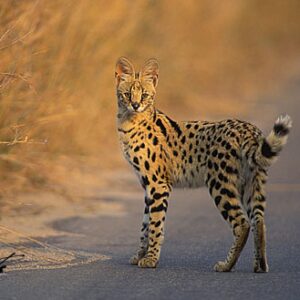
The EWT analyses roadkill data regularly, and one of the species that has caught our attention is the Serval. This mostly solitary, nocturnal species was considered extinct, or near-extinct, in the latter half of the 20th century, largely due to the mistaken belief that it caused damage to agricultural crops and compounded by competition from other carnivores such as jackal. Reintroductions and range expansions have led this species to recover to an estimated adult population of somewhere between 4,509 and 13,654 individuals, but the population is again considered to be declining due to a loss of its wetland habitat.
Serval (Leptailurus serval)
Servals are predominantly solitary except when mating or before young would leave their mothers at around eight months old. Like Leopards, the young females form territories adjacent to that of their mother, with males having larger territories that overlap that of several females.
The N3 Toll Concession, which manages the 412 km stretch of road from Heidelburg (Gauteng) to Cedara (KwaZulu-Natal), has been extremely supportive of our efforts to mitigate roadkill along the Toll Route and is concerned about the safety of both the road users and the wildlife living alongside the road.
In addition to our usual reports to the N3 Toll Concession, the EWT has been looking into why the Serval is one of the most common species reported (Figure 2) and why their roadkill numbers show an upward trend.We plotted the location of the roadkill along the N3 and noted that although roadkills were spread along the length of the road, there was a cluster along the northern parts of the route. This area is predominantly highveld sourveld and is either farmed for cattle or game or planted with mieliesWe also looked at the proximity of water to the road. Servals are wetland specialists, which are likely to be clustered close to water bodies. Water is spread fairly evenly across the landscape, and where perennial rivers are not available, farmers have created artificial water points for livestock and/or game. The diet of Servals consists mainly of Vlei Rats, so the abundance of water along the N3 does create the ideal habitat for them.
Our work is still in its infancy, and we plan to keep investigating the drivers of roadkill for this species by investigating the following:
- Whether Serval prefer artificial or natural water bodies;
- The abundance of prey species;
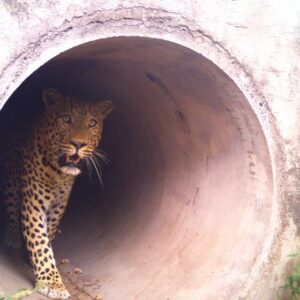
- Whether or not Serval use underpasses (tunnels and culverts) to cross the road; and
- If the Serval being killed on the road are young dispersing males or breeding adults, and the impact of this on the local and broader population.
Thank you to the N3 Toll Concession for their ongoing support of our work and Ford Wildlife Foundation for keeping us on the road.
Reptile Awareness Day Shines Spotlight on Western Cape’s Scaled Biodiversity
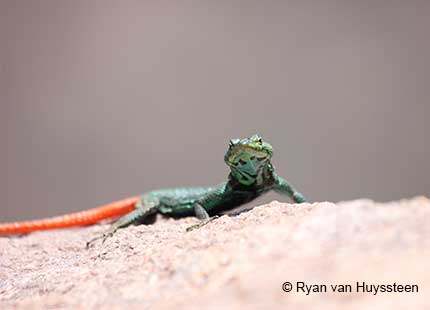
This Reptile Awareness Day, we celebrate the remarkable diversity found at Lettas Kraal Private Nature Reserve in the Anysberg region. The Western Cape boasts 155 reptile species, with 22 found nowhere else on Earth. Situated in the transitional zone between mountain fynbos and Klein Karoo veld, Lettas Kraal’s 7,000 hectares provide critical habitat for 54 reptile species – 31 of which were recorded during a 2020 survey by EWT’s Drylands Conservation Programme.
Notable Species at Lettas Kraal
The reserve protects both common and threatened reptiles including:
- Endangered Karoo Dwarf Tortoise (Chersobius boulengeri) – IUCN Red Listed
- Karoo Sand Snake (Psammophis notostictus)
- Western Sandveld Lizard (Nucras tessellata)
- Bibron’s Thick-Toed Gecko (Chondrodactylus bibronii)
- Karoo Dwarf Chameleon (Bradypodion gutturale)
Reptile Awareness Day Initiatives
Our educational event for Anysberg landowners and farmworkers covered:
Identification of local reptile families
- Venomous snake awareness and bite first aid
- Myth-busting about snake behaviour
- Dangerous arachnid recognition (spiders/scorpions)
- Hands-on encounters with common species
Why This Matters
As former EWT Field Officer Jean-Pierre Le Roux notes, Lettas Kraal’s size makes it invaluable for reptile conservation. The reserve:
- Protects vulnerable endemic species
- Provides corridors between habitats
- Offers research opportunities
- Educates local communities
This Reptile Awareness Day, we encourage everyone to appreciate these often-misunderstood creatures that play vital roles in our ecosystems.
Learn more:
Lettas Kraal Nature Reserve
EWT Drylands Programme
MRI Whale Unit Research: Drones Revolutionise Whale Conservation
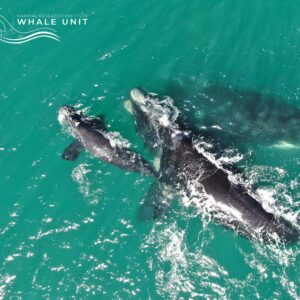
The MRI whale unit research partnership between the Endangered Wildlife Trust and University of Pretoria is transforming how we study Southern Right Whales. Using cutting-edge drone technology, researchers can now assess whale body conditions and behaviour patterns in a cost-effective, non-invasive manner – critical for understanding climate change impacts on marine ecosystems.
Drone Technology Breakthroughs
The EWT’s licensed drone operations (SACAA-approved since 2020) are enabling groundbreaking conservation work:
- Power line safety: Attaching bird flight diverters
- Wildlife monitoring: Thermal imaging for nocturnal animal counts
- Marine research: Photogrammetry of whale populations
Southern Right Whale Research
The unit employs specialised drones to:
- Capture high-resolution aerial images
- Measure body condition indices (BCI)
- Track individual whales over time
- Compare populations across South Africa, Australia and Argentina
“Drone technology has revolutionised our research,” says Dr Els Vermeulen, MRI Whale Unit Research Manager. “We can now track body condition variations annually and observe behaviours invisible from boats.”
Climate Change Connections
The research highlights worrying trends:
- Krill populations (whales’ main food) affected by ocean warming
- Declining body conditions may indicate ecosystem stress
- Long-term data crucial for conservation planning
How to Get Involved
Contact Lourens Leeuwner (lourensl@ewt.org.za) for drone operation enquiries
USING CONSERVATION CANINES TO SAVE OUR SPECIES FROM THE ILLEGAL WILDLIFE TRADE
Andrew Taylor, Wildlife in Trade Programme Manager, Endangered Wildlife Trust, andrewt@ewt.org.zaIllegal Wildlife Trade (IWT) is one of the biggest threats to biodiversity worldwide, and an ongoing poaching surge places particular strain on some of South Africa’s most threatened species. With funding from IUCN Save Our Species African Wildlife Initiative and the European Union, the Endangered Wildlife Trust (EWT) aims to reduce IWT by reducing the poaching of five iconic mammals. White and Black Rhinos, listed as Near Threatened and Critically Endangered respectively on the IUCN Red List of Threatened Species, are both experiencing population declines due to illegal harvesting. Temminck’s Pangolin, listed as Vulnerable, is being mercilessly targeted by poachers for local and international markets and given its rare status and slow rates of reproduction, they are almost certainly experiencing population declines, although we do not have accurate population data. The African Savannah Elephant, now listed as Endangered, is not currently under threat from poaching in South Africa but has been hugely impacted across the continent, making South African populations more important to secure. Finally, the African Lion, listed as Vulnerable, is coming under increased threat from IWT for its claws and teeth and needs protection from poachers before it’s too late.
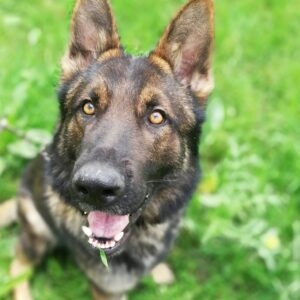
A combination of approaches is needed to reduce poaching, each focusing on different links in the wildlife trade chain. When implemented in combination with other measures, one effective method is the use of highly trained conservation canines. These dogs are trained to detect specific wildlife products and, when working at reserve gates and other strategic locations, provide a quick and reliable method of screening vehicles entering for concealed firearms and ammunition and vehicles leaving for wildlife contraband. These dogs thus prevent poachers from using vehicles to carry their weapons into reserves or transport animal parts out. Tracking dogs provide a mechanism to locate incursion entry and exit points along reserve boundaries, track poachers inside reserves, and, if they do not catch up with poachers, can identify routes taken, providing critical data for predicting future poacher movements.
Under this grant, the EWT will support seven reserves threatened by poaching by providing them with detection or tracking dogs, training for dog handlers, as well as ongoing support for dog-handler teams. Three reserves will receive detection dogs, two will receive tracking dogs, and two, which already have dogs, will receive support for their current dogs and handlers. All seven reserves have rhinos and some of the other threatened species mentioned above, and all have experienced revenue losses because of tourist travel bans resulting from COVID-19. This has severely limited their ability to generate sufficient income to maintain functioning conservation canine units to support their anti-poaching defence.
So far, we have three dogs and one new handler undergoing initial training which will be certified before deployment. We are grateful to IUCN Save Our Species and the European Union for the generous support in our fight to protect our threatened species against poaching.


This publication was produced with the financial support of the European Union through IUCN Save Our Species. Its contents are the sole responsibility of the Endangered Wildlife Trust and do not necessarily reflect the views of IUCN or the European Union.
LATEST STORIES

Message From Our CEO: Finding Hope in Conservation’s Daily Wins
This Message From Our CEO, Yolan Friedmann, reflects on a month of meaningful celebrations and conservation progress. September brought numerous special days – from International Rhino Day to National Arbour Day – each reminding us of nature’s fragility and our collective responsibility to protect it.
September Highlights at EWT
We celebrated significant achievements:
- New hiking trails launched in the Soutpansberg Protected Area
- Conservation Canines honoured for their anti-poaching work
- Pilanesberg National Park secured critical anti-poaching funding
- Living Legacy forest planted to honour bequest donors
- New team members joined our growing conservation force
A Time for Renewed Perspective
In challenging times marked by:
- The ongoing pandemic
- Economic pressures
- Environmental threats
We must cherish each day’s opportunities to:
- Protect endangered species
- Restore habitats
- Inspire future conservationists
“In an imperfect world, we must celebrate the chances each new day brings to make things better,” notes Friedmann. “Every day should be a special day for conservation.”
As spring renews our landscapes, let it renew our commitment to safeguarding South Africa’s natural heritage.
Contact our CEO: yolanf@ewt.org.za
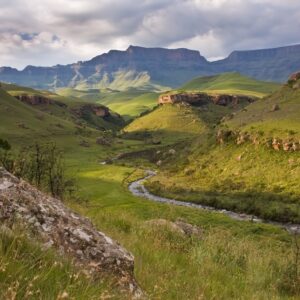
Conservation-conscious Developments: A New Era for South African Ecology
The push for conservation-conscious developments has reached a milestone with South Africa’s national Environmental Screening Tool. This digital platform, developed by the Department of Forestry, Fisheries and Environment (DFFE), helps developers identify and protect sensitive ecosystems before breaking ground – a game-changer for biodiversity protection.
How the Tool Works
The web-based system cross-references proposed sites with:
- 4,633 plant species and 425 animal species data
- Cultural and archaeological heritage sites
- Priority habitats from SANBI and BirdLife South Africa
- Real-time sensitivity mapping across all provinces
“This prevents the oversight of threatened species that often disguise themselves or appear seasonally,” explains Dr Dominic Henry of EWT, who helped develop the tool.
Conservation-conscious developments: Standardising Environmental Assessments
New protocols (gazetted October 2020) now mandate:
- Minimum data requirements for specialist studies
- Consistent impact assessment methodologies
- Clear guidelines for reporting on Species of Conservation Concern
Why This Matters Now
With South Africa:
- Ranking as the 12th largest carbon emitter
- Accelerating renewable energy projects
- Facing increased rural development pressures
The tool balances economic growth with ecological protection – ensuring conservation-conscious developments become the norm rather than the exception.
Public Participation Encouraged
Citizens can use the open-access tool to:
- Identify local species of concern
- Submit informed comments on development proposals
- Advocate for better project siting
“This is a paradigm shift,” notes SANBI’s Domitilla Raimondo. “For the first time, everyone from developers to community members can access the same biodiversity data during planning stages.”
THE INAUGURAL GLOBAL CONGRESS FOR LINEAR INFRASTRUCTURE AND ENVIRONMENT
Wendy Collinson-Jonker, Endangered Wildlife Trust, wendyc@ewt.org.za The Endangered Wildlife Trust and the International Conference on Ecology and Transportation, otherwise known as ICOET, hosted the virtual Global Congress for Linear Infrastructure and Environment, on 20 and 21 September. With over 100 delegates from 24 different countries, the congress, aimed to provide a new opportunity for a global gathering that includes both the intellectual content of a scientific conference and the international reach of the United Nations and Sustainable Development Goals.
Linear infrastructure is essential for connecting society: our systems of roads, railways, pipelines, and power lines all serve to link our cities, developments and resources, and our energy and water supplies. Therefore, it is perhaps ironic that linear infrastructure does exactly the opposite for natural systems – by crisscrossing landscapes, linear infrastructure serves to fragment ecosystems, isolate populations, and reduce natural flows. Roads, railways, fences, and power lines constrain animal movements. They pose direct threats to species from collisions and indirect threats by increasing access by people to previously untapped resources.
Currently, there are five active continental conferences. The Infrastructure and Ecology Network Europe, or IENE, was established in 1996, whilst the International Conference on Ecology and Transportation, or ICOET, started in 1999, with a primary focus on the United States and North America. Both conferences presented the development of a new field of ecology. In 2009, the Australasian Network for Ecology and Transportation (ANET) commenced, followed by the Congresso Iberoamericano de Biodiversidade e Infraestrutura Viária or CIBIV in 2010 and then the newest, the African Conference for Linear Infrastructure and Ecology in 2019.
Each of these conferences has representatives from industry (e.g., planning, engineering, construction), representatives from transport, regulatory, planning, and environmental agencies at all levels of government, research institutions, non-government organisations, environmental consultants, and community groups (e.g., wildlife carers, environmental groups). While these conferences promote international participation, they are inherently focused on the work and issues important to their host continent, but they have joined forces for the Global Congress for Linear Infrastructure and Environment. GCLIE is intended to complement the existing continental conferences on transportation ecology by providing a platform that focuses on broader, higher-level, global issues and policies that can influence national and international knowledge sharing and bring about positive change. The Global Congress will facilitate truly global opportunities for conversation and debate issues that create bridges between and push the boundaries outside of our respective continental conferences, aiming to improve our understanding of world issues and influence action at this scale.
Building on the achievements of the continental conferences, the event also aims to develop tools (e.g., scientific briefs on particular topics) for influencing global decision-makers to aim for more sustainable new and existing linear infrastructure. The event is organised back-to-back with ICOET held virtually from 22-30 September 2021.
After nearly a year and a half of the global pandemic, we’re all extremely familiar with online engagement, and the online format has certainly enabled the participation of people from afar and will allow for constructive interaction among participants. By bringing together a diverse range of participants from across the world, GCLIE is fostering a community of practice that will collectively answer some of the most challenging questions of our time.
“I attended the GCLIE as a precursor to the 2021 ICOET conference. This congress was a truly comprehensive global overview of the factors fragmenting habitat, disturbing ecological functions, and impeding the necessary and natural movement of wildlife at multiple scales. Throughout the congress the conceptual framework of thinking globally and acting locally manifest in the case studies and policy level presentations and discussions. The GCLIE was an opportunity to identify commonalities, both great and small, that transcend geopolitical boundaries and align practitioners, academics, and policy-makers for success. The virtual format facilitated global participation and representation. Very well done. I look forward to the next GCLIE.”
– Chris Slesar | Environmental Resource Coordinator, Vermont Agency of Transportation, USA
“GCLIE was the first opportunity to discuss research and policy related to mitigating the impacts of linear infrastructure at a global level – involving a high diversity of researchers and practitioners with experience from all around the world. It felt reassuring to notice that different continents face similar challenges and to discuss together how we can all collaborate to overcome them.”
Dr. Fernanda Z. Teixeira, Postdoctoral researcher, Ecology Graduate Program, Federal University of Rio Grande do Sul (UFRGS)
“I had the pleasure this week to participate in the coming together of a global forum on transportation and the environment. The world is being transformed at an unprecedented speed through the construction of roads, railways, pipelines and other transportation infrastructure, and GCLIE must play a pivotal role in ensuring the infrastructure that is planned and built today has a positive impact on society and the natural environment. The need for GCLIE has never been more critical – and I am excited to see how GCLIE develops in the years ahead.”
Dr Rodney van der Ree, National Technical Executive – Ecology, WSP Australia Pty Limited
GCLIE 2021 not only provided a necessary bridge between existing continental communities of practice but begun the critical work of leveraging national and continental solutions to generate a global movement for ecologically sustainable linear infrastructure. Sarah Chiles, Landscape Infrastructure Advisor – Kenya, Ewaso Lions & Grevy’s Zebra Trust
LATEST STORIES
Water for Life: Transforming Health and Conservation in Kutama
The Water for Life initiative, a partnership between the Endangered Wildlife Trust and Coca-Cola Foundation’s RAIN programme, is tackling critical water, health and sanitation challenges in Kutama near the Soutpansberg mountains. This holistic project addresses two fundamental needs: clean water access and menstrual health education.
The Twin Crises We’re Addressing
- Water and Sanitation
- Diarrhoeal diseases caused 1.6 million deaths globally in 2017 (Our World in Data)
- Many communities lack clean water for basic handwashing
- Our school programmes teach germ transmission and proper hygiene
- Menstrual Health
- 400 secondary school girls receiving reusable sanitary pads
- Focus groups providing vital health education
- Combating stigma while reducing waste (Ecological impact research)
Water for Life: Environmental Benefits
The initiative extends beyond immediate human needs:
- Alien plant clearing improves watershed function
- Reduced sanitary waste protects ecosystems
- Healthier communities support conservation efforts
See EWT’s Work in Action
Discover more about our Soutpansberg conservation work in our Forgotten Mountain video.
For project details, contact Dr Jenny Botha: jennyb@ewt.org.za
Science Snippets: Vultures’ Power – Traditional Use and Conservation Concerns
New Research on Vulture Use in Traditional Medicine
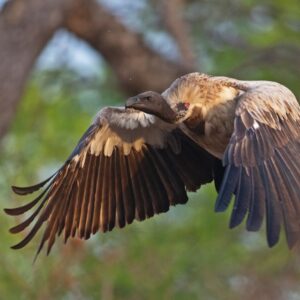
A published paper co-authored by EWT scientists* examines the complex relationship between traditional healing practices and vulture conservation in South Africa. This Science Snippets: Vultures’ Power study, titled Uses of Vultures in Traditional Medicines in the Kruger to Canyons Biosphere Region, South Africa, reveals critical insights into how cultural beliefs impact endangered vulture populations.
Key Findings from the Research
The study documents:
- Interviews with 51 traditional healers in Mpumalanga and Limpopo provinces
- Specific vulture parts used for different purposes:
- Brains: Believed to enhance clairvoyance
- Hearts: Thought to increase intelligence
- Livers: Used to promote prophetic dreams
- Mixed preparations: For employment-related purposes
Conservation Impacts
The research highlights alarming trends:
- Supply chain issues:
- Most vultures obtained through poisoning or trapping
- Single poisoning events often kill multiple birds
- Prices range from ZAR300 to ZAR1,500 per bird
- Population threats:
- Estimated 400-800 vultures used annually in the study region
- Cape vultures most sought-after for perceived potency
- Some healers report using up to 10 birds per year
Recommendations for Sustainable Coexistence
The authors propose balanced solutions:
- Developing alternatives: Promoting non-vulture ingredients for traditional medicine
- Community engagement: Educating about vultures’ ecological importance
- Policy reinforcement: Strengthening enforcement against illegal wildlife trade
- Monitoring programmes: Tracking vulture populations and trade patterns
The Way Forward
This Science Snippets: Vultures’ Power research provides crucial data to inform conservation strategies. While respecting cultural traditions, the study emphasises the urgent need to protect vulture populations that:
- Maintain ecosystem health through carcass removal
- Provide disease control by preventing pathogen spread
- Offer economic benefits to livestock farmers
Read the full study:
Journal of Raptor Research
Citation:
Mashele, N., Thompson, L.J., & Downs, C.T. (2021). Uses of Vultures in Traditional Medicines in the Kruger to Canyons Biosphere Region, South Africa. Journal of Raptor Research 55(3).
CONSERVATION CHAMPION
vc_column_text css=”.vc_custom_1633342873766{padding-top: 5px !important;padding-right: 5px !important;padding-bottom: 5px !important;padding-left: 5px !important;background-color: #ffffff !important;}”]A very big thank you to Nika Viljoen, who raised R5,600 for the EWT at her school, Potchefstroom Gymnasium, by encouraging learners to wear flip-flops for the day in exchange for a donation. This is what she had to say:
“I have always been someone who cares and who wants to make some kind of difference and this side of me started to really itch when I was 12/13. I would always try and come up with some kind of idea to do something, to help someone or make an impact, and that’s when the thought occurred to me to do a fundraiser. I came across the EWT, and everything they do immediately pulled me in. Nature and the incredible creatures God gifted us has always held a special place in my heart, and the fact that we are killing them, destroying their homes and taking away their families devastated me, and I knew I had to do something, anything to try and help, and raising funds for EWT was the perfect opportunity.”
I feel like we raised some good funds and I am eternally and incredibly grateful for the opportunity I got, but I am definitely not going to stop there. I will keep on trying to make a difference, step by step.”
“We need your help! The global covid crisis has shown us more than ever how important it is to work together to support the future of our planet – the people, the environment and the animals within it.
We will be running together and on our own over the next few months, and we will add our distances together to make up the 535 km journey from our school to Big Ben in London. We hope you will cheer us on by donating to this very worthy charity – www.ewt.org.za”
