EWT Golf Fundraiser May 2022: A Success for Wildlife
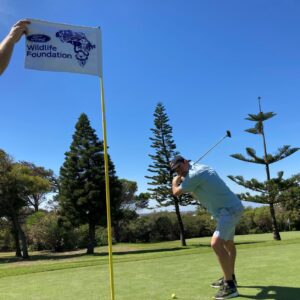
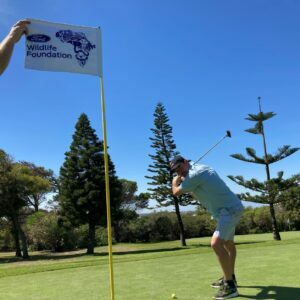
The EWT Golf Fundraiser May 2022 was a major success. Thanks to Alex Forbes, our headline sponsor, golfers gathered at Stellenbosch Golf Club on 20 May 2022. The weather was perfect, and the stunning winelands provided a beautiful backdrop. Most importantly, the event raised vital funds for the Endangered Wildlife Trust (EWT) to protect Africa’s threatened species.
We owe special thanks to Sarah Raine for her hard work. Additionally, we appreciate every golfer and sponsor who made this day possible. Because of your support, the EWT can continue its critical conservation efforts.
Gratitude to Our Sponsors & Partners
This event succeeded thanks to our generous supporters:
Alex Forbes, Painted Wolf Wines, La Motte, Warwick, Thelema, Cavalli, Remhoogte, Glenelly, Alto, Meerlust, Hill & Dale, Spier, Klein Welmoed, Stellenbosch Hills, Val du Vie, Bellevue, Stellenbosch Kitchen, Ginos, La Pineta, Java Cafe Bistro, De Stormme, Juvenate, Le Simme, Post & Pepper, Pirates, Rome in a Bite, Du Vin, Noop, Asta Italian, Arkeste, Genke, Craft Wheat & Hops, Monnneaux, Hygge Hygge, De Wingerd, Long Table, Die Wingerd, Aha Hotel & Lodge, Stellenbosch Hotel, Lanzerac Hotel & Spa, The Log Cabin, Majeka House Spa, Mooiplaas Manor, Pearl Valley, Grande Roche Hotel & Spa, Wedgeview Spa, Windsor House, Ocean Golf Guest House, Nova Constantia Boutique Residence, Studio Ngong, Q20, Spanjaard, Lighter For Nature, Canon, Miir, Peninsula Beverages, Westlake Golf Club, Stellenbosch Golf Club, Africa’s Legends.
Your support makes a real difference. The EWT Golf Fundraiser May 2022 was more than just golf—it was a step toward saving wildlife.
We look forward to future events and thank you for joining this important cause!
The funds raised from this event will go towards our critical conservation activities and help us continue saving species, conserving habitats and benefitting people.
Check out our Events page for more exciting events near you!
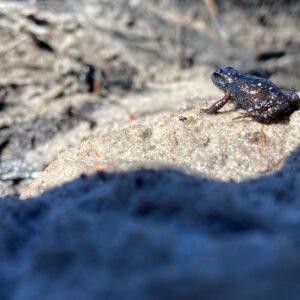
Rough Moss Frog (Arthroleptella rugosa). Photo credit: Johan du Plessis
The Rough Moss Frog (Arthroleptella rugosa) is a Critically Endangered frog species found only on a single mountain range, the Klein Swartberg, in the Overberg district of the Western Cape, South Africa. In 2020 we realized that this little frog was in big trouble. Its habitat was being degraded rapidly by alien invasive vegetation to such an extent that the survival of the only known population of this species was uncertain.
With this realization, the Endangered Wildlife Trust (EWT) approached the IUCN Save Our Species fund for support to implement a critical rapid action intervention to save this population. In 2021, the IUCN Save Our Species answered the plea for assistance with co-funding from the European Union. This support allowed us to develop a firebreak system around this original population of Rough Moss Frogs. This critical intervention supported the planning of an ecological burn in 2022 as a tool to manage an extensive pine infestation that was damaging the population’s seepage habitat. This was a novel approach to amphibian species conservation on the Klein Swartberg Mountain, not least globally.
During the surveys supported by the SOS project, an additional three populations of this species were recorded on the Klein Swartberg by project partner Bionerds PTY Ltd. This was a welcome discovery, bringing the known populations to four. Two of these newly discovered populations were in well-managed natural habitats, also good news for the species!
On 16 March 2022, the firebreaks and planning for the ecological fire were completed by our contractor, Enviro Wildfire, through the employment of an alien vegetation clearing team from the local community of Caledon. The planned ecological burn took place during the week of 28 March 2022. The ecological burn was intended to eradicate invasive pine trees and allow for the recovery of natural fynbos vegetation, not only for the conservation of the Rough Moss Frog population but also for various other Endangered plants and animals. This intervention will also benefit the local community living in the catchment zone below the Klein Swartberg by increasing the water yield from the mountain draining into the aquatic systems in the seeps and rivers and the agricultural community reliant on these water resources.
Team preparing firebreaks in the Klein Swartberg, Western Cape, South Africa. Photo credit: Johan du Plessis
The burn was successful, with very few invasive alien pine trees remaining. And those that survived will be cleared mechanically in the coming months, alongside the development of a long-term alien vegetation clearing plan covering the full extent of the mountain and supported by project partners, the Klein Swartberg Conservancy and the Fynbos Trust. In addition to the 800 ha planned for the burn, over 4,500 ha of the mountain also burnt, including the three additional Rough Moss Frog population sites discovered during the project. Post-fire monitoring by the team has happily confirmed the presence of Rough Moss Frogs at one of the burn sites. These populations will be continuously monitored over the coming breeding season (June onwards). This monitoring will include post-fire bioacoustics monitoring (recording of frog calls) to compare with pre-fire recordings to document the recovery of these populations in the coming years as habitat is restored.
Southern slope after ecological burn in the Klein Swartberg, Western Cape, South Africa. Photo credit: Johan du Plessis
The project not only achieved its objective of significantly reducing the threat of invasive vegetation to the original population but also forged partnerships, discovered previously unknown populations of a Critically Endangered species and initiated formal habitat protection processes for five properties where the species is now known to occur.
This project is supported by IUCN Save Our Species and co-funded by the European Union. The contents of this publication are the sole responsibility of the Endangered Wildlife Trust and do not necessarily reflect the views of IUCN or the European Union.
So far, we have deployed two tracking dogs in reserves and will soon be deploying a further four, including both tracking and detection dogs. We have also supported the full training of two new handlers and partial training for a third handler through our relationship with Genesis K9 Group. Furthermore, we provide ongoing support to these deployed dogs and the handlers who have recently completed their training to reinforce what they have learned.
This project is supported by IUCN Save Our Species and co-funded by the European Union. The contents of this publication are the sole responsibility of the Endangered Wildlife Trust and do not necessarily reflect the views of IUCN or the European Union.
LATEST STORIES
Thanks to this grant, the EWT supports seven reserves that have many ecologically and economically important species threatened by poaching. We are taking a three-pronged approach that includes deploying freshly trained young Conservation Canines (trained in detection or tracking), training dog handlers who will be responsible for working with and looking after these dogs and supporting these dog-handler teams in these reserves to ensure they have what they need to work effectively.
Black Rhino (Diceros bicornis) in the Eastern Cape, South Africa. The Black Rhino is threatened by the illegal trade in rhino horn products. Photo credit: the african eye
The reserves we are assisting suffered income losses during the COVID-19 pandemic due to tourist travel bans, and we aim to support them through these hard economic times. Many reserves at risk of poaching use a variety of approaches to combat it, with anti-poaching field rangers commonly the first line of defence. Certified dog-handler teams can provide invaluable support to these teams on the ground in several ways. Our dogs either track poacher incursion routes within a reserve or provide a quick and reliable method for screening vehicles for concealed firearms or wildlife contraband.
So far, we have deployed two tracking dogs in reserves and will soon be deploying a further four, including both tracking and detection dogs. We have also supported the full training of two new handlers and partial training for a third handler through our relationship with Genesis K9 Group. Furthermore, we provide ongoing support to these deployed dogs and the handlers who have recently completed their training to reinforce what they have learned.
Conservation Canine Nala, a three-year old Belgian Malinois recently deployed in the Eastern Cape. Nala is a tracking dog and works with anti-poaching teams to protect threatened species.
This project is supported by IUCN Save Our Species and co-funded by the European Union. The contents of this publication are the sole responsibility of the Endangered Wildlife Trust and do not necessarily reflect the views of IUCN or the European Union.
LATEST STORIES
Conservation Canines to Save our Species from illegal wildlife trade
Dr Andrew Taylor, EWT’s Wildlife in Trade Programme Manager, andrewt@ewt.org.za
South Africa is blessed with exceptional wildlife and landscapes that attract tourists and boost our economy. Some of our country’s biggest drawcards, such as White and Black rhinos (which are Near Threatened and Critically Endangered, respectively on the IUCN Red List of Threatened Species), the African Savannah Elephant (Endangered), and the African Lion (Vulnerable), play vital roles in our ecosystems while also bringing in valuable ecotourism income. However, these species are threatened by the global illegal wildlife trade (IWT), which is a major cause of population declines in some countries. With funding from the IUCN Save Our Species Rapid Action Grant and the European Union, the Endangered Wildlife Trust (EWT) aims to reduce IWT by preventing wildlife poaching. We use our Conservation Canines to achieve this by training and deploying them to detect wildlife products and track poachers.
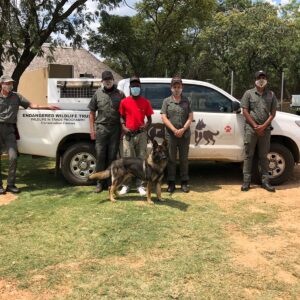
Newly qualified dog handler trained at Genesis K9 Newly qualified dog handler trained to reduce poaching as part of the project funded by the IUCN Save Our Species Rapid Action Grant and the European Union.
Thanks to this grant, the EWT supports seven reserves that have many ecologically and economically important species threatened by poaching. We are taking a three-pronged approach that includes deploying freshly trained young Conservation Canines (trained in detection or tracking), training dog handlers who will be responsible for working with and looking after these dogs and supporting these dog-handler teams in these reserves to ensure they have what they need to work effectively.
Black Rhino (Diceros bicornis) in the Eastern Cape, South Africa. The Black Rhino is threatened by the illegal trade in rhino horn products. Photo credit: the african eye
The reserves we are assisting suffered income losses during the COVID-19 pandemic due to tourist travel bans, and we aim to support them through these hard economic times. Many reserves at risk of poaching use a variety of approaches to combat it, with anti-poaching field rangers commonly the first line of defence. Certified dog-handler teams can provide invaluable support to these teams on the ground in several ways. Our dogs either track poacher incursion routes within a reserve or provide a quick and reliable method for screening vehicles for concealed firearms or wildlife contraband.
So far, we have deployed two tracking dogs in reserves and will soon be deploying a further four, including both tracking and detection dogs. We have also supported the full training of two new handlers and partial training for a third handler through our relationship with Genesis K9 Group. Furthermore, we provide ongoing support to these deployed dogs and the handlers who have recently completed their training to reinforce what they have learned.
Conservation Canine Nala, a three-year old Belgian Malinois recently deployed in the Eastern Cape. Nala is a tracking dog and works with anti-poaching teams to protect threatened species.
This project is supported by IUCN Save Our Species and co-funded by the European Union. The contents of this publication are the sole responsibility of the Endangered Wildlife Trust and do not necessarily reflect the views of IUCN or the European Union.
Dr Jenny Botha, EWT’s People in Conservation Manager, jennyb@ewt.org.za
“Such a blessing,” the young girl murmured as she received samples of reusable sanitary pads as part of a Water, Health, and Hygiene (WASH) project the EWT is implementing in Kutama, a vibrant area consisting of nine villages situated at the foot of the majestic Soutpansberg mountains in the Vhembe Biosphere Reserve. Despite most residents being innovative and self-driven, unemployment levels are high, and many families struggle financially, as is common throughout South Africa. Those who are fortunate enough to have a job often work far from home, leaving children in the care of grandparents or other caregivers. Despite progress in addressing global water and sanitation deficits, in 2017 approximately 1.6 million people died of diarrheal diseases. Many of these disease are spread through contaminated hands. Safe water, sanitation and hygiene underpin human, animal, and environmental health. Yet millions still lack access to clean water and basic hygiene products and information on germ transmission and risks to human and environmental health is often lacking or inaccurate.
Washing with soap is an effective and cost effective way to save lives. Moreover, by reducing exposure to a range of infectious diseases, it also reduces absenteeism through illness from work and school.With over 80% of households in Kutama deriving a monthly income of less than R3,200, purchasing basic necessities is challenging, and, as with many communities in South Africa, sanitary pads are unaffordable for many women and girls.
The Endangered Wildlife Trust (EWT) started the WASH project in 2019 as part of an integrated water conservation project in the Soutpansberg in partnership with the Coca-Cola Foundation’s Replenish Africa Initiative (RAIN). In the first year, we developed and piloted interactive lessons and teaching aids on germ transmission and hand washing, which were implemented alongside primary school educators in the classroom, reaching over 700 learners.
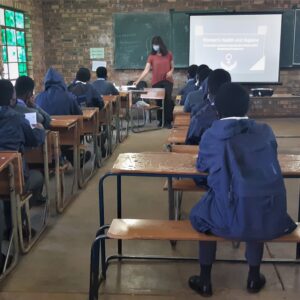
Primary School Germ Transmission Activity in Kutama, Limpopo
The timing of this project was fortuitous, for, in March 2020, the Covid-19 pandemic hit South Africa. Regular handwashing has always been critically important to reduce the spread of serious infections, diarrhoea, and other illnesses, especially in children. However, this simple activity and other stringent hygiene measures have become a global imperative. In 2020 we introduced additional curriculum-based learning materials to approximately 475 primary school learners to reinforce handwashing and related health messages in fun, interactive ways, and in 2021, we reached a further 800 learners and their teachers. Educators were provided with resource packs to enable them to continue implementing the germ transmission and handwashing lessons to learners on an ongoing basis.
To support secondary schools in Kutama, we developed educational resources on women’s health and hygiene and held focus group discussions with 440 girls from grades 8-11 in two secondary schools in collaboration with their Life Orientation educators. We also gave each learner and some educators and school staff reusable sanitary pads to try.
Apart from assisting families financially, quality reusable sanitary pads can last for up to three years. It has been estimated that the average woman will use approximately 11,000 sanitary pads during her lifetime. Globally, municipalities and sanitation personnel are grappling to cope with the waste generated from sanitary materials, which ends up in landfills or flushed into sewerage systems, where it causes major management headaches. Substituting disposable sanitary pads or tampons with reusable pads or menstrual cups costs far less and substantially reduces the impacts of waste on water and the environment.
Our aim going forward is to gradually roll out similar WASH projects in other primary and secondary schools across all the EWT’s project sites in South Africa. Through our Education for Sustainable Development project, the Guardians of the Future, we will continue working with educators to co-develop additional curriculum-aligned interactive teaching aids and educational resources to support teaching in subjects such as Natural Science and Technology, Life Orientation, Social Sciences, and other subjects. Through these and similar interventions, we aim to support schools in developing capable, confident, and scientifically literate youth who understand the interwoven connections between people and nature and the value of collective efforts to reduce our environmental footprints and live more sustainably.
Learners walking home from school in Kutama
Thank you to the Coca-cola Foundation for sponsoring this project under its Replenish Africa Initiative (RAIN) and to the Ford Foundation for ensuring that we can get to schools and other project sites easily, no matter where they are.
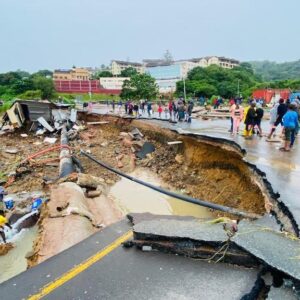
yolanf@ewt.org.za The recent Durban floods made history for all the wrong reasons and the devastation and mayhem caused shocks to thousands of people, our economy, and our environment. Much has been said, and there is almost no room to say much else if it weren’t for us needing to take stock of how a significant amount of the impact could have been prevented. And I don’t only mean addressing the complexity of reducing human-induced climate change, as the jury is still out if this was a climate change-related event. It is tricky to attribute extreme weather events to climate change anywhere, but more so in KwaZulu-Natal, where the lack of comprehensive long-term rainfall records makes systematic climate analysis close to impossible. And given that extreme weather events do occur, to attribute them all to climate change requires much more robust record-keeping and scientific evaluation.
What we do know is that over the 24-hours on 11 April, more than 300 mm of rain fell over KZN, around 75% of South Africa’s annual precipitation. These rains were caused by a cold-weather system that seldom reaches South Africa but often causes large-scale destruction in Mozambique. Much of the havoc was unavoidable, but let’s focus on what should not have happened. Mass landslides triggered by destabilised ridges and embankments due to the removal of indigenous vegetation and land clearing for development could have been reduced, and some even prevented entirely. Stormwater drains that were clogged with litter or overgrown weeds could have cleared roads and infrastructure of lethal water levels, and well-maintained infrastructure dealing with sewage management and water provision may have withstood the floods or been offline for less time, thus reducing a human healthcare catastrophe. Fast-moving debris that killed people and destroyed homes, in many cases resulted from illegal dumping and poor construction, and the tons of plastic, waste and rubble that now litters beaches and riverbanks will be pillars paying tribute to the role of humans in this not-so-natural disaster after all.
Developers who insist on flouting environmental regulations to build into flood lines, strip vegetation, and ignore natural seams should be held accountable for at least a portion of the losses; regulators who sign off on these developments should shoulder a portion, too; and municipalities that ignore spatial planning principles and laws to authorise rampant urban creep should be held accountable for the balance. The lack of well-planned and properly constructed and maintained infrastructure along with reliable service delivery to the most vulnerable communities, combined with the overcrowded inhabitation by millions of vulnerable people in shacks built on steep hillsides, riverbanks and in valleys, played a big role in the increased death toll from the floods and mudslides.
As the floodwaters began to subside, stories of triumph and heroism emerged to bear testimony to human resilience and the spirit of survival. People came together to support, assist, and care for one another. The reality is that this spirit of common purpose, Ubuntu, and mutual dependence must prevail if we are to prevent similar devastation in the future. We may not be able to control weather systems and extreme rainfall, but we MUST prepare for it by taking heed of our reliance on intact habitats and our susceptibility to the power of nature; our vulnerability to natural processes that we cannot control and, therefore our need to protect the natural systems designed to protect us from those very events. The KZN floods demonstrated the dire need for entrenching sustainability into our development plans and paying due regard to the integration of intact natural systems into spatial planning as opposed to the removal thereof as an obstacle to progress. The adherence to environmental regulations, and the promotion of climate education, robust monitoring, functional early warning systems, maintained and functioning infrastructure, and equitable social development should all underpin the rebuilding of KZN with resilience as the cornerstone of all rebuilding and planning in this province and its cities which are arguably the most vulnerable to weather events and climate change going forward. Without this, rest assured that this WILL happen again.
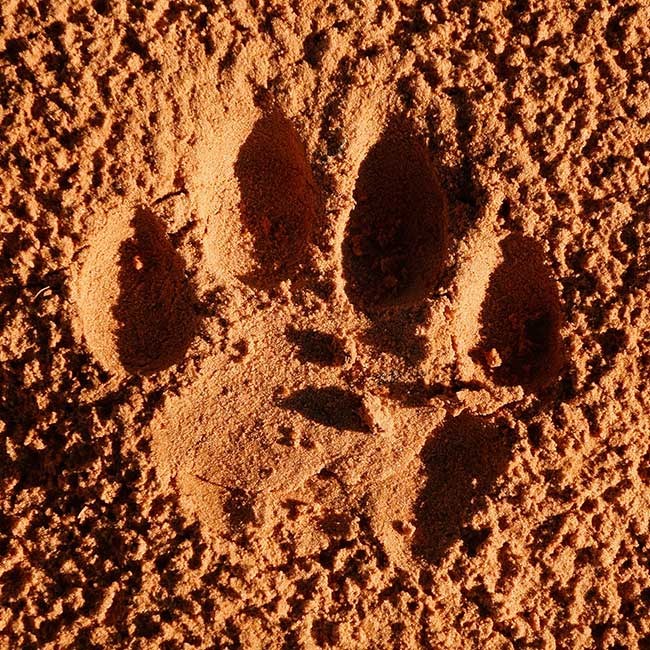
Hey guys! Thanks for all the attention – I know I’m super cute! So, I thought you might like to hear a bit about me. I joined the Endangered Wildlife Trust’s pack as a Conservation Canine Cadet in March 2022. Boy was I nervous! Here were all of my heroes and little old me – leaping after them to follow in their paw prints. But I was born to do this job! Join me on my adventure as I prove I have what it takes to become a canine defender of wildlife.
Becoming a Conservation Canine is a lot of work, takes a lot of time, and treats (and Sean’s shoes) aren’t cheap! And I can’t rush it. I think it’s because, if I skip steps, I won’t be ready for all the situations I might come across if I qualify one day (claws crossed). Well that’s what I’ve been told anyway – so far I’ve been playing and racing around meeting the staff at the EWT’s Conservation Campus – easy peasy! Apparently I don’t do any real work for the first few months. Tough life hey? I’m just supposed to go everywhere and see everything I possibly can so nothing scares me (as if!). I think I heard them say it’s also so I don’t get distracted too easily when I do start working.
Anyway, lots to see and smell but I’ll give you another update soon!
Courtney Maiden, Endangered Wildlife Trust MSc Student
Over 750,000 km of roads crisscross South Africa, and the country’s natural habitats and wildlife are gravely threatened by further road development. Furthermore, with the anticipated increase of vehicles on the roads over the coming years, the likelihood of more wildlife-vehicle collisions is worrying. The Vervet Monkey (Chlorocebus pygerythrus) has adapted to thrive in human-altered landscapes. However, this also means they face many risks from humans and their activities. Vervet monkeys face daily challenges living in an urban environment due to increasing habitat loss and fragmentation. The clearing of treed areas for roads and other purposes forces monkeys to the ground, increasing their risk of being hit by vehicles. An important first step in reducing this outcome is the design of safe and cost-effective structures by which animals can safely cross the road.
Over the past two decades, wildlife crossing structures have been installed to facilitate wildlife movement over or under roads and railways to connect habitats and reduce roadkill. These structures are often custom-designed for each site and according to the needs of the targeted species. Yet, less than a handful of studies look at the effectiveness of different measures in reducing wildlife‐vehicle collisions in South Africa. Moreover, systematic assessments on designing safe and cost‐effective crossing structures for wildlife have not been carried out to date in our country, despite their importance in preventing Vervet Monkeys and other animals from becoming roadkill.
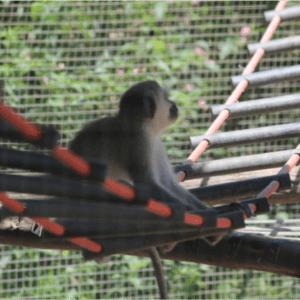
In March 2022, Courtney Maiden from the Endangered Wildlife Trust tested three different canopy bridge designs for Vervet Monkeys to identify one standardised design for the benefit of free‐ranging Vervet Monkey troops. The observational experiments took place at the Centre for the Rehabilitation of Wildlife (CROW) in Durban, where the three bridge designs were installed in two Vervet Monkey enclosures. Testing different canopy bridge designs in an ex-situ environment such as CROW allows us to establish design guidelines that can be used for free-ranging Vervet Monkeys in-situ (in their natural habitat). These ex-situ experiments are vital for understanding how Vervet Monkeys behave on different canopy bridge designs and identifying the most suitable bridge design to increase the likelihood of the bridges being used in the wild.
The bridges were made using polypropylene rope and recycled plastic. The design is adaptable to varying installation lengths, heights, and crossing environments. By observing the monkeys directly and using camera trap footage, we found that the ladder bridge was used most often and showed great potential for being the most suitable design.The positioning of any wildlife crossing structure is equally as important as its design. As the Vervet Monkey is a territorial species with daily foraging paths, installing canopy bridges along preferred movement pathways is vital for maximum benefit. Examining troop territories, crossing areas, and frequency of use can inform the best bridge location. Through the EWT-WTP student mentorship and with help from Wendy Collinson-Jonker (EWT) and Sandra Jacobson (US Forest Service Wildlife Biologist), Courtney has visited potential bridge installation sites in KwaZulu Natal and is currently studying road crossing hotspots to determine where bridges would be most likely to be used as intended.
Once suitable sites have been identified, we can begin the exciting part – testing the design identified as most suitable (the ladder bridge) on free-ranging monkeys. Watch this space for updates! All information and research updates can also be found on Instagram (@wildways_sa), Facebook (Wild Ways South Africa), and EWT platforms.
Provinces challenged to manage their land more sustainably
By Bonnie Schumann, EWT Drylands Conservation Programme, bonnies@ewt.org.za
The UNDP-GEF5 Sustainable Land Management (SLM) Project and the Endangered Wildlife Trust (EWT) recently brought Engineering Technicians and LandCare officials together for a unique SLM challenge. The officials, all experts in soil erosion control, represented four provincial departments of agriculture from the Western-, Eastern- and Northern Cape, and the Free State. The challenge was hosted by the Samara Private Game Reserve near Graaff Reinet, in the Mountain Zebra Camdeboo Protected Environment (MZCPE) in the Eastern Cape, from 7–10 February 2022.
The four teams were tasked to assess three sites on Samara with varying severities of soil erosion that are typically found in the region. The teams were challenged to develop practical, cost-effective and replicable technologies and approaches to addressing the soil erosion issues. The degradation is primarily caused by historical grazing practices that were not ideal and is compounded by continuous grazing by game. What makes veld regeneration in this landscape particularly challenging is the topography in the area. The catchments are large and consist of mostly steep slopes, which result in high volume, very erosive runoff directed towards the lower slopes, where soils are vulnerable to erosion. The protracted drought experienced in the Karoo over the last approximately eight years resulted in a loss of vegetation cover, leaving soils exposed and vulnerable to both wind and water erosion.
The spirit between the provincial teams was positive, open, and cooperative, with high levels of camaraderie. Teams shared survey results, advice, and suggestions. Training of younger technicians formed an integral component of this knowledge sharing initiative. The collective institutional experience of the team was around 400 years, which is really astonishing considering there were only 14 participants. The challenge was concluded with a knowledge-sharing workshop and seminar. Participants on the last day included the Samara Management Team, neighbouring farmers, and two senior government officials from the Western- and Northern Cape responsible for Sustainable Land Management. The provincial teams presented their suggested soil conservation plans, and some lively discussions followed. In summary, all the participants agreed that this wealth of technical knowledge is critically important for SLM and soil conservation in the drylands. We need to ensure that this hard-earned experience and “institutional” knowledge needs to be shared with the next generation of soil technicians.
The next step will entail compiling these case studies and sharing the information with all the stakeholders in the MZCPE and throughout the drylands to encourage soil conservation action. Watch this space!
This initiative formed part of the United Nations Development Programme’s GEF 5 SLM Project – Small Grants initiative. The EWT, through their Karoo Forever SLM project, is responsible for the implementation of small grants in the Karoo landscape.
Science Snippets: Crane populations bounce back after concerted conservation effort in KwaZulu-Natal, South Africa
Erin Adams, Tamsyn Galloway-Griesel, and Lizanne Roxburgh, EWT Science and Planning Unit, erina@ewt.org.za
South Africa is home to three of the four African Crane species. These include South Africa’s national bird, the Blue Crane (listed as Vulnerable on the IUCN Red List), the Grey-crowned Crane (Endangered) and the Wattled Crane (Vulnerable). The three crane species converge within the KwaZulu-Natal province of South Africa (see map), and crane populations declined severely in this region in the 1980s. And as a result, there have since been considerable conservation efforts focused there. Annual aerial surveys have been conducted in this region by the Endangered Wildlife Trust – International Crane Foundation partnership and Ezemvelo KZN Wildlife for many years to monitor crane population sizes. In a recent publication* co-authored by EWT scientists, the results of the long-term aerial surveys were analysed in relation to the conservation initiatives. As cranes’ deaths due to collisions and electrocutions with powerlines are common, particularly amongst young birds, markers were placed on powerlines in high-risk areas to improve visibility and reduce crane mortalities. Another major threat to cranes is habitat loss, and so protecting crane habitats has been one of the major interventions in KwaZulu-Natal. This was achieved by declaring new protected areas, getting willing landowners onboard to maintain crane habitats on their property and involving the general public to become “crane custodians”, who would report any powerline collisions and any crane nest disturbances they may come across. The extent of these initiatives was monitored over 15 years (from 2003 to 2018), along with monitoring crane population numbers with standardised annual aerial surveys to determine whether they increased due to these initiatives.
Within KZN, all three crane populations have slowly but steadily increased in size since 2003. These numbers are directly correlated with the conservation initiatives in the region. The protection of crane habitats has facilitated the return of cranes to previously disturbed areas but are now protected and maintained due to the work of crane custodians. A reduction in crane mortalities due to the increased visibility of marked powerlines has also been recorded.The authors concluded that the conservation initiatives to conserve cranes in KZN have effectively increased the population numbers of these threatened species. It was not possible to determine which conservation initiative, in particular, was the most effective, but rather concluded that a combination of all of these interventions has allowed for an increase in the crane population sizes, and led to this conservation success story.
*Galloway-Griesel, T., Roxburgh, L., Smith, T., McCann, K., Coverdale, B., Craigie, J., Pretorius, M., Nicholson, S., Michael, M., Durgapersad, K., & Chetty, K. (2022). Evidence of the effectiveness of conservation interventions from long-term aerial monitoring of three crane species in KwaZulu-Natal, South Africa. Bird Conservation International, 1-16.
The cat’s out of the bag – understanding South Africa’s captive lion sector
Christina Hiller, EWT Wildlife in Trade Programme Consultant, tinah@ewt.org.za
South Africa is currently the only country with an extensive captive lion sector where lions in captivity significantly outnumber wild and free-roaming animals. There is an ongoing debate around the practices of keeping lions for commercial use, and captive lion hunting, the lion part trade, and human interaction such as cub-petting have been heavily criticised. However, there was a need to establish a detailed understanding of South Africa’s captive lion sector and evaluate its environmental and socio-economic impacts.
The Endangered Wildlife Trust initiated a study to close this information gap by developing an improved understanding of the sector and the trade of captive lion products and services. The research aimed to supply the South African government and the local CITES (Convention on International Trade in Endangered Species of Wild Fauna and Flora) authority with sound information to inform future policy decisions and measures to adequately address the sector’s influences on environmental, economic, and social outcomes and developments.
We conducted 51 semi-structured interviews and verified and supplemented the findings through five focus-group sessions with experts from related fields and desk review activities. Interview parties consisted of 31 captive lion facilities in four provinces, i.e., the Free State, North West, Limpopo and Gauteng and 20 key players in the sector. These actors included professional hunters of captive lions, taxidermists, lion part traders, live lion traders, veterinarians, scientists, non-governmental organisations (NGOs), and provincial environmental management inspectors (EMIs). In addition, we collected quantitative data on captive lion facilities from the South African provinces where the interviews took place to further augment the research findings.The research report describes how the sector is structured and functioning amidst influencing factors such as mainstream and social media pressure, regulatory conditions, and conflicting ideas about the meaning of sustainability and sustainable use regarding an iconic species like the lion.
We found that captive lion owners’ underlying motives and deep-seated attitudes are behind the uniqueness of every captive lion facility’s (business) model. A combination of eleven different motives underpinned the decision to establish a captive lion facility. Only four of those were income-related. It was found that facilities were seldom established primarily for financial gain, suggesting the importance of personal drivers other than income generation and profit. Furthermore, our research revealed five distinctly different sector clusters with corresponding supply chain models and typical breeding systems. Findings suggested that facilities do not specifically breed lions for their bones, so this was not considered a separate cluster. The lion bone trade rather forms part of the hunting tourism cluster.
Cluster 1: No lion revenue cluster
Cluster 2: Sanctuary cluster
Cluster 3: Guest attraction cluster
Cluster 4: Live export cluster
Cluster 5: Hunting tourism cluster (incorporating the lion part trade)
Legal trade in each cluster was organised along a distinct supply chain (except for cluster 1 without lion-related trade activities). All supply chains in the sector are separate, and research did not show an organised supply chain wherein captive lions were hunted after being used for human-lion interactions. However, a shared supply chain segment for selling lions to other South African facilities combined with a lack of traceability makes it feasible to move captive lions between clusters, especially between the guest attraction, live export, and hunting tourism clusters. It was clear that there was little transparency in the sector because of the non-existent, inefficient, or inconsistent collection, storage, and sharing of information about facilities and their trade activities.
The research data suggest that reasonable and tolerable management practices fall into five domains: financial health, legality, conservation, animal welfare, and social responsibility. Moreover, two specific areas emerged as seemingly insurmountable obstacles for managing captive lion facilities. On the one hand, the data suggest that managing a captive lion facility and animal rights are mutually exclusive. On the other hand, the interviews revealed that transformation is not happening, which is why the facilities are deemed not acceptable.
The insights of this research will support more robust decisions about the sector. We conclude that it will be critical to follow a nuanced approach to shape the sector’s future, mindful of the five clusters. Simultaneously, immediate measures ought to be taken to prevent undesired loss or harm until a clear future scenario for the sector materialises.
The report will be released soon – keep an eye on our socials and check back here in a few days for the link.