WE HAVE DOGS IN THE FIGHT AGAINST POACHING
DR ANDREW TAYLOR, EWT WILDLIFE IN TRADE PROGRAMME MANAGER

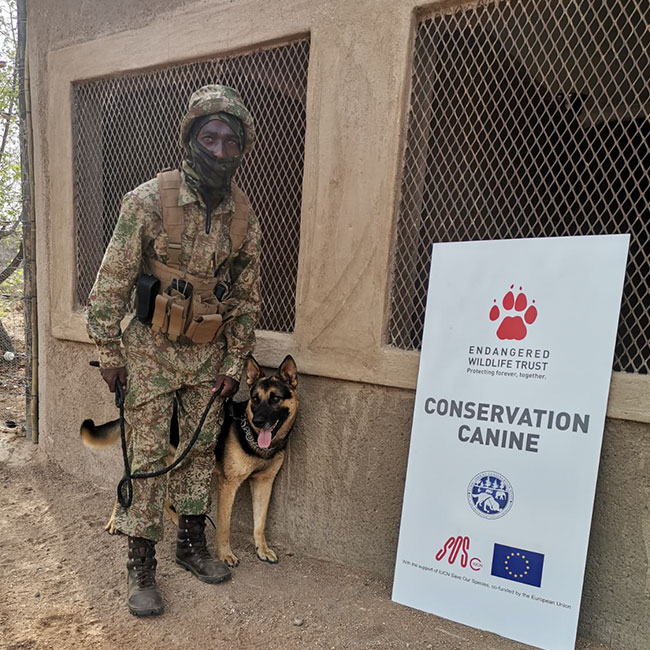
EWT Conservation K9 Bekah and handler Precious
The Endangered Wildlife Trust supports anti-poaching initiatives in game reserves using tracking and detection dogs known as conservation K9s. A project generously funded by the IUCN Save Our Species Rapid Action Grant and the European Union has enabled us to deploy six new dogs over the past year into priority reserves in Limpopo and the Eastern Cape. Although the grant period has ended, the EWT continues to support the reserves to ensure continuity and sustainability of the use of dogs to support their rangers, and our Conservation K9 Project Coordinator, Shadi Henrico, recently visited four of the dogs posted in Limpopo.
Ruger, a male Dutch Shepherd, and Bekah, a female Belgian Malinois sponsored by Global Conservation Force, were deployed to a big five reserve in June 2022. As tracking dogs, Ruger and Bekah walk daily patrols along the fence line with their handler Precious, sniffing out evidence of illegal infiltrations into the reserve that may be related to poaching activity. If someone has entered the reserve through the fence, these dogs will detect their scent and can follow the route they took, allowing Precious to find the trespasser and uncover the intentions behind their incursion.

EWT Conservation K9 Gold and handler Clifford
Gold, a certified detection dog, was deployed to another big five reserve in August 2022, where he is finding his feet and bonding with his newly qualified handler Clifford. Clifford was trained at Genesis K9 with support from the IUCN SOS and the EU, and works with Gold to screen vehicles at entrance gates and other locations to ensure that no contraband is smuggled into or out of the reserve. Gold’s sharp nose can detect firearms, ammunition, rhino horn, elephant ivory, pangolin scales, and lion bones and will immediately alert Clifford if he catches a suspicious whiff so that they can investigate further.
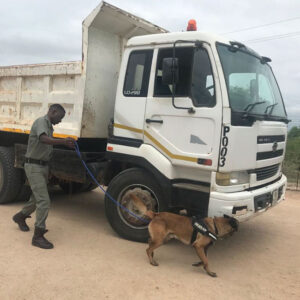
EWT Conservation K9 Juice and handler Kaizer searching vehicles
Juice, a large male Malinois, has been deployed to a reserve in the Associated Private Nature Reserves (APNR) adjacent to Kruger National Park, where he is screening vehicles entering and leaving the reserve. He has been partnered with Kaizer, an experienced dog handler and will be working hard to catch wildlife traffickers. Like Gold, Juice will focus on detecting firearms, ammunition, and threatened wildlife species.
Secrets of the Soutpansberg
Cyrintha Joubert, the EWT’s Soutpansberg Protected Area, Water Conservation Project Coordinator
There are 18 recognised centres of endemism in southern Africa – localised areas with high species diversity found nowhere else. The Soutpansberg Mountain Range is one of these and has the highest plant diversity of all these centres. Many of the Soutpansberg endemic species are rare and threatened. Around 3,000 vascular plant species occur in the 6,800 km² Soutpansberg Mountains. Six biomes are found in the mountains: forest, thicket, savannah, grassland, fynbos, and wetland.
Not only are the species living in the mountains of high conservation value, but they also hold cultural value and have medicinal properties that are sought-after for traditional healing practices and mainstream pharmaceuticals. The EWT strives to conserve these plants in collaboration with partners in the Soutpansberg, ensuring that those who depend on them for any purpose can legally access the species they need sustainably. Here are a few secrets of the Soutpansberg that you may come across should you be lucky enough to visit the area or hike the recently established Old Salt Trail.
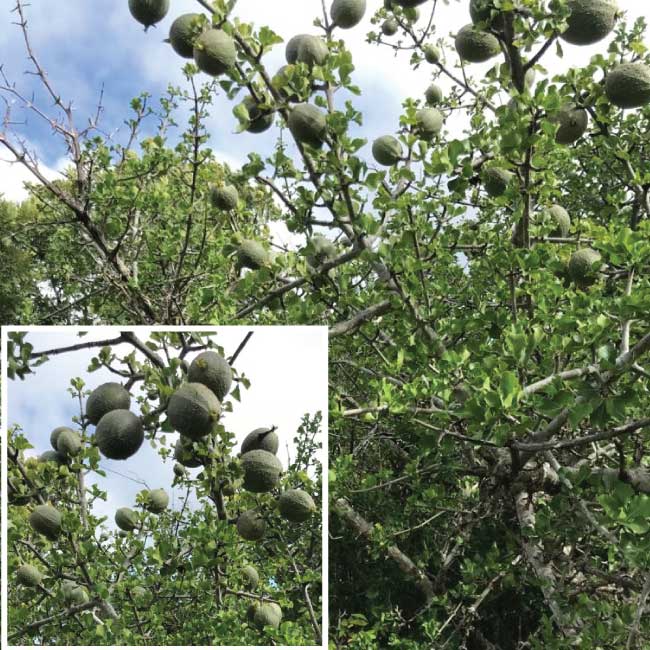
Monkey Orange
Strychnos spinosa
The genus name, Strychnos, is taken from the Greek word for deadly, which refers to poisonous alkaloids contained in the seed integuments. “Spinosa” refers to the spines. The poison strychnine is derived from an Asian species of Strychnos. The seeds should be avoided as they are poisonous or could have purgative effects. The fruit only appears after good rains and has a smooth, hard, yellow look when ripe. Inside the outer ‘shell’ is tightly packed seeds surrounded by a fleshy, edible covering. Most of this plant is used medicinally, with the roots and leaves used to treat certain snake bites. After the seeds have been removed, the dried fruits are used as musical instruments.
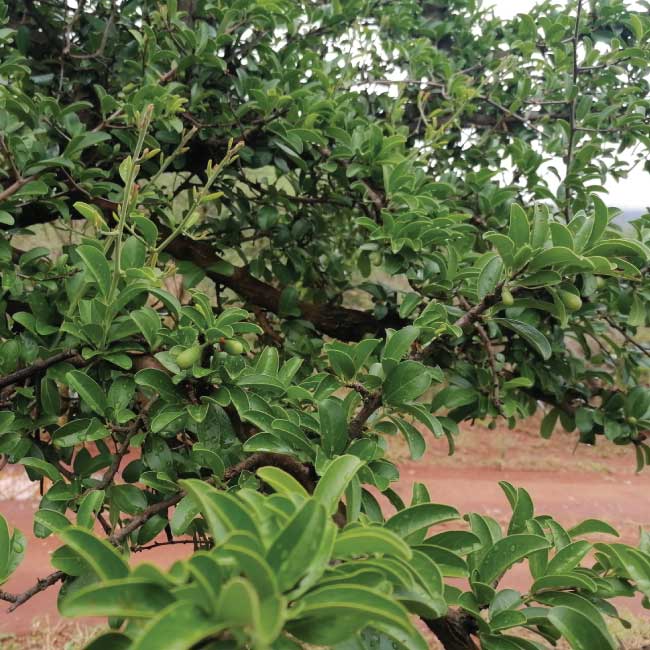
Sour Plum or Monkey Plum
Ximenia caffra
A sour worm with no added sugar! This is an extremely versatile plant, and all parts are used. While the fruit can be eaten fresh, it tastes slightly sour and is often made into jams, desserts, or jellies. As the wood is hard, it is used for making pot handles, firewood, and even for construction purposes. The oil extraction from the seeds has various uses, from cosmetics to the softening of leather. The fruit is high in potassium, and the leaves and roots are used to treat coughs, body pains, and even malaria.
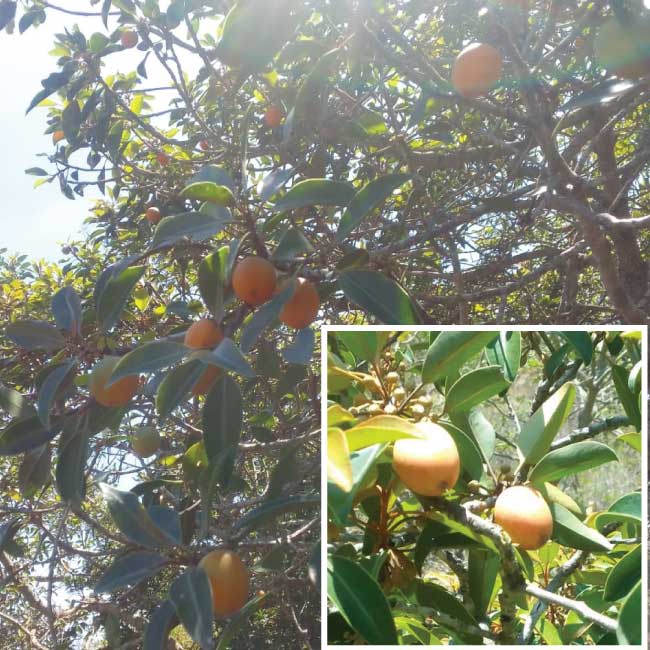
Stem fruit
Englerophytum magalismontanum
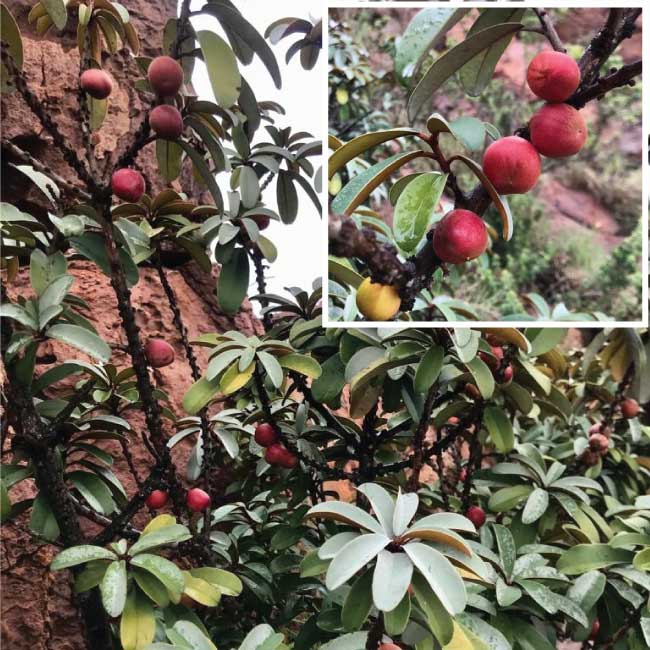
This small to medium-sized evergreen tree has delicious fruits which are extremely high in Vitamin C with a content of 40 mg per 100 g. The fruit is fleshy and contains sticky, milky latex when picked and the skin removed. The tree fruits from December to February. When ripe, the fruit is bright red and can be eaten fresh or used to make jam, wine, and even vinegar. These plants’ roots are also used medicinally to treat rheumatism and abdominal pain. They have beautiful silky golden hairs on the back of the leaves, and the tree has a silvery look from afar.
Transvaal Red Milkwood
Mimusops zeyheri
The botanical name is derived from the Greek mimo, meaning ape, and ops, meaning resembling an ape. This might reference the flowers’ colour or the corolla’s shape. This tree is fairly popular amongst humans, birds, and various primates as it has tasty ripe yellow fruit with a high Vitamin C content.
Some more mobile endemic species to find in the Soutpansberg Mountains
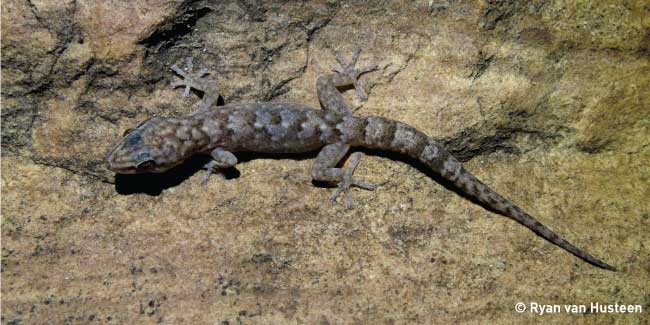
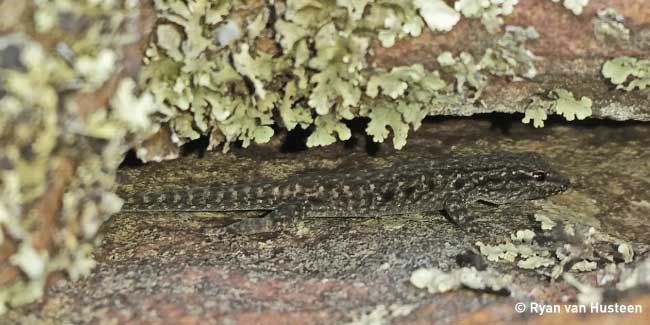
Pienaar's Flat Gecko
Afroedura pienaari
A widespread and abundant gecko that shelters in rock cracks and under loose barks in trees. At night, it forages on rocks, trees, vegetation, and the ground.
Cryptic Dwarf Gecko
Lygodactylus incognitus
This shy gecko lives on trees and rocks and is restricted to the higher altitudes in the mist belt.
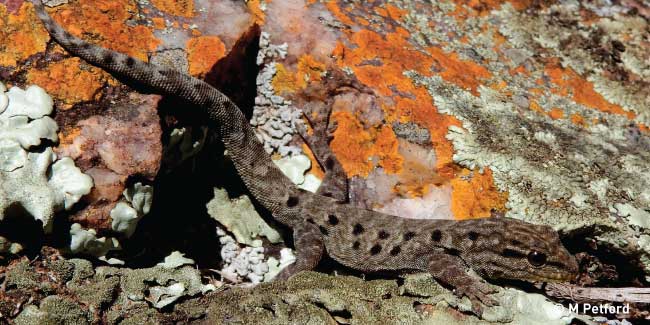
Soutpansberg Dwarf Gecko
Lygodactylus soutpansbergensis
A shy gecko that lives in the rocky areas throughout the Soutpansberg
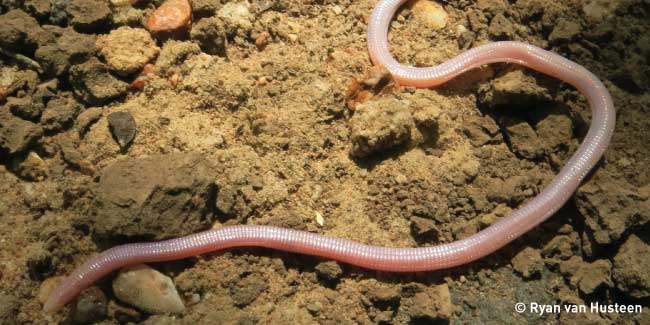
Soutpansberg Worm Lizard
Chirindia langi occidentalis
This lizard is rarely encountered as it spends its life underground. It is locally common in certain areas and absent in others.
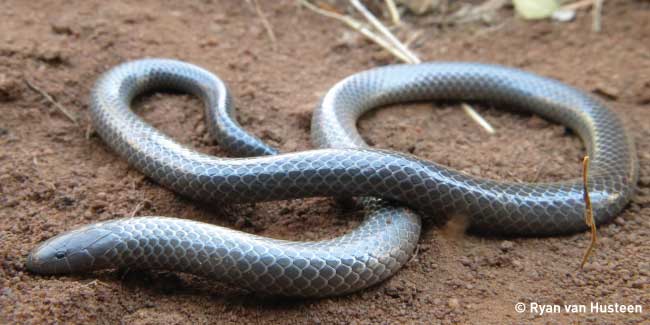
Soutpansberg Purple-glossed Snake
Amblyodipsas microphthalma ssp. nigra
A near-endemic to the Soutpansberg. These snakes spend most of their time underground and occasionally come to the surface to feed and disperse. They can be found in virtually any habitat, from the hot bushveld areas to the montane grassland on top of the Soutpansberg and throughout the mountain range. Limpopo’s only near-endemic snake!
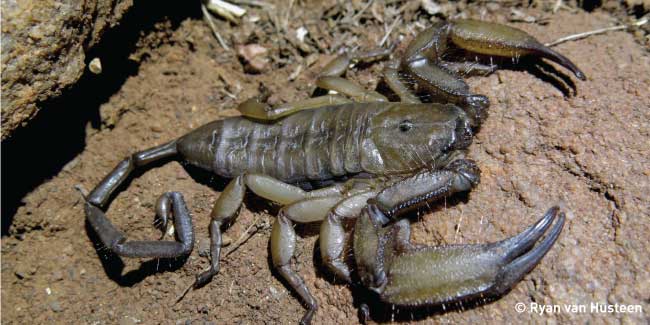
Soutpansberg Hadogenes Scorpion
Hadogenes soutpansbergensis
The only described endemic scorpion in the Soutpansberg. These large flattened scorpions prefer to live in rock cracks and are widespread and abundant in the Western Soutpansberg.
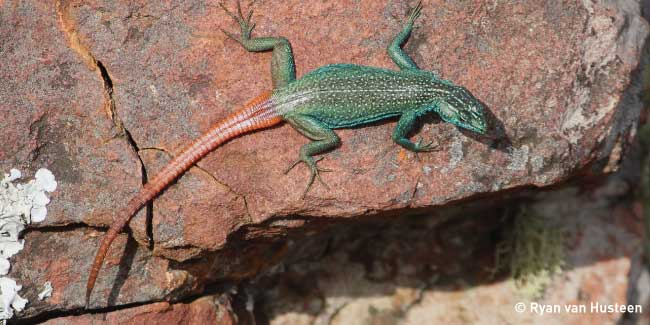
Soutpansberg Flat Lizard
Platysaurus relictus
Endemic to the western Soutpansberg, these colourful lizards live on rocks in warm and hot areas. They live in small colonies and feed on insects, fruits, and plants.

A conservation success story – the return of the majestic Cape Vulture
Lindy Thompson and Danielle du Toit, the EWT’s Birds of Prey Programme
Cape Vultures (Gyps coprotheres) are endemic to southern Africa. They are one of South Africa’s larger vulture species, weighing up to 11 kg. They forage in open vegetation types such as Fynbos, Kalahari, Karoo, grassland, and open woodland. Breeding pairs are monogamous and usually raise one chick. The majestic Cape Vulture was listed as Endangered on the IUCN’s Red List of Threatened Species, but in 2021 it was ‘down listed’ to Vulnerable. This is a remarkable conservation success story and testament to the tireless efforts of multiple generations of conservationists in southern Africa. Removing the Cape Vulture from the list of Endangered species in 2021 received very little media attention, despite being an important case study that can provide hope and inspiration to current and future conservationists. This achievement resulted from a concerted effort by various organisations, including the Endangered Wildlife Trust (EWT), BirdLife South Africa, and wildlife rehabilitation centres such as Moholoholo, VulPro, and others. A team of 31 contributors, which included the EWT’s Samantha Page-Nicholson) supplied information and justified why this species should (or should not) stay classed as ‘Endangered’. Threats to the species include unsafe wind energy developments, poisoning events, unsafe power lines, and food availability may play a large role in the successful breeding and population trends of this species. Current conservation actions for the Cape Vulture include systematic monitoring, education and awareness programmes, protection by national and international legislation, the expansion of formally protected areas (such as the Soutpansberg), and the creation and growth of Vulture Safe Zones.
The importance of Vulture Safe Zones in Cape Vulture conservation
Karoo Vulture Safe Zone Document
In India in the 1990s, vulture populations suffered drastic declines. Scientists were baffled as to why until the study of carcasses revealed the presence of the veterinary non-steroidal anti-inflammatory drug, Diclofenac. They concluded that this drug was the root cause of the mass fatality and had cost about 90% of the vulture population in the area in the space of a decade. This became known as “The Indian Vulture Crisis.” The disappearance of Vultures led to the ecological tipping of scales. Mammalian scavengers such as jackals and feral dogs took advantage of the increased food supplies, and their populations increased. The high number of mammals on carcasses inadvertently led to an increase in the spread of pathogens. India faced, and still faces, a rabies epidemic that costs 30,000 human lives per year and billions of dollars in health fees. The urgent need for action to stop the rapid decline of vulture species in Eurasia and Africa led to the development of the Multi-Species Action Plan to Conserve African-Eurasian Vultures (commonly referred to as the Vulture MsAP). It is a comprehensive and strategic plan which covers ranges across two continents. Vulture Safe Zones are an activity recognised in the Vulture MsAP to encourage the responsible management of the environment by actively reducing threats to vultures in identified areas. They are specified geographic areas where conservationists and landowners use targeted conservation measures adapted for the vulture species present. These measures include safeguarding electrical infrastructure to minimise collisions and electrocutions, reducing the use of poisons, covering or altering reservoirs to prevent vulture drownings, and using NSAIDs responsibly. The most important thing to remember is the responsible management of resources that vultures use, such as the availability of safe perches, water for drinking and bathing, and food. Vulture Safe Zones also promote responsible disposal of carcasses on which vultures scavenge to reduce poisoning through pesticides and lead fragments that remain in a carcass after an animal is shot.
The Karoo Vulture Safe Zone
Landowners in the karoo region of South Africa established the Karoo Vulture Safe Zone (KVSZ) to increase the area’s Cape Vulture populations that have been decimated by persecution resulting from misinformation and a general misunderstanding of their role in the ecosystem. Landowners in the mid-20th century believed that it was vultures killing their small livestock when they would find the birds feeding on them during the day. Unbeknownst to them at the time, the jackal population in the area was beginning to take advantage of the easy prey and kill them during the night. Now, the landowners in the area are admirably working to fix these past mistakes. In August 2020, the first landowner signed up to proclaim his property a Vulture Safe Zone. Since then, the KVSZ has grown to 730,000 hectares owned by 94 landowners committed to making their properties Vulture Safe. The project continues to encourage the responsible management of properties across the karoo landscape through landowner engagements and environmental education, which focus on sustainable and safe practices of managing predators and water resources and the safe disposal of carcasses. The KVSZ team also works through the strategic partnership between the EWT and Eskom to make problem powerlines safe for vultures. Cape Vulture sightings within the project area are reported to the KVSZ team, and it is exciting to receive reports of up to 70 birds roosting on cliffs that were previously void of these magnificent birds. Monitoring efforts by the team to better understand the populations traversing the Eastern Cape skies have shown an increase in breeding pairs in known sites and the possible development of new breeding sites. All of these give the team more motivation to make the Karoo and the larger Eastern Cape a safe space for Cape Vultures. The Vulture Safe Zone process is long, and it will take time until the area is completely vulture safe. In the interim, we continue to encourage vulture safe management and measures and spread awareness of the need for areas like this.
References:
Benson, P.C. and McClure, C.J. (2019). The decline and rise of the Kransberg Cape Vulture colony over 35 years has implications for composite population indices and survey frequency. Ibis 162: 863-872. https://doi.org/10.1111/ibi.12782 BirdLife International (2021). Gyps coprotheres. The IUCN Red List of Threatened Species 2021: e.T22695225A197073171. https://dx.doi.org/10.2305/IUCN.UK.2021-3.RLTS.T22695225A197073171.en accessed on 25 August 2022. Howard, A., Hirschauer, M., Monadjem, A., Forbes, N. and Wolter, K. (2020). Injuries, mortality rates, and release rates of endangered vultures admitted to a rehabilitation centre in South Africa. Journal of Wildlife Rehabilitation 40: 15-23. Mbali Mashele, N., Thompson, L.J. and Downs, C.T. (2022). Trends in the admission of raptors to the Moholoholo Wildlife Rehabilitation Centre, Limpopo province, South Africa. African Zoology 57: 56-63. https://doi.org/10.1080/15627020.2021.2016073 Thompson, L.J. and Blackmore, A.C. (2020). A brief review of the legal protection of vultures in South Africa. Ostrich 91: 1-12. https://doi.org/10.2989/00306525.2019.1674938
Poisoning poses a deadly risk to vultures in West Africa
Dr Lindy Thompson, the EWT’s Birds of Prey Programme
African vulture numbers are declining at an alarming rate, and their key threat throughout Africa is believed to be poisoning. One of the reasons people poison vultures is to obtain body parts, both for consumption and use in African Traditional Medicine. Dr Clément Daboné (from the Universities of Tenkodogo and Joseph Ki-Zerbo, both in Burkina Faso) collected information on incidents of mass vulture killings to learn more about the risk that poisoning poses to vultures in West Africa.
Dr Daboné conducted 730 interviews with butchers, veterinarians, foresters, and abattoir guards at numerous sites across Burkina Faso. His results revealed that vultures were killed in motor vehicle collisions and electrocutions at electricity poles, but poisoning was the deadliest threat to vultures in Burkina Faso. Out of 879 known vulture deaths, 779 were due to poisoning. Interestingly, Dr Daboné found that more vultures were more likely to be killed using poisoned baits closer to the country’s borders, suggesting that poisoning was being done by people from neighbouring countries. He concluded that the recent intentional vulture poisoning events in Burkina Faso were linked to the increasing demand for vulture parts in West Africa.
Dr Daboné and his team highlighted the need for awareness campaigns in local communities to teach people about the risks of using poison. They also mentioned the need for improved legislation and stronger commitment by West African governments to stop the trade in vulture body parts and prevent the extinction of these highly threatened birds and the services they provide.
Vultures face similar threats in southern Africa, and the Great Limpopo Transfrontier Conservation Area is a wildlife poisoning hotspot. For this reason, the EWT’s Birds of Prey Programme has assisted in drafting South Africa’s new national Vulture Biodiversity Monitoring Plan, and we are providing Wildlife Poisoning Response Training to rangers so that they know how to identify, detect, and respond effectively to wildlife poisoning events by containing the crime scene and sampling carcasses for investigative purposes. Rangers are also trained on methods to save as many surviving birds as possible and decontaminate the scene to prevent further poisoning of animals or people. Together, we can make a difference.
The study was titled ‘Trade in vulture parts in West Africa: Burkina Faso may be one of the main sources of vulture carcasses’, and you can access it here: https://doi.org/10.1017/S095927092100054X
References:
Daboné, C., Ouéda, A., Thompson, L.J., Adjakpa, J.B. & Weesie, P.D.M. (2022) Trade in vulture parts in West Africa: Burkina Faso may be one of the main sources of vulture carcasses. Bird Conservation International. https://doi.org/10.1017/S095927092100054X
Gore, M.L., Hübshle, A., Botha, A.J., Coverdale, B.M., Garbett, R., Harrell, R.M., Krueger, S., Mullinax, J.M., Olson, L.J., Ottinger, M.A., Smit-Robinson, H., Shaffer, L.J., Thompson, L.J., van den Heever L. & Bowerman, W. (2020) A conservation criminology-based desk assessment of vulture poisoning in the Great Limpopo Transfrontier Conservation Area. Global Ecology and Conservation 23:e01076. https://doi.org/10.1016/j.gecco.2020.e01076
A conservation success story – the return of the majestic Cape Vulture
Lindy Thompson and Danielle du Toit, the EWT Birds of Prey Programme
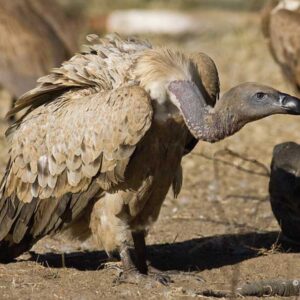
Cape Vultures (Gyps coprotheres) are endemic to southern Africa. They are one of South Africa’s larger vulture species, weighing up to 11 kg. They forage in open vegetation types such as Fynbos, Kalahari, Karoo, grassland, and open woodland. Breeding pairs are monogamous and usually raise one chick.
The majestic Cape Vulture was listed as Endangered on the IUCN’s Red List of Threatened Species, but in 2021 it was ‘down listed’ to Vulnerable. This is a remarkable conservation success story and testament to the tireless efforts of multiple generations of conservationists in southern Africa. Removing the Cape Vulture from the list of Endangered species in 2021 received very little media attention, despite being an important case study that can provide hope and inspiration to current and future conservationists. This achievement resulted from a concerted effort by various organisations, including the Endangered Wildlife Trust (EWT), BirdLife South Africa, and wildlife rehabilitation centres such as Moholoholo, VulPro, and others. A team of 31 contributors, which included the EWT’s Samantha Page-Nicholson) supplied information and justified why this species should (or should not) stay classed as ‘Endangered’. Threats to the species include unsafe wind energy developments, poisoning events, unsafe power lines, and food availability may play a large role in the successful breeding and population trends of this species. Current conservation actions for the Cape Vulture include systematic monitoring, education and awareness programmes, protection by national and international legislation, the expansion of formally protected areas (such as the Soutpansberg), and the creation and growth of Vulture Safe Zones.
The importance of Vulture Safe Zones in Cape Vulture conservation
In India in the 1990s, vulture populations suffered drastic declines. Scientists were baffled as to why until the study of carcasses revealed the presence of the veterinary non-steroidal anti-inflammatory drug, Diclofenac. They concluded that this drug was the root cause of the mass fatality and had cost about 90% of the vulture population in the area in the space of a decade. This became known as “The Indian Vulture Crisis.” The disappearance of Vultures led to the ecological tipping of scales. Mammalian scavengers such as jackals and feral dogs took advantage of the increased food supplies, and their populations increased. The high number of mammals on carcasses inadvertently led to an increase in the spread of pathogens. India faced, and still faces, a rabies epidemic that costs 30,000 human lives per year and billions of dollars in health fees.
The urgent need for action to stop the rapid decline of vulture species in Eurasia and Africa led to the development of the Multi-Species Action Plan to Conserve African-Eurasian Vultures (commonly referred to as the Vulture MsAP). It is a comprehensive and strategic plan which covers ranges across two continents. Vulture Safe Zones are an activity recognised in the Vulture MsAP to encourage the responsible management of the environment by actively reducing threats to vultures in identified areas. They are specified geographic areas where conservationists and landowners use targeted conservation measures adapted for the vulture species present. These measures include safeguarding electrical infrastructure to minimise collisions and electrocutions, reducing the use of poisons, covering or altering reservoirs to prevent vulture drownings, and using NSAIDs responsibly. The most important thing to remember is the responsible management of resources that vultures use, such as the availability of safe perches, water for drinking and bathing, and food. Vulture Safe Zones also promote responsible disposal of carcasses on which vultures scavenge to reduce poisoning through pesticides and lead fragments that remain in a carcass after an animal is shot.
The Karoo Vulture Safe Zone
Landowners in the karoo region of South Africa established the Karoo Vulture Safe Zone (KVSZ) to increase the area’s Cape Vulture populations that have been decimated by persecution resulting from misinformation and a general misunderstanding of their role in the ecosystem. Landowners in the mid-20th century believed that it was vultures killing their small livestock when they would find the birds feeding on them during the day. Unbeknownst to them at the time, the jackal population in the area was beginning to take advantage of the easy prey and kill them during the night. Now, the landowners in the area are admirably working to fix these past mistakes. In August 2020, the first landowner signed up to proclaim his property a Vulture Safe Zone. Since then, the KVSZ has grown to 730,000 hectares owned by 94 landowners committed to making their properties Vulture Safe. The project continues to encourage the responsible management of properties across the karoo landscape through landowner engagements and environmental education, which focus on sustainable and safe practices of managing predators and water resources and the safe disposal of carcasses. The KVSZ team also works through the strategic partnership between the EWT and Eskom to make problem powerlines safe for vultures.
Cape Vulture sightings within the project area are reported to the KVSZ team, and it is exciting to receive reports of up to 70 birds roosting on cliffs that were previously void of these magnificent birds. Monitoring efforts by the team to better understand the populations traversing the Eastern Cape skies have shown an increase in breeding pairs in known sites and the possible development of new breeding sites. All of these give the team more motivation to make the Karoo and the larger Eastern Cape a safe space for Cape Vultures.
The Vulture Safe Zone process is long, and it will take time until the area is completely vulture safe. In the interim, we continue to encourage vulture safe management and measures and spread awareness of the need for areas like this.
You can help raise important funds for Cape Vulture conservation by supporting the Rhino Peak Challenge ambassadors, who aim to complete a 21 km course to ascend the famous Rhino Peak in the Maloti Drakensberg World Heritage Site. The Rhino Peak Challenge raises awareness and funds, for Wildlife ACT, the EWT, and Ezimvelo KZN Wildlife (EKZN), for projects focused on vultures, rhinos and cranes. The EWT’s Cath Vise will participate in the Rhino Peak Challenge this year. Cath manages the Protected Area Programme in the Soutpansberg, where there is a colony of nesting Cape Vultures. Please consider supporting Cath and the other Rhino Peak Challenge ambassadors by clicking this link:
https://rhinopeakchallenge.co.za/participants.aspx?participant=576715fb-a8b2-431e-807a-909ea6c39db4
References:
Benson, P.C. and McClure, C.J. (2019). The decline and rise of the Kransberg Cape Vulture colony over 35 years has implications for composite population indices and survey frequency. Ibis 162: 863-872. https://doi.org/10.1111/ibi.12782
BirdLife International (2021). Gyps coprotheres. The IUCN Red List of Threatened Species 2021: e.T22695225A197073171. https://dx.doi.org/10.2305/IUCN.UK.2021-3.RLTS.T22695225A197073171.en accessed on 25 August 2022.
Howard, A., Hirschauer, M., Monadjem, A., Forbes, N. and Wolter, K. (2020). Injuries, mortality rates, and release rates of endangered vultures admitted to a rehabilitation centre in South Africa. Journal of Wildlife Rehabilitation 40: 15-23.
Mbali Mashele, N., Thompson, L.J. and Downs, C.T. (2022). Trends in the admission of raptors to the Moholoholo Wildlife Rehabilitation Centre, Limpopo province, South Africa. African Zoology 57: 56-63. https://doi.org/10.1080/15627020.2021.2016073
Thompson, L.J. and Blackmore, A.C. (2020). A brief review of the legal protection of vultures in South Africa. Ostrich 91: 1-12. https://doi.org/10.2989/00306525.2019.1674938
Poisoning Risk to Vultures: A West African Crisis with Continental Implications
The poisoning risk to vultures has reached catastrophic levels in West Africa, where 89% of recorded vulture deaths result from deliberate poisoning. Dr Clément Daboné’s groundbreaking research in Burkina Faso reveals this alarming trend, with 779 of 879 documented vulture fatalities attributed to poisoned baits – particularly near national borders, suggesting transnational trafficking of vulture parts for traditional medicine.
Key Findings from Burkina Faso
- 730 interviews with butchers, veterinarians and abattoir staff
- Poisoning accounts for 89% of vulture deaths
- Border areas highest risk – indicating cross-border trade
- Secondary poisoning kills hundreds per incident
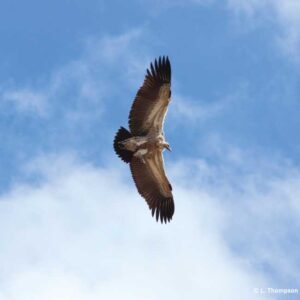
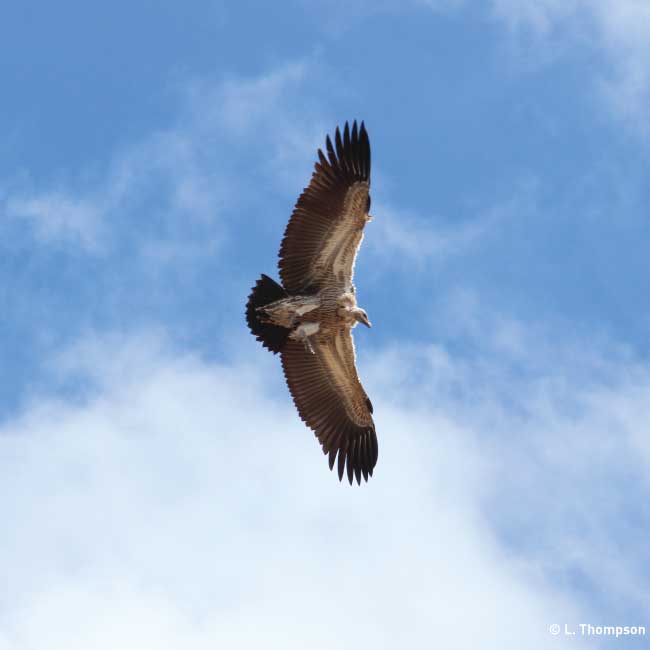
A Critically Endangered White-backed Vulture, Gyps africanus, photographed in South Africa’s Limpopo Province © L. Thompson.
Poisoning Risk to Vultures: Southern African Parallels
The crisis mirrors threats in the Great Limpopo Transfrontier Conservation Area, where the EWT’s Birds of Prey Programme is taking action:
- Drafting South Africa’s Vulture Biodiversity Monitoring Plan
- Training rangers in Wildlife Poisoning Response
- Teaching crime scene preservation and carcass sampling
- Developing protocols to save surviving birds
“Each poisoning event can wipe out entire vulture colonies,” explains Dr Lindy Thompson. “We’re racing to build capacity before it’s too late.”
Urgent Conservation Measures Needed
-
Community awareness campaigns on poisoning impacts
-
Stronger legislation against vulture part trade
-
Cross-border cooperation to combat trafficking
-
Alternative livelihoods for traditional healers
With African vulture populations declining by up to 90% for some species, addressing the poisoning risk to vultures is critical to preventing ecological collapse across the continent.
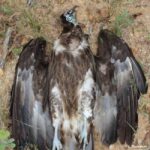
A Critically Endangered subadult Hooded Vulture, which was poisoned, along with 64 other birds of prey, in South Africa’s Limpopo Province in 2015. © L. Thompson.
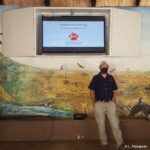
John Davies from the EWT’s Birds of Prey Programme talking about wildlife poisoning at Moholoholo Wildlife Rehabilitation Centre in South Africa’s Limpopo Province in 2020. © L. Thompson.
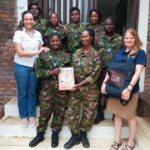
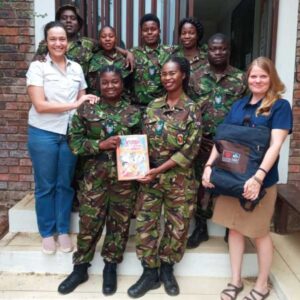
Dr Lindy Thompson (right), from the EWT’s Birds of Prey Programme, presented Wildlife Poisoning Response Training for the Black Mambas, an all-female anti-poaching force, in South Africa’s Limpopo Province.
The study was titled ‘Trade in vulture parts in West Africa: Burkina Faso may be one of the main sources of vulture carcasses’, and you can access it here: https://doi.org/10.1017/S095927092100054X
References:
Daboné, C., Ouéda, A., Thompson, L.J., Adjakpa, J.B. & Weesie, P.D.M. (2022) Trade in vulture parts in West Africa: Burkina Faso may be one of the main sources of vulture carcasses. Bird Conservation International. https://doi.org/10.1017/S095927092100054X
Gore, M.L., Hübshle, A., Botha, A.J., Coverdale, B.M., Garbett, R., Harrell, R.M., Krueger, S., Mullinax, J.M., Olson, L.J., Ottinger, M.A., Smit-Robinson, H., Shaffer, L.J., Thompson, L.J., van den Heever L. & Bowerman, W. (2020) A conservation criminology-based desk assessment of vulture poisoning in the Great Limpopo Transfrontier Conservation Area. Global Ecology and Conservation 23:e01076. https://doi.org/10.1016/j.gecco.2020.e01076
Dr Lindy Thompson, the EWT’s Birds of Prey Programme