
Science snippet:
From Conflict to Climate – What is Threatening Lions in Africa?
By Erin Adams, Science Officer
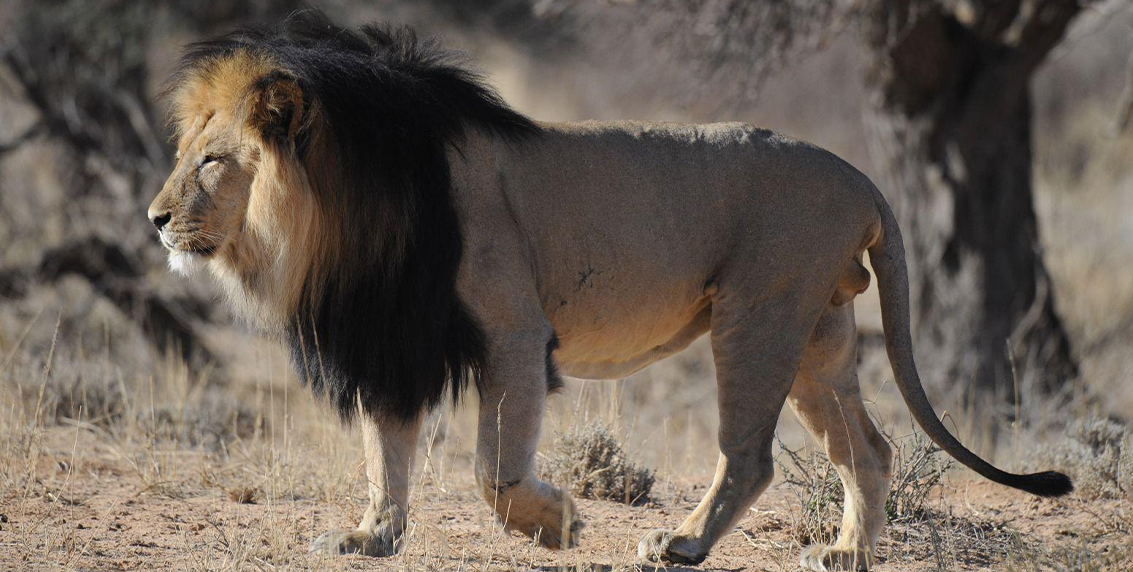
Lions in Africa face a wide range of threats throughout their habitat, with both the type and intensity of these threats varying significantly by region.
Endangered Wildlife Trust (EWT) scientists recently published the results of a continent-wide study to assess to nature and severity of threats to lion populations, finding that these varied per region.
To gather data, researchers distributed an online survey to landscape managers and lion researchers working within 132 lion subpopulations, representing approximately 75% of the current lion range across Africa. The aim was to develop a global threat index, which considered factors such as civil unrest, armed conflict, climate change, and trophy hunting. A local threat index was also created, evaluating both direct and indirect threats, Direct threats included vehicle collisions, intentional poisoning, snaring by-catch, cultural killings, retaliatory killings, unregulated trophy hunting, and disease, and indirect threats, included habitat loss, infrastructure development within lion territories, and the expansion of agriculture and human settlements.
Additional contributing factors, such as ineffective population management, small and isolated populations vulnerable to local extinction, loss of natural prey due to poaching or habitat degradation, and inconsistent or insufficient funding for lion conservation areas were also assessed.
Based on responses from the questionnaires, lion populations are believed to be increasing in 38% of their range, are stable in 37%, and declining in 17%. Threat severity was perceived to be highest in Central Africa, while Southern Africa faced comparatively lower perceived threat severity. The highest threat indices were recorded in Angola, the Democratic Republic of Congo, Cameroon, and Ethiopia, whereas Rwanda, South Africa, and Namibia had the lowest. Key factors influencing threat severity were the presence of communities within lion habitats, livestock grazing and competition with wildlife, fencing practices, community engagement, and available management resources.
Across the continent, the most severe perceived threats to lions varied by region. Higher threat indices were significantly associated with several factors. These were not only the presence of communities living within lion habitats and livestock grazing within the area, but also competition between livestock and wildlife, and inadequate management resources. In contrast, subpopulations that were fully fenced reported significantly lower local threat severity scores. A major challenge noted across the continent was resource limitation, as almost half of the surveyed lion populations (49.24%) reportedly lacked sufficient resources to adequately reduce the illegal killing of lions.
In Central Africa, lions are perceived to be most severely impacted by human encroachment, the loss of prey due to poaching, and retaliatory or pre-emptive killings to protect livestock. In East Africa, the most pressing threats include inconsistent or insufficient funding for conservation, retaliatory or pre-emptive killings, and human encroachment into lion habitats. In southern Africa, lions face challenges from inconsistent or insufficient funding, human encroachment, and infrastructure development near or within their territories. Meanwhile, in West Africa, the most severe threats are the loss of natural prey due to poaching, targeted poaching of lions for their body parts, and the vulnerability of small, isolated populations.
On a global scale, climate change was considered the most significant perceived threat to lion populations in East and southern Africa. In Central Africa, civil unrest is perceived to pose a direct danger to lion populations. Similarly, in West Africa, civil unrest and local conflicts were seen as the greatest global threats due to their impact on the effectiveness of protected area management.
Another major threat to lions is poaching. This crime poses a multifaceted and significant threat to lion populations, encompassing both targeted killing for body parts and unintentional bycatch in snares. Lion populations are declining rapidly due to direct threats such as targeted poaching for body parts for the illegal wildlife trade. This practice is suspected to be driven by both local traditional medicinal practices and the international illegal wildlife trade, where lion bones are sometimes smuggled to the East as a substitute for dwindling tiger (Panthera tigris) parts. Lions were reported to be poached for parts in 30% of surveyed subpopulations (40 out of 132), with the most frequently sought parts being skin, claws, teeth, and fat. Uses for these parts, particularly in local markets, range from strengthening the body, curing diseases, increasing power, and improving the immune system.
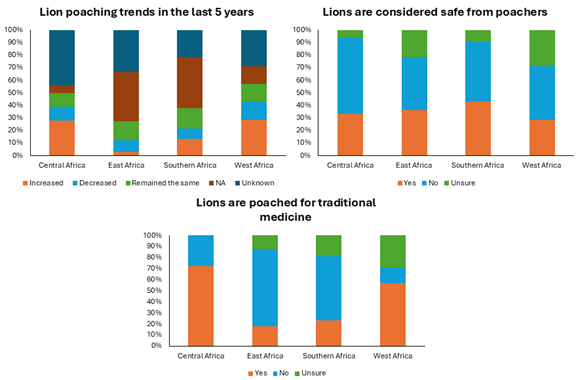
Figure 1. Responses to questions relating to poaching of lions per region in Africa (reported as percentages, n = 132) (Graphs adapted from Nicholson, S. K., Roxburgh, L., Bauer, H., Adams, E., Asfaw, T., Naude, V. N., & Slotow, R. (2025). African lion conservation requires adaption to regional anthropogenic threats and mitigation capacity. Global Ecology and Conservation, 62, e03760)
This study highlights the complex and region-specific challenges facing lions in Africa. Identifying the most severe threats at the population level is essential for developing targeted and effective conservation strategies. At the site level, this understanding allows managers to implement and enforce effective mitigation measures, such as utilising fencing, which was found to significantly lower local threat severity scores. These findings inform policymakers and multilateral conventions, guiding decisions and prioritising areas that require immediate, intensive conservation action. This prioritisation is vital for highly threatened areas like Angola, Cameroon, and Ethiopia, which face high threat severity alongside insufficient resources. Furthermore, identifying the most common resource limitations (such as a lack of consistent funding) is essential for generating greater investment to safeguard vulnerable lion populations, halt expected population declines, and achieve long-term conservation success.
*Nicholson, S. K., Roxburgh, L., Bauer, H., Adams, E., Asfaw, T., Naude, V. N., & Slotow, R. (2025). African lion conservation requires adaption to regional anthropogenic threats and mitigation capacity. Global Ecology and Conservation, 62, e03760.