[vc_row][vc_column][vc_row_inner css=”.vc_custom_1564132218313{margin-right: 2% !important;margin-left: 2% !important;}”][vc_column_inner width=”2/3″ css=”.vc_custom_1564134365074{padding-right: 8% !important;padding-left: 8% !important;}”][vc_column_text]
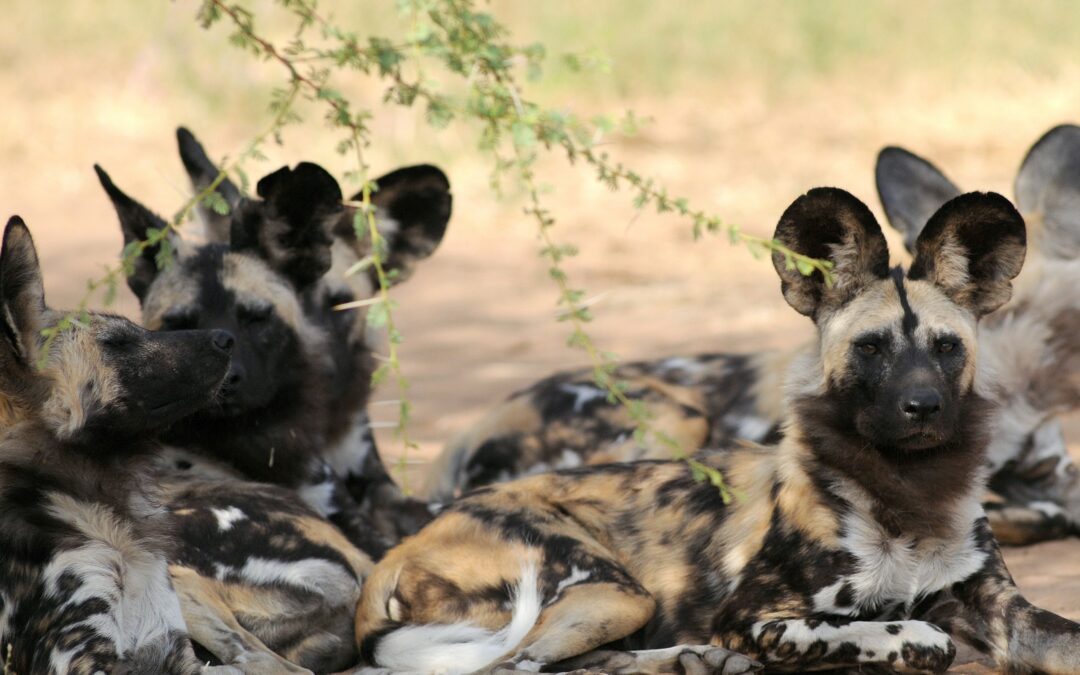
SCIENCE SNIPPET: WILD DOGS – SOUTH AFRICA’S MOST ENDANGERED CARNIVORE
[/vc_column_text][vc_single_image image=”5468″ img_size=”full” alignment=”center”][vc_column_text]Samantha Nicholson, Science Officer and African Lion Database Coordinator, EWT Conservation Science Unit
SamanthaN@ewt.org.za
[/vc_column_text][vc_column_text]Across Africa, there are only an estimated 6,600 Wild Dogs that occur in the wild, making them the continent’s 2nd most Endangered carnivore behind the Ethiopian Wolf. In Africa, Wild Dogs inhabit only 14 of the 39 countries where they historically occurred, having lost approximately 93% of their historic range due to habitat loss and a rapidly expanding human population. Sadly, this species faces many other threats such as loss of prey, conflict-related killings, snaring and roadkill incidents.
In a recent published study (Nicholson, S. K., Marneweck, D. G., Lindsey, P. A., Marnewick, K. & Davies-Mostert, H. T. 2020. A 20-year review of the status and distribution of African Wild Dogs (Lycaon pictus) in South Africa. African Journal of Wildlife Research 50: 8-19.), we completed a national assessment of the status and distribution of South Africa’s population of Wild Dogs – the country’s most Endangered carnivore. We looked at two decades of population and distribution data for the species, from 1998 to 2017, and found some interesting results.
South Africa is considered to have three subpopulations of Wild Dogs:
1) The Kruger National Park
2) A managed metapopulation that has been established through reintroductions into isolated, fenced reserves across the country
3) A free-roaming population that occurs naturally outside protected areas – predominantly in KwaZulu-Natal, Limpopo and Mpumalanga provinces.
For the study period, the Kruger population has generally averaged 163 adults and yearlings and although the population growth has declined slightly, the population has remained stable through the years. Kruger has consistently supported the highest proportion of the national population of Wild Dogs over the last two decades.
South Africa’s managed metapopulation is made up of a series of individual reserves with intensive management among the reserves, to ensure that there is genetic flow between them. This subpopulation is managed by the Endangered Wildlife Trust and the Wild Dog Advisory Group (WAG). The number of metapopulation reserves has increased over the years, and the average annual population is 108 adults and yearlings. The metapopulation is the only subpopulation that has increased significantly over time and this is due to intensive conservation efforts and the reintroduction of Wild Dogs into 15 additional reserves since 1998. The contribution of the metapopulation to South Africa’s national population has increased significantly over time.
Free-roaming Wild Dogs make up the smallest subpopulation in the country with an average annual population of approximately 79 adults and yearlings. This subpopulation faces the largest number of threats as it is largely unprotected and generally outside of protected areas.
The overall South African population of Wild Dogs has remained stable for our study period and while it is a small population (< 500 individuals), the good news is that it is increasing.[/vc_column_text][vc_single_image image=”5469″ img_size=”large” add_caption=”yes”][vc_single_image image=”5470″ img_size=”large” add_caption=”yes”][/vc_column_inner][vc_column_inner width=”1/3″][vc_column_text css=”.vc_custom_1566891493571{margin-top: 8px !important;border-bottom-width: 6px !important;}”]
LATEST STORIES
[/vc_column_text][vc_widget_sidebar sidebar_id=”cs-1″][/vc_column_inner][/vc_row_inner][/vc_column][/vc_row][vc_row][vc_column width=”1/3″][vc_googleplus][/vc_column][vc_column width=”1/3″][vc_facebook][/vc_column][vc_column width=”1/3″][vc_tweetmeme][/vc_column][/vc_row]
THE UGANDA CRANE FESTIVAL 2020 DRAWS GREY CROWNED CRANES TO THE CELEBRATIONS
Jimmy Muheebwa, Uganda Projects Coordinator, Gilbert Tayebwa, Research and Monitoring Field Assistant, and Phiona Orishaba, Community Education Field Assistant, EWT African Crane Conservation Programme
JimmyM@ewt.org.za, GilbertT@ewt.org.za, and PhionaO@ewt.org.za
The unusual happened as the International Crane Foundation/Endangered Wildlife Trust/NatureUganda Partnership celebrated cranes on 2 March 2020 in Kabale, Uganda. The function that was held at Kikungiri Primary School and attracted hundreds of participants including primary school children, university students, conservationists, civic leaders, the media community, private sector practitioners, and politicians. Surprisingly, cranes, which were slated to be the centre of the talk during the celebrations, made an appearance, to the amazement of many.
The Uganda Crane Festival formed part of the build up to World Wildlife Day 2020, and was intended to promote partnerships and engagements with stakeholders who may be impacting on wetlands and cranes, increase crane and wetland awareness among youths in the project area, and engage communities to improve their appreciation of wetlands and their connection to Grey Crowned Cranes.
By 8:30 on the morning of the festivals, hundreds of participants had gathered at Highland Hotel Kibale, where they received t-shirts and banners. Guided by the traffic police and led on by a brass band, the procession marched through Kabale town up to the celebrations venue, Kikungiri Primary School. The guest of honour on this auspicious occasion was the Minister for Tourism, Wildlife and Antiquities, Godfrey Kiwanda, who was taken on a tour of a variety of wetlands-based arts and crafts exhibitions displayed by schools and communities to demonstrate sustainable use. The EWT’s Jimmy Muheebwa was afforded the opportunity to share project initiatives such as Crane Custodianship, “Cranes in the Classroom”, and the Conservation Agreement approach, and how the initiatives have contributed to improved crane breeding success. A “Cranes in the Classroom” school assessment had also been conducted, and the winning schools received their prizes – a plaque for first place and certificates for second and third places – at the festival. Katuna Primary School were well-deserving winners, while Rushabo Primary School and Buhara Primary School took second and third place respectively.
As Minister Kiwanda took to the podium, a flock of cranes hovered in the area, clearly considering landing in the area. The crowd had been taught how to make crane calls, and put this knowledge to good use, calling for over five minutes, which then transformed into dancing, singing, gesturing, and clapping in imitation of Grey Crowned Cranes. The minister was amused by the timing of the cranes’ appearance, just as he was about to speak, and wondered if it had been prearranged. He was glowing in his praise of the work being done by the cranes project, and paid special tribute to EWT partners, the International Crane Foundation. The minister also launched the National Species Action Plan for the Grey Crowned Crane, the development of which NatureUganda had championed, on behalf of the government of Uganda. The proceedings were closed with local communities staging a crane dance, which the minister couldn’t resist joining.
THE EWT AND THE CONSERVATION COACHES NETWORK HOST SOUTH AFRICA’S FIRST CCNET COACH TRAINING
Claire Relton, Senior Science Officer, EWT Conservation Science Unit
ClaireR@ewt.org.za
Conservation organisations, like the EWT are tackling complex and urgent environmental issues across the globe. Funders, donors, and key stakeholders are counting on us to meet our conservation goals and have positive, effective and lasting impact. To this end, conservation teams need to plan, monitor, adapt and improve their strategies while providing accurate evidence for what works and what doesn’t work. Conservation Coaches are trained facilitators that train and assist teams and their stakeholders with developing adaptive conservation plans in order to achieve the desired success. Earlier this year, the EWT hosted South Africa’s first, and Africa’s third, CCNET Coach Training at Valverde Eco Hotel, near Lanseria, Gauteng. The Conservation Coaches Network (CCNET, established in 2009) is a dynamic community of conservation planners from around the world, whose mission is to lead conservation project teams through the Conservation Standards five-step process in order to develop and adapt effective strategies and measures of success.
Three well-experienced coach trainers facilitated the course, namely John Morrison (WWF US), Genevieve Pence (CapeNature) and Erica Cochrane (International Crane Foundation). The training took place over the course of a week and included both theoretical, teambuilding and practical learning sessions, as well as an enlightening field trip to the Sterkfontein Caves in the Cradle of Humankind. Four EWT staff members participated in the course and are now certified CCNET Conservation Coaches, including Dr Lizanne Roxburgh and Claire Relton from the EWT’s Conservation Science Unit, and Kerryn Morrison and Dr Adalbert Aine-omucunguzi from the EWT/ICF African Crane Conservation Programme. Other participants included staff from CapeNature, SANCCOB, Wildlife Conservation Society, Panthera, Conservation South Africa and Peace Parks Foundation. The hugely successful event not only ignited long-term collaboration between the EWT and other African conservation organisations implementing the Conservation Standards, but also initiated participants into the larger global CCNET community. As part of the Conservation Standards movement, the EWT aims to work collaboratively towards measurable and impactful conservation for the benefit of nature and people.
