CONSERVATION CHAMPION: DALEEN ROODT
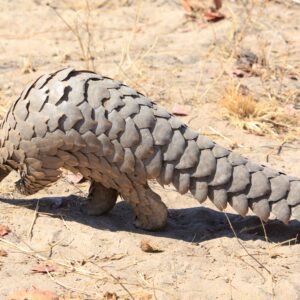
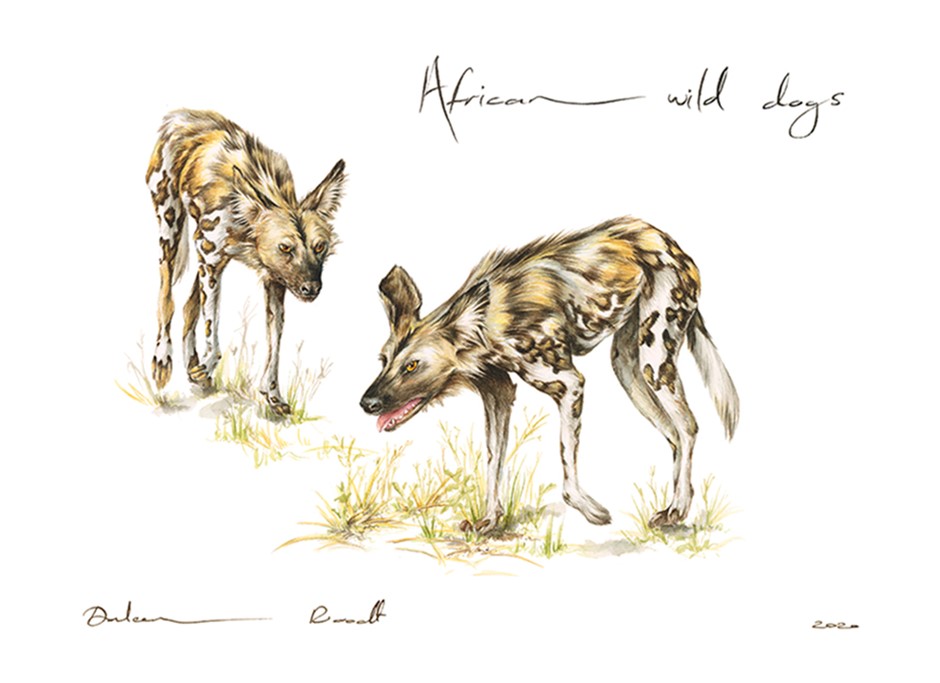
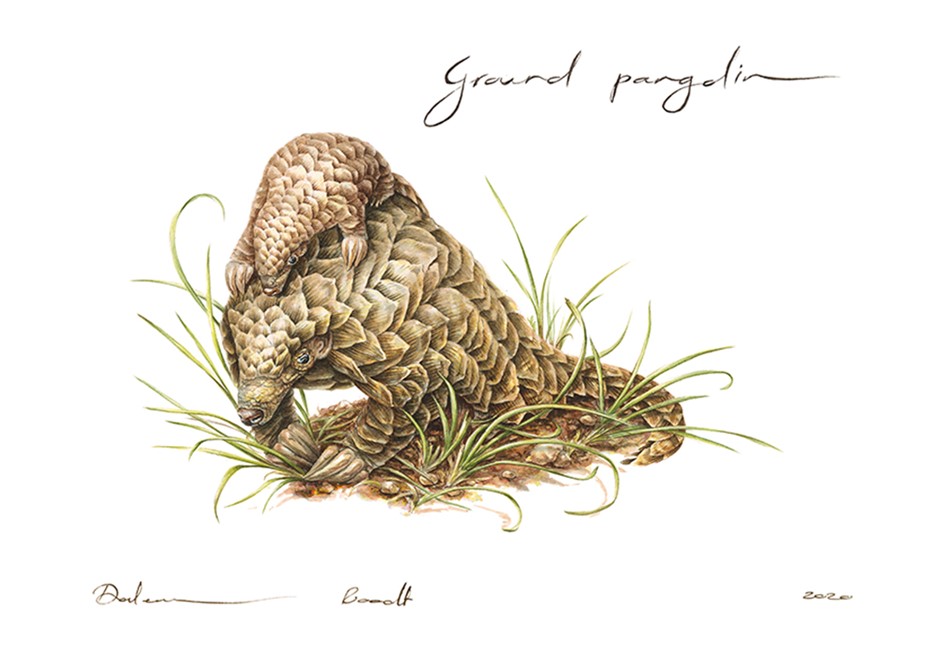
Tammy Baker, EWT Business Development Officer, tammyb@ewt.org.za Daleen Roodt is our latest Conservation Champion. She has painted two watercolour illustrations of the African Wild Dog and the Pangolin. She describes the intricate process she underwent to create these remarkable images in a guest article to follow. Fifty limited-edition, certified, high-quality archival prints of each illustration have been made. All proceeds from the sales will be going directly to the Endangered Wildlife Trust (EWT), specifically contributing to their projects relating to Wild Dog and Pangolin conservation.
“The indelible impression of these beautiful creatures has truly inspired me. I hope that my art will play a small role in the efforts to ensure the survival of these species.”
Purchase your unique limited-edition print here
Print size: 310 mm x 228 mm (each).
Postage fee to your nearest Postnet will be R99
For more information, contact Daleen at info@daleenroodt.com or Tammy Baker, EWT Business Development Officer tammyb@ewt.org.za.
PAINTING PANGOLINS AND WILD DOGS FOR CONSERVATION
Daleen Roodt, info@daleenroodt.com
Exploring new subjects
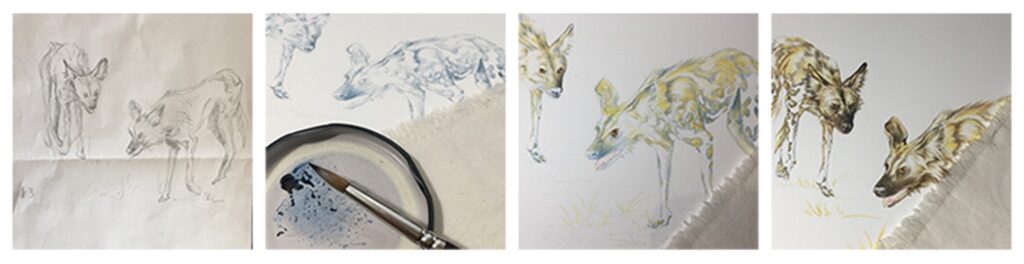
When first commissioned to paint two watercolour illustrations of endangered wildlife species, I knew that it was going to challenge my usual painting methodology. The request came from a longstanding client for whom I’ve been painting indigenous tree and bird species since 2012. This year they requested the Ground Pangolin (Smutsia temminckii) and African Wild Dog (Lycoan pictus). Even though animal wildlife is not one of my major themes, I was excited to expand my repertoire.
As far as flora is concerned, I am fairly particular about working from live plant material, as opposed to working from photos. This hands-on interaction with my subjects has always been an essential part of my process. So, when it comes to having to paint a wild animal, particularly one which is extremely scarce or threatened, the dilemma I face, is that I can’t exactly ask the carnivore to “sit down” next to my desk for me to stroke its tail…
The painting-process
I was fortunate enough that a friend who is very proficient with wildlife photography kindly offered me the use of some of her high definition photos of Wild Dogs to construct a unique composition. It was not hard to fall in love with the lush marbling enrobing these animals. The texture of their beautiful fur coats very much resembled for me the texture of a bird’s feathers, and it felt like pure indulgence to recreate this effect in watercolour.
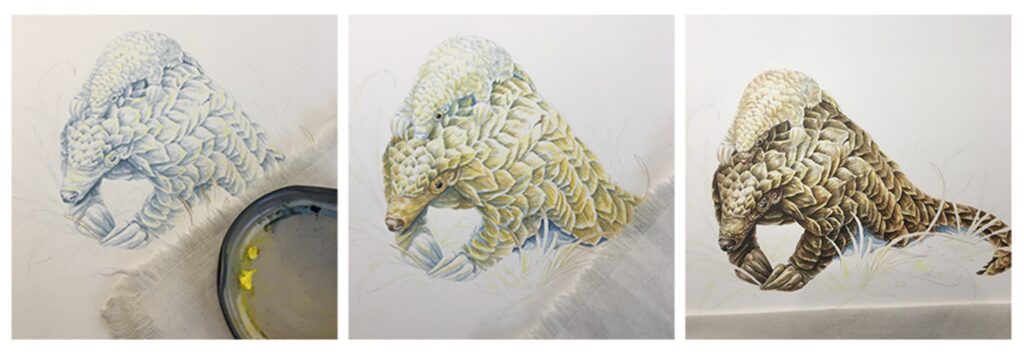
When it came to the pangolins, I was more challenged in finding sufficient media to work from. I didn’t simply want to copy a pre-existing web photo. The only way of getting to know how these peculiar creatures move, how they breathe, how their finely grooved armour of scales glide in seamless motion, was to watch hours of videoclips, acquainting myself with as much character as has been captured on film, and then constructing a unique composition from the available information. This journey revealed shocking insight into their unfortunate exploitation on the illegal trade market. There is a sad vulnerability that surrounds these beautiful creatures, but I wanted to communicate hope by portraying a mother with her young.
Conservation status
Both of the subject species have been in the limelight of late because of their threatened status of existence. The African Wild Dog, also known as the Painted Wolf, is South Africa’s most endangered carnivore, threatened by loss of habitat due to agriculture and hunted by farmers who fear for their livestock. Pangolins, on the other hand, are currently the highest-trafficked animals on the planet. Their scales are used in traditional medicine, and they are hunted for bushmeat and illegally consumed as a “delicacy”. Even though pangolins may appear tough and well armoured, these secretive, nocturnal mammals have a very fragile existence. Little is known about their habits and behaviour, but the shocking discovery of their gruesome exploitation is a living nightmare.
I felt deeply touched by the newfound awareness of the endangered existence of both these species. I wanted my artworks to have more meaning than mere illustration, to have some sort of contribution to the conservation of these animals. That’s when the idea was borne to sell art prints as a fundraiser initiative.
The EWT ticked all the right boxes to qualify as the beneficiary; its Carnivore Conservation Programme working to re-establish, maintain, and expand safe, habitable space for threatened carnivores, including wild dogs, and their Wildlife in Trade Programme targeting trade-related threats to the survival of species such as the pangolin. They are a reputable organisation whose efforts have received local and international awards, but more importantly, are making a major positive impact on the conservation of many species and environments.
Fifty of each of these certified, limited-edition, high-quality archival prints have been made. All proceeds from the sales will be going directly to the EWT, specifically contributing to their projects relating to Wild Dog and pangolin conservation.
To contribute and purchase your unique limited-edition print, please follow this link.
To life… and its continuation.
A GLOBAL NETWORK OF ROADS RESEARCHERS – WHERE TO FROM HERE?
Wendy Collinson, Programme Manager, EWT Wildlife in Transport Programme, wendyc@ewt.org.za
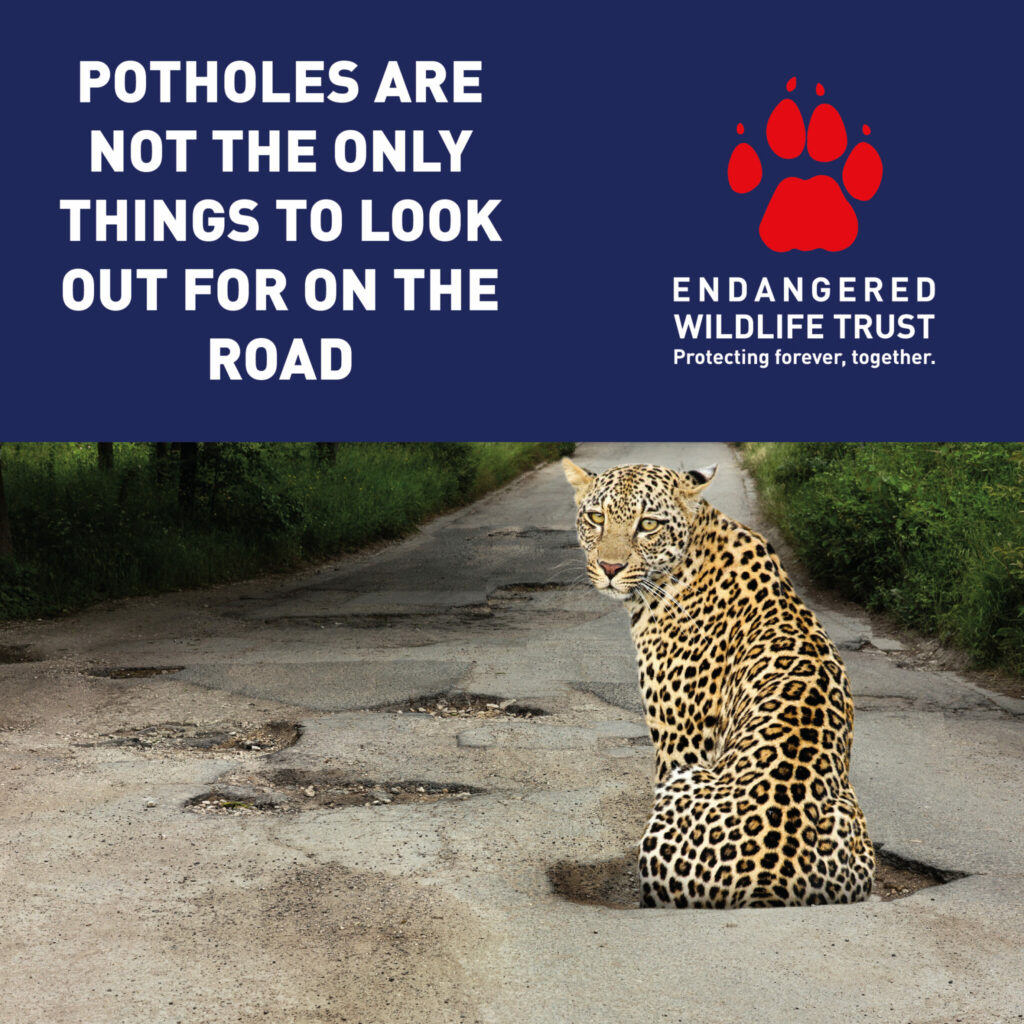
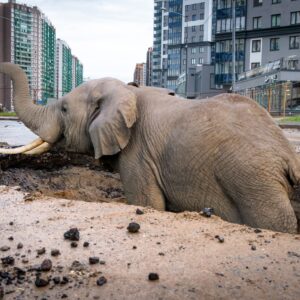
Roads fragment wildlife habitats, leading to wildlife population declines, and wildlife is frequently struck by vehicles on roads, often resulting in severe injury or death for the animal and the human occupants of the vehicle. Recording such incidents is the first step towards understanding the causes and other factors involved so that actions can be taken to prevent or reduce them.
October was National Transport Month in South Africa, a month-long campaign used by the South African Department of Transport to engage directly with its stakeholders around transport issues. The EWT also champions Transport Month to encourage the public to join its citizen science data collection project and to raise awareness about the causes and consequences of wildlife-vehicle collisions on our roads. These data are collected so that the EWT and partners can identify hotspots where roadkill is a common occurrence, and determine what factors contribute to the occurrence of road collisions. These data also allow us to provide recommendations based on scientific findings regarding the development of new roads, or modifications of existing roads, to prevent the impacts the roads, and vehicles that use them, have on our wildlife.
The Endangered Wildlife Trust has been gathering wildlife-roadkill-data on regional and national roads across South Africa since 2010. We have done this through national campaigns via social media, roadkill awareness days, promotional materials, and the development of a smartphone app called “RoadWatch”, through which citizen scientists can submit their roadkill sightings. The EWT has also partnered with South African road agencies to train road patrollers to gather roadkill data, a method commonly employed in other countries to identify roadkill hotspots on highways, where roadkill-reduction-measures can be implemented. To date, approximately 200 route patrollers have been trained, expanding the roadkill database from 2,000 entries in 2010, to almost 25,000 at present.
Through an exciting collaboration between researchers from South Africa, Austria, Belgium, Canada, the Czech Republic, the United Kingdom, and the United States, the EWT’s Wildlife and Transport Programme published a study in leading international journal Biological Conservation on the efficacy of different roadkill data collection methods. The researchers undertook a global survey to assess the various methods used by different countries to collect roadkill data that help to inform transportation and conservation decisions and to initiate the development of best-practice guidelines for the collection and use of the data. While we promote our campaigns for sightings throughout the year (although a little more during Transport Month), UK researchers, use an intensive annual campaign called ‘Project Splatter’ to encourage members of the public to submit roadkill data only during one period in the year, and the Czech Republic uses primarily crash statistic data provided from law enforcement, not from the public. “Even though there may be variations in the methods of how we gather our data’, said co-author Sarah Perkins, a researcher from Cardiff University in the UK, “the outcomes are the same. We seek to provide current best-practice for collecting and using roadkill data to inform transportation and conservation decisions.”
The different methods were found to have similar outcomes, but the research team suggested that one of the most important decisions regarding data analysis is to identify the intended audience and how the data are to be used, and therefore, how the analysis and graphical outputs are portrayed. It is also critical to provide feedback on data submitted, not only through obligatory reports to the road agencies but to keep members of the public engaged and motivated to continue reporting.
“Our publication highlights the range of people, technologies, and species involved in collecting data about roadkill, all of which should lead to actions to reduce roadkill worldwide.”
Fraser Shilling of the Road Ecology Center at UC Davis in the United States
Roadkill data collection currently provide one of the largest, continuous sources of observations of diverse wildlife in the world. These data are useful information for preventing the WVC event itself and conserving wildlife. Consequently, developing any app. to record roadkill data (or any form of conservation data) must make an instant impression, due to the vast choice of wildlife apps available. Through international collaborations such as this latest paper, the EWT aims to establish a global network of roadkill reporting systems, identify best practices and practical applications for improved conservation research, and develop guidelines for better management of road networks globally.
Please contact the EWT for more information or to get involved. Roadkill data can be emailed to roads@ewt.org.za or OR you can download the smartphone app (EWT Road Watch) and start reporting:
• Go to Google Play on your smartphone https://play.google.com/store
• Type in ‘EWT Road Watch’
• Click on ‘INSTALL’, and it will download to your phone
• Once installed, you will need to enter your user details, either your email address or phone number. You will only need to do this once, and we will never share your information
• You can then begin reporting roadkill sightings
• It doesn’t matter if your phone does not have signal, the app will log your location and submit records once you are back in network range.
Your support will no doubt help us to protect our wildlife, but please don’t put your own life at risk to collect information. Always consider your safety, and please do not use your phone while driving !important;}”] When reporting roadkill, please provide the following information:
• Location of roadkill (GPS coordinates)
• Identification of species (as best as possible)
• Date and time seen
• Notes on the local habitat type (e.g. riverine, grassland, rocky, wetland, etc.) are also be useful.
Good identification photos (particularly if the carcass is very squashed) are very helpful BUT only stop and take a photo if it is safe to do so, then try and record the following:
• BIRDS: Tail and wing feathers/beak and feet (if the whole bird is no longer there) and eye
• REPTILES: Scales/head shape/foot shape (if applicable)
• AMPHIBIANS: Foot shape (webbed)/presence of warts/colouration around head and eye
• MAMMALS: Fur/hair colour/body size/teeth type (carnivore or herbivore) Visit the EWT website for more information: www.ewt.org.za
The core supporters of the EWT’s Wildlife and Transport Programme are Bakwena Platinum Corridor Concessionaire, De Beers Group of Companies, Ford Wildlife Foundation, N3 Toll Concession, GreenMatter, and TRAC N4.
The EWT would like to acknowledge all the co-authors of the paper:
Fraser Shilling (Road Ecology Center, Department of Environmental Science and Policy, University of California, Davis, United States)
Michal Bil (Department of Geography, Faculty of Science, Palacký University, Czech Republic)
Diemer Vercayie (Natuurpunt, Mechelen, Antwerp, Flanders, Belgium)
Florian Heigl (Institute of Zoology, University of Natural Resources and Life Sciences Vienna, Austria)
Sarah E. Perkins (School of Biosciences, Cardiff University, United Kingdom)
Sandra MacDougall (School of Arts and Science, Red Deer College, Alberta, Canada)
LEAVE A LEGACY FOR LIFE: WILLS WEEK 2020
Emily Taylor, EWT Communications Officer, emilyt@ewt.org.za
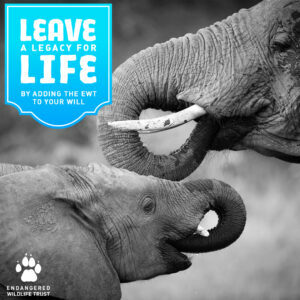
The EWT celebrated Wills Week from the 26–30 October 2020. During this week, we highlighted the importance of having an up-to-date will to ensure the fulfilment of your last wishes, and that including in your will a bequest to an organisation like the EWT is a perfect way to ensure that your legacy contributes to a better future for our planet. And donations to the EWT from your estate also qualify for tax relief on your estate, which means that your beneficiaries benefit more.
Established in Clive Walker’s garage in the 1970s, the Endangered Wildlife Trust has steadily grown into an international conservation NGO with a staff of over 100, saving threatened species and ecosystems across southern and eastern Africa. The EWT is proud of the positive impact we have had on some of Africa’s most endangered wildlife over the past 48 years, all of which was done with our strong partners and loyal supporters. With your support, and that of many before you, we have taken conservation in Africa to new heights. As a trust reliant entirely on donor funding, we haven’t done this alone. Our legacy has been borne and carried by the support we have received, and much of our work is only made possible through bequests. You can become an integral part of wildlife conservation when you join the EWT family, working together to save the species and natural spaces on our beautiful continent.
The EWT has been privileged to receive bequests from the following individuals, and through their generosity, we have achieved significant milestones in species conservation and habitat protection, and we extend our sincerest thanks.Bequests received 2019/20
Harvey Trust
Simmon Estate
Yvonne Morris
Conor Tomlin
Gaynor Estate
BA Nicholson
 None of us can avoid the need to have an up-to-date will that ensures that our last wishes are carried out, and our legacy is continued in the way that we want it to. We have joined forces with Capital Legacy to make the process as simple as possible. Capital Legacy is also committed to protecting forever, together, and for every Legacy Protection Plan™ referral they receive from the EWT, they will make a donation to our critical conservation work. Please use this link if you would like to use their services and please specify that you are an EWT supporter The EWT Forever Forest
All bequests made to the EWT create legacies for life that are immeasurable and remembered through the survival of our Endangered species and their wild spaces. However, as an organisation, we feel it is important to do more to celebrate the legacies bequeathed to us, and the contribution they make towards protecting forever, together. To this end, we have created a Forever Forest on our Conservation Campus in Midrand, in which we plant an indigenous Forever tree for each person who leaves a Legacy for Life, providing a living memorial that will be cared for and continue to grow for generations to come!
Forever Forests are beautiful, tranquil places for friends and family to gather, pay tribute, heal, remember, and to celebrate all life. If you yearn for a better future for your children, leave a Legacy for Life by remembering the EWT in your will, and help us to secure the health of our planet and its wildlife, beyond your lifetime.
For more information, contact Tammyb@ewt.org.za