FOLLOWING FLEDGELINGS
Rebotile Rachuene, African Grass-owl Project Coordinator, EWT’s Birds of Prey Programme (BOPP), tselaner@ewt.org.za
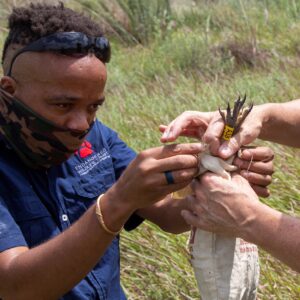
Five years ago, we embarked on a project to monitor African Grass-owl fledgelings once they leave their nests to understand their movement patterns and behaviour. To do so, we ring them so that we, and others, can identify individual owls when they are seen again.
Since 2017, we have ringed at least 30 individuals from both the Mpumalanga and Gauteng provinces. The majority of these individuals were fledgelings, and two were breeding adults. The ringing follows extensive field monitoring to ensure that the nests are not disturbed during the owls’ breeding and nesting periods. As soon as they reach fledgeling age, we go in and ring them
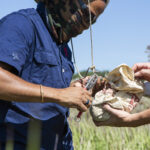
This month, we were fortunate enough to ring five fledgelings, about six weeks old, now from two different nests in Midrand, Gauteng, two siblings from one nest, and three from the other. Working together with our partner, the Greater Kyalami Conservancy (GEKCO), we have successfully safeguarded these nests and eventually successfully ringed our first clutch of fledgelings in the area since 2018. One nest is in a site destroyed by fire in the 2018/2019 season, and the other is in a new breeding site that we discovered had been occupied recently – very exciting news! The five chicks were released and will be monitored closely up until they fledge and find their own sites to nest in. In 2019, one of our ringed birds was found actively breeding 10 km away from where it was ringed, which was extremely valuable information, demonstrating how this form of monitoring can provide us with a better understanding of how far they can travel in search of new territories.
REMEMBERING OUR FALLEN HEROES
In loving memory of Gary Grant
Tammy Baker, EWT Business Development Officer
Gary Grant was one of the kindest and most generous individuals I have ever met. Gary was a big family man and loved nothing more than to spend time in the bush with his wife Debbie and his son and daughter.
His wife Debbie had this to say about Gary:“Gary was an incredibly special man, and we miss him desperately. I just want to say a huge thank you to you for organising one of Gary’s best days in the bush – this would be the day we spent with Grant doing the Wild Dog tracking in the Kruger, whilst an incredible experience at the time, is now also a cherished memory for me of Gary at his absolute happiest. The EWT will always remain close to my heart, and I promise I’ll try to ensure that we continue with Gary’s commitments to yourselves.
Yolan Friedmann, EWT CEO wrote the following tribute:
“Gary’s unfailing love of wildlife and his support of the Endangered Wildlife Trust ensured that we were able to undertake much more work to save the threatened species that rely on us for their future and this was even more valued in a year that was just as tough for them. Gary’s legacy will live on, not just in our hearts, but in the conservation benefits his support brought to Wild Dogs, Cheetahs, vultures, cranes, and a host of other threatened species. We will honour his memory through the life of a dedicated indigenous tree planted at our Campus in Midrand, and we will never forget the role he played in all our lives.
Celebrating the life of conservation legend Anne van Dyk
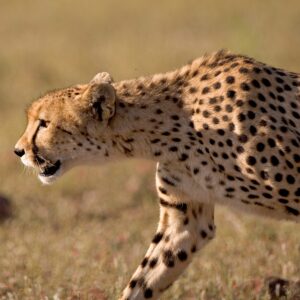
The EWT is deeply saddened by the passing of Ann van Dyk. Ann dedicated her life to the conservation of Cheetahs and was intimately involved with the EWT’s work from the early 1970s to generate interest, funding, and action for Cheetah conservation. Anne van Dyk played an important role in kick-starting the Cheetah Range Expansion work currently coordinated by the EWT. The major changes in land use that came with South Africa’s transition to democracy opened up millions of hectares of suitable habitat for wild Cheetahs and they recolonised from Botswana into areas where they been almost eradicated for decades, including the Bray-Vryburg area of the North West, the Lephalale-Thabazimbi area of the Waterberg, and the Hoedspruit-Phalaborwa area of the Lowveld. Wildlife ranchers and livestock farmers did not want these economically destructive animals on their properties. In the process, 157 ‘problem’ Cheetahs were removed from farms and ranches and relocated to 41 newly established state and private game reserves across the country.
More than 100 Cheetahs were held temporarily at the Anne van Dyk De Wildt Cheetah Centre before being released back into free-ranging conditions at their new reserves. These actions essentially established a new network of reserves that contained Cheetahs, where they had been previously wiped out. In 2009, when the wild Cheetah component of De Wildt’s work was handed over to the EWT, this network included 217 Cheetahs on 41 reserves. Since then, we have increased this population to 455 wild Cheetahs on 63 reserves and expanded beyond South African borders to Malawi and Zambia. This restored population of wild Cheetahs currently constitutes the only growing wild Cheetah population worldwide. Over the years, the EWT and Ann worked together on numerous projects, including vulture conservation and nurturing conservation talent.
The EWT thanks Ann for her enormous contribution to Cheetah conservation through the awareness, knowledge, and value she generated for this threatened species over 60 years. We salute her and send our heartfelt condolences to the family and friends who mourn her loss.
EMPOWERING LOCAL LADIES THROUGH TECHNOLOGY
Esther Matthew, EWT’s Drylands Conservation Programme, estherm@ewt.org.zaThe Endangered Wildlife Trust (EWT) has been operating in Loxton (Northern Cape) for the past 15 years, the EWT’s Drylands Conservation Programme based in this one-primary-school-town. The Loxton school, JJ Booysen, burned down in 2017, including the school’s computer room, which has severely limited learner and community member exposure to technology. In 2018, we opened the EWT E-learning Centre, with support from Rand Merchant Bank, to fill the gap. To date, we have hosted three six-week courses for Grade 7s (11-13 years of age), two Google Earth courses for students and emerging farmers, and a photography course for teenagers that we hope to host once a year going forward. The centre was also used in 2019 to host adult literacy classes.
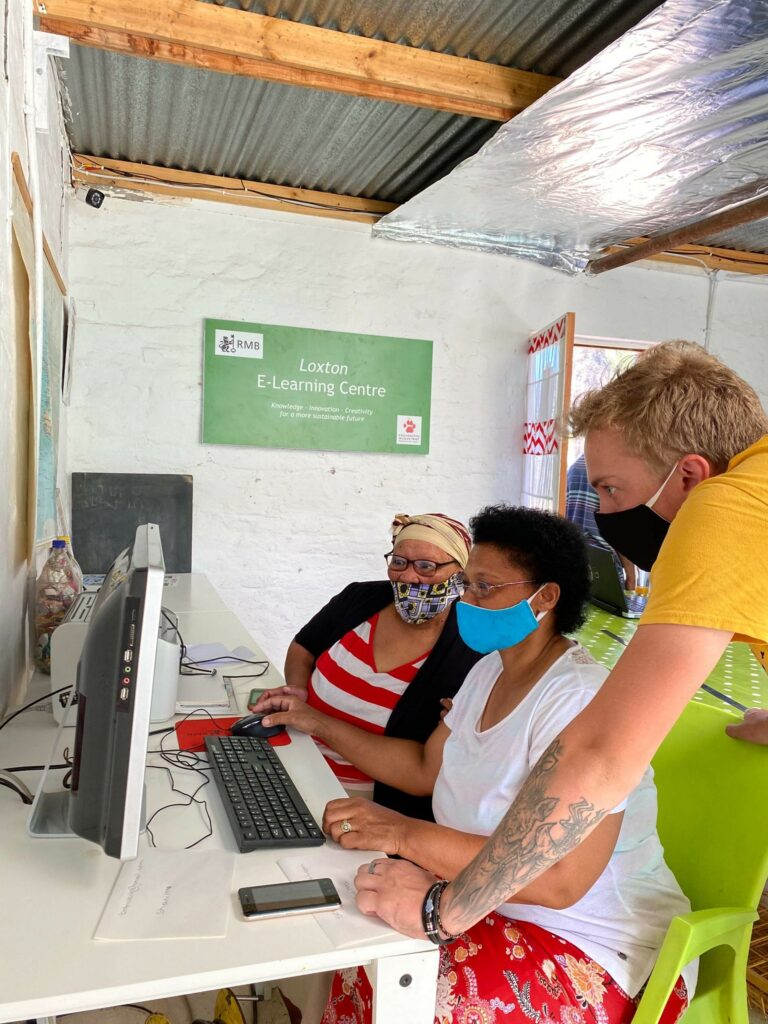
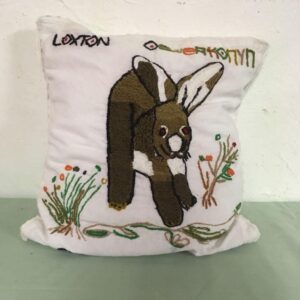
The Laslappies are a local, all-women needlework cooperative based in Loxton. Their cooperative was established in 2018, and their needlework was originally inspired by the Critically Endangered Riverine Rabbit occurring in the surrounding area. Since the start of the cooperative, the ladies have steadily grown their business and are now creating everything from curtains to face masks, both for the community and larger commercial companies.
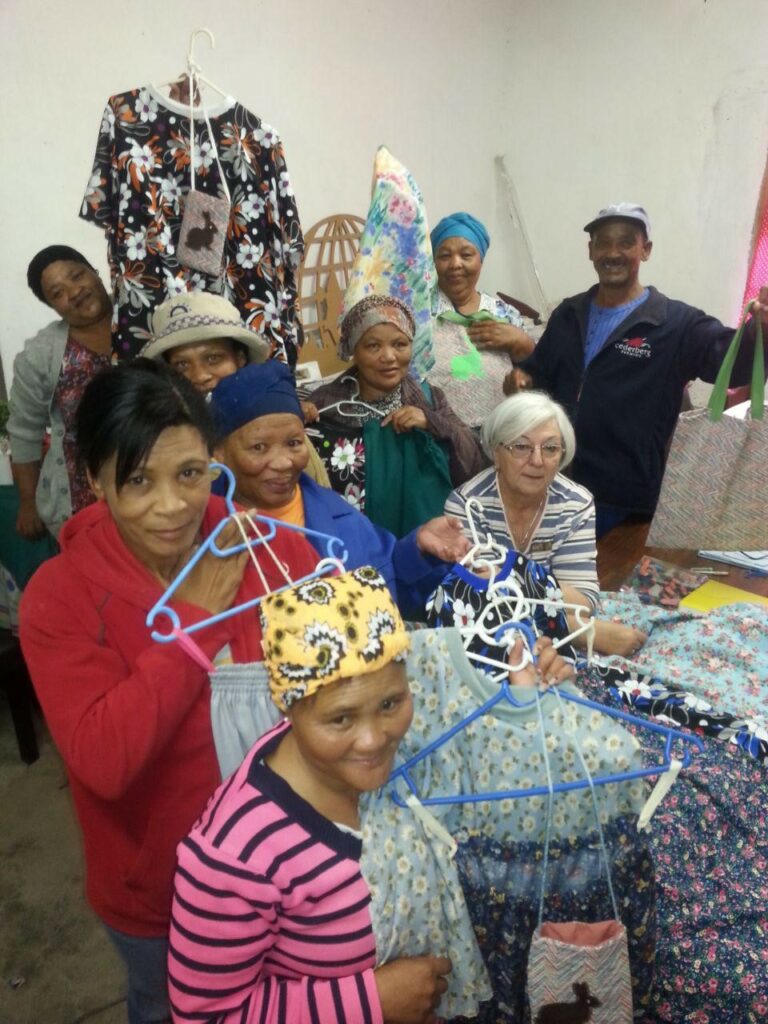
The EWT’s Drylands Conservation Programme supports these ladies’ efforts by providing them with additional opportunities and training, and the Laslappies started their first computer skills classes this month at the EWT’s E-learning Centre in Loxton. In these classes, the ladies will learn how to create documents, send emails, scan and print documents, and other skills beneficial for their business activities. We want to give special thanks to our two local volunteers, Llewellyn and Dante, for hosting these sessions. We hope to one day expand and improve the centre to provide training to larger groups of learners and community members.
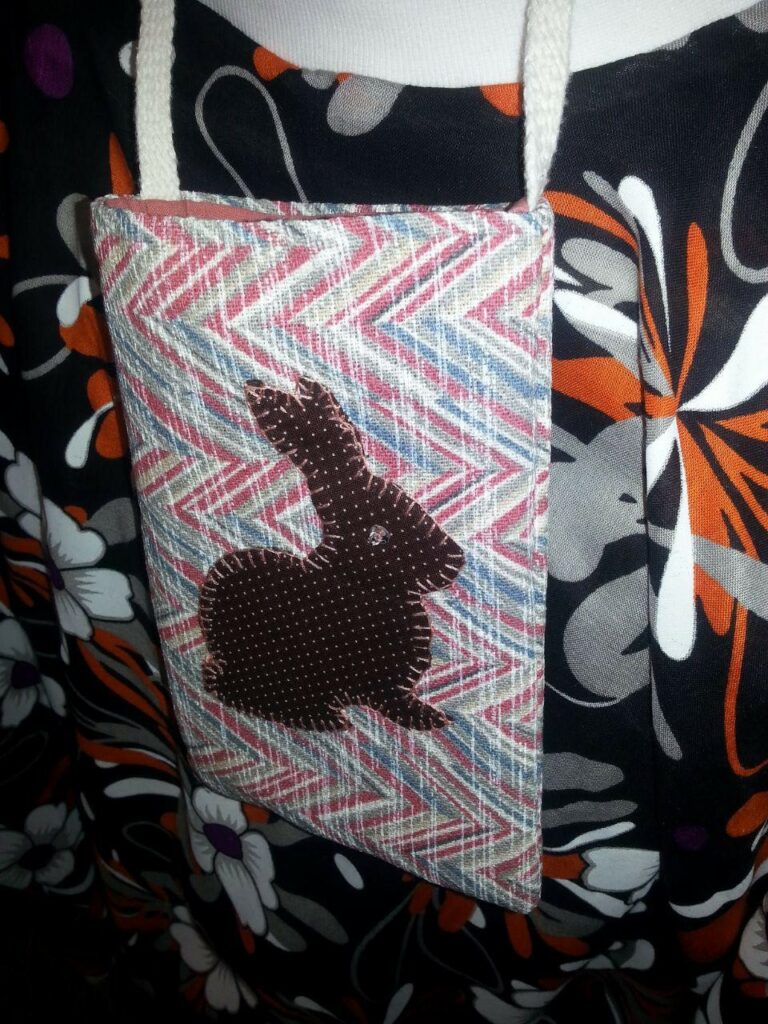
This initiative is made possible by Rand Merchant Bank.
A LEGACY FOR LIFE
My involvement with EWT goes back to the late 1970s when I became aware of the amazing work being done even then by the EWT and its charismatic and committed Founder, Clive Walker.
I was particularly impressed that, despite running on a shoestring, based on funds raised from the sale of prints of Clive’s paintings (see here), and through the efforts of a dedicated volunteer Ladies Committee, EWT was able to make a discernible difference in Southern African conservation. It was not just the conservation of Cheetah and Wild Dog that drew my attention, but I was particularly moved by EWT’s contribution towards saving the desert elephants and desert rhinos in the remote regions of Namibia and the engagement of local communities to help make this happen.
I volunteered my services to Clive as a reasonably well-connected businessman and fundraiser, and one of my first successes for the EWT was to raise funds to repair the leaking roof of the old premises at the Johannesburg Zoo.
In the early 1980s, then EWT Chairperson Angus Morrison invited me to become a Trustee. By this stage, Dr John Ledger had become EWT’s Director, and the Trust was expanding its reach, building on the solid foundation created by Clive Walker and the earlier Trustees. As a Trustee, I continued to be active in the procurement and fundraising areas and was also privileged to represent EWT in various forums, including presenting a special award to the SANDF unit that did the most for conservation. Later on, I was instrumental in merging the African Raptor Information Centre into the EWT’s Raptor Conservation Group.
I migrated to Australia in 1999, where my future wife lived, but was requested by John Ledger to remain a Trustee. I did so until 2006 when I felt that as a Trustee living abroad, with limited opportunity to make a worthwhile contribution, I should step down and make way for other potential Trustees living in South Africa, who would be better able to serve EWT. However, my interest in EWT has never abated, not least because of my many years of involvement and my life membership of the organisation but importantly because of the great strides EWT is making in wildlife conservation and human engagement.
I had met Yolan Friedmann during my time with EWT when she was involved, together with Dr Paul Bartels, in an EWT-supported project to explore the viability of storing DNA samples for genome sequencing, with the potential to revolutionise biodiversity research. There was even talk of using the DNA of a Quagga skin at a museum in Holland to recreate the quagga and other extinct species. Australia has also experienced the loss of some flagship species, including the famed Tasmanian Tiger, and so from Australia, I contacted Yolan to explore possibilities for collaboration with the Australian Museum, who were interested in the work being conducted by her and Paul.
I was very happy to note Yolan’s later appointment as EWT CEO, and her impressive stewardship of EWT since then has reinforced my views that EWT is one of the most effective ‘conservation in action’ organisations in the world, and certainly in Southern Africa.
It is funny how the wheel turns because, in 2020, I joined a webinar organised by Jacana Publishers that featured Yolan and Clive Walker. It was an absolute eye and ear-opener to learn just how much this organisation has achieved over the years and continues to achieve today, and I seem to recall Yolan having used words to the effect that she dreams of a day when there will be no need for an EWT, but sadly, I can’t see that happening. EWT will and must continue to perform its vital role in line with its vision of “a world in which both humans and wildlife prosper in harmony with nature.”
Following that webinar, I have volunteered to assist EWT in Australia and New Zealand to help it to achieve this vision. In addition, I have decided to leave a bequest to the EWT because I believe it is the most effective conservation organisation in Southern Africa, with measurable successes in both human and animal terms. I believe that it behoves all who support the EWT’s vision and mission to do everything possible to help it to succeed, both in our lifetime and beyond, and that is what I am doing!
Rob Schneider, 2021
In the spring, a tree will be planted in Rob’s honour as the first in our Forever Forest. A tree will be added for each person who leaves a bequest to the EWT to acknowledge that their legacies will live on through the EWT’s conservation work.
If you too yearn for a better future for your children, leave a Legacy for Life by remembering the EWT in your will, and help us secure the health of our planet and its wildlife beyond your lifetime.
All bequests made to the EWT create legacies for life that are immeasurable and remembered through the survival of our endangered species and spaces.
FINDING YOUR FROG PRINCE(SS)
Dr Jeanne Tarrant, EWT’s Threatened Amphibian Programme Manager, jeannet@ewt.org.za
Background
South Africa (including Lesotho and eSwatini) has 135 frog (anuran) species, represented by 12 families, with over a third of the diversity within one family, the Pyxicephalidae. Over half of these species (54%) are endemic to the region, i.e. they don’t occur anywhere else in the world. Forty-four species (33%) fall into the IUCN threatened categories or where we don’t have enough data to assess them. While we have a fairly good understanding of the status of our Threatened frog species (assessed in 2010 and again in 2016), an assessment of our Least Concern species has not been published since 2004. Several new species have also since been described, which is very exciting, but these have not yet assessed for their threat status.
Species data
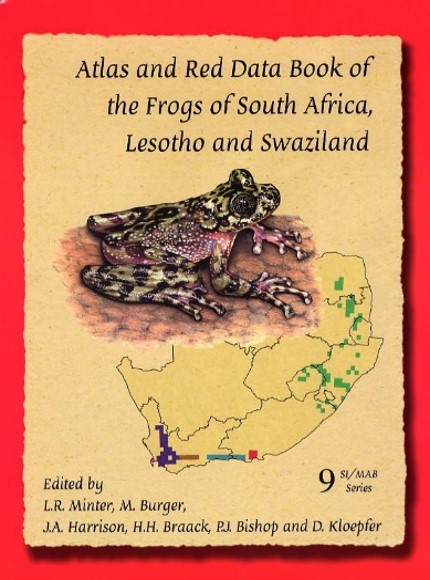
Since 2004 there has also been a massive increase in contributions of wildlife records by the public through online platforms such as iNaturalist, iSpot, and even Facebook. The collation of these ‘citizen science’ records contributeS significantly to improving our knowledge of species distribution. Accurate inferred distribution maps will be developed by consolidating these records, plus all of those existing in museum collections and private collections. These updated distribution maps are crucial for informing where and for which species conservation efforts need to be directed.
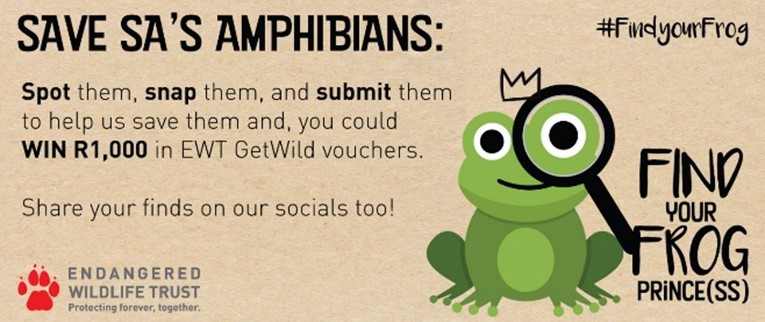
Find your Frog Prince(ss) Campaign
It is important that the public become involved in such projects and that citizen science records are used meaningfully. To this end, we launched an iNaturalist project that ran during March 2021 to feed into the thousands of records that already exist on this platform, and that will all be used to update the Atlas. One of this project’s goals is to inspire the next generation of frog biologists and conservationists to continue the very necessary work of conserving these species and their habitats well into the future to benefit people’s health and the planet.
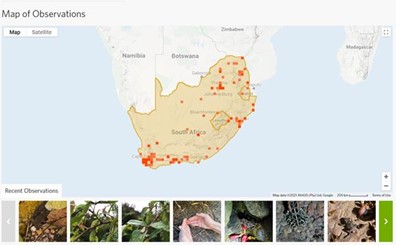
To date, we received 400 observations of 48 species from 60 observers across the country
