PULLING THE RABBIT OUT OF THE HAT ON ANYSBERG NATURE RESERVE
Marienne de Villiers, CapeNature, Faunal Ecologist, mdevilliers@capenature.co.za
While the habitat requirements of Riverine Rabbits in the Nama Karoo are pretty well understood, the same can’t be said for the Little Karoo. Understanding what constitutes suitable Riverine Rabbit habitat, or what has been coined “Rabitat” by the Endangered Wildlife Trust’s bunny expert Bonnie Schumann, is the first step towards conserving this Critically Endangered species.
Since they were first discovered on CapeNature’s Anysberg Nature Reserve in 2013, there have only been a handful of sightings of these rare bunnies. These do include some spectacular observations, however. The 2013 record was made when a Riverine Rabbit was captured by hand by CapeNature’s Corné Claassen and Marius Brand. The youngster was released unharmed after providing a valuable genetic sample. In 2019, Ishmael Wambi, a Nature Conservator at Anysberg, got some amazing video footage of a Riverine Rabbit that was startled in the headlights of his vehicle; you can view the video on this link: https://vimeo.com/328121696. And earlier this year, surprised Anysberg Field Rangers flushed two startled rabbits in the middle of the day while carrying out a game count.
While it is good to know that Riverine Rabbits are persisting in the reserve nine years after their discovery, there are still vital questions that need to be answered to ensure the protection of the species. Thanks to land purchases by WWF-SA, Anysberg is a relatively large reserve at just over 80,000 ha. But how much of this area constitutes rabitat? By working in partnership with EWT’s Drylands Conservation Programme, CapeNature aims to improve our understanding of Riverine Rabbit habitat requirements in the greater Anysberg area and to ultimately use this information to predict population size on the Anysberg Nature Reserve.
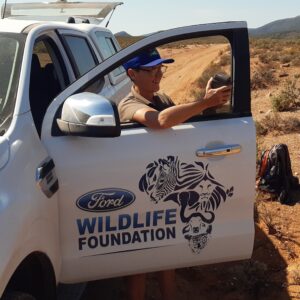
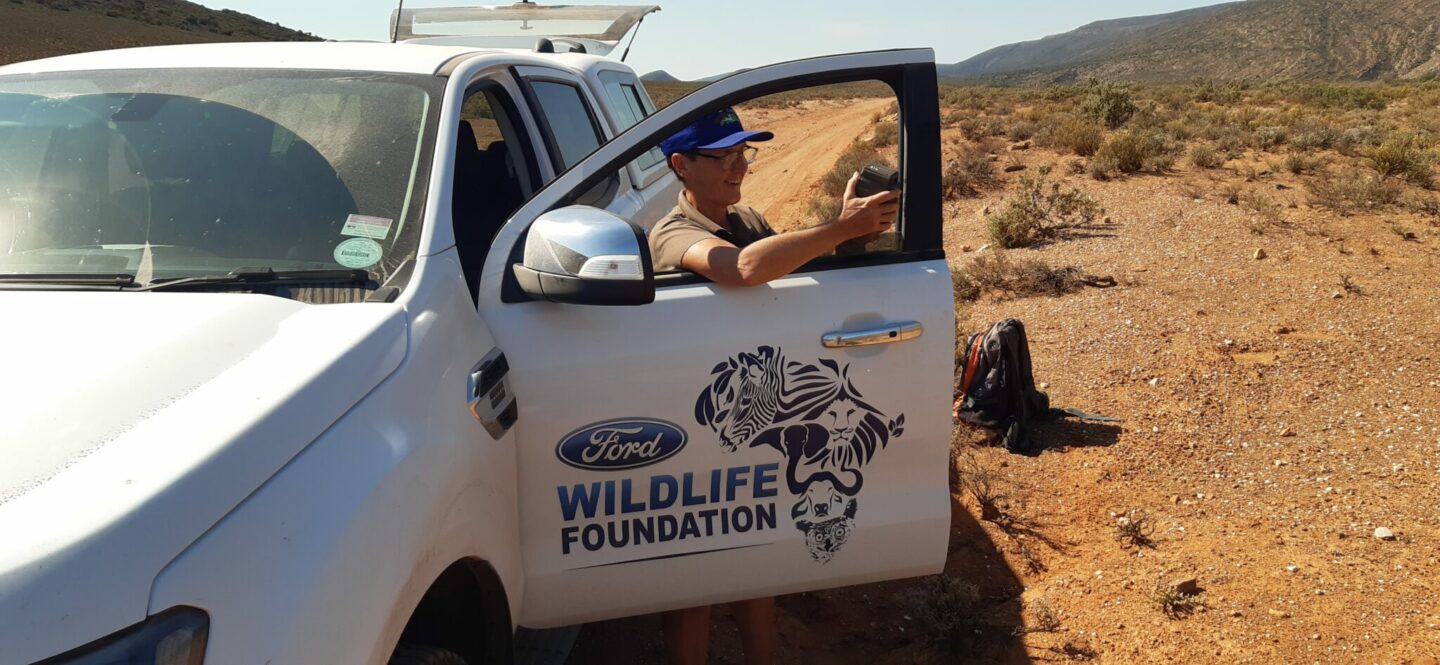
As a first step towards addressing this question, Bonnie Schuman from the EWT spent a day on Anysberg, sharing her considerable experience and expertise on the species and its requirements with CapeNature Faunal Ecologist Marienne de Villiers. With her bunny radar turned on and finely tuned, Bonnie also advised on the placement of camera traps to test for the presence of bunnies in an area on Anysberg that has never been searched for rabbits before, but where they might well occur. To read more about this excursion here) The long-term plan is to map the reserve according to potential rabitat, looking at various criteria, including soil type, slope, vegetation structure, and density. Then we will test these areas for rabbit presence using camera traps. But for now, it’s a waiting game. The cameras will stay out in the field for at least six weeks; only when the memory cards are downloaded will we know if the rabbit is in the hat, so to speak.
For more information on the Anysberg Nature Reserve:
https://www.capenature.co.za/reserves/anysberg-nature-reserve/
For more information on the Endangered Wildlife Trust:
https://ewt.org/
WHAT DOES PERMACULTURE HAVE TO DO WITH CRANES?
Lara Jordan, laraj@ewt.org.za, and Samson Phakathi, samsonp@ewt.org.za, EWT’s African Crane Conservation Programme
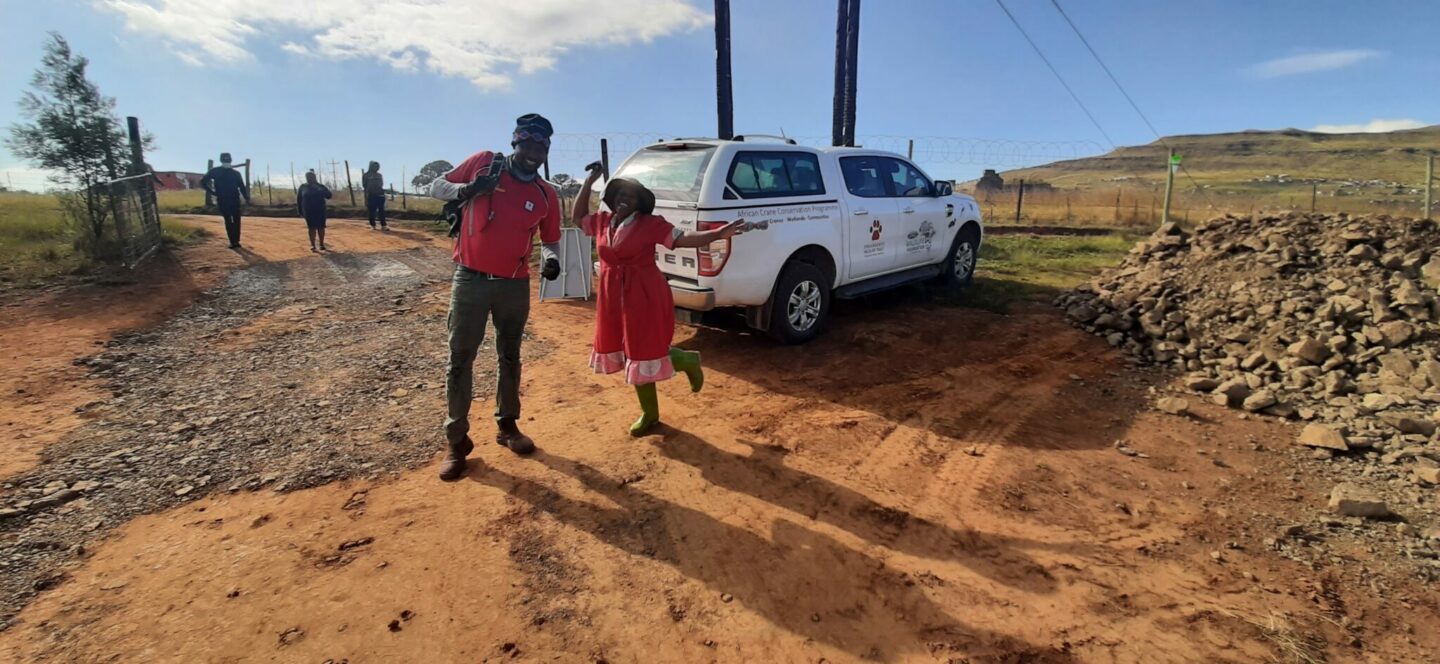 Samson Phakathi Senior Community Officer ACCP and Ntombenhle Mtambo permaculture trainer
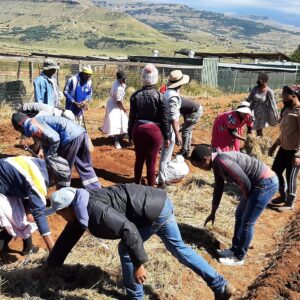
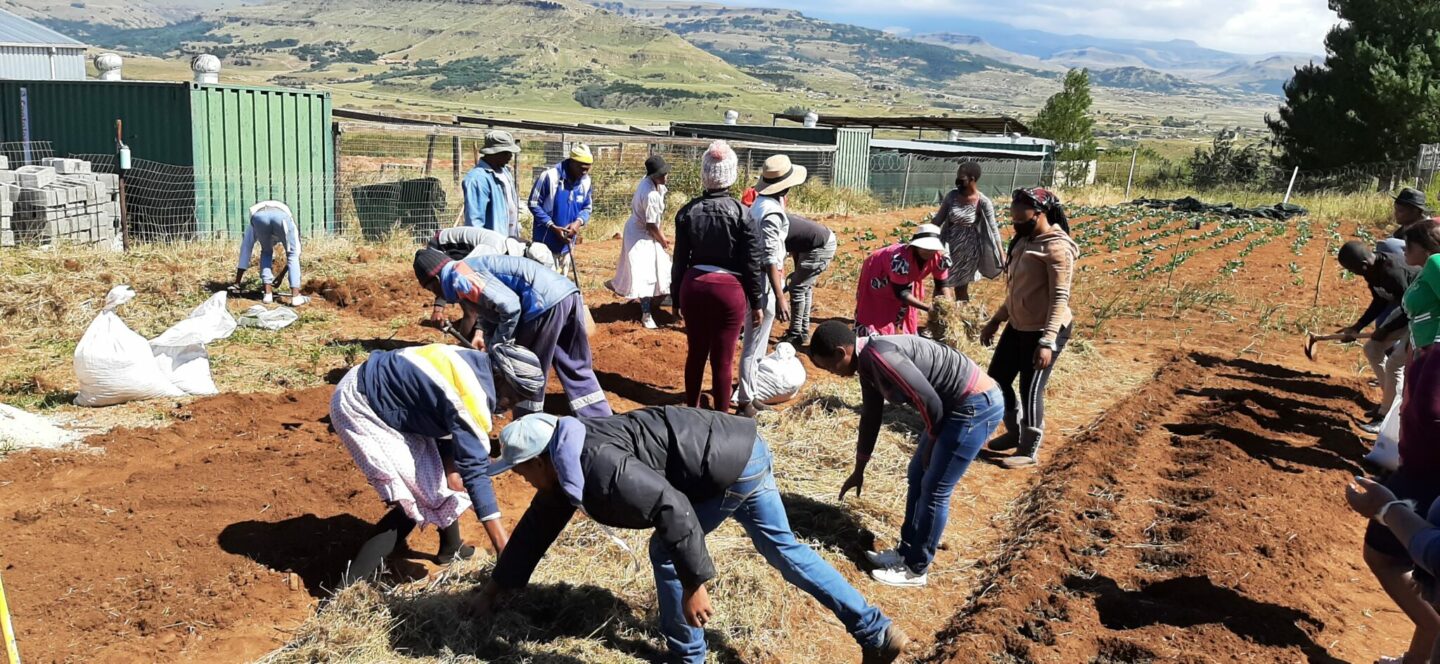 Youth in KwaMkhize learning how to construct permaculture gardens using available resources
In 2020, we saw some of the most desperate situations arise across South Africa due to the Covid-19 virus and the effects of lockdown on vulnerable communities. However, as individuals, how we react to a traumatic or desperate situation varies from person to person. In KwaMkhize, a community adjacent to the Giants Castle area of the Maloti-Drakensberg Nature Reserve, a group of youth who had felt the harsh effects of hunger requested help from the EWT to change the future by creating not only a food security garden but a sustainable garden. The Traditional Authorities are in full support of their endeavours and were delighted to have the training they needed to drive food security projects within the community.
Permaculture is the development of agricultural ecosystems intended to be sustainable and self-sufficient. Much like no-till farming, permaculture protects the soil structure of the ground and allows the carbon sequestration capability to remain intact, benefitting the environment. Ntombenhle Mtambo, a locally renowned permaculture trainer, trained over 30 youths passionate about growing their own food and looking after their soil. Nombenhle, however, never tells someone how to do something but rather lets them experience the difference. The youth, therefore, dug and planted a traditional garden, and next to that, they dug a permaculture garden. The aim was to demonstrate to the youth that an understanding of the environment and soil will teach the youth to see the difference between sustainable land use and non-sustainable land use. Ntombenhle is a clever lady like that! The youth have already started digging permaculture gardens in the community to support the most vulnerable individuals, e.g., the elderly.
You may be wondering how developing sustainable gardening helps cranes. In water catchment areas where cranes live, it is vital that the soil structure of grasslands and wetlands on which they rely for breeding is protected and sustainably utilised. In the face of global warming and the effects of climate change, land-use practices need to change to enable the survival of communities and cranes. In addition, no-till farming and gardening protect the land from soil erosion. The mulch formed creates a soak to hold water, vital for sustainability in countries with water shortages like South Africa. We are delighted to continue supporting these enthusiastic and environmentally conscious individuals. We are continuing the training in other crane-sensitive rural communities, and often where little support has been received previously. If you have never seen the difference, then we encourage you to try it out in your own gardens at home!
This project is supported by the Paul King Foundation and N3TC.
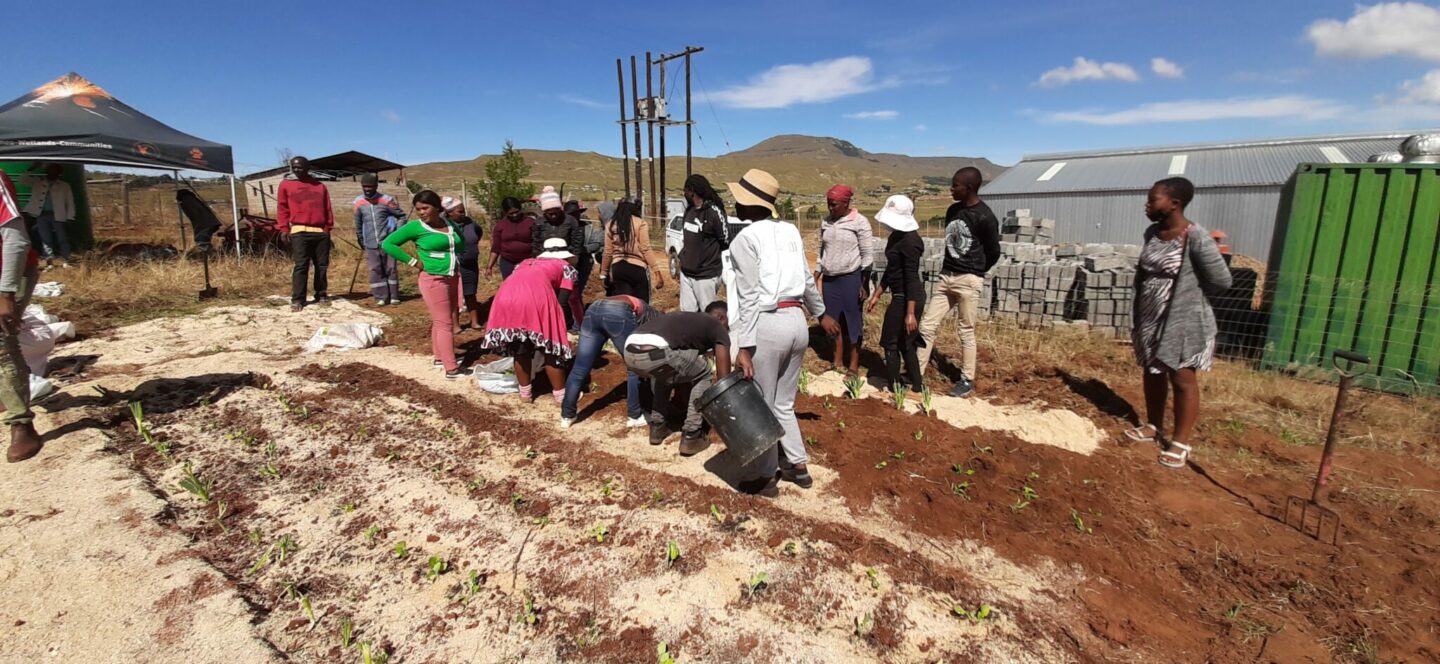 Youth in KwaMkhize learning how to construct permaculture gardens using available resources
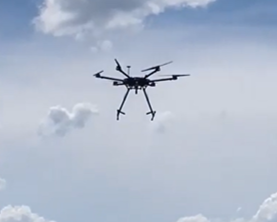
DRONE TECHNOLOGY IS SUCCESSFULLY USED TO ATTACH BIRD FLIGHT DIVERTERS TO A LIVE POWERLINE
Lourens Leeuwner, EWT’s Wildlife and Energy Programme Manager, lourensl@ewt.org.za You may remember the article we published in February entitled Technology taking conservation to new heights celebrating the granting of EWT’s license to operate remotely piloted aircraft systems (RPAS), commonly referred to as drones, by the South African Civil Aviation Authority (SACAA) in January of this year. The article detailed some of the potential applications for RPAS in conservation and detailed the aerial imagery support we provided to the Gauteng Department of Agriculture and Rural Development (GDARD) in February for the continuous monitoring of a Hippopotamus seen moving in and around residential areas in northern Johannesburg. However, the primary purpose behind our application for the license was to fulfil the vision shared by the ESKOM/EWT Strategic Partnership to enhance the efficiency of our existing interventions to reduce wildlife mortality resulting from linear infrastructure such as power lines while ensuring the safety of our technicians.
Collision with overhead power lines is a significant cause of mortality for several large bird species. Line markers are the preferred and most widely implemented approach to preventing bird collisions with power lines and can reduce mortality by up to 92% for certain species. In South Africa, line markers are currently attached to power lines by hand, via helicopter for larger transmission lines, and a bucket truck for smaller distribution lines, which all present significant safety concerns. However, drone technology now provides an alternative that negates the need to bring linemen into contact with power line cables while potentially saving millions of Rands in helicopter time and other live line equipment usually required to perform the task. Eskom’s distribution and transmission overhead power lines have a well-documented negative impact on South Africa’s threatened and protected avifauna, and therefore improving the marking efficiency and cost-effectiveness will help streamline powerline mitigation efforts to the benefit of thousands of birds.
The Endangered Wildlife Trust’s Wildlife and Energy Programme, in partnership with Eskom Holdings SOC Limited, has designed and developed a unique drone-operated system to carry and deploy bird flight diverters, or ‘flappers’, which serve as markers to improve the visibility of power line cables to birds in flight. Drones, also known as remotely piloted aircraft systems (RPAS), are revolutionising technician safety and efficiency in several spheres of industry. The main practical advantage of a drone is its ability to go places that humans and their traditional modes of transport cannot, and the most significant benefit is that it can safely perform the same tasks by eliminating the need for people to get into dangerous situations whilst reducing overall costs.
Through innovative 3D design and printing technology, the EWT developed a working prototype of a remote attachment system mounted on a drone that can attach flappers to powerlines safely. This custom-built first of its kind system can carry one magazine, holding four flappers at a time, and multiple magazines can be printed for quick reloading in the field. The magazine is suspended safely below the drone by an insulated rod, so that the pilot can position the drone away from live energy components while the magazine makes contact with the line and dispenses the flapper. The concept was successfully demonstrated to the South African Civil Aviation Authority (SACAA) in December 2020 and subsequently approved for commercial application, subject to rigorous safety and operational procedures. Following this important milestone, the system was tested in a controlled environment under the supervision of the Eskom Distribution North West Operating Unit Platinum Live Work department before a field trial was completed in the Zeerust area early in March 2021. Marking the line selected for the trial formed part of Eskom Distribution’s bird mitigation strategy, as several vultures had collided with the line previously.
Constant Hoogstad, the EWT’s Senior Manager: Industry Partnerships, initiated the project in 2016 and had this to say about the recent field trials: “What an incredible achievement for the Eskom/EWT strategic partnership to mark the first powerline in Africa with an RPAS system. This has taken years of hard work and dedication from a very committed team to ensure that history was made and is a huge win for bird species affected by collisions with powerlines. The system will enable utilities to mark power lines in a more cost-effective way from now on, which will save millions of Rands“.
Lourens Leeuwner, the EWT’s Wildlife and Energy Programme Manager, said: “The successful demonstration of this system is a major milestone for the Strategic Partnership. It simply would not have been possible without the assistance of the Eskom North West Operating Unit and the many individuals from Eskom’s Live work department who took time out of their busy schedules to assist us on the day.”
The Eskom/EWT strategic partnership is an example of what can be achieved when business and conservationists work together towards a common goal to address electricity infrastructure impacts on wildlife in South Africa for the last 24 years.
The Endangered Wildlife Trust set out to become a legal, commercial drone operator in South Africa in 2017. The non-profit, corporate, and commercial use of drones is regulated by the South African Civil Aviation Authority (SACAA), and organisations looking to operate within the legal framework enforced by the SACAA must obtain an RPAS Operating Certificate (ROC). Getting an ROC is quite onerous in terms of the various licences, registrations, and certifications an organisation must acquire – so much so that, unfortunately, many drone pilots are put off by this process and choose to operate illegally.
Should you require the services of the EWT’s drone unit for any of the activities listed above, please contact our RPAS Operations Manager, Lourens Leeuwner (lourensl@ewt.org.za ). Our RPAS are always ready to take flight for conservation.
SCIENCE SNIPPETS:
SPLAT STATS
Dominic Henry, EWT Conservation Science Unit, Ecological Modelling Specialist, dominich@ewt.org.za
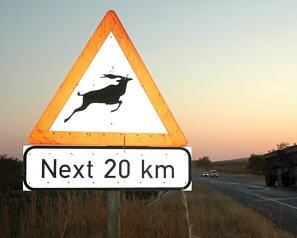
Road networks form a substantial part of current and future infrastructure development and are a major hazard for local wildlife populations. Due to high mortality rates, wildlife-vehicle collisions are a threat not only to individual animals but to broader animal communities, populations, and species. The threat of wildlife-vehicle collisions is set to increase globally as an additional 25 million kilometres of road are expected to be added to the global road network by 2050.
We need to estimate how many wildlife deaths result from vehicle collisions if we want to understand this impact on wildlife populations and develop strategies to prevent or reduce the collisions, so we need to get out there and do surveys.
However, conducting roadkill surveys is a resource-intensive exercise. Labour costs, fuel, mileage, and vehicle maintenance are just some of the costs incurred for this type of research. Depending on the study site and survey durations, these costs can escalate quickly. Research budgets are often limited, and it is important to make each rand go as far as possible. In light of financial resource limitations, the question is, is there an alternative to conducting daily surveys of roadkill while still having a robust study design?
When designing roadkill surveys, there is a trade-off between survey frequency (and all the logistical effort and costs incurred) and roadkill carcass detection. In this regard, carcass persistence (the period a carcass remains detectable before it is removed by decomposition or scavengers) is important; the longer a carcass persists, the greater the likelihood it will be detected with lower survey effort by conducting more infrequent surveys.
Part of our research, published recently in the Journal of Environmental Management, looked at this question. The study was based on Wendy Collinson-Jonker’s roadkill dataset collected in the Greater Mapungubwe Transfrontier Conservation Area. An observer drove a standardised 120 km transect daily for a month, recording all carcasses as well as how long they remained on the road. Over 340 carcasses were recorded, comprising 73 species ranging from the smallest frogs to a Brown Hyaena. We used these data to simulate what would happen if surveys were conducted with different intervals from 2–10 days.
We found that the proportion of carcasses detected decreased sharply when survey intervals were longer than three days. However, we showed that survey costs could be reduced by up to 80% by conducting non-daily surveys. By carefully considering the objectives of the survey and characteristics of the focal species, researchers can substantially reduce the costs of their studies. We developed a web app (https://roadsplat.ewt.org.za/) that can be used by researchers to compare survey costs across a variety of survey characteristics. This web app allows researchers to assess the trade-off between carcass detection and cost easily.
Details of the journal article:
Citation: Henry, D.A.W., Collinson-Jonker, W.J., Davies-Mostert, H.T., Nicholson, S.K., Roxburgh, L. and Parker, D.M. 2021. Optimising the cost of roadkill surveys based on an analysis of carcass persistence. Journal of Environmental Management 291:112664
Link to paper: https://doi.org/10.1016/j.jenvman.2021.112664
Link to app: https://roadsplat.ewt.org.za/
CONSERVATION CHAMPION
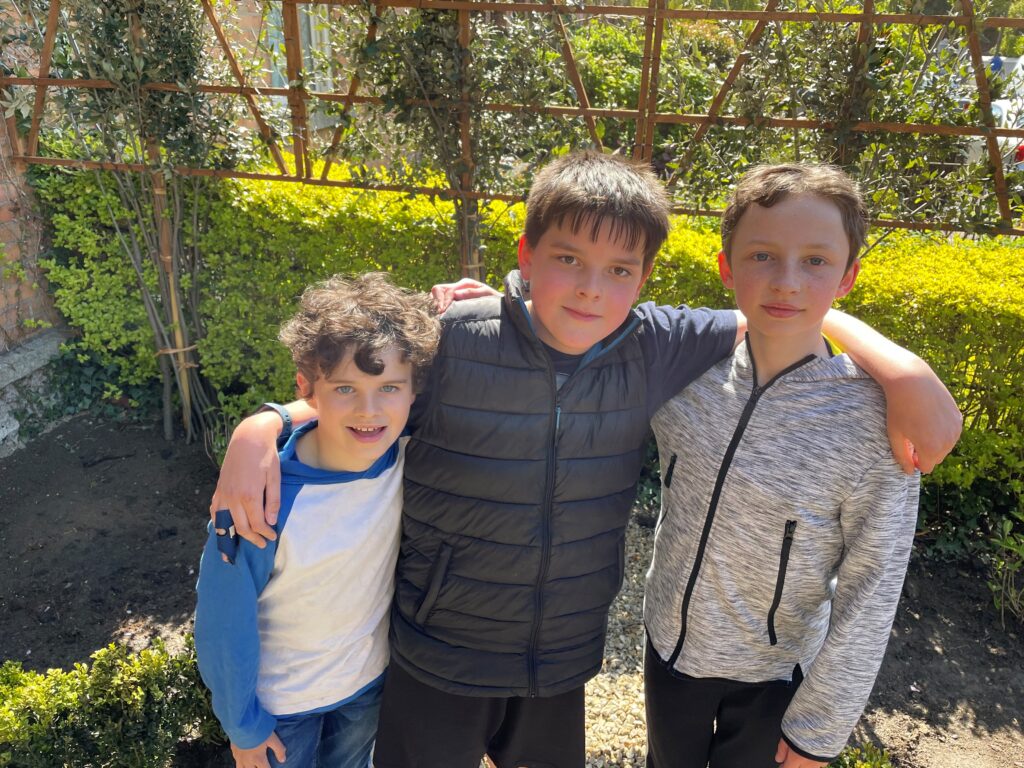
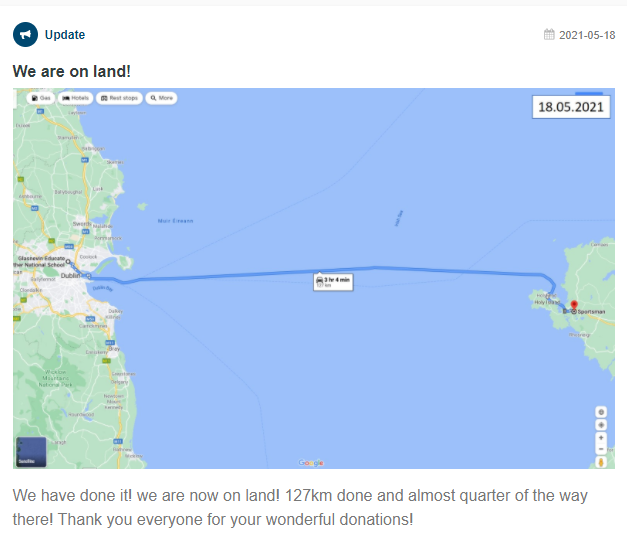
Alex, Harry, and Peter, three remarkable 11-year-old boys from Glasnevin Educate Together in Dublin, are running from Dublin to London to raise money for the Endangered Wildlife Trust.
They posted the following appeal online:
“We need your help! The global covid crisis has shown us more than ever how important it is to work together to support the future of our planet – the people, the environment and the animals within it.
We will be running together and on our own over the next few months, and we will add our distances together to make up the 535 km journey from our school to Big Ben in London. We hope you will cheer us on by donating to this very worthy charity – www.ewt.org.za”
On 28 May they posted the following update:
We just want to thank all our friends and family for the most generous donations and kind words we have received so far. We are overwhelmed to have raised €788 already. THANK YOU EVERYONE.
To support these Conservation Champions and track their progress, please follow this link: https://www.givengain.com/ap/jessica-hardy-raising-funds-for-endangered-wildlife-trust/