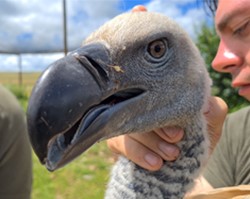
Dr. Mike the Cape Vulture
On 3 October 2021, the Lowveld BOPP team was alerted that a Cape Vulture had been found grounded on Licata Nature Reserve, northwest of Hoedspruit. The bird was initially found at sunset by the reserve wardens’ son, Stuart Reid, and although it was unclear why it could not fly, it was speculated that the bird sustained a wing injury at some point.
We arranged to collect the bird immediately after approval from LEDET, and it was taken through to Moholoholo Wildlife Rehabilitation Centre, where it was stabilised and monitored overnight by Nikkita Jackson and Rebecca Lambert. The staff there have always put an exceptional amount of effort into the rehabilitation of birds of prey and have been important allies in the past with dealing with poisoned and injured birds. The following morning, we took the bird to ProVet for x-rays, where it was immediately established that the bird had suffered a bad break to its right metacarpal. Following some emergency arrangements with LEDET, MTPA and the State Veterinary Department, we moved the bird to White River Animal Hospital, where Dr Bennie Pienaar, Dr Karien Prinsloo, and Dr Mike York did an incredible job at pinning the wing. Considering the severity of the break, it was hard to be completely confident that the bird would make a full recovery, but fortunately, the procedure was a success, and the bird could start the next part of its journey.
From here, it was then taken to Dullstroom Birds of Prey Centre, where Magdali Theron and Frith Douglas spent the next few months working their magic to get the bird back to fitness and ready to release. This is not always an easy process, and particularly at the beginning, the birds require a great deal of attention to prevent re-injury of the wing before it has fully healed. After a successful stint in the clinic, it was time to remove the bandages and the pins before placing him in one of the outside enclosures with three other Cape Vultures, two of which are non-releasable, and the third is still being rehabilitated. Fortunately, the entire process had gone incredibly well, and over the following six weeks, the bird slowly began to build up some muscle mass again until he was ready for release.
The BOPP team met up in Dullstroom on 28 January 2022 to give the bird a final check and attach a tracking device and identification ring before finally releasing it. This process could not have gone any better, and the bird immediately shot off and glided through the valley and into the distance, a great success after so much effort from several people. Although it’s still early days for this Dr Mike, he has already flown a significant distance, heading straight back to the colony at Manoutsa, popping into Mozambique, and spending some time near Shingwedzi in the Kruger National ParkThe case of Dr Mike highlights the value of collaboration between protected area management, veterinary clinics, rehabilitation centres, and conservation organisations. In combination with state-of-the-art GPS tracking, this network ensures the effective rescue, recovery, and safe release of injured birds back into the wild, where they can once again sail through the African skies. With the current declines vultures are experiencing across Africa, every individual counts. Thanks to all who played a role in the rescue and rehabilitation of this magnificent bird.
LATEST STORIES
HIDDEN IN THE GOLDEN SANDS OF TIME
Golden Moles Part One
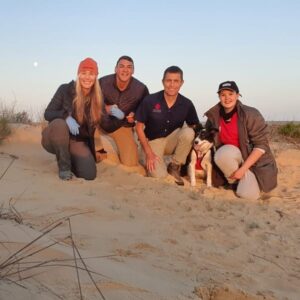
Cobus Theron, Dr Samantha Mynhardt, JP Le Roux, Esther Matthew, and Esther’s detection dog, Jessie, set out to find the Critically Endangered De Winton’s Golden Mole, a species that hasn’t been seen for more than 80 years. The team planned to use environmental DNA (eDNA) to identify these mysterious moles. eDNA refers to trace amounts of DNA that organisms ‘shed’ or leave behind in their environment in the form of skin cells, hair, blood, or scat. No, this isn’t an episode of CSI, but it’s much more exciting
The expedition time (left to right)
Dr Samantha Mynhardt, JP Le Roux, Cobus Theron, Jessie the Border Collie, and Esther Matthew. Photo credit: Nicky SounessTheir starting point was the site where the golden moles were last seen over eight decades ago – the dunes of Port Nolloth. JP Le Roux is a master scout, proficient at finding sites showing recent golden mole activity where the team could collect soil samples – hopefully containing eDNA from their target species. Another tool up our sleeve is Jessie, the Border Collie, a scent detection dog trained to detect and track various species, including the notoriously difficult to find Riverine Rabbit. She is now training to differentiate between different golden moles species, and when Jessie picks up the scent of a specific golden mole, she alerts her handler. The golden mole active at the expedition site in Port Nolloth was not one Jessie had smelled before – a promising and exciting indication.
Foraging signs from a golden mole (left) and Grant’s Golden Mole (right), a species Jessie has been trained to detect
Traditionally, eDNA is applied to aquatic environments, and working with terrestrial eDNA is a novel and challenging technique, but Samantha has successfully adapted it to soil samples. Upon her return from Port Nolloth, she extracted and analysed the eDNA through a specialised process. Preliminary results confirm that the activity seen at sample sites was that of a Cryptochloris species, either De Winton’s or its close relation, the Endangered Van Zyl’s Golden Mole. Either one is an extraordinary find, and we eagerly await more detailed results.
Finding De Winton’s Golden Mole would be a beacon of hope for conservationists – indicating that hidden wonders still wait to be discovered. Locating the areas inhabited by threatened species enables us to better protect them against the threats that endanger our wildlife, sometimes causing species to go extinct. The team will continue their research on the West Coast, hoping to find more locations inhabited by golden moles and increase community awareness and engagement around the species through social media campaigns, videos, and posters illustrating identifying features of different golden mole species.
We encourage people to report sightings of these fascinating creatures so that we can prioritise our conservation efforts, one of which is to formally secure sites containing priority golden mole habitat through biodiversity stewardship. Stay tuned to learn more!
The expedition was sponsored by Re: Wild, and the second phase of the project is supported by IUCN Save Our Species and co-funded by the European Union
LATEST STORIES
Science Snippets: Wildlife Ranches – South Africa’s Conservation Powerhouses
Private Ranches: A Growing Conservation Force
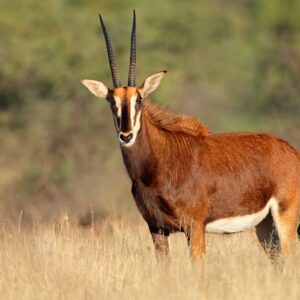
Science Snippets: Wildlife Ranches highlights a remarkable conservation success story. Across South Africa, roughly 20 million hectares of private land are dedicated to wildlife ranching—areas where sustainable wildlife-based activities generate income while protecting biodiversity. A groundbreaking study co-authored by EWT scientists* surveyed 226 wildlife ranches, revealing their untapped potential for species conservation.
Rich Biodiversity on Private Lands
The research uncovered staggering biodiversity:
- 40 wild herbivore species recorded across ranches
- 15 species per ranch on average
- Key groups included antelopes, zebras, rhinos, and elephants
- Most properties hosted at least one threatened species
- Many held translocated species outside their natural ranges
Notably, these ranches often outperformed protected areas in species richness per hectare. Larger properties consistently supported more species.
Tourism vs. Hunting: A Conservation Comparison
The study revealed key differences:
- Trophy hunting ranches had high species diversity but fewer threatened animals
- Ecotourism-focused ranches protected more vulnerable species
- Hybrid models (tourism + hunting) showed the highest overall biodiversity
Millions of Herbivores Thriving
South Africa’s ranches now sustain an estimated 4.66–7.25 million wild herbivores—a rare global example of thriving indigenous mammal populations. This success has even improved Red List statuses, like the Cape Mountain Zebra, which rebounded from Vulnerable (1930s) to Least Concern today.
Challenges: Fences and Genetics
While beneficial, ranches face conservation hurdles:
- Fencing restricts natural migration, fragmenting landscapes
- Extralimital species risk hybridization (e.g., Bontebok × Blesbok)
- Over ⅔ of Bontebok populations now show hybrid traits
Conclusion: A Vital Conservation Tool
Despite challenges, Science Snippets: Wildlife Ranches confirms these lands are critical strongholds for indigenous herbivores, including threatened species. Their blend of economic viability and ecological impact offers a model for sustainable conservation worldwide.
Study Reference:
Taylor, W. A., et al. (2021). Biodiversity and Conservation, 1-25.

Insights From The CEO: A Year of Environmental Progress and Persistent Challenges
These Insights From The CEO, Yolan Friedmann, reflect on pivotal conservation developments as 2021 draws to a close. The past months have brought both encouraging victories and sobering realities in South Africa’s environmental landscape.
Conservation Triumphs
We celebrate critical wins:
- Constitutional Court victory blocking the Yzermyn coal mine in Mpumalanga’s Mabola Protected Environment
- $8.5 billion international investment pledged for South Africa’s clean energy transition
- Strategic Water Source protection for one of only 22 areas producing 50% of our freshwater
Urgent Climate Concerns
Despite progress, alarming developments persist:
- South Africa’s refusal to sign the global coal phase-out pledge
- Continued reliance on coal despite renewable energy potential
- Ongoing load-shedding crippling economic recovery
“Life-saving decisions shouldn’t rest solely with governments when outcomes affect us all,” notes Friedmann. “Our court victories prove civil society’s vital role in environmental justice.”
Hope for the Holiday Season
As tourism rebounds, we invite nature enthusiasts to experience:
- The world’s first dedicated Wild Dog holding facility (Waterberg)
- Rare endemic frog species (Western Cape/KZN)
- Carnivore conservation programmes (Lowveld)
- Raptor experiences with vulture experts
These eco-tourism opportunities directly support our conservation work while offering unforgettable encounters with South Africa’s unique wildlife.
A Call to Continued Action
The EWT remains committed to:
- Protecting critical ecosystems
- Advocating for sensible climate policies
- Delivering hands-on conservation programmes
“As we approach 2022, we thank our supporters for standing with us through these challenging times. Your partnership makes our work possible.” – Yolan Friedmann
Contact our CEO: yolanf@ewt.org.za
Focussing on sustainable land management in Victoria West
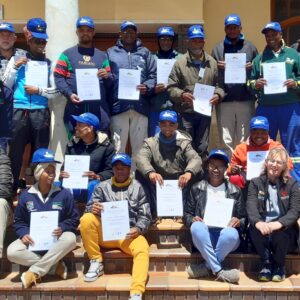
A group of emerging farmers from the Victoria West and Hutchinson area took part in an Integrated Farm Planning and Management training course held in Victoria West in October. The course was presented by the Endangered Wildlife Trust (EWT), in collaboration with the Department of Agriculture, Environmental Affairs, Land Reform and Rural Development and the Grootfontein Agricultural Institute. This was the third time the team has collaborated to present this course to farmers over the last two years: first in Loxton, then Prieska, and now in Victoria West.
The course aims to promote sustainable land management by building capacity amongst farmers, Agricultural Advisors and conservationists. It is vital that farmers are supported in their role as the custodians of the rich biodiversity found on South Africa’s farmlands. These areas fall outside formally protected areas but remain critical to ensuring the health and functioning of ecosystems across landscapes.mpleted the course. The coAltogether 12 farmers course focuses on a holistic approach to farm planning and the principles of sustainable land management. Considering the predicted impacts of climate variation, we must start changing how we are doing things to build environmental and community resilience to extreme climatic events, such as the current drought. Sedrick Visser, Agricultural Advisor (Northern Cape), took the lead in presenting this course. Visser is passionate about training farmers and has taken the lead in presenting the last two courses after he attended the first one held in Loxton as a participant. Sharing knowledge and having discussions around solution-based approaches will empower people to act positively and be the change that is needed. Courses like these enable farmers to improve their farming practices, protect natural resources and create sustainable futuresStaff from the EWT’s African Crane Conservation Programme joined the farmers on the course and underwent training to capacitate them to present the course to communities in KwaZulu-Natal early next year. The content of the course is currently being adapted to make it relevant to the grassland biome.
The training course is also available, for free, online at the www.karooforever.org.za website, created as a knowledge-sharing platform for sustainable land management. The content on the Karoo for Ever website was made possible by several specialists sharing knowledge in the form of webinars and written information. We thank them all for generously sharing their expertise and passion in the interest of promoting sustainable land management in the magnificent drylands of the Karoo.
The course was made possible with funding from the Global Environment Facility and managed by the United Nations Development Program in partnership with the Department of Environment, Forestry and Fisheries and Department of Agriculture, Land Reform and Rural Development and the National Lotteries.
For more information on the course contact:
Bonnie Schumann
Email: bonnies@ewt.org.za
Cell: 072 122 4232
or visit the website at karooforever.org.za
