WORLD RANGER DAY – A CELEBRATION OF OUR EWT CONSERVATION CANINE RANGERS
Megan Murison. EWT Communications Officer, meganm@ewt.org.za
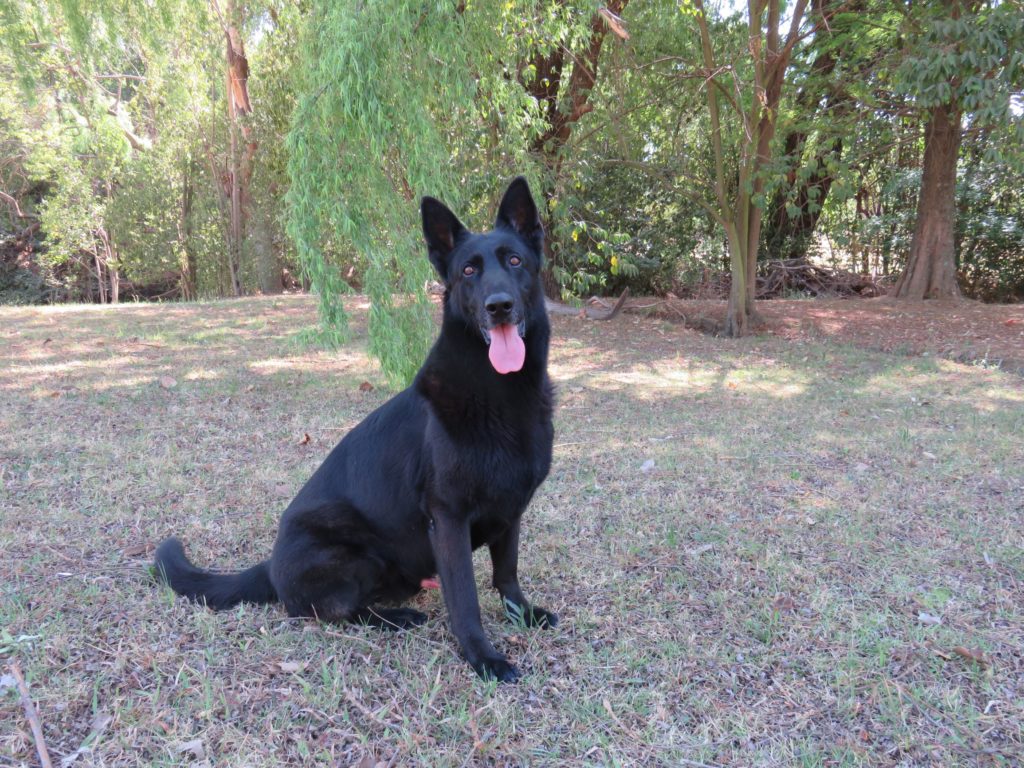
On the 31 July 2020, we celebrate World Ranger Day. This is a day to acknowledge the courageous rangers who risk their lives daily to protect our wildlife, and to commemorate the lives of those who have died fighting for this cause. This year we would like to celebrate the lives and work of our Conservation Canine rangers, particularly the two amazing dogs who passed away in June 2020, Fury and Annie.
Conservation Canine Fury worked with his handler, Shay Seebran, in the screening of vehicles for wildlife products and ammunition. Their two-year partnership included many happy memories and even a few occasions where Fury saved Shay’s life, such as when they encountered an elephant in the bush on a routine antipoaching patrol:
“Fury and I were patrolling towards an observation post approximately 8 km away, when we came across a very moody bull elephant. Despite everything I tried to defuse the situation and back away, the elephant made it clear that we had been in his comfort zone for too long, and that mock charging was not an option anymore. I unclipped Fury’s lead and chased him because I knew I was not going to outrun the elephant, nor did I want to shoot the animal. I guess Fury’s instinct kicked in and despite his size he charged at the elephant charging at me, putting himself between me and the elephant, miraculously stopping the elephant in his tracks and sending him fleeing in the opposite direction, leaving me speechless and in tears, thanking my K9 for saving my life”
-Shay Seebran
Travelling across South Africa as a team, they spent every second of the day together, leaving an everlasting footprint in the fight to save African wildlife. Fury, a legend in conservation and a well-known friend to many, has left his legacy to be carried on by many conservationists just like him. Losing him was a big loss to Shay and the EWT as a family.
“The legend may be gone, but certainly not forgotten, and I appreciate your service, rest in power son.”
-Shay Seebran
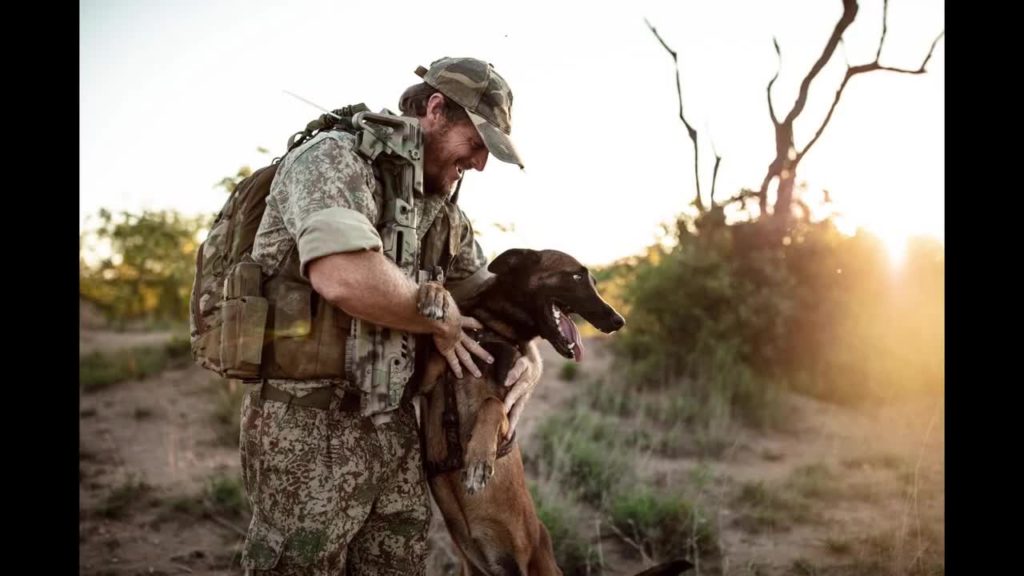
Conservation Canine Annie was sponsored by the EWT and trained at the Southern African Wildlife College. This is where she met her handler, Colin Patrick. Annie was trained to track, and her job was to follow up on poacher spoor at both fence incursions and away from crime scenes. Her legacy is proof that she was a true hero. Annie and her handler Colin were one of the first K9 Conservation teams to develop the ability to track down suspects at night, which changed the game in the fight against rhino poaching, and the team became highly successful at tracking down and arresting suspects. She assisted with over 17 arrests, one of which was a 13 hour follow up, during which they tracked poachers for 43.5 km to successfully apprehend the suspects. An extremely loyal conservation canine since 2018, she never left Colin’s side and travelled with him wherever he went.
“Their bond was unbreakable and one in a million and all were amazed by their connection”.
-Becky Patrick
“It was a privilege and honour to be a part of Annie’s life, to call her my partner and friend. Thank you, Annie, for your dedication and loyalty. Your legacy is an inspiration to all conservationists.”
-Colin Patrick
Fury’s work was funded by U.S Fish and Wildlife Service and Tourvest and supported by Royal Canin and Boehringer-Ingelheim. Annie’s work was supported by the EWT through sponsorship from the Relate Trust, MyPlanetRhino, Platinum Life, Royal Canin and Boehringer-Ingelheim, and a big thanks to Tomlin’s family for their ongoing support of the EWT Conservation Canines.
COLOUR CODING FOR CONSERVATION: ASSESSING THE RED LIST STATUS AND GREEN STATUS OF THE BLUE CRANE
Christie Craig, PhD Candidate & Western Cape Field Officer, African Crane Conservation Programme (ACCP)
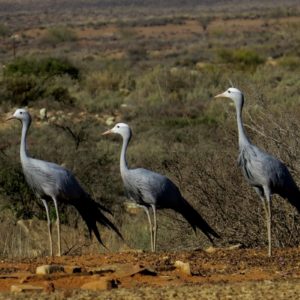
Our National Bird, the Blue Crane, is an interesting species in the context of modern conservation. They occur in the eastern grasslands of South Africa, Karoo, and Western Cape, with a very small isolated population in northern Namibia (less than 50 cranes). Blue Cranes were once abundant in our eastern grasslands, but in the second half of the 20th century, degradation of these habitats led to a crash in the Blue Crane population – an estimated decline of around 90%. At much the same time, areas of Fynbos in the Western Cape were being rapidly transformed for cultivation, namely wheat and pastures. Blue Cranes found these cultivated lands enticing and flocked to the Western Cape. Their numbers increased so dramatically that we now estimate that over half of all Blue Cranes live in the Western Cape.
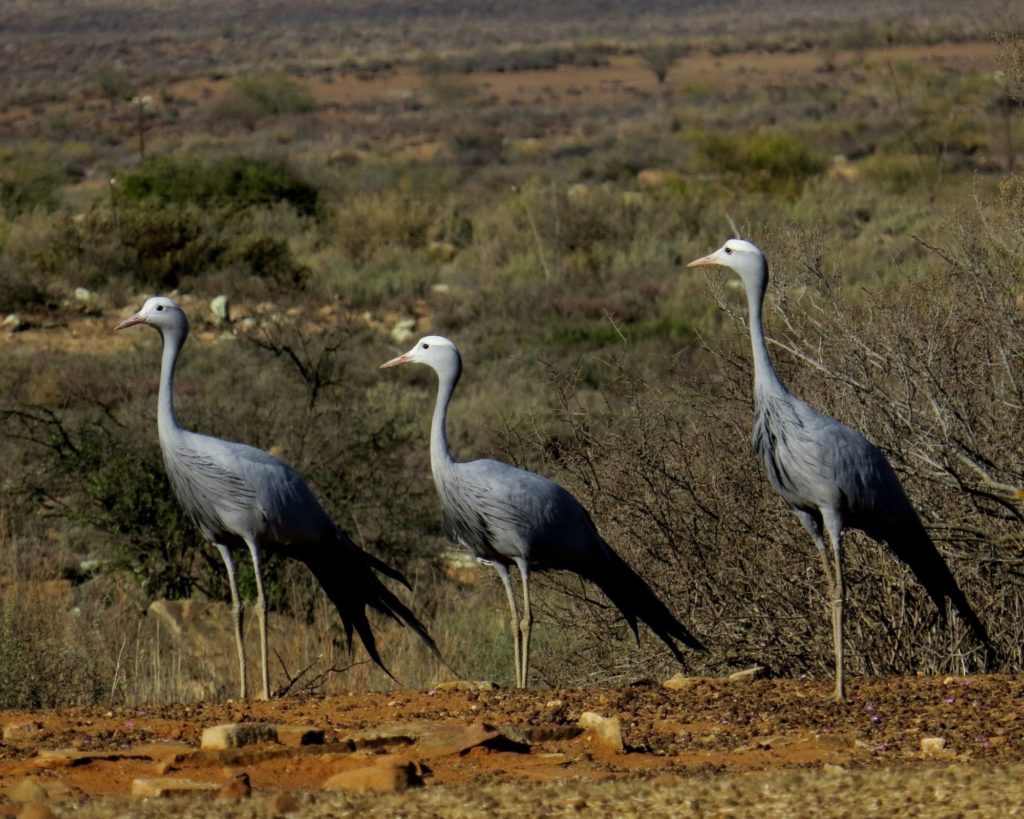
An intensively farmed agricultural landscape, such as those the Blue Cranes have chosen to occupy, can be a treacherous place for wildlife, and presents the cranes and conservationists working to protect the species with significant challenges. Threats rife in these areas include powerline collisions, fence entanglements, breeding disturbances, and occasionally conflict with farmers. Climate change and socio-economic factors placing further pressure on the agricultural landscape call into question the stability of this ‘artificial’ population. By contrast for example, the Karoo population experiences much less disturbance and as a result the population numbers have remained quite stable over the years.
The International Union for the Conservation of Nature (IUCN) Red List is a tool used to categorise the risk of extinction in species, and provides information on their range, population size, habitat and ecology, use and/or trade, threats, and existing conservation initiatives. The categories into which species are placed range in severity from Extinct, Extinct in the Wild, Critically Endangered, Endangered to Vulnerable. Species that are not yet considered threatened but have suffered some declines are categorised as Near-Threatened, while species that have healthy, stable populations are classified as Least Concern. The Red-Listing process is rigorous, and to inform the process biologists need reliable quantitative data to demonstrate actual or future declines in the species. The Blue Crane is listed on the global IUCN Red List as Vulnerable because of the declines in their grassland habitats and the rate of their population decline (30–50%) over three generations (39 years for Blue Crane).
The Red List is an incredibly useful tool for prioritising species for conservation action based on sound scientific evidence. However, it does have its limitations. As we see more positive impacts from conservation interventions, it is becoming clear that many species are in some way dependent on continued conservation efforts, and if these were to stop, the species population could once again begin to decline. These nuances are not accounted for in the red-listing process, which is what led the IUCN and other partners to establish the IUCN Green Status of Species. The Green Status is a way to categorise a species according to its recovery potential, its state of recovery, and its dependence on conservation. In December 2019, The Endangered Wildlife Trust’s African Crane Conservation Programme (EWT-ACCP) took part in a global project run by the IUCN to test the Green Status of real-world species. We ran through the process of assessing the Green Status of the Blue Crane, the results of which, as well as those for hundreds of other species across the globe, are being analysed by the IUCN and will soon be published for comment from the scientific community. We are very excited to have contributed to this exciting project, which will allow us to view threatened species not just in terms of their risk of extinction, but also of their recovery potential.
However, assessing the extinction risk of a species through the Red-List is, and will remain, an important part of understanding the conservation status of a species. In the case of the Blue Crane, with available data showing the population increasing in parts (Western Cape), and stable or slowly declining in others (Karoo and grasslands), it was proposed that the Blue Crane’s Red List status be down-listed from Vulnerable to Near-Threatened. This is every conservationist’s ultimate goal – to see species move down to less threatened categories. However, due to the population crash in the grasslands, and the uncertainty about the long-term viability of the Western Cape population, we considered the down-listing very carefully. In 2012 Sally Hofmeyr, a PhD student in the University of Cape Town’s Animal Demography Unit (ADU) undertook a detailed analysis of Blue Crane monitoring data collected by citizen scientists, which showed an increase overall for the Blue Crane population. As this data are now almost 10 years old, I worked with Sally to update this analysis up until 2019. What we found was rather concerning, as in the last 10–14 years, the Western Cape population stabilised and then began to decline. In the Overberg, where we find the highest density of Blue Cranes, the population has been declining on average by 4% per annum since 2011. More than half of all Blue Cranes are found in the Western Cape, and if we continue to see even a lower rate of decline (2% per annum), we can still expect the global population to decline in the region of 32% over the next 39 years. Given this worrying trend in the Western Cape, the EWT, the International Crane Foundation (ICF), the IUCN Crane Specialist Group, CapeNature and the Fitz Patrick Institute motivated that the Blue Crane remain listed as Vulnerable. The reasons for the decline are unclear, but my PhD project is focused on better understanding the threats and opportunities this species faces in the Western Cape. Armed with this knowledge, we are in a better position to inform and prioritise conservation action to conserve our national bird. This research is funded by the Leiden Conservation Foundation, Eskom and Dave Myers.
CONSERVATION CHAMPION: KLB ENGINEERING
Frank Jackson, Business Development Officer, EWT, Frankj@ewt.org.za
KLB Engineering (Red Rhino) is a family-run business and has been the distributor of Red Rhino products in the South African market since 1980, dedicated to achieving excellence in their service, products. and community involvement. Aside from Red Rhino, KLB’s product range includes brands such as Power Plus, Dual Power, Kreator, Pro-Pumps, Waterfall Pumps, Oleo-Mac, and Waterfall Filtration, and includes power tools, garden tools and equipment, pumps, and water filtration systems.
KLB has been a monthly donor to the EWT for over four years, contributing over R100,000 to-date. Many of the EWT’s conservation achievements have been made possible by generous contributions from regular and steadfast donors such as KLB Engineering. Claudia Kahn, from KLB’s Marketing Department had the following to say about the relationship they have with the EWT: “We believe that wildlife conservation is not only about protecting the wildlife we have now, but also preserving it for future generations to enjoy. By aiding this cause, we hope to bring excellence to the lives of South African wildlife, as well as the spectators that benefit from it. All life is precious and valuable, and deserving of a fighting chance at being conserved. It is to this end that we are proud to call ourselves donors to the Endangered Wildlife Trust.”
The EWT will forever be indebted to KLB for their ongoing support, even during the tough times of Covid-19 Pandemic. We urge our supporters to browse their product range, knowing that your purchase is also supporting the work of the Endangered Wildlife Trust.
For more information, visit www.redrhino.co.za
MANDELA DAY CAMPAIGN – 67 THINGS IN 67 DAYS – IT’S NEVER TOO LATE TO START!
In 2009, a study published in the European Journal of Social Psychology, by Phillippa Lally and colleagues from University College London, found that it took 96 subjects about 66 days for a new behaviour to become automatic.
If it takes 66 days for a new behaviour to become a habit, we will give you 67!
We know that many people were unable to venture out and help your community safely this Mandela Day and didn’t feel as though they did enough this year. For this reason, EWT created the 67 things campaign, which is a challenge to you to do one or more of 67 acts to change the world, for 67 days. If practiced regularly for 67 days, your actions can have a positive impact on people, our planet, and could become the habits that help save our future! Even though Mandela Day has passed, it is never too late to do your bit to build a better future. The acts we have identified have been categorised into the following six categories: Conservation support, Energy saving, Environmental impact, Kindness, Sustainable use, and Water saving.
If you do even one of these acts for 67 days, and this becomes a way of life, your impact can be lifelong.
You’ll never change your life until you change something you do daily. The secret to success is found in your daily routine.
– John C. Maxwell
SCIENCE SNIPPETS
IS THE NEIGHBOURHOOD GOING TO THE DOGS?
Samantha Nicholson, Lion Database Coordinator, EWT Conservation Science Unit
Carnivore species that overlap in their use of space, food or habitat are called sympatric carnivores, and competition for resources between these species can lead to conflict and death. To avoid this, species have adapted a wide range of different behavioural mechanisms to share resources, and to survive in their shared environment.
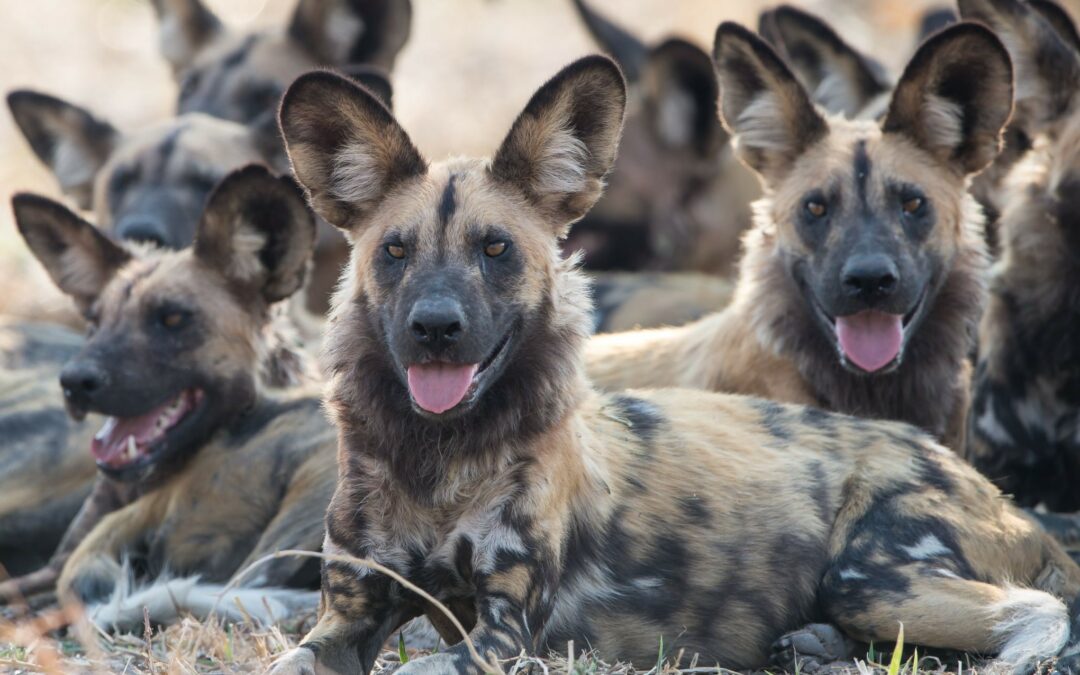
Spatial partitioning is one such mechanism, where one species will avoid an area based on another carnivore’s presence or population density. For example, among large carnivores, Lions will kill African Wild Dogs when they come into close contact, and as a result, Wild Dogs will actively spatially avoid areas where there is high Lion activity or density. Small carnivores will exhibit the same behaviour in avoidance of other carnivores. An example of this is Cape Foxes, which spatially avoid jackal core areas when foraging as they are often killed by jackals. However, some species will not exhibit this behaviour, even though there is competition. For example, neither Black-footed Cats nor Bat-eared Foxes avoid jackal core areas, even though jackals frequently kill them.
In this study, we set out to investigate the spatial relationship between Black-backed Jackals and large carnivores, to determine whether jackals use spatial partitioning at different scales to coexist with Lions and Wild Dogs. Our study was conducted in Venetia Limpopo Nature Reserve (VLNR) in Limpopo Province (South Africa). At the time of the study (2008) VLNR had a wide array of large carnivore species including Lion, Leopard, Cheetah, Spotted Hyena, Brown Hyena and Wild Dog. VLNR is a small reserve enclosed by an electrified predator-proof fence. Radio collars were fitted to three jackals from three different family groups to obtain location data. One jackal actually moved to another family group during the course of the study, which gave us data for an additional family group. At least one male and two females from each of the three Lion prides, and one dog from the single Wild Dog pack were collared.
Using the location data obtained from the collars, we calculated the annual home-range sizes of the study animals, as well as their core areas. We then compared the overlap between the three species at the home-range level (hereafter, broadscale) and the core areas (hereafter, fine scale). We found that the annual home-range sizes for the jackal groups ranged between 2.7 and 9.0 km2 while the annual home range of the pack of Wild Dogs was 339.5 km2. The annual home ranges of the three Lion prides ranged between 112.8 and 208.5 km2. Our data showed that the extent of spatial partitioning between jackals and both Wild Dogs and Lions depended on the scale at which we were looking. At the broadscale, jackals did not exhibit spatial partitioning with either of the large carnivores, meaning that there was extensive overlap between home ranges. However, when we looked at the fine scale, we found that jackals did appear to exhibit spatial partitioning. This was to be expected as both Wild Dogs and Lions kill jackals if presented with the opportunity.
Nonetheless, our study yields the first evidence of spatial partitioning between jackals and two large carnivores, and we hope future researchers will examine spatial partitioning between these species under a variety of environmental conditions across Africa, to help build a more complete understanding of their interactions.
Reference: Kamler, J. F., Nicholson, S. K., Stenkewitz, U., Gharajehdaghipour, T. & Davies-Mostert, H. T. 2020. Do black-backed jackals exhibit spatial partitioning with African wild dogs and lions? African Journal of Ecology.
