BRIDGING THE GAP FOR VERVET MONKEYS
Courtney Maiden, EWT’s Wildlife and Transport Programme student, 64083152@mylifeunisaac.onmicrosoft.com
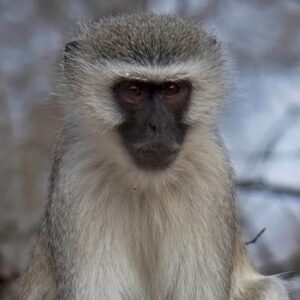
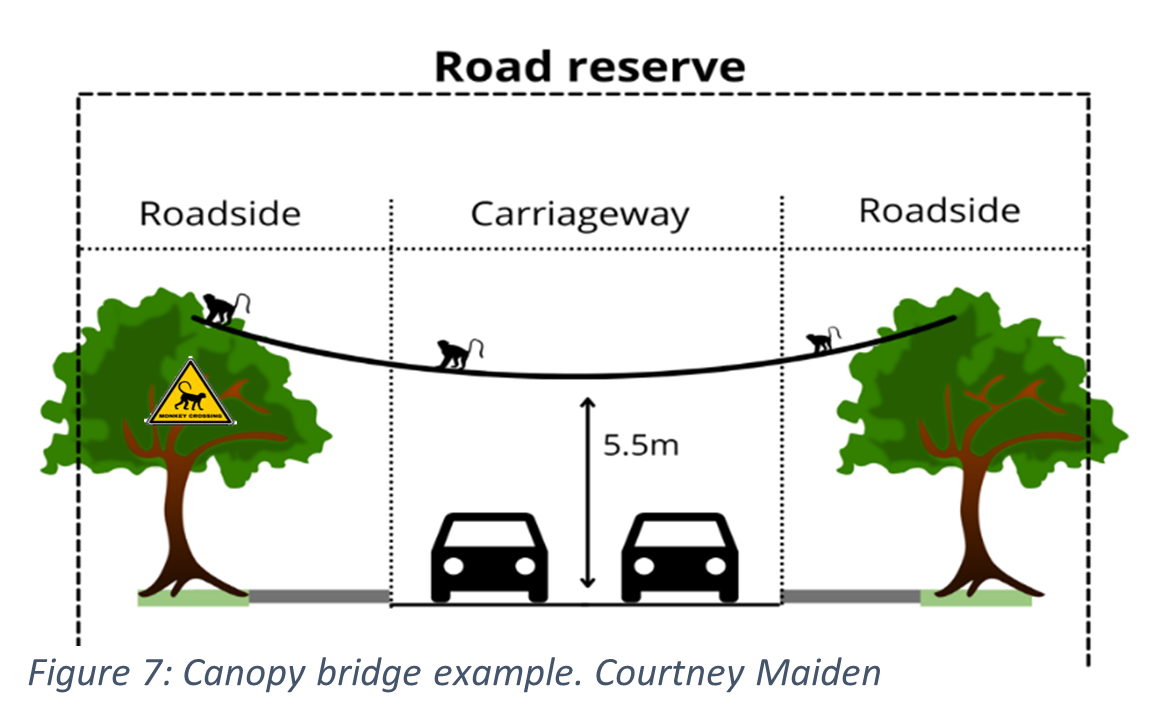
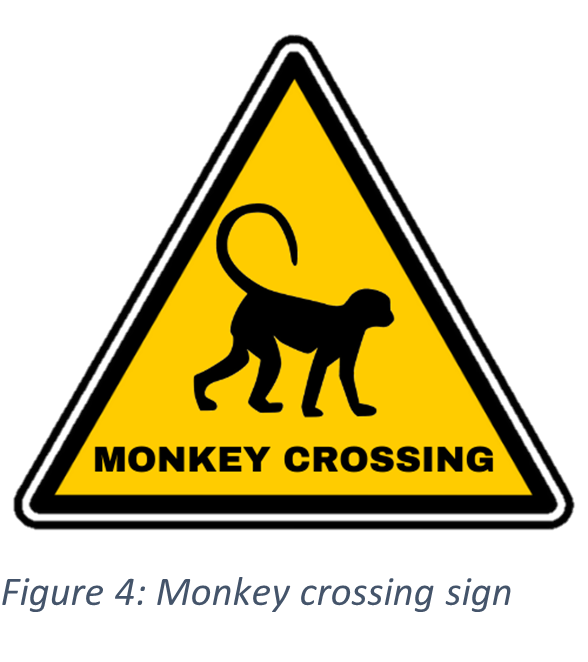
 Gaps caused in the forest canopy cover from linear infrastructure, such as roads, force arboreal species to come down to the ground and face threats such as wildlife-vehicle collisions. Wildlife crossing structures, such as canopy bridges, have been installed in many countries to reduce the impact of roads and enhance habitat connectivity for tree-dwelling species. The Vervet Monkey (Chlorocebus pygerythrus) is one of the arboreal species subjected to daily vehicle collisions throughout South Africa.
In an attempt to reduce mortalities, EWT student Courtney Maiden is designing and testing Vervet Monkey-specific canopy bridges in Durban, KwaZulu-Natal, with an end goal of installing wildlife-friendly bridges in roadkill hotspots across the country. By interrogating proposed designs and methodologies to establish a preferred Vervet Monkey crossing structure design, effective roadkill mitigation processes and species management plans can be established by integrating a simple yet potentially effective design to minimise wildlife-vehicle collisions, encourage habitat connectivity, and ensure the viability of Vervet Monkey populations. This work is being done in collaboration with the University of South Africa and the University of Wisconsin.
GOING BOSSIES
Bonnie Schumann, EWT’s Drylands Conservation Programme, Senior Field Officer, bonnies@ewt.org.za
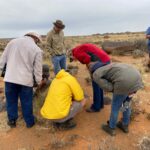
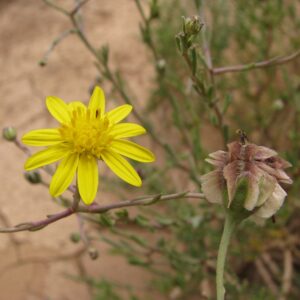
The EWT Drylands Conservation Programme, in partnership with the Grootfontein Agricultural Institute, held Karoo bossie (vegetation) identification days around Loxton this week. Altogether 32 people, mostly farmers, attended the sessions. Karoo veld generally appears rather grey and uninteresting to many passers-by, and getting to know the different species, mostly dwarf shrubs, can be very challenging at the best of times as they tend to look rather similar at first glance. For the novice, in order not to get demotivated on the first day, it is best to go in Spring and Autumn. At these times, if there has been rain, the bossies (little bushes) may be flowering and seeding, making it a lot easier to identify them. Once you spend time in the veld, you realise that there is actually a great deal of plant diversity, including over 3,000 species in the Nama Karoo. Not bad for a desert!
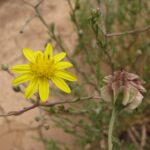
If you dare get up close and personal with the larger, thorny, rather formidable-looking bushes, you realise that they shelter a range of other fascinating species, which is why they are often called “mother bushes”. Despite the rather barren appearance of Karoo veld, when the veld is managed sustainably, the rangeland will provide fodder for wildlife and livestock year-round, as there is always something growing in every season. Grasses, which are less common as one travels west across the Karoo, are nonetheless an important component of the Karoo veld. Years of good early summer rainfall will result in a good grass component. On the other hand, the shrubs tend to prefer the cooler, wetter periods, providing valuable fodder during Autumn and Winter.
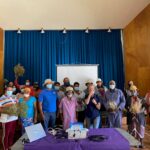
The plant identification sessions give farmers the opportunity to share their knowledge of the species growing in their area and encourage and facilitate more effective management of the veld, ensuring that the important palatable species are grazed with care, species diversity is promoted, and effective rest periods are implemented. These sessions formed part of the Karoo Forever Project, which focuses on promoting sustainable land management in the Karoo. The project is funded by the Global Environment Facility and managed by the United Nations Development Programme, in partnership with the Department of Environment, Forestry, and Fisheries, and the Department of Agriculture, Land Reform, and Rural Development.
SCIENCE SNIPPETS:
POWERLINE MARKERS PREVENT COLLISIONS IN BLUE CRANES BUT NOT LUDWIG’S BUSTARDS
Shaw JM, TA Reid, BK Gibbons, M Pretorius, AR Jenkins, R Visagie, MD Michael and PG Ryan. 2021. A large-scale experiment demonstrates that line marking reduces power line collision mortality for large terrestrial birds, but not bustards, in the Karoo, South Africa. Ornithological Applications. 10.1093/ornithapp/duaa067
Power line markers, such as flappers, are widely used to reduce or prevent bird collisions with power lines. However, few studies have robustly tested how effective they are in doing this. Power line collisions are an escalating problem for several threatened bird species endemic to southern Africa, as our powerline network continues to expand to meet the growing demand for electricity. Therefore, it is critical to know whether or not line marking works to adequately manage this problem and reduce the number of birds that are killed.
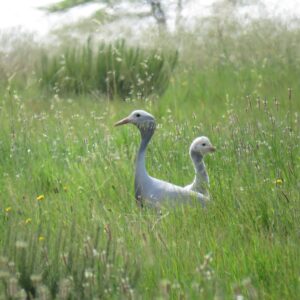
A recent paper published by Jessica Shaw from the FitzPatrick Institute of African Ornithology at the University of Cape Town, using EWT/ESKOM data, and coauthored by three EWT staff members, describes the results of a large scale eight-year experiment that tested the efficacy of the markers. The experiment was set up on 72 of 117 km of monitored transmission power lines in the eastern Karoo, South Africa, to assess whether line markers reduce bird collision mortality. The two bird species of particular interest were Blue Cranes (Anthropoides paradiseus) and Ludwig’s Bustards (Neotis ludwigii). Two different marking devices commonly used in South Africa were tested: bird flappers and static bird flight diverters.
The authors found that: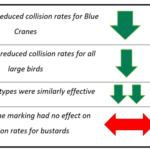
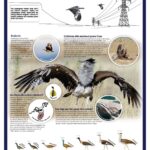
The monitoring conducted by the research team at this site also confirmed high levels of mortality of a range of species of conservation concern on unmarked lines. The authors, therefore, recommend that marking be widely installed on new power lines. However, other, more effective options need to be urgently explored to reduce collision mortality of bustards. Five different bustard species were in the top 10 list of most frequently found carcasses. High collision rates of Ludwig’s Bustards add to wider concerns about population-level effects for this range-restricted and Endangered species.
CONSERVATION CHAMPION
[Thank you to Conservation Champions Gavin Chamberlain and his team for running another successful fundraising campaign. His team provided magnificent wildlife photos, and they designed and printed these 2021 wildlife calendars to raise funds for our conservation activities. There are still some left if you would like to grab one. They are R150 each, and all proceeds go to the EWT.

FOLLOWING FLEDGELINGS
Rebotile Rachuene, African Grass-owl Project Coordinator, EWT’s Birds of Prey Programme (BOPP), tselaner@ewt.org.za
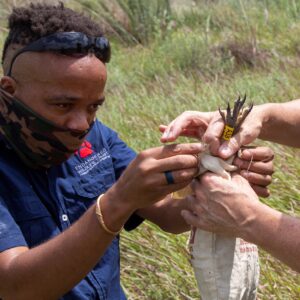
Five years ago, we embarked on a project to monitor African Grass-owl fledgelings once they leave their nests to understand their movement patterns and behaviour. To do so, we ring them so that we, and others, can identify individual owls when they are seen again.
Since 2017, we have ringed at least 30 individuals from both the Mpumalanga and Gauteng provinces. The majority of these individuals were fledgelings, and two were breeding adults. The ringing follows extensive field monitoring to ensure that the nests are not disturbed during the owls’ breeding and nesting periods. As soon as they reach fledgeling age, we go in and ring them
This month, we were fortunate enough to ring five fledgelings, about six weeks old, now from two different nests in Midrand, Gauteng, two siblings from one nest, and three from the other. Working together with our partner, the Greater Kyalami Conservancy (GEKCO), we have successfully safeguarded these nests and eventually successfully ringed our first clutch of fledgelings in the area since 2018. One nest is in a site destroyed by fire in the 2018/2019 season, and the other is in a new breeding site that we discovered had been occupied recently – very exciting news! The five chicks were released and will be monitored closely up until they fledge and find their own sites to nest in. In 2019, one of our ringed birds was found actively breeding 10 km away from where it was ringed, which was extremely valuable information, demonstrating how this form of monitoring can provide us with a better understanding of how far they can travel in search of new territories.

 Gaps caused in the forest canopy cover from linear infrastructure, such as roads, force arboreal species to come down to the ground and face threats such as wildlife-vehicle collisions. Wildlife crossing structures, such as canopy bridges, have been installed in many countries to reduce the impact of roads and enhance habitat connectivity for tree-dwelling species. The Vervet Monkey (Chlorocebus pygerythrus) is one of the arboreal species subjected to daily vehicle collisions throughout South Africa.