On any given day, one can read the news or articles on the state of the environment and the sheer enormity of the threats, challenges, and losses can be overwhelming. For those of us working in conservation, it can be even harder. The species we have dedicated our lives to protect face extinction, and we see the very worst that humans can do to wildlife. I have often been asked how I work in conservation, “isn’t it depressing” people ask? On some days, yes, but others keep our hope alive, and on 10 May 2022, I had a day of hope.
I joined a colleague, Rebo Rachuene from our Birds of Prey Programme, in the field to monitor a grass owl site. Rebo and his colleagues have been monitoring this site for over ten years. We arrived at a farm situated in the Highveld region of Mpumalanga, the area recently the focus of the deadly air case. The short drive from Johannesburg to the farm showed the severity of air pollution in the area, and while the deadly air case was focused on human health and wellbeing, I couldn’t help but wonder about the effect the air pollution was having on wildlife in the area. The farm is a mix of land uses with agriculture, virgin grasslands, and a new coal mine on its border. The threats associated with human activities began to feel overwhelming.
Grass Owl nesting site in the Highveld region of Mpumalanga, South Africa. Mixed land-use is common in the area – agricultural plots, natural grasslands, and coal mines are sandwiched in between each other
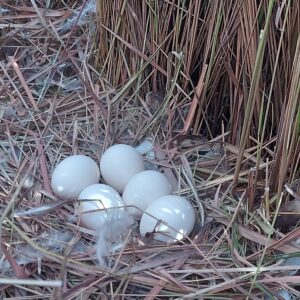
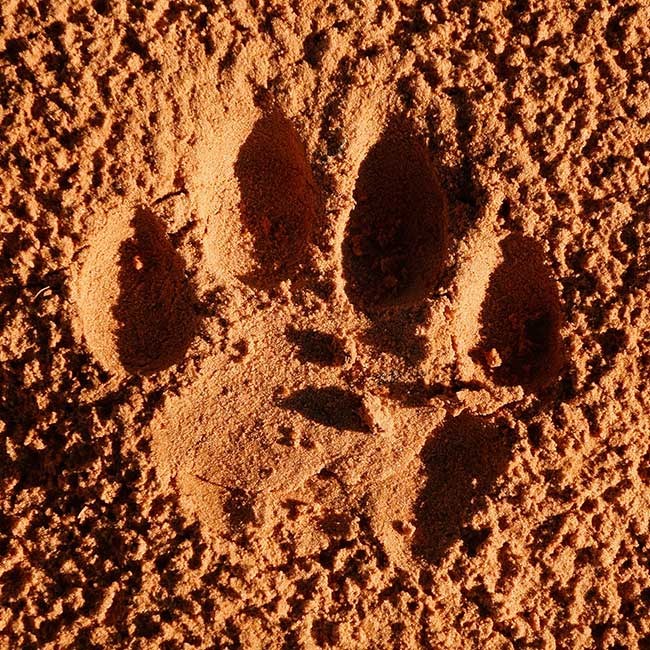
As we were approaching the nest, two birds took off – each on different sides of the wetland area the nest is in. One was a Marsh Owl, and the other, an adult Grass Owl. We found the Grass Owl nest, and instead of the fledglings we expected, we found eggs. Rebo explained that the previous eggs had probably been predated, and the Grass Owls had then laid more. In addition to natural and expected threats like predation, Grass Owls need to contend with human-related threats such as pollution, the threat of invasive species, disturbance and trampling by livestock, and habitat loss. Despite these ever-increasing threats, this species and so many others in South Africa continue to persevere. On our short walk back to the car, we came across a Brown House Snake, Serval footprints, and a Black Winged Kite – all indicators of a functional ecosystem – a safe space made possible through the incredible work of my colleagues and the conservation efforts of landowners. This is how hope is kept alive and how we can continue to promote conservation in South Africa and chip away and reduce threats from human activities. I walked away from that nest excited for the next 35 days when hopefully, the Grass Owl population will increase by five when the eggs hatch. I walked away with hope, committed to doing what I can to protect this safe space and others like it, and more committed than ever to promoting conservation in South Africa.
Grass Owl flushed from its nest. Once its eggs or chicks have been recorded and we move out, it will return to the nest.
On any given day, one can read the news or articles on the state of the environment and the sheer enormity of the threats, challenges, and losses can be overwhelming. For those of us working in conservation, it can be even harder. The species we have dedicated our lives to protect face extinction, and we see the very worst that humans can do to wildlife. I have often been asked how I work in conservation, “isn’t it depressing” people ask? On some days, yes, but others keep our hope alive, and on 10 May 2022, I had a day of hope.
I joined a colleague, Rebo Rachuene from our Birds of Prey Programme, in the field to monitor a grass owl site. Rebo and his colleagues have been monitoring this site for over ten years. We arrived at a farm situated in the Highveld region of Mpumalanga, the area recently the focus of the deadly air case. The short drive from Johannesburg to the farm showed the severity of air pollution in the area, and while the deadly air case was focused on human health and wellbeing, I couldn’t help but wonder about the effect the air pollution was having on wildlife in the area. The farm is a mix of land uses with agriculture, virgin grasslands, and a new coal mine on its border. The threats associated with human activities began to feel overwhelming.
Grass Owl nesting site in the Highveld region of Mpumalanga, South Africa. Mixed land-use is common in the area – agricultural plots, natural grasslands, and coal mines are sandwiched in between each other
As we were approaching the nest, two birds took off – each on different sides of the wetland area the nest is in. One was a Marsh Owl, and the other, an adult Grass Owl. We found the Grass Owl nest, and instead of the fledglings we expected, we found eggs. Rebo explained that the previous eggs had probably been predated, and the Grass Owls had then laid more. In addition to natural and expected threats like predation, Grass Owls need to contend with human-related threats such as pollution, the threat of invasive species, disturbance and trampling by livestock, and habitat loss. Despite these ever-increasing threats, this species and so many others in South Africa continue to persevere. On our short walk back to the car, we came across a Brown House Snake, Serval footprints, and a Black Winged Kite – all indicators of a functional ecosystem – a safe space made possible through the incredible work of my colleagues and the conservation efforts of landowners. This is how hope is kept alive and how we can continue to promote conservation in South Africa and chip away and reduce threats from human activities. I walked away from that nest excited for the next 35 days when hopefully, the Grass Owl population will increase by five when the eggs hatch. I walked away with hope, committed to doing what I can to protect this safe space and others like it, and more committed than ever to promoting conservation in South Africa.
Grass Owl flushed from its nest. Once its eggs or chicks have been recorded and we move out, it will return to the nest.
EWT Golf Fundraiser May 2022: A Success for Wildlife
The EWT Golf Fundraiser May 2022 was a major success. Thanks to Alex Forbes, our headline sponsor, golfers gathered at Stellenbosch Golf Club on 20 May 2022. The weather was perfect, and the stunning winelands provided a beautiful backdrop. Most importantly, the event raised vital funds for the Endangered Wildlife Trust (EWT) to protect Africa’s threatened species.
We owe special thanks to Sarah Raine for her hard work. Additionally, we appreciate every golfer and sponsor who made this day possible. Because of your support, the EWT can continue its critical conservation efforts.
Gratitude to Our Sponsors & Partners
This event succeeded thanks to our generous supporters:
Alex Forbes, Painted Wolf Wines, La Motte, Warwick, Thelema, Cavalli, Remhoogte, Glenelly, Alto, Meerlust, Hill & Dale, Spier, Klein Welmoed, Stellenbosch Hills, Val du Vie, Bellevue, Stellenbosch Kitchen, Ginos, La Pineta, Java Cafe Bistro, De Stormme, Juvenate, Le Simme, Post & Pepper, Pirates, Rome in a Bite, Du Vin, Noop, Asta Italian, Arkeste, Genke, Craft Wheat & Hops, Monnneaux, Hygge Hygge, De Wingerd, Long Table, Die Wingerd, Aha Hotel & Lodge, Stellenbosch Hotel, Lanzerac Hotel & Spa, The Log Cabin, Majeka House Spa, Mooiplaas Manor, Pearl Valley, Grande Roche Hotel & Spa, Wedgeview Spa, Windsor House, Ocean Golf Guest House, Nova Constantia Boutique Residence, Studio Ngong, Q20, Spanjaard, Lighter For Nature, Canon, Miir, Peninsula Beverages, Westlake Golf Club, Stellenbosch Golf Club, Africa’s Legends.
Your support makes a real difference. The EWT Golf Fundraiser May 2022 was more than just golf—it was a step toward saving wildlife.
We look forward to future events and thank you for joining this important cause!
The funds raised from this event will go towards our critical conservation activities and help us continue saving species, conserving habitats and benefitting people.
Check out our Events page for more exciting events near you!
So far, we have deployed two tracking dogs in reserves and will soon be deploying a further four, including both tracking and detection dogs. We have also supported the full training of two new handlers and partial training for a third handler through our relationship with Genesis K9 Group. Furthermore, we provide ongoing support to these deployed dogs and the handlers who have recently completed their training to reinforce what they have learned.
This project is supported by IUCN Save Our Species and co-funded by the European Union. The contents of this publication are the sole responsibility of the Endangered Wildlife Trust and do not necessarily reflect the views of IUCN or the European Union.
LATEST STORIES
Thanks to this grant, the EWT supports seven reserves that have many ecologically and economically important species threatened by poaching. We are taking a three-pronged approach that includes deploying freshly trained young Conservation Canines (trained in detection or tracking), training dog handlers who will be responsible for working with and looking after these dogs and supporting these dog-handler teams in these reserves to ensure they have what they need to work effectively.
Black Rhino (Diceros bicornis) in the Eastern Cape, South Africa. The Black Rhino is threatened by the illegal trade in rhino horn products. Photo credit: the african eye
The reserves we are assisting suffered income losses during the COVID-19 pandemic due to tourist travel bans, and we aim to support them through these hard economic times. Many reserves at risk of poaching use a variety of approaches to combat it, with anti-poaching field rangers commonly the first line of defence. Certified dog-handler teams can provide invaluable support to these teams on the ground in several ways. Our dogs either track poacher incursion routes within a reserve or provide a quick and reliable method for screening vehicles for concealed firearms or wildlife contraband.
So far, we have deployed two tracking dogs in reserves and will soon be deploying a further four, including both tracking and detection dogs. We have also supported the full training of two new handlers and partial training for a third handler through our relationship with Genesis K9 Group. Furthermore, we provide ongoing support to these deployed dogs and the handlers who have recently completed their training to reinforce what they have learned.
Conservation Canine Nala, a three-year old Belgian Malinois recently deployed in the Eastern Cape. Nala is a tracking dog and works with anti-poaching teams to protect threatened species.
This project is supported by IUCN Save Our Species and co-funded by the European Union. The contents of this publication are the sole responsibility of the Endangered Wildlife Trust and do not necessarily reflect the views of IUCN or the European Union.
LATEST STORIES
Conservation Canines to Save our Species from illegal wildlife trade
Dr Andrew Taylor, EWT’s Wildlife in Trade Programme Manager, andrewt@ewt.org.za
South Africa is blessed with exceptional wildlife and landscapes that attract tourists and boost our economy. Some of our country’s biggest drawcards, such as White and Black rhinos (which are Near Threatened and Critically Endangered, respectively on the IUCN Red List of Threatened Species), the African Savannah Elephant (Endangered), and the African Lion (Vulnerable), play vital roles in our ecosystems while also bringing in valuable ecotourism income. However, these species are threatened by the global illegal wildlife trade (IWT), which is a major cause of population declines in some countries. With funding from the IUCN Save Our Species Rapid Action Grant and the European Union, the Endangered Wildlife Trust (EWT) aims to reduce IWT by preventing wildlife poaching. We use our Conservation Canines to achieve this by training and deploying them to detect wildlife products and track poachers.
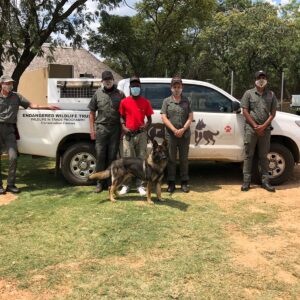
Newly qualified dog handler trained at Genesis K9 Newly qualified dog handler trained to reduce poaching as part of the project funded by the IUCN Save Our Species Rapid Action Grant and the European Union.
Thanks to this grant, the EWT supports seven reserves that have many ecologically and economically important species threatened by poaching. We are taking a three-pronged approach that includes deploying freshly trained young Conservation Canines (trained in detection or tracking), training dog handlers who will be responsible for working with and looking after these dogs and supporting these dog-handler teams in these reserves to ensure they have what they need to work effectively.
Black Rhino (Diceros bicornis) in the Eastern Cape, South Africa. The Black Rhino is threatened by the illegal trade in rhino horn products. Photo credit: the african eye
The reserves we are assisting suffered income losses during the COVID-19 pandemic due to tourist travel bans, and we aim to support them through these hard economic times. Many reserves at risk of poaching use a variety of approaches to combat it, with anti-poaching field rangers commonly the first line of defence. Certified dog-handler teams can provide invaluable support to these teams on the ground in several ways. Our dogs either track poacher incursion routes within a reserve or provide a quick and reliable method for screening vehicles for concealed firearms or wildlife contraband.
So far, we have deployed two tracking dogs in reserves and will soon be deploying a further four, including both tracking and detection dogs. We have also supported the full training of two new handlers and partial training for a third handler through our relationship with Genesis K9 Group. Furthermore, we provide ongoing support to these deployed dogs and the handlers who have recently completed their training to reinforce what they have learned.
Conservation Canine Nala, a three-year old Belgian Malinois recently deployed in the Eastern Cape. Nala is a tracking dog and works with anti-poaching teams to protect threatened species.
This project is supported by IUCN Save Our Species and co-funded by the European Union. The contents of this publication are the sole responsibility of the Endangered Wildlife Trust and do not necessarily reflect the views of IUCN or the European Union.
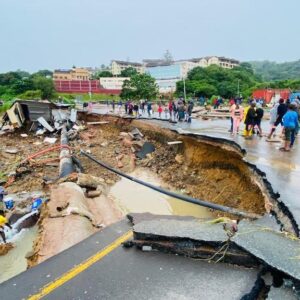
yolanf@ewt.org.za The recent Durban floods made history for all the wrong reasons and the devastation and mayhem caused shocks to thousands of people, our economy, and our environment. Much has been said, and there is almost no room to say much else if it weren’t for us needing to take stock of how a significant amount of the impact could have been prevented. And I don’t only mean addressing the complexity of reducing human-induced climate change, as the jury is still out if this was a climate change-related event. It is tricky to attribute extreme weather events to climate change anywhere, but more so in KwaZulu-Natal, where the lack of comprehensive long-term rainfall records makes systematic climate analysis close to impossible. And given that extreme weather events do occur, to attribute them all to climate change requires much more robust record-keeping and scientific evaluation.
What we do know is that over the 24-hours on 11 April, more than 300 mm of rain fell over KZN, around 75% of South Africa’s annual precipitation. These rains were caused by a cold-weather system that seldom reaches South Africa but often causes large-scale destruction in Mozambique. Much of the havoc was unavoidable, but let’s focus on what should not have happened. Mass landslides triggered by destabilised ridges and embankments due to the removal of indigenous vegetation and land clearing for development could have been reduced, and some even prevented entirely. Stormwater drains that were clogged with litter or overgrown weeds could have cleared roads and infrastructure of lethal water levels, and well-maintained infrastructure dealing with sewage management and water provision may have withstood the floods or been offline for less time, thus reducing a human healthcare catastrophe. Fast-moving debris that killed people and destroyed homes, in many cases resulted from illegal dumping and poor construction, and the tons of plastic, waste and rubble that now litters beaches and riverbanks will be pillars paying tribute to the role of humans in this not-so-natural disaster after all.
Developers who insist on flouting environmental regulations to build into flood lines, strip vegetation, and ignore natural seams should be held accountable for at least a portion of the losses; regulators who sign off on these developments should shoulder a portion, too; and municipalities that ignore spatial planning principles and laws to authorise rampant urban creep should be held accountable for the balance. The lack of well-planned and properly constructed and maintained infrastructure along with reliable service delivery to the most vulnerable communities, combined with the overcrowded inhabitation by millions of vulnerable people in shacks built on steep hillsides, riverbanks and in valleys, played a big role in the increased death toll from the floods and mudslides.
As the floodwaters began to subside, stories of triumph and heroism emerged to bear testimony to human resilience and the spirit of survival. People came together to support, assist, and care for one another. The reality is that this spirit of common purpose, Ubuntu, and mutual dependence must prevail if we are to prevent similar devastation in the future. We may not be able to control weather systems and extreme rainfall, but we MUST prepare for it by taking heed of our reliance on intact habitats and our susceptibility to the power of nature; our vulnerability to natural processes that we cannot control and, therefore our need to protect the natural systems designed to protect us from those very events. The KZN floods demonstrated the dire need for entrenching sustainability into our development plans and paying due regard to the integration of intact natural systems into spatial planning as opposed to the removal thereof as an obstacle to progress. The adherence to environmental regulations, and the promotion of climate education, robust monitoring, functional early warning systems, maintained and functioning infrastructure, and equitable social development should all underpin the rebuilding of KZN with resilience as the cornerstone of all rebuilding and planning in this province and its cities which are arguably the most vulnerable to weather events and climate change going forward. Without this, rest assured that this WILL happen again.
Hey guys! Thanks for all the attention – I know I’m super cute! So, I thought you might like to hear a bit about me. I joined the Endangered Wildlife Trust’s pack as a Conservation Canine Cadet in March 2022. Boy was I nervous! Here were all of my heroes and little old me – leaping after them to follow in their paw prints. But I was born to do this job! Join me on my adventure as I prove I have what it takes to become a canine defender of wildlife.
Becoming a Conservation Canine is a lot of work, takes a lot of time, and treats (and Sean’s shoes) aren’t cheap! And I can’t rush it. I think it’s because, if I skip steps, I won’t be ready for all the situations I might come across if I qualify one day (claws crossed). Well that’s what I’ve been told anyway – so far I’ve been playing and racing around meeting the staff at the EWT’s Conservation Campus – easy peasy! Apparently I don’t do any real work for the first few months. Tough life hey? I’m just supposed to go everywhere and see everything I possibly can so nothing scares me (as if!). I think I heard them say it’s also so I don’t get distracted too easily when I do start working.
Anyway, lots to see and smell but I’ll give you another update soon!