Conservation Canines Help to Combat Rhino Poaching

Conservation Canines Help to Combat Rhino Poaching


Conservation Canines Help to Combat Rhino Poaching


On 22 September, the Endangered Wildlife Trust’s joined countries around the world to mark World Rhino Day.

The Day has become synonymous with the plight of the white and black rhino as poachers decimated populations of this iconic member of the Big Five in the past 15 years.

It is during this onslaught that the EWT again sprang into action to save the pachyderms from extinction by founding and deploying our canine conservation unit to not only detect smuggled rhino horn, but also to track poachers within conservation areas.

World Rhino Day is marked annually to raise awareness of about the plight of the species, which has faced a poaching onslaught for more than a decade. South Africa is home to an estimated 79% of the world’s rhino population, of which approximately 2,056 black rhino and 12,968 white rhino are privately-owned. Since 2008, over 8,000 rhinos have been poached the country.
South Africa’s black rhino are listed as Critically Endangered and the white rhino as Near Threatened on the IUCN Red List of Threatened Species. Their biggest threat is the illegal wildlife trade.

The EWT’s Canine Conservation Unit (CCU) is a special project established to support the conservation efforts of the EWT through scent detection and tracking dog services. Our Conservation K9s are certified and specially trained to fulfil two critical roles. Firstly, to support anti-poaching initiatives in game reserves using tracking and detection dogs, and secondly, to detect wildlife contraband before it is smuggled out of the country.

Anti-poaching dogs are trained to track people, locate snares, find arms and ammunition, and help with the detection of spent cartridges at crime scenes. Our detection dogs are capable of detecting various plant and animal samples as well as poisons and thus have a wide range of possible conservation applications. We are continuously exploring new applications for our conservation canines to ensure that the EWT is recognised as an industry leader in the field of working dogs.

Our work began with the deployment of Rico, a Belgian Malinois and wildlife sniffer dog, at the O R Tambo International Airport’s baggage and car sections in 2012. This new member of the EWT pack was deployed to sniff ou rhino horn, ivory, abalone and other wildlife products.


The EWT’s Canine members have been deployed successfully in reserves across the country since…

The North West Province is a stronghold for Black and White Rhino conservation during these difficult days of declining national populations. With the support of funding from the U.S. Fish and Wildlife Service, we are assisting the provincial authorities to prevent poaching and grow their rhino populations for the species’ long-term survival.


Besides the use of cutting-edge technology to track rhinos remotely, and the use of real-time camera technology to strengthen surveillance of roads, fence lines and reserve areas to aid in the detection of poacher incursions, a key contribution is that of the EWTs conservation canine and handler team in the Pilanesberg Game Reserve to detect wildlife contraband and to track poachers.

Our conservation canines are stationed at reserve gates, screening vehicles for illegal wildlife products like ivory, rhino horn, pangolin scales, and ammunition. Since 2012, the EWT’s Conservation Canine unit has been a vital part of wildlife protection in reserves across South Africa. Focused on preventing illegal firearms from entering protected areas, our dogs have also been instrumental in stopping wildlife crime. Our canines have frequently been used to locate illegal arms and ammunitions and this year alone, one of our conservation canines flagged a suspicious vehicle, leading to the discovery of hidden rifles and the successful arrest of the suspects.

The Conservation Canine Unit team will assist Pilanesberg management until the end of September 2025. Having our scent detection dog, Kisha, at the gate will deter and prevent poachers from bringing weapons into the conservation area, and transporting illegal wildlife products out of the reserve if they have succeeded in poaching an animal. Weekends are very busy and the team search up to 60 vehicles in a day.

Tracking dog, Ruger, is specifically used to patrol fences and follow tracks of poachers when reserve boundaries have been breached. A key role for Ruger is to assist anti-poaching security to determine entry and exit points and routes taken by poachers, which is critical in guiding optimal placement of field rangers.


While the EWT is assisting Pilanesberg with a range of other anti-poaching activities, detection and tracking dogs are considered a crucial part of the anti-poaching arsenal to keep Rhinos and other wildlife safe.


In the nearby Madikwe Nature Reserve, the EWT has provided cutting-edge night vision scopes to the two canine teams, giving them a massive strategic advantage during anti-poaching patrols. We have also funded the installation of additional License Plate Recognition cameras at prominent intersections around the reserve. Any vehicles passing through these intersections with previous criminal ties will be flagged, with notifications sent to local law enforcement, as well as the North West Parks Board anti-poaching operations centre housed at Madikwe.

Combatting rhino poaching requires a coordinated, multi-pronged approach, the cost of which can be prohibitive in some situations. We are confident that our support to the North West Parks Board is having a tangible conservation impact, echoed by the reduction in reported poaching incidents in the province.

Saving Vultures from poisoning and other threats

Saving Vultures from poisoning and other threats

Saving Vultures from poisoning and other threats

By John Davies, Project Coordinator: Raptor Conservation & Research

International Vulture Awareness Day is marked annually in September to raise awareness about a species that is often maligned despite their vital contribution to maintaining the health of ecosystems.

Known as nature’s cleanup crew or garbage collectors, vultures play a crucial role preserve the balance of our environment by disposing of carcasses and likely preventing the spread of disease. The benefits they provide go even further.

Vulture populations have plummeted across their range in recent years, with some species now listed as Critically Endangered. To ensure the future survival of this key species, a Multi-species Action Plan to Conserve African-Eurasian Vultures (Vulture MsAP) was released under the Convention on the Conservation of Migratory Species of Wild Animals (CMS) in 2017. Its main aims are to identify and implement key conservation actions designed to reverse recent population trends and restore the conservation status of each species to a favourable level and to provide conservation management guidelines applicable to all Range States within the plan’s scope. This includes South Africa.

The Endangered Wildlife Trust plays an important role within South Africa, and Africa, to protect vultures for their most common threat – poisoning.

Through our work, we not only monitor and track all vulture species within the southern African region, but also implement a number of applied interventions to conserve the Old World Vulture Species found in South Africa. Of the 11 Old World Vultures found in Africa, seven are on the verge of extinction. These include the breeding resident White-backed Vulture, Hooded Vulture, White-headed Vulture, Cape Vulture, Lapet-faced and the vagrant, less common Egyptian Vulture, as well as the Rüppell’s Vulture.

Besides addressing the increasing threat of wildlife poisoning, our work keeps in mind the situation that arose in India in the 1990’s when the local vulture population plummeted by 95% after vultures fed on livestock carcasses that contained and anti-inflammatory drug used to treat pain and inflammation in animals and people. All vultures died soon after feeding on the tainted carcasses and local scientists attributed their deaths to kidney failure caused by the effects of the drug diclofenac.

The near extinction of vultures in this region led to the death of nearly half a million people in subsequent years, because without these natural scavengers, carcasses pile up, and diseases including rabies spread more prolifically.

In South Africa, wildlife poisoning has become an increasingly prevalent and destructive threat over the last decade. Although this has for a long time been an under-studied and poorly-known concern, more recently, the severity of this has become more topical, particularly with the impacts on large carnivore populations being more notable. With a shift to more targeted poisonings that have a higher impact on these the charismatic species, the conservation focus has shifted to a point where the need to respond and deal with these incidents is finally getting more attention.

A sad outcome of much of this is that many species of avian scavengers, such as vultures, Tawny Eagle and Bateleur, have become the innocent bystanders caught in the crossfire. For most of these species, wildlife poisoning has become the most significant threat to their long-term survival. Unlike many other forms of poaching, just a handful of large events may be enough to cause a sever reduction in the population, particularly if no interventions are put in place.

The EWT’s Birds of Prey and Vultures for Africa Programmes focusses much of their work on developing key interventions that assist in reducing the severity of these losses. Although these by no means represent an exhaustive approach to solving the issue, there is little doubt that each of these instances provides another tool to work towards the long-term protection of avian scavengers from poisoning.


Eye in The sky

One of the most crucial aspects is the early detection of poisoning events, something that historically has posed a significant challenge in most conservation areas. We developed a pioneering rapid poisoning detection system called Eye in the Sky that harnesses vultures’ natural sentinel and foraging behaviour and pairs it with novel GPS tracking technology. This system closely monitors the behavioural signatures in GPS-tracked vultures to remotely detect the presence of poison sources and feeding events associated with potentially poisoned-laced carcasses. This system was built to enhance law enforcement and response team capacity and efficiency, while reducing the impact of wildlife poisoning in southern Africa.

With our partners, including the North Carolina Zoological Society and Contemplate Wild, we are also developing monitoring and technology solutions to make our alert system practical on the frontline. The system has been programmed to send notifications and near real-time information to monitoring software platforms (e.g. EarthRanger, SMART Conservation) used by those on the ground. In concert with this, we have set up an ever-growing network of GPS-tracked vultures across poisoning hotspots in southern and East Africa, actively surveying extensive wilderness areas that would otherwise be impossible to monitor.


Rapid Response and Treatment

With this early detection, comes the need to have skilled individuals to assist in the treatment of any live animals that may be found at these sites. As such, we have embarked on developing several approaches to make this a much more effective and efficient intervention.

First and foremost has been the training of over 2000 individuals across Africa in wildlife poisoning response and the inclusion of wildlife veterinarians that are able to assist when needed with the treatment of live patients. A vast number of veterinarians have little to no real-world experience working with birds of prey, especially Vultures, and as such, their involvement with these situations has been limited previously. The EWT has embarked on a process of upskilling key veterinarians working in key focal areas to become another layer of support when needed. Many large poisoning events are spread out over a large geographic area and having several individuals able to treat live patients, greatly improves the outcome for patients, particularly considering the time constraints associated with this.

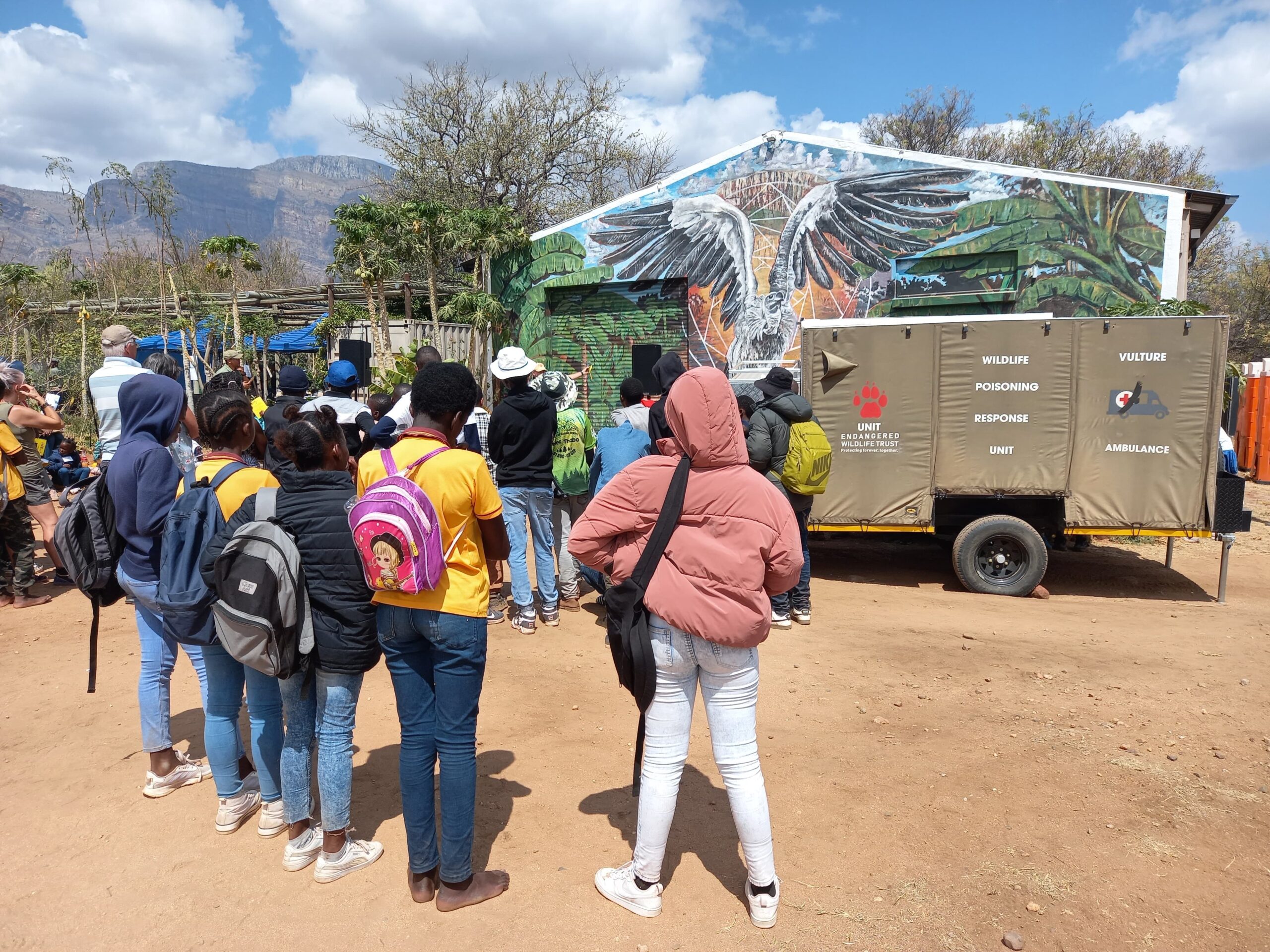
Perhaps one of the most significant limitations to this work has been the effective transport and housing of patients. That is why the EWT developed the first transport and treatment solution for these specific events, which we call our Vulture Ambulance, launched in 2023. This has been developed from the ground up to be a complete solution to teams working in the field, to not only house patients that have been found, but also additional equipment that may be needed in the field during assisting with these events.

By creating a single solution that is permanently kept ready to go, takes a large amount of the preparation and planning away from the responders. To date, this novel solution has been used to assist in excess of 30 vultures and has improved the survival of live patients found at poisoning sites to 98% over the last year. This is a significant improvement from previously, where some animals may have succumbed due to the ineffective housing and transport to a rehabilitation facility.

As a newer addition to this, we have developed emergency treatment kits that are specifically designed to have all needed items for the in-field treatment of birds at poisoning events. These kits contain all the materials necessary to effective respond to emergencies, including headlamps, backup batteries and radios. These are all items that we have found through field experience to be necessary for an effective and efficient response. We’re currently working towards expanding this equipment to more areas, adding yet another dimension to assisting people who respond to these events.

By understanding the process and having teams that understand how to work effectively, as well as having all the required equipment needed on site, we know that we can give vultures and other avian scavengers have a fighting chance. The only way to achieve this is through large-scale collaborations, and we look forward to developing these even further in future.


Collaborative Action to Address South Africa’s Snaring Crisis

Collaborative Action to Address South Africa’s Snaring Crisis


The EWT pledges less talk and more action to address South Africa’s snaring crisis at the inaugural Snare Mitigation Symposium

140 delegates attended the inaugural Snare Mitigation Symposium

Twenty-two speakers presented at the Snare Mitigtation Symposium

One of the Snare Mitigation Symposium panel discussions

WARNING: SENSITIVE IMAGES BELOW


The importance of less talk and more action to address the snaring crisis in South Africa is key to the conservation of all species.

This, and the need for greater collaboration and partnerships to address the negative impacts from the illegal snaring of wildlife, were among the outcomes of the inaugural two-day national Snare Mitigation Symposium in Pretoria.

The meeting of 140 delegates delved into the impacts, drivers and solutions to this increasing threat to wildlife and the economy. Co-led by the Department of Forestry, Fisheries and the Environment (DFFE), the Cape Leopard Trust (CLT), the Endangered Wildlife Trust (EWT), the South African National Biodiversity Institute (SANBI) and South African National Parks (SANParks), the inaugural Snare Mitigation Symposium was held at Environment House on 10 and 11 September 2024.

It brought together leading experts in wildlife crime, government officials and representatives of numerous stakeholders across the sector to examine the multifaceted aspects of the snaring crisis. The purpose was to understand existing and potential new complexities, and to share experiences and knowledge to reduce the problem both inside and outside conservation areas, in order to identify and co-create workable solutions for the benefit of people and the environment.

Snaring is motivated by complex socio-economic and cultural drivers and the symposium explored snaring from a myriad of angles and viewpoints. Information gained highlighted that animals are snared largely for personal or commercial use and is occurring at unsustainable rates across all provinces and in diverse landscapes. Sadly, many species including leopard, lion, hyena and other predators are killed as by-catch in snares originally set for bushmeat.

A key insight from the symposium is that we need more community interaction amongst stakeholders towards achieving positive outcomes for this threat to wildlife. Communities living with wildlife, and those linked to snaring, need to form an integral of the solutions being proposed, and to be undertaken, to address snaring.

No solution will be credible without the involvement of the relevant community voices in co-development of solutions. Solutions need to be diverse, purposely inclusive and tailored to, and by, the people living in the affected areas. Technological advances were showcased to improve snare detection and data collection.

Among the legal solutions highlighted by Ashleigh Dore, the EWT’s Wildlife and Law Project Manager, the need for legal reform to ensure laws applicable to snaring are the same across the country. Ashleigh also introduced a restorative justice approach to respond to snaring. Restorative justice is a holistic, inclusive and problem solving approach to justice that involves all parties involved in or impacted by the crime to (1) identify and respond to harm from the crime and (2) prevent reoffence.

Senior Conservation Manager Lourens Leeuwner, during his presentation on the threats of snaring countrywide, highlighted the results of the EWT’s recent project and proof of concept to determine whether anti-poaching dogs could be used for snare detection. The Canine Conservation Unit had spent several days testing techniques to detect snares in a farming and conservation area in Limpopo. Using two EWT anti-poaching canines, Ruger and Kisha, the team set snares in the veld before sending out rangers to find the items. While rangers only found some of the snares placed for the test, the canines had, in all cases, successfully tracked the scent of the person who had planted the snares and other items, finding most of the snares. As further proof that this technique works, the dogs were taken on a routine patrol of a farm that has problems with poachers using snares to catch wildlife. During this patrol, Ruger discovered a snare that had been planted by a real-life poacher. While there is a lot more work that needs to be done, this is proof that the concept works – an extra tool in the arsenal to combat poaching.


Among the key decisions adopted as outcomes included further research on the drivers and alternative livelihood solutions, more cohesive legislation to address snaring and other wildlife crimes, more centralised reporting and monitoring to ascertain the extent of the problem, and creating a greater understanding of the impact of snaring not only on biodiversity, but also on the economy and well-being of communities.

At a workshop following the event, the host organisations strategised next steps related to key themes and action points identified during the symposium that will include a wide range of stakeholders. Looking to the future, greater teamwork and communication between State, private sector and civil society will be cultivated to find sustainable long-term solutions for both people and wildlife.


A wire snare set to catch animals by the neck. ©Cape Leopard Trust

A snare setup in front of an animal burrow. ©Cape Leopard Trust

A wire snare along a fence line where many animals move. ©Cape Leopard Trust

X-ray photos of a caracal and porcupine killed by snares. ©COGH SPCA

Most snares are made from wire but rope and cable are also used. ©Cape Leopard Trust

An example of a wire snare. ©Cape Leopard Trust

Collected snare material ©Endangered Wildlife Trust

African wild dog found dead in snare ©Endangered Wildlife Trust

Spotted hyena found dead in snare ©Endangered Wildlife Trust

Buffalo found dead in snare ©Endangered Wildlife Trust

Painted Wolf Wines take-over the Tasting Room

Painted Wolf Wines take-over the Tasting Room

Wild dogs take over Waterkloof!

The leafy suburb of Waterkloof is in for a real treat during October when Painted Wolf Wines is the featured winery at ‘The Tasting Room” a very popular venue situated at 198 Long St,  Waterkloof, Pretoria.

For the entire month of October, the wines of this award-winning, conservation-focused winery will be available to enjoy for lunch, dinner or a sundowner drink with friends! There will also be wine available to take home with you, as the venue also holds a retail liquor licence. Many of the wines that will be on offer are not easily available in Gauteng and guests who attend the ‘new releases’ evening on Thursday 24 October will be the first to sample some exciting new vintages that will be introduced by winemaker, Jeremy Borg. The EWT will also be hosting a conservation presentation on this evening, so be sure to book early if you would like to attend – tickets for all the events are limited.

There are several other events planned for October – details are below. Please get in touch with 087 821 7708 or contact the venue directly for enquiries for bookings.

The dates to diarise are as follows :

3/10 Wine and Meze evening 6.30 for 7pm – R850 for two guests
7/10 – Sip and Print Lino printing 6pm – 9pm – R700 per person
8/10 – Sip and Print Lino printing 6pm – 9pm – R700 per person
9/10 – Sip and Print Lino printing 10am – 1pm – R700 per person
10/10 – Pinotage Dinner with Winemaker Jeremy Borg 6.30 for 7pm – R550 per person
24/10 – New releases and Conservation Dinner with winemaker Jeremy Borg 6.30 for 7pm – R620 per person

Dainfern Golf Day 2024

Dainfern Golf Day 2024

As ardent lovers of sport and the great outdoors, South Africans are often spotted supporting worthy causes through their participation in sporting days.  As part of the EWT’s fundraising efforts, we are touring our beautiful and naturally diverse country to host four golf days in the coming months.  The fourth and final event for the year, will be held at Dainfern Golf Club on the 17th of October 2024, proudly sponsored by alex forbes. This is an ideal opportunity to enjoy the outdoors, enjoy playing a few strokes and to support a great cause – the work of the Endangered Wildlife Trust.  We still have a few fourballs spots available and there are loads of incredible prizes and goodies for golfers hitting the greens in support of conservation.

Four-ball cost: R5 600 (includes halfway house, dinner and 2x golf carts)
RSVP: To secure your spot, please contact Tammy Baker at Endangered Wildlife Trust via email at tammyb@ewt.org.za or by phone on 082 903 2152.

Don’t miss out on the chance to enjoy a day of golf while supporting a great cause.

Alexforbes is the proud sponsor of this event!