By Lourens Leeuwner, Senior Conservation Manager: Business and Wildlife
Snaring for the bushmeat trade has become one of the most prominent threats to wildlife nationwide and is no longer a low-impact subsistence activity but the most common form of illegal hunting.
In other words, snaring is not necessarily driven by hunger but has evolved into a commercial business. To saturate demand, animals up to the size of an elephant are being poached. Usually set along game trails and around water points, these wire traps are set in areas with bountiful game with the intention to catch animals as they pass by. Snares are the silent drivers of extinction.
On 10 and 11 September, the EWT will be co-hosting the inaugural Snare Mitigation Symposium with the Cape Leopard Trust, the Department of Forestry, Fisheries and the Environment, SA National Parks and the SA National Biodiversity Institute in Pretoria to discuss and seek possible solutions to the pervasive threat to wildlife and the economy caused by illegal hunting with snares.
Snaring, which is essentially the use of a trap, is illegal in South Africa. Because of the nature of snaring, it is challenging trying to catch poachers red-handed and to present adequate evidence to link them to the crime and to successfully prosecute them.
Snares can be made from a variety of materials but fencing wire and cable is usually preferred. The materials are easy to obtain and snares are quick to manufacture, easy to set and difficult to detect. Their effectiveness and secret nature make them the perfect hunting tool.
Animals caught in snares experience great suffering caused by stress, injuries and mutilation, usually leading to their demise. Even when the caught animal manages to escape, the snare usually remains on its body and tightens with time. Being increasingly compromised, the animal’s condition tends to deteriorate until it can no longer continue.
Looking at the bigger picture, snaring can contribute significantly to changing the demographics and size of animal populations, ultimately contributing to the loss of biodiversity. Although, it is mostly game animals that are targeted by the poachers, the indiscriminatory nature of snares leads to what is known as bycatch: the capture of non-targeted animals such as snakes and other reptiles, mammals including predators, and even birds – many of which are Endangered.
Most conservationists and land managers find snares in the field on a regular basis and have to deal with the consequences of illegal poaching through the loss of not only valuable game, but also domestic animals along the line.
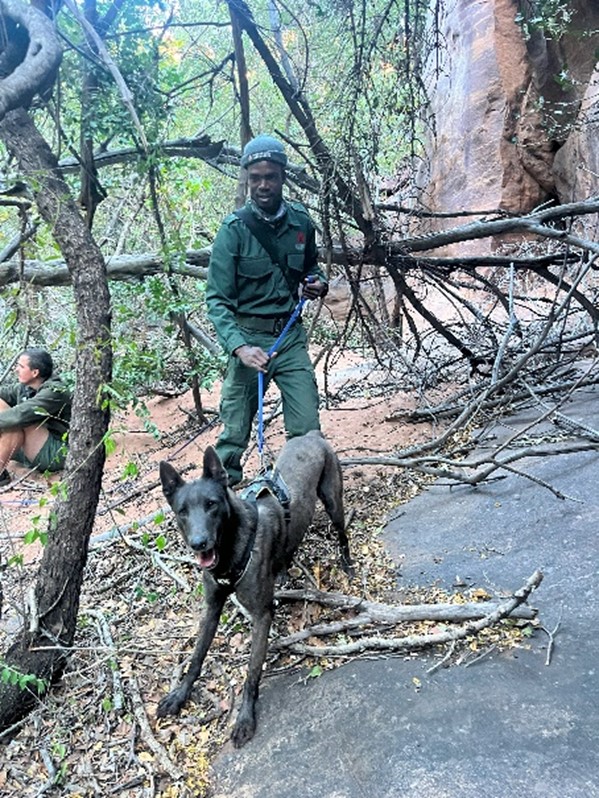
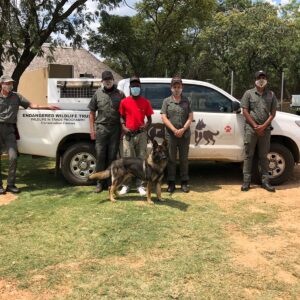
As a means to address snaring, the EWT recently undertook a project and proof of concept to determine to determine whether anti-poaching dogs could be used for snare detection. Thanks to funding from the Taronga Zoological Society in Sydney, Australia, our Canine Conservation Unit spent several days testing techniques to detect snares on Madike nature reserve in Limpopo. Using two EWT anti-poaching canines, Ruger and Kisha, the team set snares in the veld before sending out rangers to find the items. The trial was completed four times in different terrain with rangers only finding some of the snares and items dropped randomly in the veld. To prove this concept works, the rangers were again sent into the veld to find snares and the other items; this time with the dogs. In all cases, the canines successfully tracked the scent of the person who had planted the snares and other items, finding the majority of the snares. As further proof that this technique works, the dogs were taken on a routine patrol of a farm that has problems with poachers using snares to catch wildlife. During this patrol, Ruger discovered a snare that had been planted by a real-life poacher.
While there is a lot more work that needs to be done, this is proof that the concept works – an extra tool in the arsenal to combat poaching.
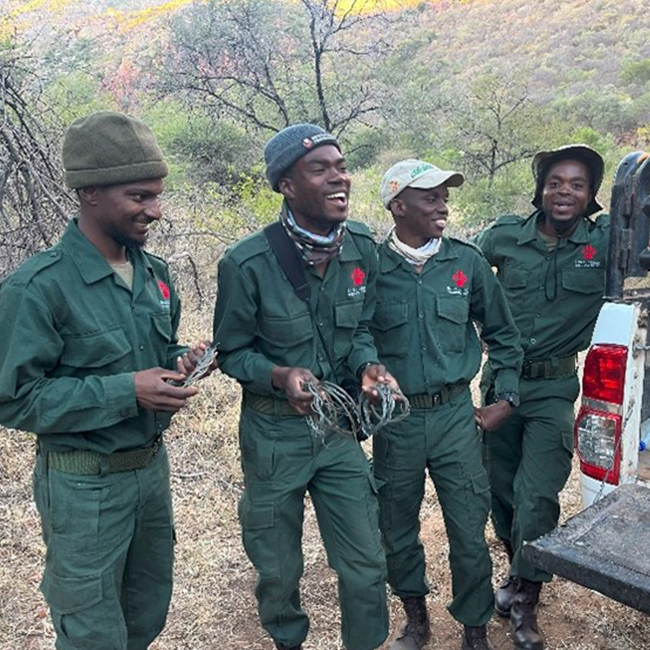
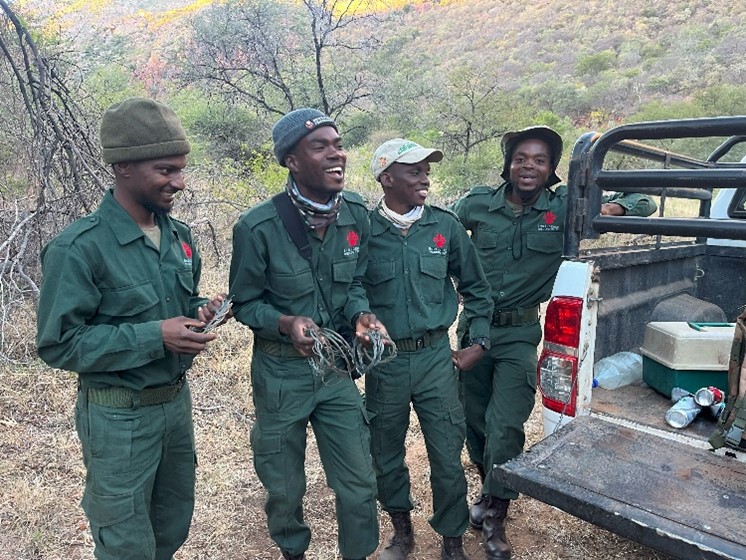
Rangers hold a variety of snares removed from the veld.
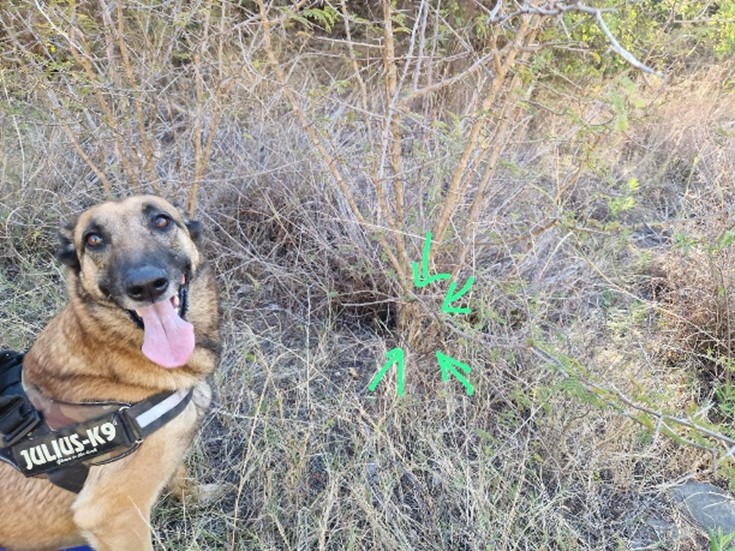
Kisha illustrating just how difficult snares are to see in the field
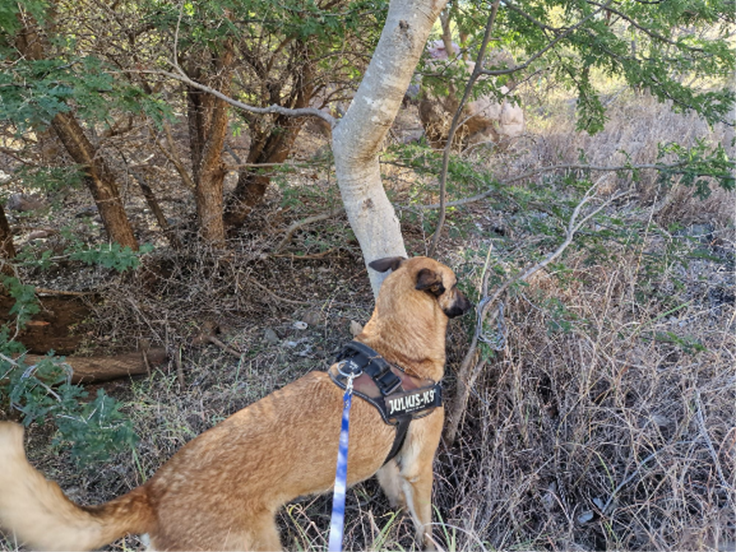
Locating a snare during the test phase of the proof of concept
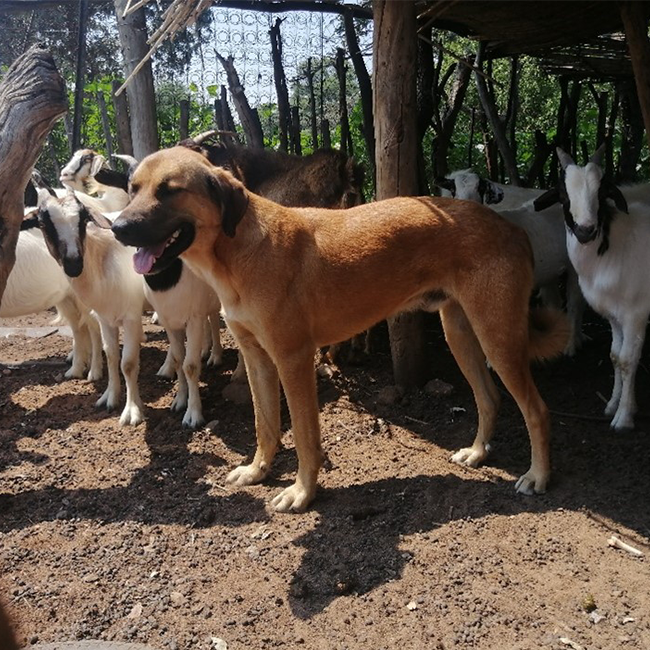
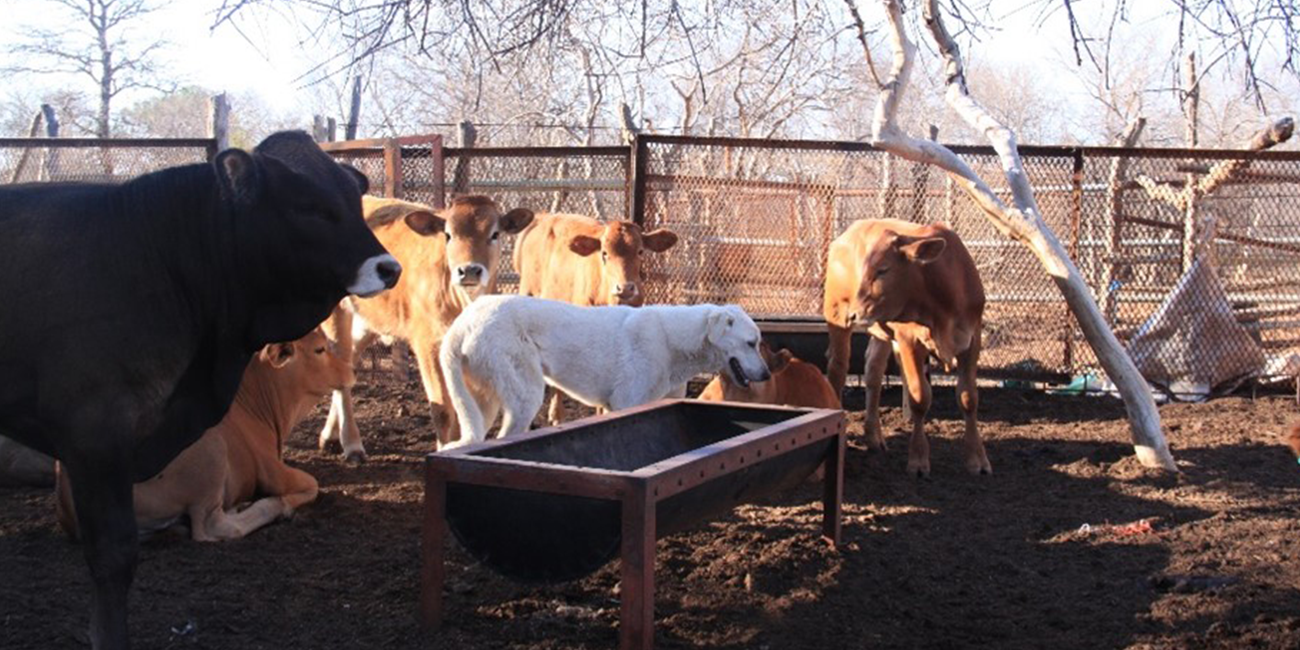
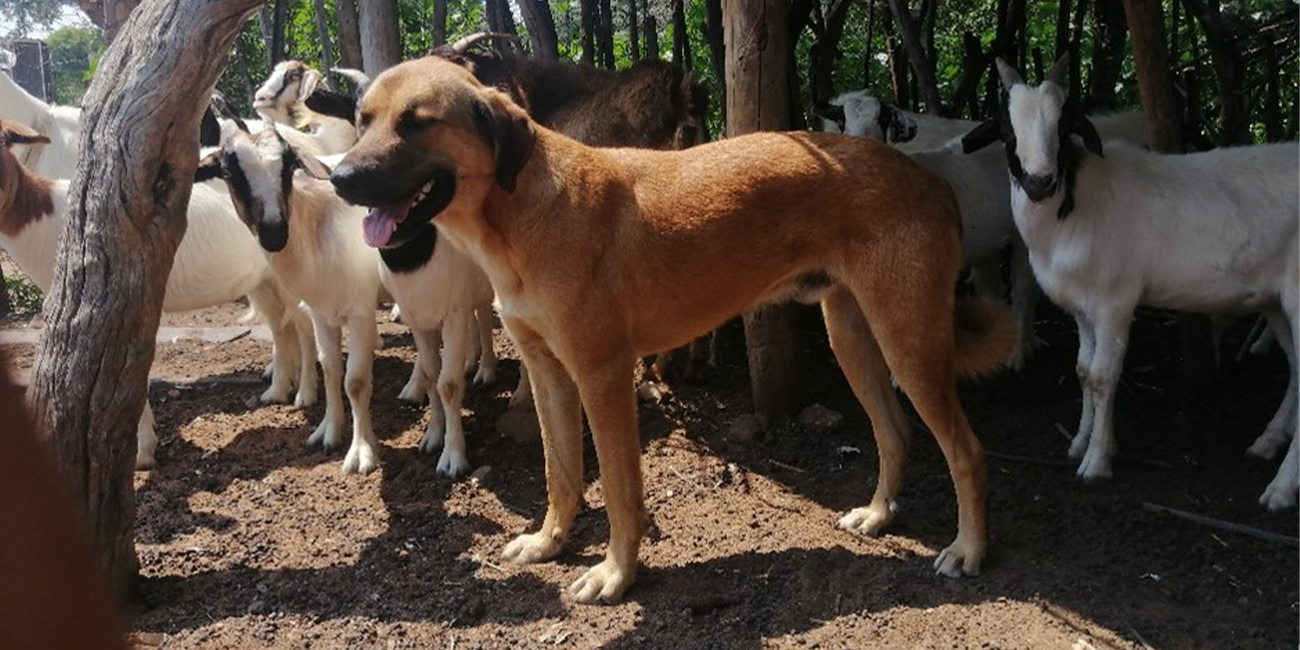
The Endangered Wildlife Trust’s Livestock Guardian Dogs protect farmed animals from predation.
In South Africa, poor livestock husbandry practices negatively impact livestock farmers through predation and threatened carnivores through persecution.
In 2008, the Endangered Wildlife Trust’s (EWT) created a Livestock Guardian Dog Project in its Carnivore Conservation Programme (CCP) to provide non-lethal solutions to livestock farmers who had experienced unsustainable losses due to predation by free roaming carnivores. This includes Jackals, Caracals, Cheetah, African Wild Dogs, Leopards and other small carnivores.
Through the project, guarding dogs are placed with livestock as puppies and grow up with the herd. This enables them to bond with the herd animals and thus protect them from carnivores that may try to predate on them. The provision of guardian dogs to farmers ultimately reduces and prevents the retaliatory killing of carnivores.
To achieve the goal of non-lethal intervention, we work together with farmers to, as far as possible, integrate this conflict mitigation methods with their farming practices.
Working with local farmers it had become clear that many lack the skills, knowledge or capacity to employ best-practice livestock husbandry methods to protect their livestock from naturally occurring large carnivores. Instead, they use lethal mitigation methods, such as snaring, shooting, gin-trapping, poisoning and hunting predators with dogs. Most lethal methods used are non-specific which means that any number of other species, and not the target species, are killed. This includes Critically Endangered White-backed Vultures, Hooded Vultures and other wildlife, such as Jackal, Caracal, Cheetah, Leopard and African Wild Dogs.
Since the inception of the project by the EWT in 2008, it became clear that among the farming practices implemented, and which increasingly put livestock at risk of predation, included letting calves that are too young into the fields with the rest of the herd, not kraaling livestock at night and even using inadequate basic livestock husbandry practices.
We have, therefore, been educating farmers and communities about the ecological and economic benefits of co-existing with carnivores. Through workshops hosted by the CCP, communities and farmers are informed about the impacts of killing key species, such as Leopard and Cheetah, and how the use of non-lethal mitigation methods prevent conflict. In the case of livestock husbandry, we reach out to our network of vets and animal technicians to advise and teach farmers how to take care of their livestock.
In order to receive a Livestock Guardian Dog, a farmer must be able to show that unsustainable losses have been suffered and that there is potential conflict between the farmer and wild species predating on his or her livestock.
Our field staff will then conduct a site visit to confirm predation issues and assess the suitability of the farm to host a guardian dog to ensure that the dog’s welfare is prioritised. Once the farmer enters into an agreement with the EWT, a Livestock Guardian Dog is provided to protect his or her animals for 12 months. Within this time, we will, on a monthly basis, provide the farmer with high quality dog food, ensure the dog is treated for both ectoparasites and endoparasites. Any veterinary needs are taken care of by the EWT, at no cost to the farmer.
A field officer visits the guardian dog once a month to check on its well-being and its effectiveness. This provides us with an opportunity to address any issues that may have arisen during the month. Once the farmer and the field officer are happy that the dog is effectively doing its job and that it is well taken care of, the EWT signs the dog over to the farmer and it becomes his or her responsibility.
Although the Livestock Guardian Dog is then no longer our responsibility, farmers are encouraged to continue keeping contact with us for any help regarding any conflict-related issues that may arise, such as conflict between the dog and carnivores. Additional free support is provided to communities to ensure that their dogs are spayed and vaccinated. This reduces the spread of disease and stops the overpopulation of dogs.
Since the inception of the Livestock Guardian Dog project, we have placed 241 guard dogs with over 200 commercial and community farms throughout South Africa, dramatically reducing the level of predation and human-wildlife conflict. The dogs placed as puppies on farms are mostly Anatolian Shepherds and Maluti Shepherds.More than Eighty percent of dogs placed develop into successful Livestock Guardian Dogs. These dogs have reduced predation on farms by up to 90 percent in most cases. This makes this project the most successful mitigation method that we have to deal with livestock predation.
So far, we have deployed two tracking dogs in reserves and will soon be deploying a further four, including both tracking and detection dogs. We have also supported the full training of two new handlers and partial training for a third handler through our relationship with Genesis K9 Group. Furthermore, we provide ongoing support to these deployed dogs and the handlers who have recently completed their training to reinforce what they have learned.
This project is supported by IUCN Save Our Species and co-funded by the European Union. The contents of this publication are the sole responsibility of the Endangered Wildlife Trust and do not necessarily reflect the views of IUCN or the European Union.
LATEST STORIES
Thanks to this grant, the EWT supports seven reserves that have many ecologically and economically important species threatened by poaching. We are taking a three-pronged approach that includes deploying freshly trained young Conservation Canines (trained in detection or tracking), training dog handlers who will be responsible for working with and looking after these dogs and supporting these dog-handler teams in these reserves to ensure they have what they need to work effectively.
Black Rhino (Diceros bicornis) in the Eastern Cape, South Africa. The Black Rhino is threatened by the illegal trade in rhino horn products. Photo credit: the african eye
The reserves we are assisting suffered income losses during the COVID-19 pandemic due to tourist travel bans, and we aim to support them through these hard economic times. Many reserves at risk of poaching use a variety of approaches to combat it, with anti-poaching field rangers commonly the first line of defence. Certified dog-handler teams can provide invaluable support to these teams on the ground in several ways. Our dogs either track poacher incursion routes within a reserve or provide a quick and reliable method for screening vehicles for concealed firearms or wildlife contraband.
So far, we have deployed two tracking dogs in reserves and will soon be deploying a further four, including both tracking and detection dogs. We have also supported the full training of two new handlers and partial training for a third handler through our relationship with Genesis K9 Group. Furthermore, we provide ongoing support to these deployed dogs and the handlers who have recently completed their training to reinforce what they have learned.
Conservation Canine Nala, a three-year old Belgian Malinois recently deployed in the Eastern Cape. Nala is a tracking dog and works with anti-poaching teams to protect threatened species.
This project is supported by IUCN Save Our Species and co-funded by the European Union. The contents of this publication are the sole responsibility of the Endangered Wildlife Trust and do not necessarily reflect the views of IUCN or the European Union.
LATEST STORIES
Conservation Canines to Save our Species from illegal wildlife trade
Dr Andrew Taylor, EWT’s Wildlife in Trade Programme Manager, andrewt@ewt.org.za
South Africa is blessed with exceptional wildlife and landscapes that attract tourists and boost our economy. Some of our country’s biggest drawcards, such as White and Black rhinos (which are Near Threatened and Critically Endangered, respectively on the IUCN Red List of Threatened Species), the African Savannah Elephant (Endangered), and the African Lion (Vulnerable), play vital roles in our ecosystems while also bringing in valuable ecotourism income. However, these species are threatened by the global illegal wildlife trade (IWT), which is a major cause of population declines in some countries. With funding from the IUCN Save Our Species Rapid Action Grant and the European Union, the Endangered Wildlife Trust (EWT) aims to reduce IWT by preventing wildlife poaching. We use our Conservation Canines to achieve this by training and deploying them to detect wildlife products and track poachers.
Newly qualified dog handler trained at Genesis K9 Newly qualified dog handler trained to reduce poaching as part of the project funded by the IUCN Save Our Species Rapid Action Grant and the European Union.
Thanks to this grant, the EWT supports seven reserves that have many ecologically and economically important species threatened by poaching. We are taking a three-pronged approach that includes deploying freshly trained young Conservation Canines (trained in detection or tracking), training dog handlers who will be responsible for working with and looking after these dogs and supporting these dog-handler teams in these reserves to ensure they have what they need to work effectively.
Black Rhino (Diceros bicornis) in the Eastern Cape, South Africa. The Black Rhino is threatened by the illegal trade in rhino horn products. Photo credit: the african eye
The reserves we are assisting suffered income losses during the COVID-19 pandemic due to tourist travel bans, and we aim to support them through these hard economic times. Many reserves at risk of poaching use a variety of approaches to combat it, with anti-poaching field rangers commonly the first line of defence. Certified dog-handler teams can provide invaluable support to these teams on the ground in several ways. Our dogs either track poacher incursion routes within a reserve or provide a quick and reliable method for screening vehicles for concealed firearms or wildlife contraband.
So far, we have deployed two tracking dogs in reserves and will soon be deploying a further four, including both tracking and detection dogs. We have also supported the full training of two new handlers and partial training for a third handler through our relationship with Genesis K9 Group. Furthermore, we provide ongoing support to these deployed dogs and the handlers who have recently completed their training to reinforce what they have learned.
Conservation Canine Nala, a three-year old Belgian Malinois recently deployed in the Eastern Cape. Nala is a tracking dog and works with anti-poaching teams to protect threatened species.
This project is supported by IUCN Save Our Species and co-funded by the European Union. The contents of this publication are the sole responsibility of the Endangered Wildlife Trust and do not necessarily reflect the views of IUCN or the European Union.
THE BRAVE JOURNEY OF SMOKE AND HER PACK OF AFRICAN WILD DOGS
Cole du Plessis, Wild Dog Range Expansion Project Coordinator & KZN Regional Carnivore Coordinator, EWT Carnivore Conservation Programme
coled@ewt.org.za
In South Africa, most of our reserves (protected areas) share boundaries with dense rural community settlements or farmers – this means that the direct threat to any wild animal significantly increases when they leave a protected area. Deliberate persecution, snaring, hunting, disease, and roadkill are some of those threats.
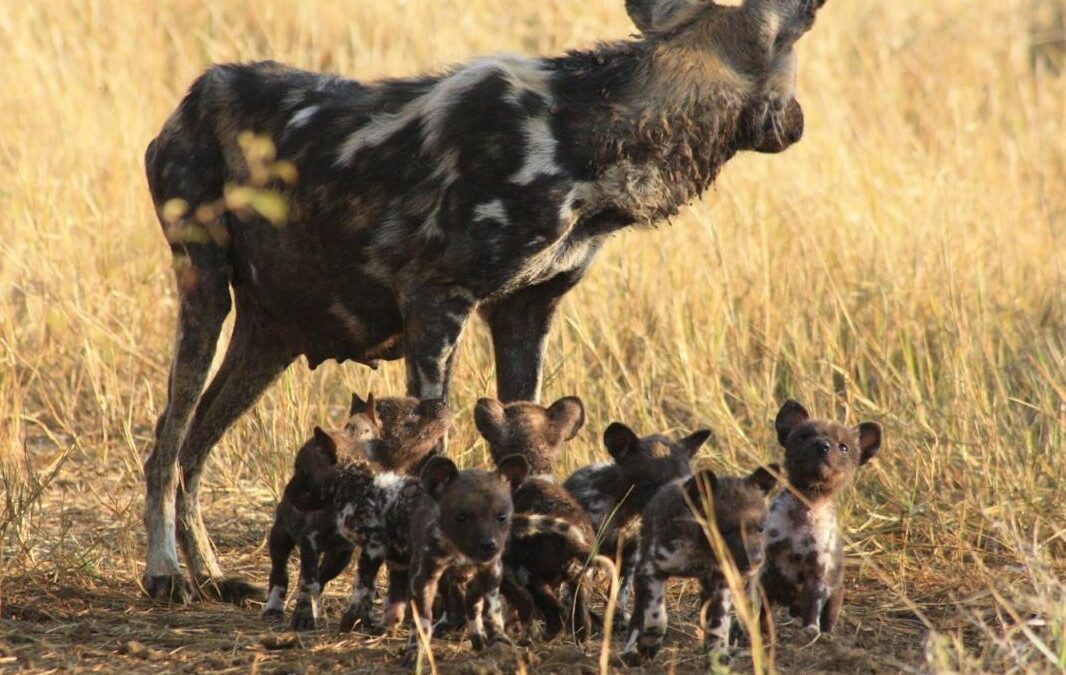
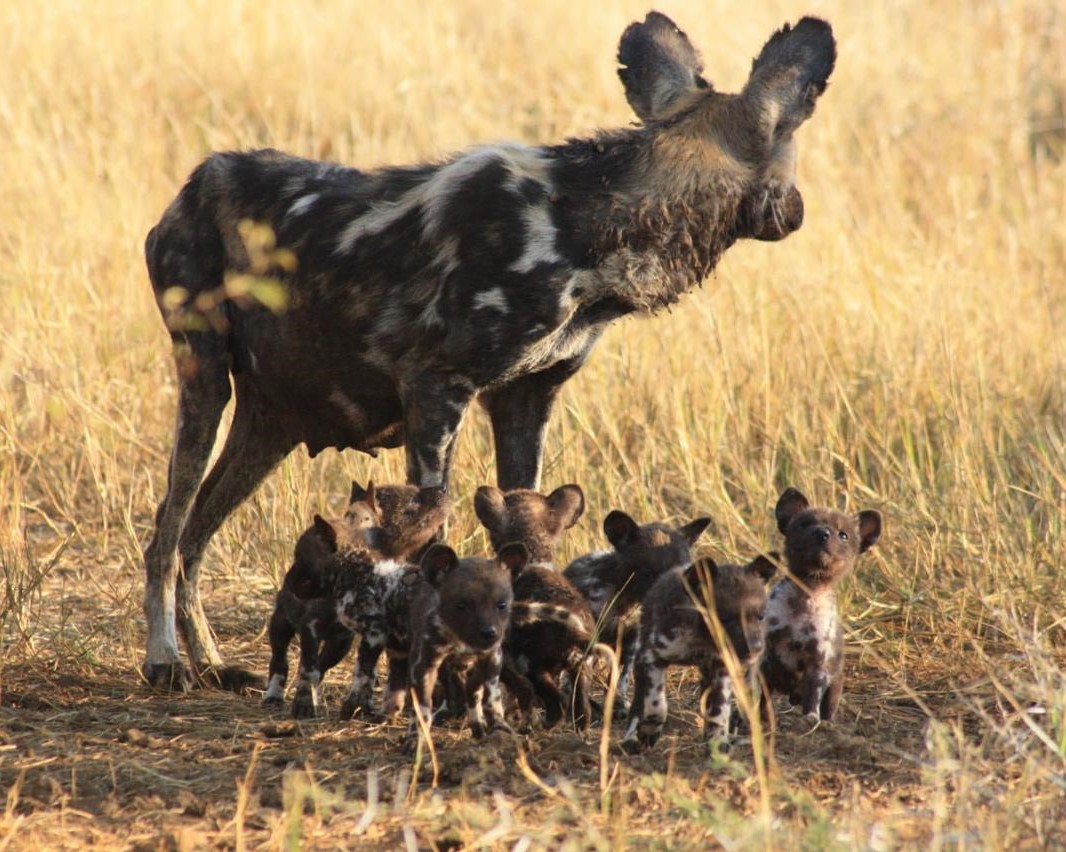
In 2018, the Nqolothi Wild Dog pack, led by a female named Smoke, left the protection of the Hluhluwe-iMfolozi Park and settled in nearby communal land. To the communities, , a predator like a Wild Dog can pose a threat to people or their livelihoods. The latter is far more likely. While there has never been a documented case of a Wild Dog killing a person, they do prey on livestock and large packs can do significant damage, particularly in rural subsistence farming communities.
Unfortunately, there was no functional tracking collar on the Nqolothi pack and monitoring them seemed like an impossible task. It was also almost like the pack had sensed the loss of their protection when leaving the reserve as they became highly elusive…only leaving the odd clue behind when they moved. When there was a sighting or report, we made a valiant effort to get there in time, but the pack was always long gone upon arrival. Tension was mounting in the community. Many goats had been reported dead and, whether there was evidence or not, it all pointed to Smoke and her pack. The community was losing patience and wanted to kill the pack to protect their livestock. It became a race against time to find them.
After almost a year of living in communal land, the pack finally exposed themselves. Smoke had fallen pregnant and went down to den. The weakness here was that the den site anchored them, and they started leaving traces. One day, community members used their hunting dogs to follow the scent back to the den and managed to dig out and kill two of the pups. When we arrived, just the carcasses of the pups remained. The rest of the pack had abandoned their den and took the remaining pups with them. We needed to intensify our efforts.
We immediately set up remotely triggered field cameras to monitor the area and spent nights in the field closer to where the Wild Dogs operated. A vet was on call and would be flown by chopper as soon as we received reports of sightings or discovered fresh signs. Eventually our luck changed. The pack made a brief appearance back in Hluhluwe-iMfolozi Park. The team responded immediately and for the first time the pack stuck around long enough for us to see them. One of the Wild Dogs was immobilised, and a satellite collar finally fitted. This was the game changer. We could now monitor the pack and plan their capture. We would normally call the pack in using recorded Wild Dog “hoo” calls and free dart them from a vehicle. Unfortunately, this pack had become far too skittish to use this method. Capturing this pack would involve careful planning and preparation, large capture nets, experienced game capture staff and a helicopter to guide them into the capture site. This operation needed to be perfectly executed, and it was. In one go, all the pack members were safely captured and transported to a holding facility nearby. At last, they were safe.
But the pack now needed a new home. Fortunately, Madikwe Game Reserve in the North West, was in a position to take them and the ever supportive Bateleurs offered to fly them there. Three months later, when all the permits were in place and preparations made, the pack was re-anaesthetised and driven to the Mkuze airstrip. The plane was prepped and ready on arrival. We carefully transferred the sedated Wild Dogs into the plane, and we were ready to begin our four-hour journey with our VERY SPECIAL cargo. Once we touched down, the pack was transferred to vehicles and driven to the boma. They had arrived at their new home. What we only realised on the plane was that Smoke had fallen pregnant again and only had a few weeks before she would have her pups. Normally, we use the soft-release method, where the pack stays in the boma to acclimatise to their new environment. This counteracts their instinct to return to their former territory and ensures that they will establish themselves in their new home. But Smoke needed time to explore her new territory and scout a safe den site. So, the pack was only in the boma for a brief period before they were released.
Using the satellite collar data, we were able to remotely monitor the pack as they started to explore their new home. And, after a few weeks, the collar data showed that the pack kept returning to the same point. Smoke had started denning and the rest of the pack was hunting and bringing food back to her. The pack was given their space to live in peace – they had the code to survival and didn’t need anyone checking in on them. But after weeks of eager anticipation, one of the researchers on Madikwe was given the green light to go in and check on the pack. Much to our excitement, they were all present and healthy, with the new offspring stumbling around at their feet.
As a result of an increasing human population and development, Wild Dogs no longer have the space that they need to thrive. South Africa is quickly approaching its relatively small Wild Dog carrying capacity. Many of the Wild Dog reserves are surrounded by farmland, so when Wild Dogs choose to expand their range or disperse, by default, they come under threat. In order to save our most endangered carnivore, we need to keep working at expanding safe space by reintroducing Wild Dogs into South Africa’s many fenced reserves. These reserves, in turn, serve as source populations as we work with partners such as African Parks, Peace Parks, and the Carr Foundation to recover former Wild Dog range across the continent.
It wasn’t ideal that we had to relocate Smoke’s pack, but we owed it to them to give them refuge. They can, once again, be at peace.
Thank you to our long-time partners Ezemvelo KZN Wildlife, Wildlife ACT, the Bateleurs, North West Parks Board and Madikwe Game Reserve, and donorsRichard Bosman, Painted Wolf Wines, Tania Ihlenfeldt, Tata Consultancy Services, and the Relate Trust. It is a pleasure to work alongside you and share the common goal of conserving our most endangered carnivore.
LOCKDOWN DOESN’T MEAN SLOW DOWN FOR THESE CONSERVATION CANINES
Shadi Henrico, Conservation Canine Project Coordinator, EWT Wildlife in Trade Programme
shadih@ewt.org.za The lockdown has brought new challenges, but our Conservation Canines continue to work (and play) as hard as ever.
Tracking under the moon light
With the implementation of the nationwide lockdown, our tracking dogs’ efforts in reserves were increased due to the risk of increased criminal activities. In the Lowveld, EWT Conservation Canine Annie and her handler were part of an operation involving several crime prevention units. They tracked down and assisted with the capture of two suspected poachers. Annie and her handler also supported an operation in which eight suspects were caught in the possession of dried- and fresh bushmeat, knives, axes, and snares. She happily works with her handler in any conditions and adapts very quickly no matter day or night, sun, or rain.
Taking flight
Time is of the essence when tracking suspected poachers. EWT Conservation Canine Puk, based in the Lowveld, has increased his training on flying in helicopters with his handler. This is a quick way to get to work and start tracking, and reduces time available for suspects to escape. Puk is the second EWT Conservation Canine to be trained to ride in a helicopter. Once the rangers in the field discover any incursions, attempted poaching, or actual poaching in progress, they alert the canine team, which can get in the air within a very short time. Once they get closer, they can lower the handler and dog to the ground and this team can immediately track down the culprits!
Vehicle detection
It is of the utmost importance to search all vehicles entering and exiting reserves for wildlife contraband, ammunition and arms. These searches are conducted daily. In April alone, two of our EWT Conservation Canines, Spike and Fly, searched 221 vehicles at reserve entrances. Large areas and compounds are also covered by these teams. With the implementation of lockdown, certain unforeseen challenges risen. For example, Fly fell ill during this time. Thanks to excellent veterinarians, he was treated, and work resumed. Even in lockdown and with the heat of the Lowveld, we always prioritise our canines’ health and happiness!
Training during lockdown
We have two handlers, Shay Seebran and Innocent Buthelezi, staying at our Gauteng Conservation Campus in Midrand to care for our dogs and continue their training. When the lockdown was announced, we developed a plan of action that would allow for daily training to continue to take place, despite our senior handlers not being able to train in person. Our lockdown canine training involves using live video calls and regular check-ins. From her home in Pretoria, our Conservation Canine Coordinator, Shadi, video calls our handlers every day to see how both the dogs and the humans are doing in this challenging time and observe training in real time, providing instruction and feedback. Each day, these EWT Conservation Canines do open area searches, vehicle searches, building searches, and training on tyre rims. This keeps them up to date and makes sure that they do not lose their focus on the job. Just like us – they must keep their skills up to speed! Training records are completed as normal and our dogs are at their happiest when they can work.
Normal husbandry, like kennel cleaning and feeding, continues as normal. Welfare remains our top priority – we love our happy, healthy dogs – and they love long walks and getting groomed. We are very privileged to have our own dogs on our own property. Here they can still go for long walks, run free and swim. They probably have it better than most of us in lockdown!
Thanks to our funding partners, US Fish and Wildlife, Tourvest, Greeff Properties, the Tomlin family, Royal Canin, Boehringer-Ingelheim, MyPlanet Rhino Fund, Relate Trust, Platinum Life and GivenGain.