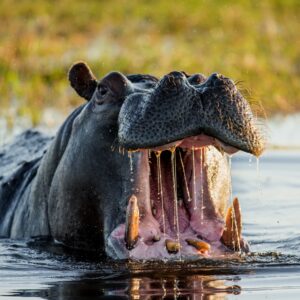
NEVER A DULL MOMENT, THANKS TO MACSTEEL!
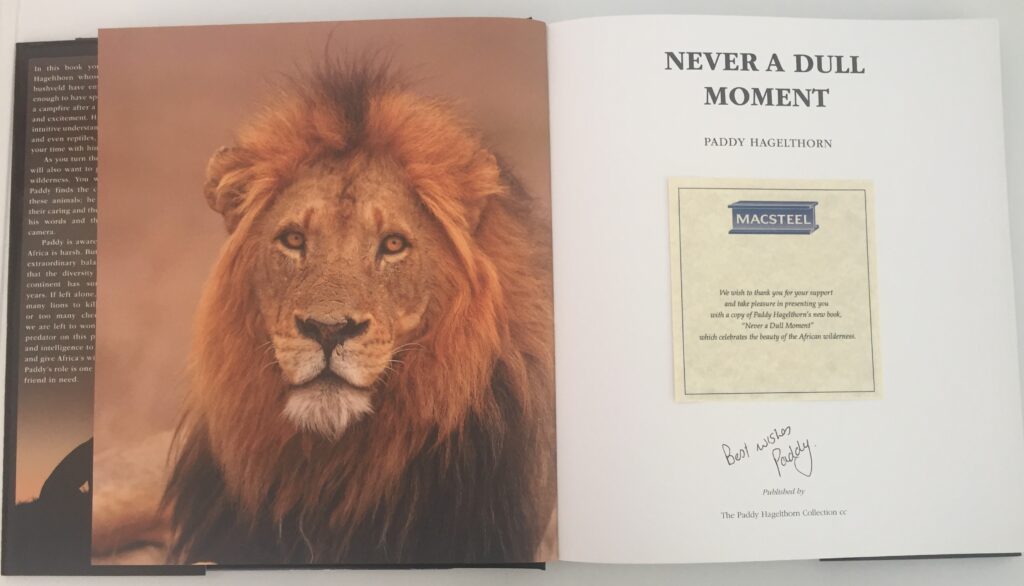
] This beautiful coffee table book is a collection of wildlife photography and stories by Paddy Hagelthorn, aptly titled “Never a dull moment”.
Not only has this book been signed by the author, but full proceeds go to the EWT as they have been generously donated to the EWT by Macsteel.
Selling for R450. To purchase this book, please go to our online shop or email Tammy Baker on tammyb@ewt.org.za
AT LEAST 28 EXTINCTIONS HAVE BEEN PREVENTED BY CONSERVATION ACTION IN RECENT DECADES
Lizanne Roxburgh, Senior Scientist, EWT Conservation Science Unit, lizanner@ewt.org.za
Reference: Bolam, F.C, Mair, L., Angelico, M., Brooks, T.M, Burgman, M., McGowan, P. J. K & Hermes, C. et al. 2020. How many bird and mammal extinctions has recent conservation action prevented? Conservation Letters, e12762. doi: https://doi.org/10.1111/conl.12762
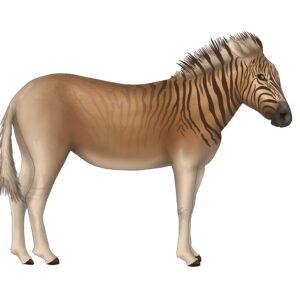
A study led by Newcastle University, UK and BirdLife International has found that conservation action has prevented the global extinction of at least 28 bird and mammal species since 1993. The species include Puerto Rican Amazon (Amazona vittate), Przewalski’s Horse (Equus ferus), Alagoas Antwren (Myrmotherula snowi), Iberian Lynx (Lynx pardinus) and Black Stilt (Himantopus novaezelandiae), among others.
The international team of scientists, including the EWT and other co-authors from South Africa, has estimated the number of bird and mammal species that would have disappeared forever without the efforts of conservationists in recent decades. The researchers found that 21–32 bird and 7-16 mammal species extinctions have been prevented since 1993, with the ranges reflecting the uncertainty inherent in estimating what might have happened under hypothetical circumstances.
The research team compiled information from 137 experts on the population sizes, trends, threats, and actions implemented for the most threatened birds and mammals, to estimate the likelihood that each species would have gone extinct without action. Their findings show that without conservation actions, extinction rates would have been around 3–4 times greater. Sadly, within the same period, 15 bird and mammal species went extinct (or are strongly suspected to have gone extinct).
The study has highlighted the most frequent actions taken to prevent extinctions in these bird and mammal species. Twenty-one bird species benefited from invasive species control, 20 from conservation in zoos and collections, and 19 from site protection. Fourteen mammal species benefited from legislation changes and nine from species reintroductions and conservation in zoos and collections.  The findings are highly relevant to the UN Convention on Biological Diversity (CBD), which came into force in 1993. Over its lifetime, at least 28–48 bird and mammal species extinctions have been prevented. Through the Convention, governments adopted the ‘Aichi Biodiversity Targets’ in 2010, which committed countries to tackle the loss of nature. It is widely expected that the CBD’s next official report will show that most targets have not been met.
However, the results of our study show that despite the overall failure to meet the targets for conserving nature set through the UN a decade ago, we have achieved significant success in preventing extinctions. This success should encourage governments to reaffirm their commitment to stop extinctions and recover populations of threatened species in the coming decade. Such a commitment is both achievable and essential to sustain a healthy planet. In many ways, this is a call to action: it shows what we can achieve if we act now to support conservation and prevent extinction.

MYSCHOOL CARD BENEFICIARY
Thank you to the team at MySchoolMyVillageMyPlanet and to Woolworths, Engen, Bidvest Waltons, Flight Centre, Loot.co.za, and newest partner store Builders Warehouse for their ongoing support. By adding the Endangered Wildlife Trust as a beneficiary on your MySchool card, you are raising much-needed conservation funds every time you swipe.

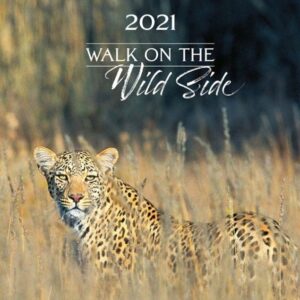
TAKE A WALK ON THE WILD SIDE
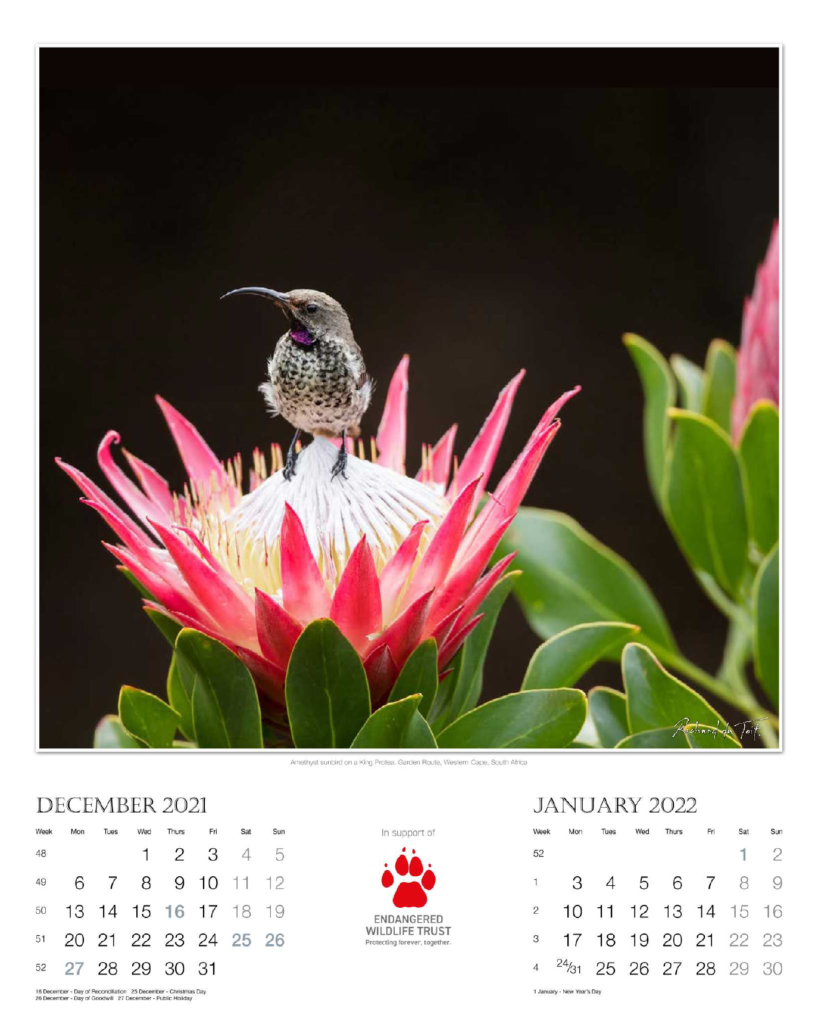
The EWT’s 2021 wildlife wall calendar, Walk on the Wild Side, once again showcases Richard du Toit’s stunning photography. Richard, an internationally acclaimed photographer, never fails to capture a stunning image. The calendar is in portrait and comes individually boxed ready for distribution. Proceeds from the sale of the calendars are donated to the EWT.
Cost R400
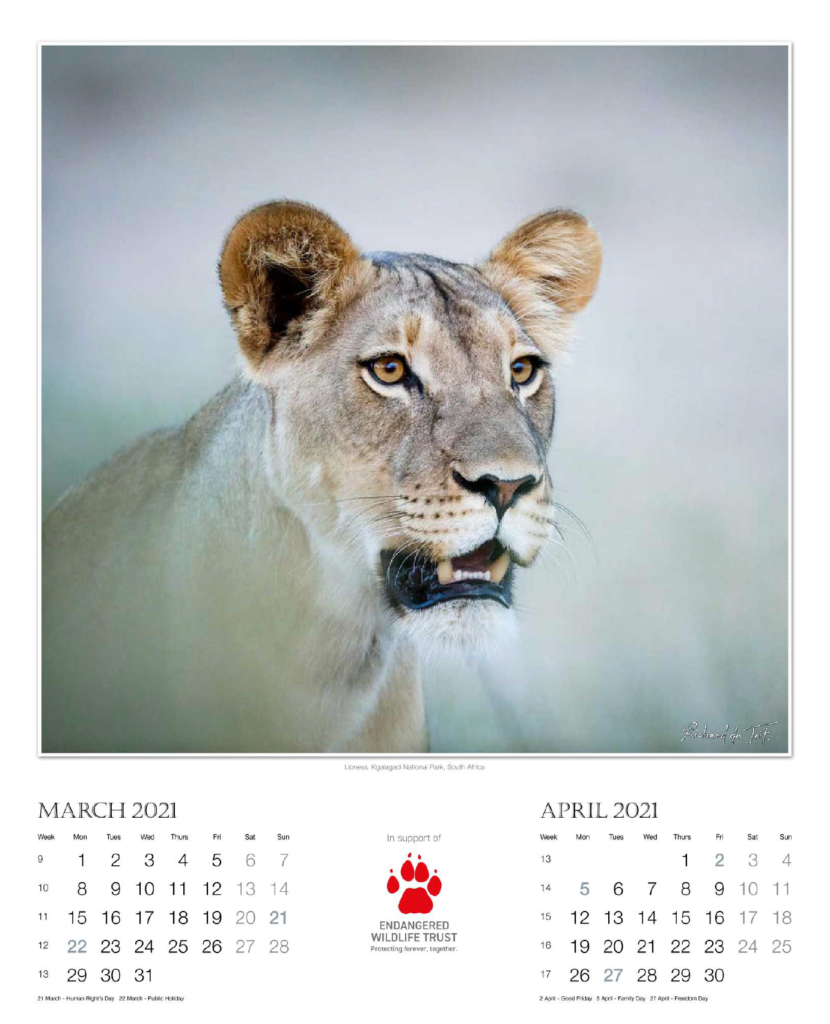
To purchase this beautiful calendar, please go to our online shop or email Tammy Baker on tammyb@ewt.org.za
COMING UP IN OCTOBER – NATIONAL TRANSPORT MONTH
Millions of animals are killed on the roads every year, and these incidents often cause injury or death to humans, as well as significant and costly damage to vehicles. By collecting information, we are better able to identify hot-spots, common species involved, and other variables that may come into play, such as weather and time of day. This information better equips us to develop strategies to mitigate the threats that transport infrastructure and vehicles pose to wildlife and humans. One of the ways of counting the number of animals killed on the road is through training route patrol staff to collect the data while on patrol, but we can all do more. October is National Transport Month, and we would like to encourage everyone to get involved by collecting animal road mortality data from all over South Africa. It is super easy!
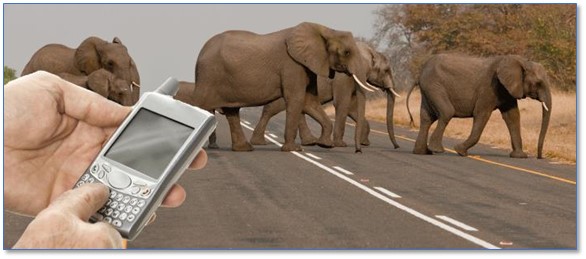
You can submit your data can be submitted via email: roads@ewt.org.za
OR you can download the smartphone app (EWT Road Watch) and start reporting
• Go to Google Play on your smartphone https://play.google.com/store
• Type in ‘EWT Road Watch’
• Click on ‘INSTALL’, and it will download to your phone
• Once installed, you will need to enter your user details, either your email address or phone number. You will only need to do this once, and we will never share your information
• You can then begin reporting roadkill sightings
• It doesn’t matter if your phone does not have signal, the app will log your location and submit records once you are back in network range.
rated annually on 10 August!
Your support will no doubt help us to protect our wildlife, but please don’t put your own life at risk to collect information. Always consider your safety, and please do not use your phone while driving. When reporting roadkill, please provide the following information:
• Location of roadkill (GPS coordinates)
• Identification of species (as best as possible)
• Date and time seen
• Notes on the local habitat type (e.g. riverine, grassland, rocky, wetland, etc.) are also be useful.
Good identification photos (particularly if the carcass is very squashed) are very helpful BUT only stop and take a photo if it is safe to do so, then try and record the following:
• BIRDS: Tail and wing feathers/beak and feet (if the whole bird is no longer there) and eye
• REPTILES: Scales/head shape/foot shape (if applicable)
• AMPHIBIANS: Foot shape (webbed)/presence of warts/colouration around head and eye
• MAMMALS: Fur/hair colour/body size/teeth type (carnivore or herbivore)

 This beautiful coffee table book is a collection of wildlife photography and stories by Paddy Hagelthorn, aptly titled “Never a dull moment”.