THE CITY NATURE CHALLENGE
www.iNaturalist.org
The City Nature Challenge is an annual international event organised by the Natural History Museum of Los Angeles County and the California Academy of Sciences and has been taken up by cities worldwide. It is tricky for scientists to conduct biodiversity surveys in urban areas because the habitats are so fragmented, and it is not always possible to access private properties. This iNaturalist challenge calls on citizen scientists to help record the wildlife occurring in their cities.
Cities contain ecosystems that, while not all in a natural state, are filled with wildlife that have adapted their behaviour to survive and thrive in these environments and are essential in maintaining a balance in green spaces and urban ecosystems, which provide us with critical services such as oxygen and carbon sequestration, flood and drought regulation, water, recreational space, and many more. To maximise our understanding and protection of the wildlife in cities, scientists need to have all the information they can get, and you can help just by looking around and recording what you see!
“Citizen scientists collect thousands of valuable records every day on biodiversity and the environment to assist conservation and research efforts across the globe. Play your part in helping to protect your patch of nature in your city by participating in this great global initiative and recording what species occur there.”
Dr Lizanne Roxburgh, Senior Scientist, EWT Conservation Science Unit
This year’s challenge takes place in two parts. The first phase (30 April–3 May 2021) involves taking pictures of wild plants and animals. The second phase (4 May–9 May 2021) is dedicated to identifying what was observed during the challenge.
To participate, download the app and sign-up to iNaturalist, find a project in your city (or start one!) and join in the fun – it’s addictive! See www.inaturalist.org/projects/city-nature-challenge-2021 for more information.The following projects in South Africa have been registered so far:
Nelson Mandela-Bay
Ethekwini
City of Cape Town
Garden Route
Tshwane
Check out the project journals for training, helpful hints, and other great resources to get you started!
RESCUE AND REHABILITATION OF A POISONED EGYPTIAN GOOSE
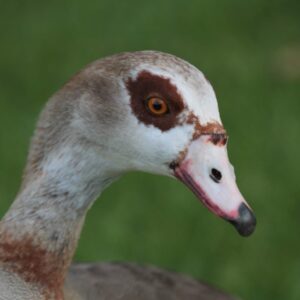
Dr Lindy Thompson (lindyt@ewt.org.za) and John Davies (EWT Birds of Prey Programme Field Officers), Rebecca Lambert and Nikita Jackson (Moholoholo Wildlife Rehabilitation Centre), and Carrie Hickman (APRN Ground Hornbill Project). In December 2020, while conducting fieldwork along the Olifants River, we found a poorly-looking Egyptian Goose showing signs that indicated it might have been poisoned. While the goose appeared to be in an otherwise good condition , with no visible injuries (broken bones or bleeding) or signs of trauma, it stumbled, fell, and rolled down the riverbank when it tried to get away from us as we approached. It was unable to fly. The African Wildlife Poisoning Database contains records of 724 Egyptian Geese that have been poisoned in Africa between 1998 and 2020. The substances used are usually organophosphates and carbamates (pesticides), and we think that most cases emanate from human-wildlife conflict due to crop damage by the geese. In this case, we suspect the goose may have been grazing in lucerne that was recently sprayed with insecticide.] We collected the unfortunate goose and drove it to Moholoholo Wildlife Rehabilitation Centre, leaving it in the capable hands of their experienced clinic team. On its arrival, the Egyptian Goose was treated with Atropine (used to treat organophosphate and carbamate poisoning) and activated charcoal (which binds to many toxins and prevents their absorption), and then it was given Ringers solution (to replace fluids and electrolytes) every two hours. After that, the goose received tubed pet food (a recovery food that is easy to digest), and then later, it was fed with pigeon pellets, crushed mealies, mealworms, flying ants, and grasshoppers. On 4 February 2021, after all this treatment and time to heal, the rehab team was happy with the bird’s condition, and we released it close to where we found it on the Olifants River. It flew off as though nothing had happened, without a backward glance – just how we like it to be every time we return wildlife to the wild. Click here to see a video of this bird being released: https://www.instagram.com/p/CLB80t5AvGy/ After publicising this rescue on Instagram, people asked us why we bothered rescuing a bird many people view as a pest species because its numbers are increasing. Firstly, when we found the bird and realised that it had been poisoned and was suffering we decided to rescue and rehabilitate it as the possible death of this bird would have bene due to human action and not natural causes. Secondly, if we had left the poisoned goose in the bush and it had died, it may have been fed on by scavengers such as vultures and jackals, which in turn may have experienced secondary poisoning. Thirdly, the EWT’s John Davies’ work with the annual Balule Waterbird Survey showed that Egyptian Goose numbers have increased along the Olifants River and a few other river systems in the Lowveld, mainly due to the deterioration of water quality due to human actions and large-scale losses of riparian forest, which has created open banks suitable for this species. Egyptian Geese exploit suitable conditions, and when these environmental conditions change, we expect their numbers to decline again. In 2020, in Balule Game Reserve, there were 377 Egyptian Geese along 49.8 km of river, including 47 chicks, while 84 Egyptian Geese were counted near the Phalaborwa barrage, and 71 at Three Bridges, almost half were found at the two most transformed (polluted) sections of the Olifants River. For most of the river, the average number of Egyptian Geese was just over four adults per kilometre, likely still slightly higher than normal, but not excessive. This is similar to parts of the Kruger National Park large-scale loss of riparian habitat have taken place.
  On the property where the goose was found, none of the 19 vulture nests we are monitoring was lost due to disturbance from Egyptian Geese. In fact, over the last six years of the EWT’s vulture nest-monitoring in the Lowveld, we have found only one case where an Egyptian Goose tried to breed in a nest still used by a recently-fledged Hooded Vulture. After numerous interactions between the geese and the vultures, the Goose’s breeding attempt failed, and there was no negative impact on the vultures. See here for more details
Thank you to Andre Botha for sharing records from the African Wildlife Poisoning Database, https://www.africanwildlifepoisoning.org/.
Please submit records of any poisoned wildlife to this database, and please contact Dr Gareth Tate at GarethT@ewt.org.za for details of Wildlife Poisoning Response Training in the Lowveld.
BRIDGING THE GAP FOR VERVET MONKEYS
Courtney Maiden, EWT’s Wildlife and Transport Programme student, 64083152@mylifeunisaac.onmicrosoft.com
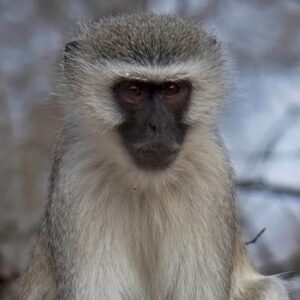
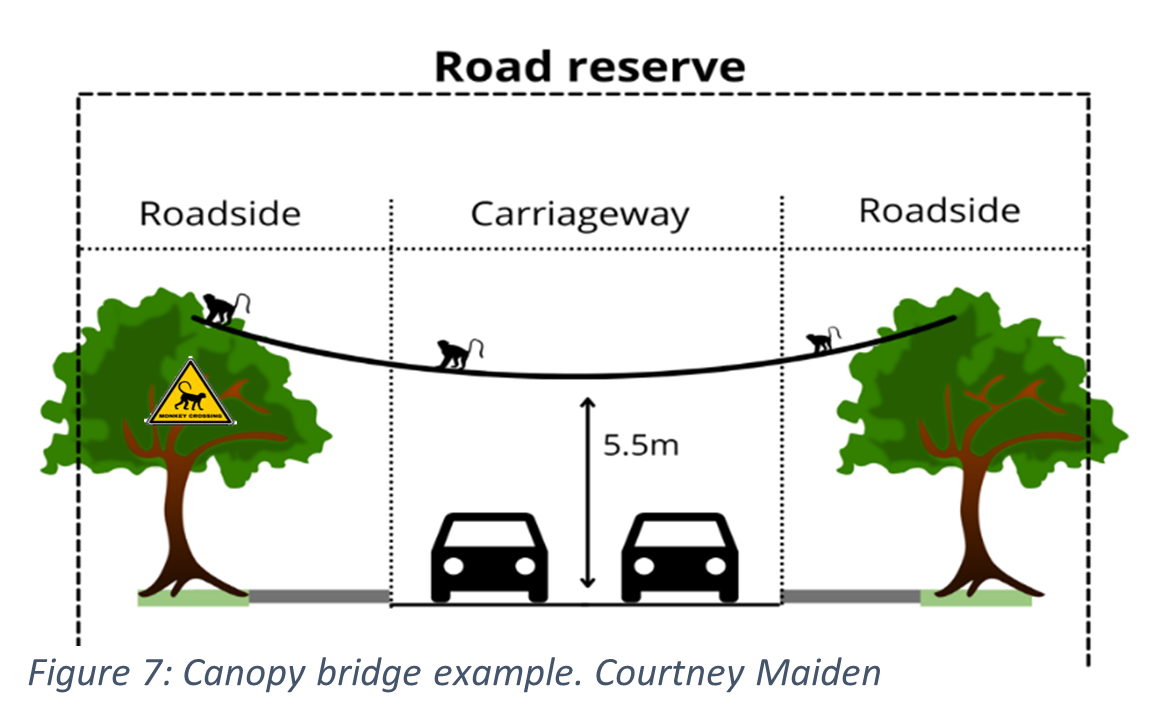
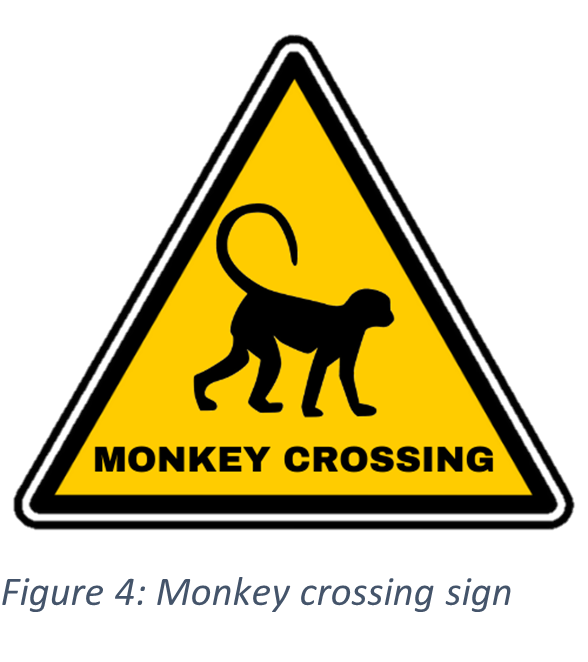
 Gaps caused in the forest canopy cover from linear infrastructure, such as roads, force arboreal species to come down to the ground and face threats such as wildlife-vehicle collisions. Wildlife crossing structures, such as canopy bridges, have been installed in many countries to reduce the impact of roads and enhance habitat connectivity for tree-dwelling species. The Vervet Monkey (Chlorocebus pygerythrus) is one of the arboreal species subjected to daily vehicle collisions throughout South Africa.
In an attempt to reduce mortalities, EWT student Courtney Maiden is designing and testing Vervet Monkey-specific canopy bridges in Durban, KwaZulu-Natal, with an end goal of installing wildlife-friendly bridges in roadkill hotspots across the country. By interrogating proposed designs and methodologies to establish a preferred Vervet Monkey crossing structure design, effective roadkill mitigation processes and species management plans can be established by integrating a simple yet potentially effective design to minimise wildlife-vehicle collisions, encourage habitat connectivity, and ensure the viability of Vervet Monkey populations. This work is being done in collaboration with the University of South Africa and the University of Wisconsin.
GOING BOSSIES
Bonnie Schumann, EWT’s Drylands Conservation Programme, Senior Field Officer, bonnies@ewt.org.za
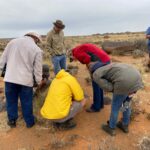
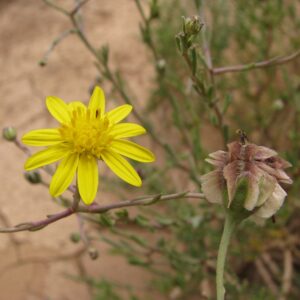
The EWT Drylands Conservation Programme, in partnership with the Grootfontein Agricultural Institute, held Karoo bossie (vegetation) identification days around Loxton this week. Altogether 32 people, mostly farmers, attended the sessions. Karoo veld generally appears rather grey and uninteresting to many passers-by, and getting to know the different species, mostly dwarf shrubs, can be very challenging at the best of times as they tend to look rather similar at first glance. For the novice, in order not to get demotivated on the first day, it is best to go in Spring and Autumn. At these times, if there has been rain, the bossies (little bushes) may be flowering and seeding, making it a lot easier to identify them. Once you spend time in the veld, you realise that there is actually a great deal of plant diversity, including over 3,000 species in the Nama Karoo. Not bad for a desert!
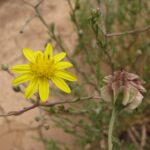
If you dare get up close and personal with the larger, thorny, rather formidable-looking bushes, you realise that they shelter a range of other fascinating species, which is why they are often called “mother bushes”. Despite the rather barren appearance of Karoo veld, when the veld is managed sustainably, the rangeland will provide fodder for wildlife and livestock year-round, as there is always something growing in every season. Grasses, which are less common as one travels west across the Karoo, are nonetheless an important component of the Karoo veld. Years of good early summer rainfall will result in a good grass component. On the other hand, the shrubs tend to prefer the cooler, wetter periods, providing valuable fodder during Autumn and Winter.
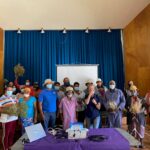
The plant identification sessions give farmers the opportunity to share their knowledge of the species growing in their area and encourage and facilitate more effective management of the veld, ensuring that the important palatable species are grazed with care, species diversity is promoted, and effective rest periods are implemented. These sessions formed part of the Karoo Forever Project, which focuses on promoting sustainable land management in the Karoo. The project is funded by the Global Environment Facility and managed by the United Nations Development Programme, in partnership with the Department of Environment, Forestry, and Fisheries, and the Department of Agriculture, Land Reform, and Rural Development.
SCIENCE SNIPPETS:
POWERLINE MARKERS PREVENT COLLISIONS IN BLUE CRANES BUT NOT LUDWIG’S BUSTARDS
Shaw JM, TA Reid, BK Gibbons, M Pretorius, AR Jenkins, R Visagie, MD Michael and PG Ryan. 2021. A large-scale experiment demonstrates that line marking reduces power line collision mortality for large terrestrial birds, but not bustards, in the Karoo, South Africa. Ornithological Applications. 10.1093/ornithapp/duaa067
Power line markers, such as flappers, are widely used to reduce or prevent bird collisions with power lines. However, few studies have robustly tested how effective they are in doing this. Power line collisions are an escalating problem for several threatened bird species endemic to southern Africa, as our powerline network continues to expand to meet the growing demand for electricity. Therefore, it is critical to know whether or not line marking works to adequately manage this problem and reduce the number of birds that are killed.
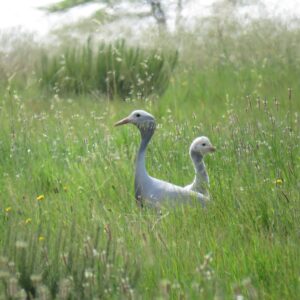
A recent paper published by Jessica Shaw from the FitzPatrick Institute of African Ornithology at the University of Cape Town, using EWT/ESKOM data, and coauthored by three EWT staff members, describes the results of a large scale eight-year experiment that tested the efficacy of the markers. The experiment was set up on 72 of 117 km of monitored transmission power lines in the eastern Karoo, South Africa, to assess whether line markers reduce bird collision mortality. The two bird species of particular interest were Blue Cranes (Anthropoides paradiseus) and Ludwig’s Bustards (Neotis ludwigii). Two different marking devices commonly used in South Africa were tested: bird flappers and static bird flight diverters.
The authors found that: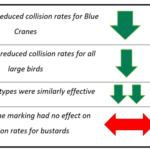
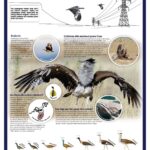
The monitoring conducted by the research team at this site also confirmed high levels of mortality of a range of species of conservation concern on unmarked lines. The authors, therefore, recommend that marking be widely installed on new power lines. However, other, more effective options need to be urgently explored to reduce collision mortality of bustards. Five different bustard species were in the top 10 list of most frequently found carcasses. High collision rates of Ludwig’s Bustards add to wider concerns about population-level effects for this range-restricted and Endangered species.



