
A WORD FROM THE CEO
Yolan Friedmann, EWT CEO
yolanf@ewt.org.za It all began with an email in March 2015 from a wonderful ally and friend in conservation, Rob Brett, who works with our partner Conservation International. Rob asked me if we could meet regarding the potential for the EWT to get involved in the conservation of land in the Soutpansberg Mountains as he was engaging with Phil and Sue Roberts, an Australian couple who had visited the area, fallen in love with it, and wanted to help purchase a property to secure this critical landscape for Leopard conservation. For 40 odd years, the EWT had held the belief that our most effective position was to support other landowners to conserve habitats and species and not be in the ‘land game’ ourselves. But this conservation with Rob sparked my interest, and the more we spoke about this forgotten mountain, the urgent need for its formal protection, the critical importance of its water catchments, cultural heritage sites and extraordinary levels of species endemism, the more it became evident that the best way to catalyse urgent conservation attention was to have some skin in the game as a landowner ourselves.
From what began with Phil and Sue’s passionate desire to invest in African conservation in 2015 has now become a conservation success story unfolding before our eyes, where an overlooked and little-known Garden of Eden is becoming a model for sustainable conservation and an emerging nature-based local economy.
The Roberts’ funding resulted in the initial purchase of the 1,400-hectare Medike Nature Reserve. In just six short years, with the extraordinary support of partners like the Rainforest Trust and Doug Wilson, we doubled the reserve’s size to include Medike West. The dream to create a 23,000-hectare Protected Area is fast becoming a reality, with the commitment of several landowners to include their properties through the establishment of the Western Soutpansberg Nature Reserve Association in 2020 to protect and manage the area through the biodiversity stewardship programme, increasing the protection of the mountain’s unique biodiversity. With funding from the F E van Pletzen / L Steynberg Trust, we reached another fantastic milestone last week by opening up over 40 km of trail running paths and another 68 km of hiking trails across several spectacular landscapes and farms in the magical mountain. I was fortunate enough to be part of the recce team, which spent five days testing these virgin trails that will open access to nature lovers globally to enjoy this serene wilderness and support its ongoing conservation. Moreover, it is part of creating sustainable, nature-based employment opportunities for our trail-cutters, rangers, and guides who hail from local communities and are eager to share their natural and cultural heritage with visitors. This is a unique opportunity to undertake a true wilderness hike in which you can experience absolute quiet, untampered vistas, pristine wilderness, overwhelming beauty, unique biodiversity, large numbers of endemic and highly threatened species, and ancient cultural history. Just some of the features you will see on this hike and nowhere else is a Yellowwood forest with trees of over 80 m high, Euphorbias, Giant Strelitzias, and Samango monkeys and a Leopard density that turns sand roads into veritable tracking highways every morning.
Watch this space for the official opening of hiking, trail running, and mountain bike trails next month, as well as opportunities to do specialist experiences for birders and tree huggers, all to the benefit of conservation and the upliftment of communities in this special place. For more, visit our EWT Destinations page and watch the video The Forgotten Mountain.
LATEST STORIES
WILD DOGS REINTRODUCED TO MALAWI AFTER DECADES OF ABSENCE
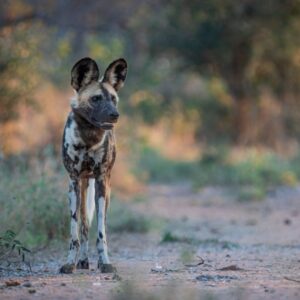
On 27 July 2021, 14 African Wild Dogs were translocated successfully from South Africa and Mozambique to Liwonde National Park and Majete Wildlife Reserve in a historic project to reintroduce this Endangered species to Malawi. The translocation was undertaken through a collaboration between the Endangered Wildlife Trust [EWT] and African Parks, which manages Liwonde and Majete protected areas in partnership with Malawi’s Department of National Parks and Wildlife (DNPW). While helping to repopulate both parks, the reintroduction represents a major international effort to conserve African Wild Dogs, with only 6,600 individuals, or just 700 breeding pairs, estimated to be left on the continent.
“The Wild Dog is one of Africa’s most Endangered mammals, so we’re extremely proud to have been able to establish safe spaces in Malawi where their long-term survival can be assured”, said the Director of Malawi’s Department of National Parks and Wildlife Brighton Kumchedwa. “The conservation of our country’s natural heritage is central to our· national development strategy. Over the past two decades, our collaboration with African Parks and local communities has helped to restore multiple iconic species to our protected areas, contributing not only to meeting global biodiversity targets but to sustainable economic growth”.
The African Wild Dogs were sourced from Gorongosa National Park and Karingani Game Reserve in Mozambique, and Somkhanda Community Game Reserve and Maremani Nature Reserve in South Africa. On 27 July, all 14 animals were flown in a single aircraft from Mozambique’s Massingir Airport to Blantyre in Malawi. Eight dogs were released into bomas in Liwonde National Park and six into bomas in Majete Wildlife Reserve, where they will remain for several weeks, allowing them to adjust to the new conditions before being fully released into the wider park areas. Each pack has been fitted with a mix of satellite and radio collars to facilitate the continual monitoring of their location and habitat use and ensure their long-term protection in the parks.The dogs
The Liwonde National Park (Malawi) females were born in Somkhanda Community Game Reserve, the only community-owned reserve in the Wild Dog Range Expansion Project. Wild Dogs were introduced into the reserve in 2015, and from the reserve’s successes, Somkhanda Community Game Reserve can now contribute back to the Wild Dog range expansion work. In this case, three sisters born in 2019, offspring of the Kalahari females and Hluhluwe-iMfolozi Park males, recently showed signs of dispersal, and the collaborative decision was to capture them and bond them to male Wild Dogs and introduce the newly formed pack into Liwonde Game Reserve. Thank you to Somkhanda Game Reserve, Wildlands, Wildlife ACT – Focused Conservation, UmPhafa Private Nature Reserve (Colchester Zoo), and Ezemvelo KZN Wildlife for making this possible.
The Liwonde National Park (Malawi) males were born in Maremani Nature Reserve, a beautiful game reserve in the tropical savannah in northern Limpopo, close to the Limpopo River in the northernmost area of South Africa.
The males dispersed from their natal pack and went in search of females. In the space of ten days, the group covered 600 km, which included a stint into Bubye Valley Conservancy (Zimbabwe). Due to their vulnerability to several threats (persecution, snaring, and roadkill), a decision was made to capture the male Wild Dogs, bond with the Zululand females and introduce them into Liwonde National Park. Maremani Nature Reserve has been vital in the success of this Wild Dog population and a champion for the species in the surrounding areas.
The Majete males come from the original pack introduced into Gorongosa National Park in 2018. Gorongosa National Park is Mozambique’s flagship reserve and now boasts a thriving Wild Dog population with more than 100 Wild Dogs now roaming the landscape.
Several months ago, the Gorongosa-born males, having just turned two, dispersed from their natal pack and roamed into the buffer areas outside the park. Dr Antonio Tonecas, the head Gorongosa vet, captured the males and brought them back to safety the safety of the Gorongosa boma. Following the decision to include these males in the Majete Wildlife Reserve reintroduction, the group was relocated by air by the Mozambican veterinarian team and placed in the predator boma at Karingani Game Reserve, where they were bonded with females.
The Majete females were born on Karingani Game Reserve. The Karingani Pack was introduced in 2019 and has thrived in Karingani since. Karingani is situated in the southwest of Mozambique, bordering South Africa’s Kruger National Park. The strong conservation focus and monitoring at Karingani have seen the Wild Dog population double in the past two years.
In addition to this, Karingani has also been working in close partnership with the young organisation, Mozambique wildlife alliance – an emerging Mozambican wildlife veterinary team, mandated by the National Administration of Conservation Areas (ANAC), with high conservation impact across the country.
The Karingani pack found the Gorongosa males only days after they arrived in the Karingani boma. The Karingani team cleverly and skillfully lured the three selected females into the second compartment of the boma, capturing them without the use of anaesthesia. Since these females needed no convincing to choose the Gorongosa males, the bonding in the Karingani boma went very smoothly.

FUTURE FIELD GUIDES FOR NIEUWOUDTVILLE
JP le Roux, EWT’s Drylands Conservation Programme Field Officer, jeanpierrel@ewt.org.za
The town of Nieuwoudtville is situated in South Africa’s Northern Cape, on the Bokkeveld Plateau. This region is known as the “bulb capital of the world” because it has the highest number of indigenous bulbous flower species on Earth. The Bokkeveld Plateau is also home to Papkuilsfontein, https://papkuilsfontein.com/, a farm in the process of being declared a Protected Environment. This initiative is part of the GEF 5 Sustainable Land Management (SLM) Project.
Although Papkuilsfontein is a commercial sheep and rooibos tea farm, the Van Wyk family farm has always put conservation at the forefront of farming activities. The family also diversified their income by venturing into tourism, renovating several historical buildings into quiet retreats for guests, and more recently developing hiking and mountain bike trails in collaboration with the EWT. While sustainable land management and biodiversity conservation are priorities, providing employment opportunities is also high on Papkuilsfontein’s agenda, as this is an important function in rural regions such as this, where employment opportunities are limited.
As part of the project, the EWT and Papkuilsfontein are training two local community members, Dustin Gouws and Jeraldo Skippers, as Apprentice Field Guides (NQF2) through FGASA. We have provided them with tablets and guiding books, are mentoring the aspiring guides to get their qualifications, and doing weekly contact sessions to ensure their studies stay on track.
Aside from the theory component, Apprentice Field Guides need to have sound knowledge of the history, geology, plants and animals in the specific area of their guiding operation. To achieve this, we assist the guides with various training events and take them on practical excursions in and around the Nieuwoudtville area. The trainee guides have had an action-packed year and completed a diverse range of training interventions, including their Introduction to Guiding, First Aid (Level 1 and 2), Plant Identification, photography, and planning guided tours.
On 5 August 2021, Bonnie Schumann, EWT’s Nama Karoo Coordinator, hosted a practical training session for the two trainee guides at Papkuilsfontein. The training focused on using camera traps to assess animal biodiversity in the area so that the aspiring guides can learn which mammals occur there. Camera traps are great as they offer an effective non-invasive monitoring method to assess the species richness of medium to large terrestrial mammals and capture images of elusive nocturnal species. The camera trap survey will be aimed at capturing images of the 36 mammal species that can be found on the farm, which include Leopards, Black-backed Jackals, Silver Foxes, Bat-eared Foxes, Smith’s Red Rock Rabbits, Porcupines, duikers, Cape-clawless Otters, Pole Cats, baboons, Rock Hyraxes, Klipspringer, and Aardvarks. The training started early at the Papkuilsfontein reception. The large and informative map details the vegetation types, topography found on the farm, points of interest, and the hiking and biking trails. Bonnie used this as an opportunity to discuss where best to place cameras, taking into account what animals might be found in the different habitats. It is important to cover all the different vegetation and habitat types when placing cameras as these determine which species occur where. After a quick cup of Outliers coffee, http://outlierscoffee.co.za/product/endangered/, an introduction to using a GPS and setting up a camera trap followed.
We spent the whole day on the farm placing ten cameras in the different areas. Being out in the field offered great opportunities to explore, interpret what we found, and discuss the patterns and processes such as nutrient cycling and the role of pioneer plants. A lucky sighting of a Black Spitting Cobra opened a great discussion on snakes, their role in the environment and relevant first aid. The cameras will be left for about eight weeks, after which the guides will assess the footage and learn to use Google Pro to plot their discoveries. The camera trap survey will also directly contribute to a better understanding of the biodiversity richness of the area. Stay tuned to find out what we capture. The GEF 5 Sustainable Land Management Project https://karooforever.org.za/ is implemented by the Endangered Wildlife Trust’s Dryland Conservation Programme (EWT) and is funded by the United Nations Development Programme in partnership with the Department of Environment, Forestry, and Fisheries and Department of Agriculture, Land Reform, and Rural Development. The GEF 5 SLM project promotes innovative approaches to protecting vulnerable ecosystems in dryland areas.
LATEST STORIES
FIRE FOR FROGS: USING PLANNED BURNS TO SAVE THE HABITAT OF THE CRITICALLY ENDANGERED ROUGH MOSS FROG
Alouise Lynch, Bionerds, alouise.lynch@bionerds.co.za
Jeanne Tarrant, EWT Threatened Amphibian Programme Manager, jeannet@ewt.org.za
Kier Lynch, Bionerds, Keir.lynch@bionerds.co.za
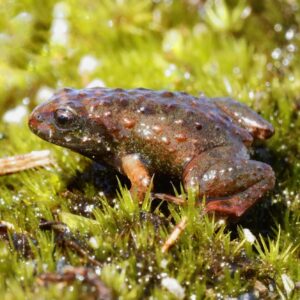
The Klein Swartberg Mountain towers above the town of Caledon in the Western Cape of South Africa amidst a field of agricultural development. This lone mountain is home to the only known populations of the Critically Endangered (IUCN Red List 2016) Rough Moss Frog, a minuscule amphibian species that requires moist mountain seeps to breed. These habitats are severely at risk from encroaching alien pine infestations threatening to dry out these crucial habitats.
The Endangered Wildlife Trust’s (EWT) Threatened Amphibian Programme (TAP) included the Rough Moss Frog as a species of conservation priority given its endemicity, high level of threat, and known population decline (IUCN Red List 2016).
During initial surveys conducted by EWT in May 2020, we observed a marching forest of alien vegetation engulfing the then only known population of Rough Moss Frogs. It became evident that rapid intervention, in the form of an ecological burn, was needed to save and secure this population. Unfortunately, the Covid-19 epidemic halted all efforts to implement any interventions in 2020. The Rapid Action Grant from the IUCN Save Our Species and the European Union awarded to this project in May 2021 will be used to create a firebreak around the Rough Moss Frog populations in the coming months. Thereafter, in early 2022, a controlled ecological fire will be used to manage the aliens. The subsequent clearing of pines will create job opportunities for local alien vegetation clearing teams from the Caledon community.
In July 2021, we held stakeholder engagement meetings and conducted a site visit with the EWT, Enviro Wildfire, the Fynbos Trust, the Klein Swartberg Conservancy, Overberg Agri, and Bionerds to establish the placement of the firebreaks on the Klein Swartberg Mountain. We made an exciting discovery of a new population of Rough Moss Frogs during the site visit, further emphasising the importance of this rapid intervention!
This project is funded by the IUCN Save Our Species and the European Union. The IUCN Save our Species aims to improve the long-term survival prospects of threatened species. It also focuses on supporting the species’ habitats and working with the communities sharing this habitat. It achieves success by funding and coordinating conservation projects across the globe. The Member States of the European Union have decided to combine their know-how, resources, and destinies. Together, they have built a zone of stability, democracy, and sustainable development whilst maintaining cultural diversity, tolerance, and individual freedoms. The European Union is committed to sharing its achievements and values with countries and peoples beyond its borders.
LATEST STORIES
AFRICAN CONFERENCE FOR LINEAR INFRASTRUCTURE AND ECOLOGY
Wendy Collinson, EWT Wildlife and Transport Programme Manager, wendyc@ewt.org.za
Lourens Leeuwner, EWT Wildlife and Energy Programme Manager, lourensl@ewt.org.za
Sarah Chiles – Landscape Infrastructure Advisor – Kenya, Ewaso Lions and Grevy’s Zebra Trust, chiles.sarah@gmail.com
Harriet-Davies Mostert, EWT Head of Conservation, harrietd@ewt.org.za
The second African Conference for Linear Infrastructure and Ecology (ACLIE), co-hosted by the Endangered Wildlife Trust (EWT), Grevy’s Zebra Trust (GZT), and Ewaso Lions (EL), took place between 12 and 17 August 2021. The first ACLIE conference was held in 2019 in the iconic Kruger National Park, South Africa, with 115 participants from 21 countries. ACLIE 2021 attracted almost 200 participants from 25 countries, 11 of which were African. We also had participants with diverse backgrounds from the engineering, ecology, policy, and finance sectors.
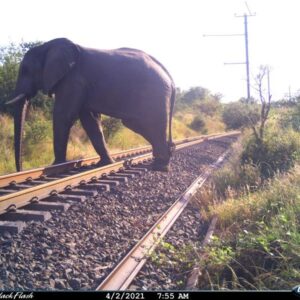
Linear infrastructure is essential for connecting society: our roads, railways, pipelines, and power lines link our cities, developments, resources, energy and water supplies. Therefore, it is perhaps ironic that linear infrastructure does exactly the opposite for natural systems – by crisscrossing landscapes, linear infrastructure serves to fragment ecosystems, isolate populations, and reduce natural flows. Roads, railways, fences, and power lines constrain animal movement, pose direct threats to species from collisions and indirect threats from increased human access to previously untapped resources, and new pathways for invasion by alien flora and fauna, with significant ecological consequences.
In many ways, Africa represents the final frontier for infrastructure development. The continent’s population has doubled in the last three decades and currently stands at 1.3 billion. Most experts agree that if it continues at its current rate, Africa’s population will double again by 2050. This means that about two-thirds of the world’s population growth is expected to take place on our continent, and by 2050 Africa will be home to more than a quarter of the world’s people. As populations and economies grow, they require greater investments in infrastructure. Over the next few decades, we will need significant investments in railways, roads, energy, and other infrastructure to meet the growing demands of emerging African economies.
ACLIE 2021 intends to foster and build on cross-sectoral African engagement and encourage the exchange of solutions around “Connecting for Resilience”. Considering the most pressing issues of our time – climate change, biodiversity loss, COVID-19, and the spectre of future pandemics – efforts to maintain ecological and human resilience are critical. The ability of ecosystems to maintain their functions and services is fundamental to sustainable development and human health.
This year’s conference was centred around four major sub-themes, one for each day. The first theme was centred around adapting to climate change, the second on innovating for mitigation and improvement, the third on planning for snowballing and cumulative impacts, and the fourth and final theme centred on applying economic tools and finance for reducing environmental impacts. After nearly a year and a half of the global pandemic, we’re all extremely familiar with online engagement, and this format has certainly enabled the participation of people from afar and allowed for constructive interaction among participants.
Each day, this conference kickstarted with an indaba, with a line-up of esteemed experts who shared their insights around the specific theme for the day. These were followed by the 20×20 sessions, where a series of presenters presented 20 images from a project they are involved in for 20 seconds. These included mitigation measures used in Cape Town to assist the Endangered Western Leopard Toad to cross the road, the use of a remotely piloted aircraft system (i.e. a drone) for marking power lines, and using bioacoustics methods to understand the linear movement of Endangered marine mammals. There were so many fantastic presentations about African issues that it is hard to select just a few to provide examples.
A new type of presentation for ACLIE was the Lion’s Den session, which provided a space where solutions were pitched to a panel of leaders, with opportunities for questions and input from the audience. Pitches included an intelligent green and grey infrastructure design system (iGGIDS), which obtained buy-in from the ‘Lions’, and the redesign of a roadkill reporting app.
Each of the first three days ended off with specialist training sessions delivered by leaders in their fields. This kind of training contributes strongly to the capacity building element of ACLIE and featured training on ‘Economic tools for informing linear infrastructure decision making’, energy system reliability through wildlife interaction mitigation’, and ‘design, construction and maintenance of wildlife crossing structures’.
Leonard Sielecki, Wildlife Program Manager from the British Columbia Ministry of Transportation and Infrastructure, said, “I am very impressed by the large South African and African representation. You have attracted a very impressive, very comprehensive range of wildlife protection-related people from the African Continent.”
Further to this, Kishaylin Chetty, Senior Environmental Advisor for Eskom, said, “The ACLIE conference is an exceptional event, that coordinates industry, civil society, government, and specialists to come together to discuss theory and feasibility surrounding linear infrastructure and its practice through Africa. The conference is a founding pillar towards responsible development in Africa.”
“ACLIE has been an extremely important convergence of knowledge, expertise, and practice from the linear infrastructure and ecology and conservation worlds. We have seen everything from demonstrations of laying overpasses to the importance of road verges and powerline diverters. Critically, we have also received commitments from major financiers of how they intend, and are, streamlining their policies to ensure that, as Africa builds new infrastructure, our landscapes will remain connected, and we will remain the drivers of the process. There are few things more hopeful”. Resson Kantai Duff, Deputy Director of Ewaso Lions
“Despite the challenges of holding a conference remotely, ACLIE 2020 was superbly organised and moderated. Participants were lively and active, and I got to meet and learn from a lot of globally experienced ecologists and industry professionals. I especially enjoyed listening to cutting edge innovations in modelling and data collection as well as successful Private-Public Partnerships that have informed infrastructure development. Can’t wait for the next conference!” David Kimiti, Deputy Director Research and Impact, Grevy’s Zebra Trust
We want to extend our thanks to AfricaMassive for logistical support of the event, Dr Rodney van der Ree and Dr Fraser Shilling for the donation of the prizes, and all the speakers and attendees, without whom this conference would not have been possible.
Finally, we’d like to announce that the next ACLIE will be held in Kenya in 2023.
LATEST STORIES
