Science Snippets: Wildlife Ranches – South Africa’s Conservation Powerhouses
Private Ranches: A Growing Conservation Force
Science Snippets: Wildlife Ranches highlights a remarkable conservation success story. Across South Africa, roughly 20 million hectares of private land are dedicated to wildlife ranching—areas where sustainable wildlife-based activities generate income while protecting biodiversity. A groundbreaking study co-authored by EWT scientists* surveyed 226 wildlife ranches, revealing their untapped potential for species conservation.
Rich Biodiversity on Private Lands
The research uncovered staggering biodiversity:
- 40 wild herbivore species recorded across ranches
- 15 species per ranch on average
- Key groups included antelopes, zebras, rhinos, and elephants
- Most properties hosted at least one threatened species
- Many held translocated species outside their natural ranges
Notably, these ranches often outperformed protected areas in species richness per hectare. Larger properties consistently supported more species.
Tourism vs. Hunting: A Conservation Comparison
The study revealed key differences:
- Trophy hunting ranches had high species diversity but fewer threatened animals
- Ecotourism-focused ranches protected more vulnerable species
- Hybrid models (tourism + hunting) showed the highest overall biodiversity
Millions of Herbivores Thriving
South Africa’s ranches now sustain an estimated 4.66–7.25 million wild herbivores—a rare global example of thriving indigenous mammal populations. This success has even improved Red List statuses, like the Cape Mountain Zebra, which rebounded from Vulnerable (1930s) to Least Concern today.
Challenges: Fences and Genetics
While beneficial, ranches face conservation hurdles:
- Fencing restricts natural migration, fragmenting landscapes
- Extralimital species risk hybridization (e.g., Bontebok × Blesbok)
- Over ⅔ of Bontebok populations now show hybrid traits
Conclusion: A Vital Conservation Tool
Despite challenges, Science Snippets: Wildlife Ranches confirms these lands are critical strongholds for indigenous herbivores, including threatened species. Their blend of economic viability and ecological impact offers a model for sustainable conservation worldwide.
Study Reference:
Taylor, W. A., et al. (2021). Biodiversity and Conservation, 1-25.

Insights From The CEO: A Year of Environmental Progress and Persistent Challenges
These Insights From The CEO, Yolan Friedmann, reflect on pivotal conservation developments as 2021 draws to a close. The past months have brought both encouraging victories and sobering realities in South Africa’s environmental landscape.
Conservation Triumphs
We celebrate critical wins:
- Constitutional Court victory blocking the Yzermyn coal mine in Mpumalanga’s Mabola Protected Environment
- $8.5 billion international investment pledged for South Africa’s clean energy transition
- Strategic Water Source protection for one of only 22 areas producing 50% of our freshwater
Urgent Climate Concerns
Despite progress, alarming developments persist:
- South Africa’s refusal to sign the global coal phase-out pledge
- Continued reliance on coal despite renewable energy potential
- Ongoing load-shedding crippling economic recovery
“Life-saving decisions shouldn’t rest solely with governments when outcomes affect us all,” notes Friedmann. “Our court victories prove civil society’s vital role in environmental justice.”
Hope for the Holiday Season
As tourism rebounds, we invite nature enthusiasts to experience:
- The world’s first dedicated Wild Dog holding facility (Waterberg)
- Rare endemic frog species (Western Cape/KZN)
- Carnivore conservation programmes (Lowveld)
- Raptor experiences with vulture experts
These eco-tourism opportunities directly support our conservation work while offering unforgettable encounters with South Africa’s unique wildlife.
A Call to Continued Action
The EWT remains committed to:
- Protecting critical ecosystems
- Advocating for sensible climate policies
- Delivering hands-on conservation programmes
“As we approach 2022, we thank our supporters for standing with us through these challenging times. Your partnership makes our work possible.” – Yolan Friedmann
Contact our CEO: yolanf@ewt.org.za
Focussing on sustainable land management in Victoria West
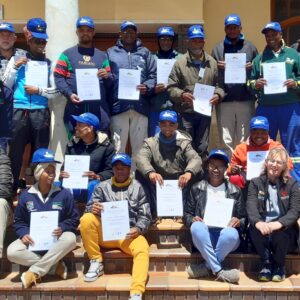
A group of emerging farmers from the Victoria West and Hutchinson area took part in an Integrated Farm Planning and Management training course held in Victoria West in October. The course was presented by the Endangered Wildlife Trust (EWT), in collaboration with the Department of Agriculture, Environmental Affairs, Land Reform and Rural Development and the Grootfontein Agricultural Institute. This was the third time the team has collaborated to present this course to farmers over the last two years: first in Loxton, then Prieska, and now in Victoria West.
The course aims to promote sustainable land management by building capacity amongst farmers, Agricultural Advisors and conservationists. It is vital that farmers are supported in their role as the custodians of the rich biodiversity found on South Africa’s farmlands. These areas fall outside formally protected areas but remain critical to ensuring the health and functioning of ecosystems across landscapes.mpleted the course. The coAltogether 12 farmers course focuses on a holistic approach to farm planning and the principles of sustainable land management. Considering the predicted impacts of climate variation, we must start changing how we are doing things to build environmental and community resilience to extreme climatic events, such as the current drought. Sedrick Visser, Agricultural Advisor (Northern Cape), took the lead in presenting this course. Visser is passionate about training farmers and has taken the lead in presenting the last two courses after he attended the first one held in Loxton as a participant. Sharing knowledge and having discussions around solution-based approaches will empower people to act positively and be the change that is needed. Courses like these enable farmers to improve their farming practices, protect natural resources and create sustainable futuresStaff from the EWT’s African Crane Conservation Programme joined the farmers on the course and underwent training to capacitate them to present the course to communities in KwaZulu-Natal early next year. The content of the course is currently being adapted to make it relevant to the grassland biome.
The training course is also available, for free, online at the www.karooforever.org.za website, created as a knowledge-sharing platform for sustainable land management. The content on the Karoo for Ever website was made possible by several specialists sharing knowledge in the form of webinars and written information. We thank them all for generously sharing their expertise and passion in the interest of promoting sustainable land management in the magnificent drylands of the Karoo.
The course was made possible with funding from the Global Environment Facility and managed by the United Nations Development Program in partnership with the Department of Environment, Forestry and Fisheries and Department of Agriculture, Land Reform and Rural Development and the National Lotteries.
For more information on the course contact:
Bonnie Schumann
Email: bonnies@ewt.org.za
Cell: 072 122 4232
or visit the website at karooforever.org.za
CONSERVATION CHAMPIONS OCTOBER 2021
Speed space
The EWT would like to thank Speedspace for the donation of beautiful cabins for our workspace. For over 45 years, Speedspace has specialised in providing long- or short-term affordable, practical, and efficient on-site space management solutions. These cabins have assisted the staff by providing them with safe, clean, and spacious workspaces, enabling them to continue EWT’s critical conservation work in comfort and style.
Forever Forest
Johan Pansegrouw and Stefan Delpoort visited our Conservation Campus in Midrand last week to plant five indigenous trees that they donated. These trees are the newest addition to our Forever Forest. Thank you Johan and Stefan for your generosity.You can be a conservation champion too! Have you linked your MySchool card to the EWT yet?LATEST STORIES
SAVING SPOTS AND STRIPES
Claire Patterson-Abrolat claire@ewt.org.za and Wendy Collinson-Jonker wendyc@ewt.org.za, Endangered Wildlife Trust infrastructure is a common feature wherever humans have settled. South Africa is rated as the 25th largest country in the world and ranked 18th in relation to the total road length (65,600 km paved, 689,000 km unpaved) and 74th in the total number of cars per 1,000 people. Roads are critical in providing access to primary health care, education, markets, and employment, ultimately improving livelihoods.
However, South Africa is the third most biologically diverse country in the world, and it is increasingly clear that roads and road users affect the functioning of ecosystems in which they occur. Direct collisions with wildlife have the most obvious impact, but the indirect disruption of ecological processes is equally important. Habitat loss, degradation, and population fragmentation, and disruption of the processes that maintain regional populations are just some of the ways roads can affect biodiversity.
Development is taking place rapidly, with new roads and housing developments mushrooming and trans-continental rail and road developments being expedited. In the past, such developments were planned without much thought to their impact on biodiversity, but the EWT has been working hard to improve road-user safety – that of both the occupants of vehicles and the wildlife living adjacent to or crossing our roads. We’ve been collecting data in a variety of ways, including the use of citizen scientists (data submissions from the general public), planned surveys and, importantly, using the road patrollers that drive our highways daily to deal with any hazard they come across, including the removal of dead animals from the road.
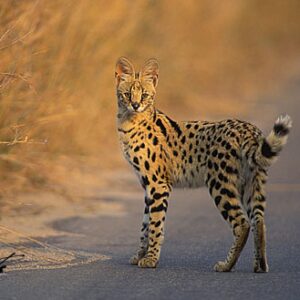
The EWT analyses roadkill data regularly, and one of the species that has caught our attention is the Serval. This mostly solitary, nocturnal species was considered extinct, or near-extinct, in the latter half of the 20th century, largely due to the mistaken belief that it caused damage to agricultural crops and compounded by competition from other carnivores such as jackal. Reintroductions and range expansions have led this species to recover to an estimated adult population of somewhere between 4,509 and 13,654 individuals, but the population is again considered to be declining due to a loss of its wetland habitat.
Serval (Leptailurus serval)
Servals are predominantly solitary except when mating or before young would leave their mothers at around eight months old. Like Leopards, the young females form territories adjacent to that of their mother, with males having larger territories that overlap that of several females.
The N3 Toll Concession, which manages the 412 km stretch of road from Heidelburg (Gauteng) to Cedara (KwaZulu-Natal), has been extremely supportive of our efforts to mitigate roadkill along the Toll Route and is concerned about the safety of both the road users and the wildlife living alongside the road.
In addition to our usual reports to the N3 Toll Concession, the EWT has been looking into why the Serval is one of the most common species reported (Figure 2) and why their roadkill numbers show an upward trend.We plotted the location of the roadkill along the N3 and noted that although roadkills were spread along the length of the road, there was a cluster along the northern parts of the route. This area is predominantly highveld sourveld and is either farmed for cattle or game or planted with mieliesWe also looked at the proximity of water to the road. Servals are wetland specialists, which are likely to be clustered close to water bodies. Water is spread fairly evenly across the landscape, and where perennial rivers are not available, farmers have created artificial water points for livestock and/or game. The diet of Servals consists mainly of Vlei Rats, so the abundance of water along the N3 does create the ideal habitat for them.
Our work is still in its infancy, and we plan to keep investigating the drivers of roadkill for this species by investigating the following:
- Whether Serval prefer artificial or natural water bodies;
- The abundance of prey species;
- Whether or not Serval use underpasses (tunnels and culverts) to cross the road; and
- If the Serval being killed on the road are young dispersing males or breeding adults, and the impact of this on the local and broader population.
Thank you to the N3 Toll Concession for their ongoing support of our work and Ford Wildlife Foundation for keeping us on the road.
