Cameron Cormac, PhD Candidate with the EWT’s Wildlife and Transport Programme, ctcormac@gmail.com
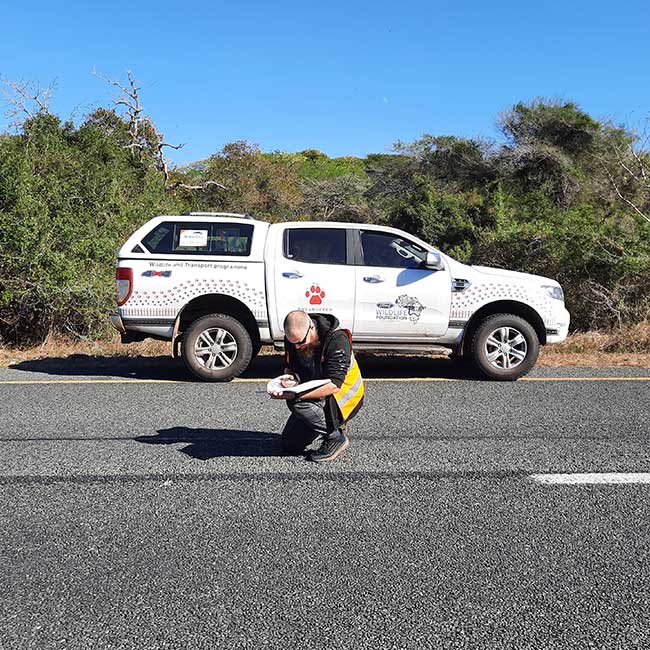
I am Cameron Cormac, a PhD candidate in my second year of study at the University of KwaZulu-Natal – on my way to a career in conservation. I work with the EWT’s Wildlife and Transport Programme and Ezemvelo KZN Wildlife, researching the effects of linear infrastructure on vertebrates in Hluhluwe-Imfolozi Park and northern Zululand.
A typical day for me depends on which of the two study sites I am stationed at when I’m not back in Pietermaritzburg doing data analysis, lab work, or writing up my thesis chapters. When in Hluhluwe-Imfolozi Park, I focus on the R618, which bisects the park. My day begins an hour and a half before sunrise in the research camp near Hilltop resort, typically in pitch darkness surrounded by nothing but the sound of nocturnal insects and a light breeze blowing through the trees. A banana and a low-sugar or sugar-free energy drink help me wake up and give me some quick sustenance before I head out for an hour’s drive at 40 km/h through empty park roads. I pass through the gates of Nqumneni ranger camp before taking air and road surface temperature readings at one of three control points.
My morning survey starts after taking the temperatures at the control point on the Hlabisa side of the survey area. I spend two hours driving at 40 km/h looking for carcasses of animals killed along the 18 km survey area. A typical session sees me both trying to find carcasses for my data collection and not wanting to find too many dead animals. I usually find between three and seven carcasses. However, there are times when I don’t find any carcasses and others when there are more than 20. But every day, we are greeted by the fantastic sunrises of Zululand’s Lebombo mountains and often encounter elephants strolling down the road.
Morning sessions end with another hour’s drive back to base camp or a two-hour drive to Hluhluwe town while passing through South Africa’s oldest protected area. We’ll get several sightings of some of South Africa’s iconic animals if we’re lucky.
The rest of my days are spent doing data entry, reading linear infrastructure articles, handling project admin, preparing for nocturnal sessions, and preparing food. Meals usually consist of a light breakfast, yoghurt bowls or eggs and avocado on toast, some form of sandwich at midday and a hearty meal for dinner.
Juvenile Southern African python (Python natalensis) found crossing dirt road near Nqumeni ranger camp
My days end with a nocturnal session, typically after dinner, depending on the time of sunset, which is a rinse and repeat of the morning survey. The only difference is that nocturnal sessions provide exquisite visuals of the setting sun. Nocturnal surveys also usually give us a few very welcome, very much alive herpetofauna (amphibians and reptiles) trying to cross the road. I am a herpetologist, so this gives me great joy. These records fall into another of my data chapters aimed at identifying reptile species likely to cross my survey roads successfully. My favourite kind of bedtime story!
I sincerely thank my sponsor, the Ford Wildlife Foundation, who supplies the vehicle I use to conduct my surveys. Without their generous donation, this project would not be possible.
The world’s road networks are highly disturbed and fragmented areas that negatively affect many animals. Wildlife-vehicle collisions are one of the more visible effects of road, estimated to be the second-largest cause of human-related deaths in animals. One of the by-products of the Covid-19 pandemic was much lower levels of human activity related to lockdowns enforced in many countries to reduce the spread of the disease. This decrease in human activity has been named the “anthropause”, which was at its peak in April 2020. With the anthropause came a large decrease in vehicle traffic. The impact of the anthropause, particularly of decreased traffic, on species, was examined in a recent publication co-authored by EWT scientists*. With worldwide travel restrictions in full effect from April 2020, vehicle use dropped by over 50% in many countries. During this same period, scientists found a significant drop in wildlife-vehicle collisions, with as much as a 48% reduction recorded in some countries. The absence of traffic also likely brought about behavioural changes in wildlife and could have had various other ecological effects not yet documented. Some possible changes include animals being able to move more freely between fragmented landscape patches, increases in survival and population sizes, and less spreading of invasive species along roads (see figure below, from Perkins et al. 2022, which illustrates some of the possible impacts of a reduction in traffic).
Traffic noise was another aspect reviewed in this study. Researchers found that animals were less fearful with reduced traffic noise over the lockdown period. Furthermore, they noted that there were localised changes in animal distributions. For example, large animals were spotted moving through urban areas. The lowered volume of traffic noise also resulted in some birds changing their tune. For example, urban birds have been observed to alter the frequency of their song as they no longer had to compete with traffic noise. While lockdowns provided temporary relief, allowing wildlife to thrive again, human activity is recovering to pre-pandemic levels. This brief pause has allowed us to gain new insights into the impact of traffic on wildlife. The return of traffic highlights the need to have proper surveillance measures in place to help document, explain, and reduce the effects of roads on wildlife and critically evaluate the impacts of this widespread human activity on wildlife. *Perkins, S. E., Shilling, F., & Collinson, W. (2022). Anthropause opportunities: Experimental perturbation of road traffic and the potential effects on wildlife. Frontiers in Ecology and Evolution, 192.**The EWT has a road watch app for you to record any roadkill sightings, helping us to identify hotspot areas and the species most at risk. Search for Road Watch on the Google Play Store to download the app!
The world has many challenges facing it right now, and life is not easy for almost anyone anywhere. No matter how diverse the problems are, they are all characterised by a single factor: a deepening and widening lack of ethical, honest leadership. From the Ukraine – Russian war; to corruption and the collapse of South African SOEs; the lack of service delivery; human-induced climate change; the poor management of the COVID pandemic, and the shocking decisions in the USA to reduce a woman’s right to govern her own body whilst at the same time reducing the limits on carrying handguns in public in New York, leading to “a significant increase in handgun license applications” (Observer, 6/27/22)…. The list is endless. One can hardly think of a political or institutional leader with the faith and trust of their people right now as communities increasingly lose hope that their futures are safeguarded by those they elected to protect them.
How did we find ourselves in a global crisis of the decline in the legitimacy and credibility of leadership almost everywhere? In nature, leadership is earned, after hard and often damaging battles are won, where one’s right to lead is earned by a show of strength, tactical brilliance, commitment and courage. All of which only has meaning because it demonstrates one’s ability to protect, safeguard and ensure future life in the herd/pack /flock you will lead. And leadership is temporary. For once you fail, once you are weak, once you cannot defend, protect, feed, lead or secure the future of your followers, you are out. You do not retain your position through a rigged election or well-funded campaigns, and you cannot continue in a position of power if the future of your followers and the survival of your species is at risk by your actions. Selfishness is not rewarded, and personal gain is punished in a world where leadership is a great responsibility awarded to only the finest and for only that time in which they can prove their worth to the larger group. Every single day.
So how does the most intelligent species of them all find itself in a position where our leaders may well be our downfall and the biggest risk to the future of humanity? Of all the distinctions between humans and the rest of the creatures on this planet, this is the one that puzzles me the most. It is as if we have lost our ability to understand the most basic of all things required from our leaders and to choose them based on millennia-old criteria that really only focus on the survival of the species as the prevailing goal of all leadership.
In nature, leadership is determined entirely by the willingness of followers to be led by that individual. And what makes other animals fall into line and follow their leader? They will follow a leader they can trust to keep them safe, fed and protected; a leader that has their back at all times, a leader that acts with the best interest of the whole; and can demonstrate on a daily basis their ability to sustain the future of their species. This may require tactics like nurturing relationships, creating alignments, choosing allies, fending off enemies, following ancient traditions and demonstrating power through elaborate rituals or combats. And winning the position of leadership will most often then mean less sleep, more courage, a willingness to fight and often. Facing risk, enduring injuries, and often being quite alone.
It seems to me that human beings are doing it quite wrong when it comes to the most fundamental survival tactics of all times: that of choosing our leaders. And the proof lies in where we find ourselves as a species, with all our hardships and difficulties, all of which are entirely manmade. How did the most developed, intelligent species on earth get this one survival tactic so wrong? It is time to revert back to the hardwired expectations of leadership that are engrained in our DNA and to choose a new generation of leaders to demonstrate the kind of behaviours that will sustain our species. At the end of the day we really are just that: another species on this planet. And one which seems to have lost the instinct for survival that is so strong in the wildlife that surrounds us. It’s time to look around and learn.
Hi, I am Delta, a six-month-old brown and white Border collie. My parents work with sheep on a farm in the Eastern Cape, so I have good working genes. I recently moved to the Nama-Karoo to train as a scent detection dog with the EWT’s Drylands Conservation Programme. I hope my nose and enthusiasm will help the EWT with their conservation research projects. My first job is to find Riverine Rabbit scat, so I have started my training on the scent. However, I am still a little bit young to start working full-time, so my human (Esther Matthew) has made it her goal to expose me to as many things as possible. These include places, people and other animals! She recently took me to the EWT head office in Johannesburg. What a great experience! After around 12 hours in the car (not my favourite part), I got to play with some of the other EWT working dogs, which was fantastic. My new buddy, Mufassa, is also a Conservation Canine Cadet in training! I also got to meet loads of new people, saw my first rabbits and chickens, and see all the new sights and smell all the different smells. It was also interesting to live in a different house for a week. I’m already looking forward to my next adventure…
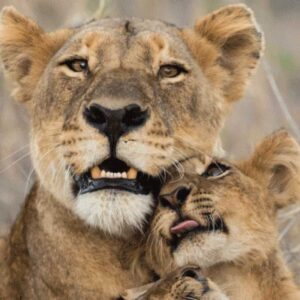
Melissa Jacobs and Sune Alexander are passionate about the plight of our wild lions and are running the Comrades Marathon to raise money for lions by supporting our lion project in the Greater Limpopo Transfrontier Park (GLTFCA).
The Endangered Wildlife Trust, SANParks, the National Administration of Conservation Areas in Mozambique, the Mozambique Wildlife Alliance, and Peace Parks Foundation have embarked on an ambitious partnership to understand and protect the GLTFCA’s population of Africa’s most iconic species. A vital project component involves monitoring lion prides across the GLTFCA using GPS satellite collars. The information provided by the collars helps anti-poaching teams to produce priority maps that show habitat, landscape features, and other resources used regularly by lions. Teams can then focus their protection efforts in high-risk areas rather than trying to secure large swathes of ‘potential’ lion habitat. Poachers sometimes use similar information to target lions more effectively, and we want to be a step ahead of them. The collars will also be used to check on the lions more frequently to identify missing individuals and track their movements to identify potential poaching activities.
The EWT will use the funds raised by Sune and Melissa to collar lions and implement relevant anti-poaching activities.
Satellite VHF Lion collars: R50,000 each
Lion monitoring for one month: R50,000
Vehicle payment and maintenance for 24 months: R250,000
100 Camera traps: R250,000
Help us do more for our wild lions – the Pride of Africa!
To find out more and support Sune and Melissa, follow this link.