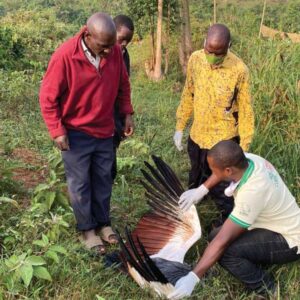
Addressing the impacts of power lines on Grey Crowned Cranes in Lwengo
Gilbert Tayebwa (Southcentral Uganda field officer and Sarah Kugonza (Conservation Intern)
Introduction
Any bird able to fly stands a chance of colliding with above-ground power lines and being killed or electrocuted when perching or nesting on electricity structures and cables. In Lwengo and possibly other regions of Uganda, power lines pose the greatest threat to the Endangered Grey Crowned Crane’s survival. Migrating birds at night, birds flying in groups, and fast-flying and large birds like storks and raptors are particularly vulnerable to power line collisions. Electrocution from power lines has also been reported.
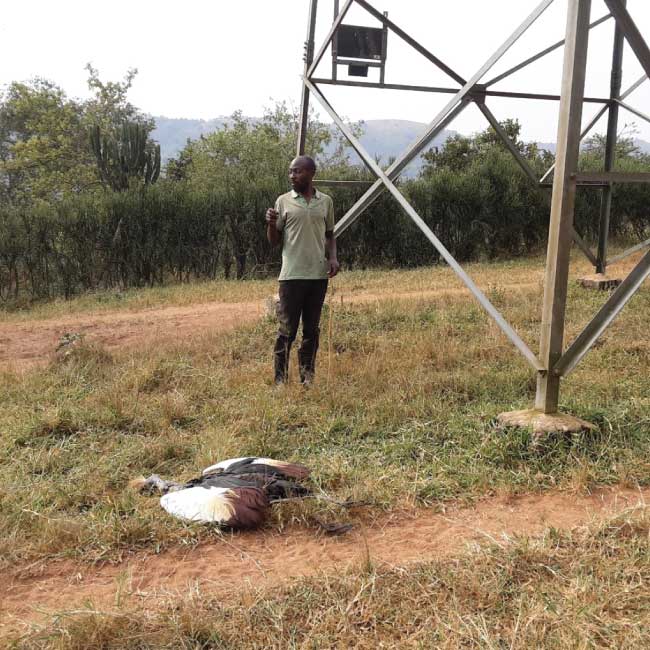
Grey Crowned Crane mortality beneath a power line in Lwengo, Uganda
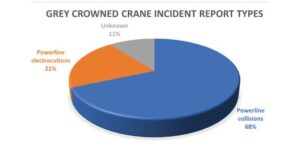 The percentage contribution of incidents by various electricity power line categories. The International Crane Foundation (ICF) and Endangered Wildlife Trust (EWT) Partnership’s African Crane Conservation Programme aims to find and implement preventative solutions to lessen the damage power lines have on cranes, other birds, and their surrounding ecosystems. In Lwengo, more than 21 cranes have died after flying into and perching on power wires over one year. Grey Crowned Cranes are the only crane species affected by electrocution because it is the only crane that perches and roosts in trees and on power line infrastructure. Some of these cranes are electrocuted or shocked, and as a result of the accident, they perish. To better understand the impacts of human-caused mortality on cranes in south-central Uganda, we are implementing a project to understand how power lines and associated infrastructure affects biodiversity in Lwengo. We are using various methods, including:
- Mapping the distribution pattern of Grey Crowned Crane incidents caused by power line infrastructure (key emphasis and activities have been on mapping incidents and identifying incident hotspots)
- Establishing transects for routine monitoring
- Empowering key stakeholders (especially Crane Custodians, wetland management committees, and local government leaders to identify, handle, and ethically address crane-power line incidents.
Capacity Building
Crane Custodians are local community members who voluntarily care for cranes and their wetland habitats. Currently, the ACCP in southcentral Uganda has 15 custodians in Lwengo (eight females and seven males) and 15 in Rukiga who have been vetted for engagement in power line surveys. The selection was based on gender inclusiveness.
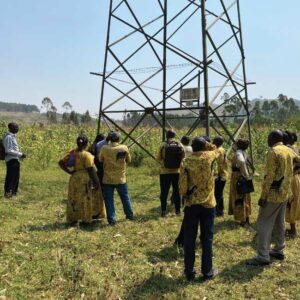
The custodians being taught how to collect data during power line surveys.
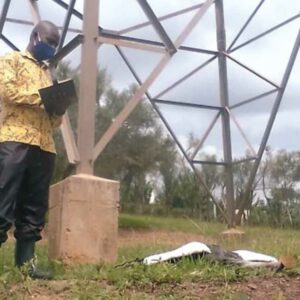
A crane custodian, after identifying an incident and recording it
Community engagement
Meetings and hands-on-field works are being held with other stakeholders, such as the communities that live in crane power line incident hotspots, to identify incidents, disseminate information on the presence of power line threats to cranes and other birds surveying critical hotspots for power line collisions. The project team has trained the groups on various aspects, such as:
- The different ways to handle power line incident mortalities
- How to report power line mortalities (currently, the project team, crane custodians, and nearby authorities are responsible for responding)
- Power line incident identification (differentiating between a power line collision and electrocution and elaborating on the cause of the incident)
- Adherence to safety guidelines when monitoring and handling power line-related mortalities.
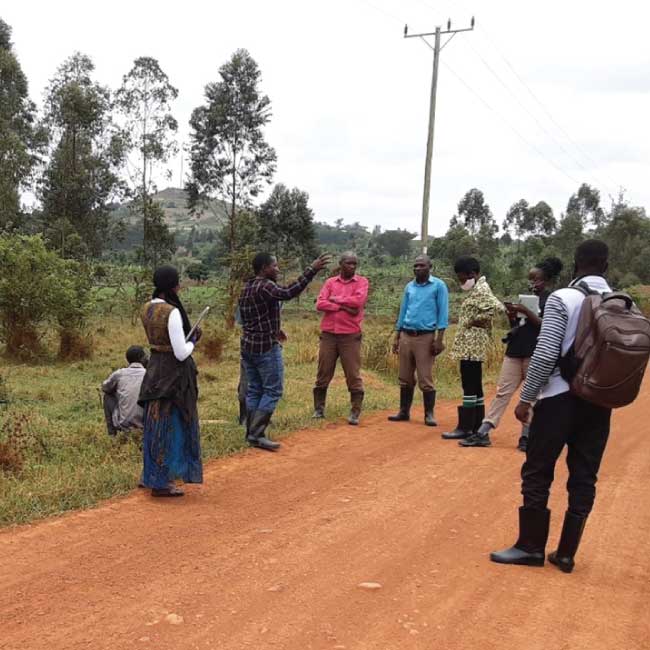
Community members during a field-based powerline survey in Lwengo
Most of the communities engaged are helping to disseminate information to other local communities on how and when to report power line incidents. The trainees can now spread information about the possibility of zoonotic diseases spreading to people who handle dead wildlife, such as cranes below power lines, and mobilise community members to report power line-related incidents involving cranes.
Capacity building within the project team
In June 2022, the Uganda team received one week of skills-building and enhancement sessions (in-house and field-based training). The team engaged in planning and developing powerline incidents data collection protocols and the setup of scientifically robust methods in crane mortality incidents data collection, including developing a risk assessment tool.
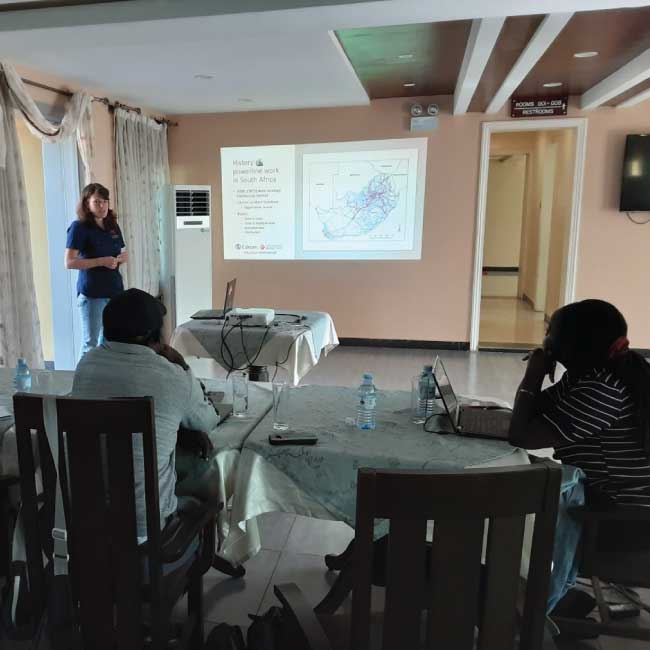
The EWT’s Christie Craig from South Africa training the Uganda team in Power lines
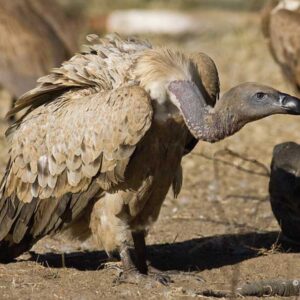
A conservation success story – the return of the majestic Cape Vulture
Lindy Thompson and Danielle du Toit, the EWT Birds of Prey Programme
Cape Vultures (Gyps coprotheres) are endemic to southern Africa. They are one of South Africa’s larger vulture species, weighing up to 11 kg. They forage in open vegetation types such as Fynbos, Kalahari, Karoo, grassland, and open woodland. Breeding pairs are monogamous and usually raise one chick.
The majestic Cape Vulture was listed as Endangered on the IUCN’s Red List of Threatened Species, but in 2021 it was ‘down listed’ to Vulnerable. This is a remarkable conservation success story and testament to the tireless efforts of multiple generations of conservationists in southern Africa. Removing the Cape Vulture from the list of Endangered species in 2021 received very little media attention, despite being an important case study that can provide hope and inspiration to current and future conservationists. This achievement resulted from a concerted effort by various organisations, including the Endangered Wildlife Trust (EWT), BirdLife South Africa, and wildlife rehabilitation centres such as Moholoholo, VulPro, and others. A team of 31 contributors, which included the EWT’s Samantha Page-Nicholson) supplied information and justified why this species should (or should not) stay classed as ‘Endangered’. Threats to the species include unsafe wind energy developments, poisoning events, unsafe power lines, and food availability may play a large role in the successful breeding and population trends of this species. Current conservation actions for the Cape Vulture include systematic monitoring, education and awareness programmes, protection by national and international legislation, the expansion of formally protected areas (such as the Soutpansberg), and the creation and growth of Vulture Safe Zones.
The importance of Vulture Safe Zones in Cape Vulture conservation
In India in the 1990s, vulture populations suffered drastic declines. Scientists were baffled as to why until the study of carcasses revealed the presence of the veterinary non-steroidal anti-inflammatory drug, Diclofenac. They concluded that this drug was the root cause of the mass fatality and had cost about 90% of the vulture population in the area in the space of a decade. This became known as “The Indian Vulture Crisis.” The disappearance of Vultures led to the ecological tipping of scales. Mammalian scavengers such as jackals and feral dogs took advantage of the increased food supplies, and their populations increased. The high number of mammals on carcasses inadvertently led to an increase in the spread of pathogens. India faced, and still faces, a rabies epidemic that costs 30,000 human lives per year and billions of dollars in health fees.
The urgent need for action to stop the rapid decline of vulture species in Eurasia and Africa led to the development of the Multi-Species Action Plan to Conserve African-Eurasian Vultures (commonly referred to as the Vulture MsAP). It is a comprehensive and strategic plan which covers ranges across two continents. Vulture Safe Zones are an activity recognised in the Vulture MsAP to encourage the responsible management of the environment by actively reducing threats to vultures in identified areas. They are specified geographic areas where conservationists and landowners use targeted conservation measures adapted for the vulture species present. These measures include safeguarding electrical infrastructure to minimise collisions and electrocutions, reducing the use of poisons, covering or altering reservoirs to prevent vulture drownings, and using NSAIDs responsibly. The most important thing to remember is the responsible management of resources that vultures use, such as the availability of safe perches, water for drinking and bathing, and food. Vulture Safe Zones also promote responsible disposal of carcasses on which vultures scavenge to reduce poisoning through pesticides and lead fragments that remain in a carcass after an animal is shot.
The Karoo Vulture Safe Zone
Landowners in the karoo region of South Africa established the Karoo Vulture Safe Zone (KVSZ) to increase the area’s Cape Vulture populations that have been decimated by persecution resulting from misinformation and a general misunderstanding of their role in the ecosystem. Landowners in the mid-20th century believed that it was vultures killing their small livestock when they would find the birds feeding on them during the day. Unbeknownst to them at the time, the jackal population in the area was beginning to take advantage of the easy prey and kill them during the night. Now, the landowners in the area are admirably working to fix these past mistakes. In August 2020, the first landowner signed up to proclaim his property a Vulture Safe Zone. Since then, the KVSZ has grown to 730,000 hectares owned by 94 landowners committed to making their properties Vulture Safe. The project continues to encourage the responsible management of properties across the karoo landscape through landowner engagements and environmental education, which focus on sustainable and safe practices of managing predators and water resources and the safe disposal of carcasses. The KVSZ team also works through the strategic partnership between the EWT and Eskom to make problem powerlines safe for vultures.
Cape Vulture sightings within the project area are reported to the KVSZ team, and it is exciting to receive reports of up to 70 birds roosting on cliffs that were previously void of these magnificent birds. Monitoring efforts by the team to better understand the populations traversing the Eastern Cape skies have shown an increase in breeding pairs in known sites and the possible development of new breeding sites. All of these give the team more motivation to make the Karoo and the larger Eastern Cape a safe space for Cape Vultures.
The Vulture Safe Zone process is long, and it will take time until the area is completely vulture safe. In the interim, we continue to encourage vulture safe management and measures and spread awareness of the need for areas like this.
You can help raise important funds for Cape Vulture conservation by supporting the Rhino Peak Challenge ambassadors, who aim to complete a 21 km course to ascend the famous Rhino Peak in the Maloti Drakensberg World Heritage Site. The Rhino Peak Challenge raises awareness and funds, for Wildlife ACT, the EWT, and Ezimvelo KZN Wildlife (EKZN), for projects focused on vultures, rhinos and cranes. The EWT’s Cath Vise will participate in the Rhino Peak Challenge this year. Cath manages the Protected Area Programme in the Soutpansberg, where there is a colony of nesting Cape Vultures. Please consider supporting Cath and the other Rhino Peak Challenge ambassadors by clicking this link:
https://rhinopeakchallenge.co.za/participants.aspx?participant=576715fb-a8b2-431e-807a-909ea6c39db4
References:
Benson, P.C. and McClure, C.J. (2019). The decline and rise of the Kransberg Cape Vulture colony over 35 years has implications for composite population indices and survey frequency. Ibis 162: 863-872. https://doi.org/10.1111/ibi.12782
BirdLife International (2021). Gyps coprotheres. The IUCN Red List of Threatened Species 2021: e.T22695225A197073171. https://dx.doi.org/10.2305/IUCN.UK.2021-3.RLTS.T22695225A197073171.en accessed on 25 August 2022.
Howard, A., Hirschauer, M., Monadjem, A., Forbes, N. and Wolter, K. (2020). Injuries, mortality rates, and release rates of endangered vultures admitted to a rehabilitation centre in South Africa. Journal of Wildlife Rehabilitation 40: 15-23.
Mbali Mashele, N., Thompson, L.J. and Downs, C.T. (2022). Trends in the admission of raptors to the Moholoholo Wildlife Rehabilitation Centre, Limpopo province, South Africa. African Zoology 57: 56-63. https://doi.org/10.1080/15627020.2021.2016073
Thompson, L.J. and Blackmore, A.C. (2020). A brief review of the legal protection of vultures in South Africa. Ostrich 91: 1-12. https://doi.org/10.2989/00306525.2019.1674938
Poisoning Risk to Vultures: A West African Crisis with Continental Implications
The poisoning risk to vultures has reached catastrophic levels in West Africa, where 89% of recorded vulture deaths result from deliberate poisoning. Dr Clément Daboné’s groundbreaking research in Burkina Faso reveals this alarming trend, with 779 of 879 documented vulture fatalities attributed to poisoned baits – particularly near national borders, suggesting transnational trafficking of vulture parts for traditional medicine.
Key Findings from Burkina Faso
- 730 interviews with butchers, veterinarians and abattoir staff
- Poisoning accounts for 89% of vulture deaths
- Border areas highest risk – indicating cross-border trade
- Secondary poisoning kills hundreds per incident
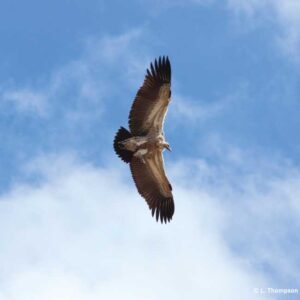
A Critically Endangered White-backed Vulture, Gyps africanus, photographed in South Africa’s Limpopo Province © L. Thompson.
Poisoning Risk to Vultures: Southern African Parallels
The crisis mirrors threats in the Great Limpopo Transfrontier Conservation Area, where the EWT’s Birds of Prey Programme is taking action:
- Drafting South Africa’s Vulture Biodiversity Monitoring Plan
- Training rangers in Wildlife Poisoning Response
- Teaching crime scene preservation and carcass sampling
- Developing protocols to save surviving birds
“Each poisoning event can wipe out entire vulture colonies,” explains Dr Lindy Thompson. “We’re racing to build capacity before it’s too late.”
Urgent Conservation Measures Needed
-
Community awareness campaigns on poisoning impacts
-
Stronger legislation against vulture part trade
-
Cross-border cooperation to combat trafficking
-
Alternative livelihoods for traditional healers
With African vulture populations declining by up to 90% for some species, addressing the poisoning risk to vultures is critical to preventing ecological collapse across the continent.
A Critically Endangered subadult Hooded Vulture, which was poisoned, along with 64 other birds of prey, in South Africa’s Limpopo Province in 2015. © L. Thompson.
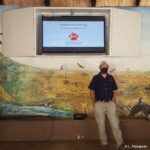
John Davies from the EWT’s Birds of Prey Programme talking about wildlife poisoning at Moholoholo Wildlife Rehabilitation Centre in South Africa’s Limpopo Province in 2020. © L. Thompson.
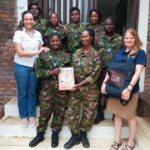
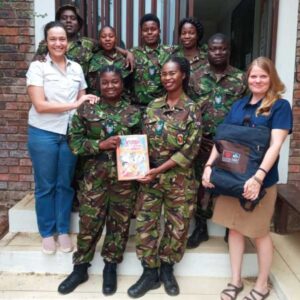
Dr Lindy Thompson (right), from the EWT’s Birds of Prey Programme, presented Wildlife Poisoning Response Training for the Black Mambas, an all-female anti-poaching force, in South Africa’s Limpopo Province.
The study was titled ‘Trade in vulture parts in West Africa: Burkina Faso may be one of the main sources of vulture carcasses’, and you can access it here: https://doi.org/10.1017/S095927092100054X
References:
Daboné, C., Ouéda, A., Thompson, L.J., Adjakpa, J.B. & Weesie, P.D.M. (2022) Trade in vulture parts in West Africa: Burkina Faso may be one of the main sources of vulture carcasses. Bird Conservation International. https://doi.org/10.1017/S095927092100054X
Gore, M.L., Hübshle, A., Botha, A.J., Coverdale, B.M., Garbett, R., Harrell, R.M., Krueger, S., Mullinax, J.M., Olson, L.J., Ottinger, M.A., Smit-Robinson, H., Shaffer, L.J., Thompson, L.J., van den Heever L. & Bowerman, W. (2020) A conservation criminology-based desk assessment of vulture poisoning in the Great Limpopo Transfrontier Conservation Area. Global Ecology and Conservation 23:e01076. https://doi.org/10.1016/j.gecco.2020.e01076
Dr Lindy Thompson, the EWT’s Birds of Prey Programme

Careers in Conservation – Bringing conservation to life through storytelling
Kedibone Chauchau, the EWT’s Communications and Marketing Department
My name is Kedibone Jacqueline Chauchau. I am the last of five kids, born and bred in the West of Johannesburg. My mom owned an Early Childhood Development Centre that she operated from our garage at home. My dad started as an educator in rural Limpopo, about 5 km from the Kruger National Park’s Punda Maria gate and later became a truck driver at Spoornet (now known as Transet). They are both retired now and living in Malamulele, Saselamani.
I grew up in a bilingual household with a Pedi mom and a Tsonga dad. We have conversations in both languages, sometimes using them in a single sentence. Outside my household was a community speaking Tswana, Sotho, Zulu, Xhosa, and Venda, and I absorbed all of them, developing a passion for languages and now fluent in seven.
However, while I can speak in many tongues, I was a very quiet child in school, adopted by a group of extroverts, and surrounded by loud, outgoing friends who love the spotlight – I still am.
I first realised that I was terrible with numbers in high school, so when I finished my matric, I explored career paths aligned with my strengths and passion for writing and creativity. It took a while. I studied graphic design for a year at Damelin, then transferred to the Vaal University of Technology the following year. Though it was a good fit, it didn’t feel quite right. So, I took a gap year and applied for the BA (Media Studies) Degree at the University of Limpopo.
I started my career at an ad agency three months after completing my qualification. Having majored in several things, I had the opportunity to explore and enhance my skills without limitations before becoming a conservationist, which I hadn’t dreamed was even possible with my qualifications. But a while later, I stumbled upon a job advert for a communications position with the Endangered Wildlife Trust (EWT). I applied because I want my work (and life) to make a difference by effectively communicating the important conservation work of the EWT. None of the work conservationists do matters if it remains within their circles. I want to use my curiosity and the will to make sense of everything to tell complex conservation stories and show what people are doing to conserve our planet.
Conservation storytelling is most powerful when combining words and powerful visuals of our remarkable wildlife and ecosystems. I hope to build on my communication knowledge and experience by mastering the art of visual storytelling for conservation. Studies have shown that our brains retain and transmit much more information — and process it more quickly — when delivered visually. The human brain processes visuals 60,000 times faster than text. Visuals are important because people remember only 20% of what they read and 10% of what they hear. However, people remember about 80% of what they see and do. It’s one thing to tell people why Wild Dogs are also known as Painted Wolves and another to show them the vivid coat of a Wild Dog.
Another reason visual storytelling is important is that it breaks down complex ideas. Seeing something instead of reading about it enables the audience to connect to or relate to that thing or person on a deeper level and become invested in it. Visual storytelling conveys emotions and realities more effectively and inspires people to support and participate in conservation initiatives.
Too often, we work to benefit ourselves and show little interest in working to ensure the future of the planet and others. I urge the youth to explore a fulfilling career avenue that will secure our collective future.
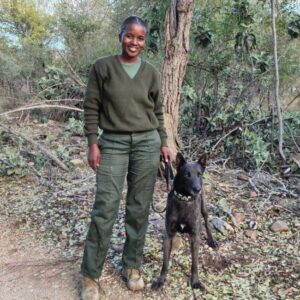
Hot on the heels of strong women working in conservation
Precious Malapane, Conservation K9 handler and anti-poaching ranger
The South African government’s theme in celebration of Women’s Day/month 2022 is “Women’s Socio-Economic Rights and Empowerment: Building Back Better for Women’s Improved Resilience”. The theme focused on strategically advancing women’s socio-economic empowerment agenda towards achieving gender equality by 2030.
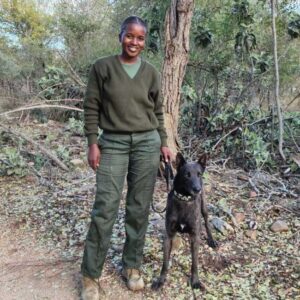
Precious and EWT Conservation K9 Ruger
The resilience of South African women has been recognised throughout our country’s history but assigned social and professional roles have often hindered women from raising their social and economic status. I am one of many women who have not let anything stand in their way. My name is Precious and I am a Conservation K9 Handler working with Ruger and Bekha, the Endangered Wildlife Trust’s Conservation K9s and strong females themselves. I am the only woman in a team of 12 rangers. I am also the only Dog Handler in the team. You might be wondering how I ended up here. This is my tale.
I grew up in a remote village off the north-eastern border of the Kruger National Park border. I was a very quiet and rather shy child. I came out of my shell when I joined a girl’s traditional dancing group at age ten, where I learned to be confident and comfortable in my skin. Attending practice every day and dancing in front of people helped me build my confidence.
I sadly lost my mother when I was just two years shy of matriculating. She was our only parent, and when we lost her, my three siblings and I started doing odd jobs around the village to survive. However, we did not let our situation get in the way of our education. I matriculated in 2014 and enrolled in the Southern African Wildlife College, where I trained as a field ranger. I was lucky enough to get an internship in the college’s K9 unit. I started working with Conservation K9s under the guidance of renowned Dog Master – Johan van Straaten, from whom I learned much. I know everything I know today because of his teachings.
My love for dogs began at a very young age when my family got one as a pet. I knew then how great dogs are. I didn’t know that they could do so much!
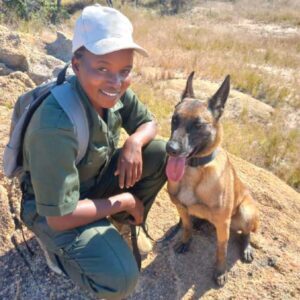
Precious with EWT Conservation K9 Bekah
I love working with dogs because they are always eager to go out and work. With them, there is no politics, social roles, or discrimination. I am just their beloved handler and trainer. I also love how they are not biased or easily swayed by external forces. Their job is to help their handler find what they are looking for, and they will not stop until they find it. And when they do, they will not leave it until the handler arrives. They have taught me to be honest and dedicated in my work.
Although I am mostly surrounded by men in my line of work, I have been fortunate to know and learn from strong women who have shaped my life and career. They have empowered me and improved my resilience both socially and economically. These are some of them:
My mother: That woman is my hero, my pillar and strength, even now in her absence. She played a huge role and did a great job as a single parent. I really love how she raised me and my siblings. I am where I am today because of her.
Theresa Sowry: The CEO of the Southern African Wildlife College. I love how involved she is on every level. You can tell she is passionate about conservation from her interaction with all students and the team at the college.
Shadi Henrico: Shadi is the Conservation Canine Project Coordinator at the Endangered Wildlife Trust. She assisted me in qualifying as a Dog Handler and trained Ruger – the dog I work with at the reserve. She also shared with me this great life I get to live now because of her willingness to help me whenever I reach out to her.
Anitjie Mkhansi: She is also a Conservation Canine handler at another private reserve. I always go to her when I face work-related challenges, and she is always keen to sit down with me and come up with solutions. Navigating work and inspiring each other as young women of the same age and in the same field makes everything easier.
Having come across all these amazing women, and in celebration of women’s month in South Africa, I encourage other women and young girls to pursue careers in conservation and dog handling because why not?
I personally believe that, as women, we can do anything we put our minds to. We are all human, after all.
With all that being said, I hope we find ways to continue liberating women from cycles of poverty and assigned social roles and giving them the resources to improve their social and economic opportunities.
We will play out of this with my favourite song – Master KG’s I am a superstar.
Keep your eyes on the Endangered Wildlife Trust’s Wild Diaries for my and Ruger’s tracking adventures.
Ruger has been sponsored by IUCN Save Our Species and co-funded by the European Union and Bekah by Global Conservation Force
