Help African Wild Dogs 

Donate today  

Tales from the Field: Dropping in on the eastern Riverine Rabbit population

Tales from the Field: Dropping in on the eastern Riverine Rabbit population

Dropping in on the Eastern Riverine Rabbit population

Dr Samantha Mynhardt and Esther Matthew, the EWT’s DRYLANDS CONSERVATION PROGRAMME
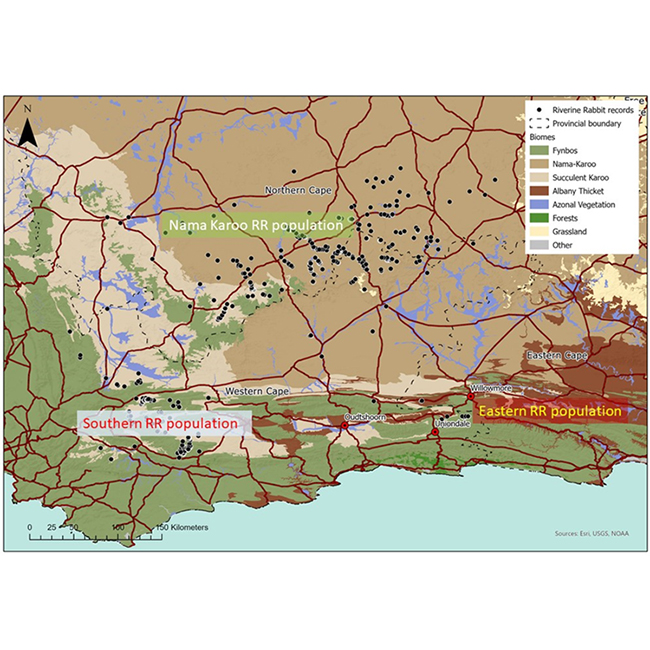
  •  The Critically Endangered Riverine Rabbit is regarded as one of Africa’s most endangered mammals, threatened predominantly by habitat transformation across the Karoo, resulting in a limited geographical distribution and seemingly small population size. The species is known from two populations: one in the Nama Karoo, where it was first discovered near Richmond in 1902, and one near Touwsriver in the Succulent Karoo, where the second population was discovered in 2003 (Figure 1). However, more recently in 2018, yet another, third population of these rabbits was discovered (through the correct identification of a roadkill specimen) just west of the Baviaanskloof, approximately 250 kilometres east of the known distribution. Research on the first two populations has been ongoing, however little to nothing is known about the third, most recently discovered population.
  • The Endangered Wildlife Trust’s Drylands Conservation Programme has been working on Riverine Rabbit conservation for over 20 years and has initiated a concerted effort to better understand this newly discovered population. Our aim is to investigate the geographic distribution of the species and any possible geographic links to the other two populations, and to gather genetic material to investigate genetic connectivity between the populations.


  • Earlier this month, three members of our team embarked on a field trip to collect Riverine Rabbit samples for this purpose. Dr Samantha Mynhardt is sampling rabbit scat (droppings) from all three populations for DNA sequence analysis, in order to map distributions and understand genetic connectivity, while Esther Matthew and her trained scent-detection dog, Delta, are assisting with establishing connections with farmers in the area, accessing properties, and locating (sniffing out) scat in the field. Delta, a two year old Border collie, is being trained to help us distinguish between the scat of different lagomorph species (hares and rabbits) in the field, to help increase efficiency.
Figure 1: Map illustrating the known extent of the three Riverine Rabbit populations occurring in three biomes across two provinces.

The Eastern population is located roughly between Uniondale and Willowmore, west of the Baviaanskloof. The species was described in 1902 from Nama Karoo specimens (northern population). The southern population was discovered in 2003 and the eastern population in 2018.

  • We surveyed four properties where our camera traps have detected Riverine Rabbits over the past couple of years, as well as an additional site, where the team spotted a live rabbit in the road. Rabbit scat was found at all the sites, in varying levels of abundance, and a total of 41 samples was collected from the five properties (eight distinct geographic sites). Samantha will extract DNA from a selected subset of these samples for genetic analysis. The DNA sequences will allow us to identify species, i.e. verify that the droppings are those of Riverine Rabbits, map geographic distributions, and investigate genetic connectivity between these samples and those of the other two populations.


  • Ultimately, the insights we gain from the population genetic analyses of these samples, regarding genetic connectivity of subpopulations, genetic diversity of the population as a whole, and of the subpopulations, and potentially also population size estimation, will help to inform and guide conservation management of the species. Perhaps the genetics will also unlock some of the secrets of the past distribution and origins of the populations.


  • This project is supported by our longest standing funder for Riverine Rabbit conservation work, the Zoological Society for the Conservation of Species and Populations (Zoologische Gesellschaft für Arten- und Populationsschutz – ZGAP). The team’s transport to sites is made possible by Ford Wildlife Foundation.



The Unseen Threat of Pampas Grass in South Africa

The Unseen Threat of Pampas Grass in South Africa

The Unseen Threat of Pampas Grass in South Africa

Dr Kerushka Pillay, the EWT’s WILDLIFE IN TRADE PROGRAMME

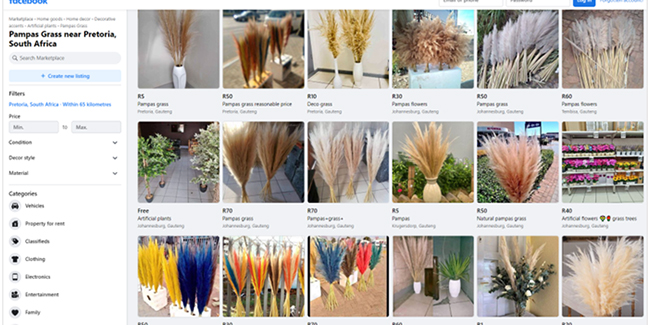
Pampas Grass, celebrated for its graceful plumes and enchanting presence, has found its way into countless South African homes and events, adorning weddings, and birthday parties and featured in bespoke interior decor. Its feathery inflorescences add an air of elegance and grace that many find irresistible. Yet, lurking beneath its captivating exterior is an ecological menace that demands our attention. The threat of Pampas Grass in South Africa is highlighted below, providing you with the basic knowledge and understanding of this unseen alien invasive species.

NB: Pictures used without permission from the internet


Pampas Grass: A Brief Overview

Common Name: Pampas Grass
Scientific Name: Cortaderia selloana, C. jubata (Poaceae family)
Alternative Common Names: Pampasgras; silwergras (Afrikaans)
Native range: South America – Argentina, southern Brazil, Uruguay, Paraguay, Argentina and Chile
Invasive Status in South Africa: CARA 2002 – Category 1a; NEMBA – Category 1b. Sterile cultivars or hybrids are not listed

Appearance and Origins

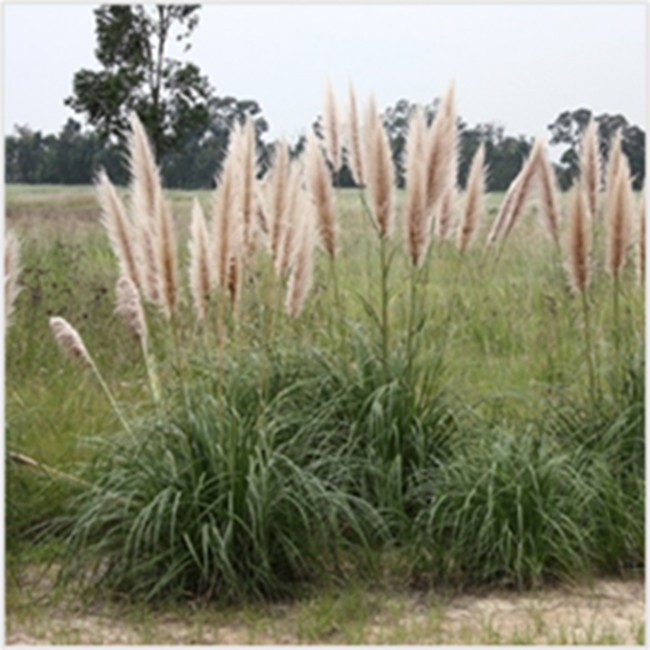
Hailing from the Pampas regions of South America, Pampas Grass is a robust tussock grass with a striking presence. Its clumps can reach impressive diameters of up to 3.5 meters, while its towering flowering stalks may soar to a height of 4 meters. The leaves of this grass are characterised by their greyish or bluish-green hues, often forming a V-shape in cross-section with rough margins. But the defining feature that captures our imagination is undoubtedly the feathery silvery-white to pink or mauve inflorescences that grace its presence from February to April.

Legislation of the Unseen Invader

In South Africa, Pampas Grass is regarded as an invasive species of serious concern. Classified as a Category 1a invasive species under the Conservation of Agricultural Resources Act (CARA) of 2002 and falling under Category 1b of the National Environmental Management: Biodiversity Act (NEMBA) National List of Invasive Species, this invasive menace has firmly established itself in the Western Cape, Eastern Cape, KwaZulu-Natal, and Gauteng provinces. According to CARA 2002, residents who fail to comply with a contravention notice could be fined R5 000 or sent to jail for up to two years, or both penalties, for a first conviction. This could be doubled at a second or subsequent conviction.

How you can help our cause:
DONATE VIA EFT:

The Endangered Wildlife Trust

FNB Rosebank (Branch code: 253305)

Account number: 50371564219

Use Reference: WIT

Historical and Present-Day Uses

In some mining areas, particularly those with soil erosion issues, Pampas Grass was employed for soil stabilisation on mine dumps. The dense root system and vigorous growth of Pampas Grass helped prevent erosion, reduce soil loss, and stabilise the soil on mining waste piles.

Pampas Grass is a highly sought-after ornamental plant with a multitude of decorative uses. Its tall stature and striking, feathery plumes make it a favourite in gardens and landscapes, where it serves as a captivating focal point, privacy screen, or windbreak. Pampas Grass plumes, prized for their beauty, are often featured in dried flower arrangements, adding elegance to interior decor and event settings, including weddings and special occasions. Additionally, its versatility extends to seasonal and holiday decor. However, while Pampas Grass is cherished for its aesthetics, it should be used responsibly, as it can be invasive in certain regions, necessitating proper management to prevent ecological harm.

Modes of Propagation and Spread

Pampas Grass employs two primary mechanisms for its relentless spread. Firstly, through seeds, the plant produces an abundance of them in an open panicle, allowing these seeds to be carried away by the wind. This ease of dispersion enables Pampas Grass to colonise new areas with astonishing efficiency. Secondly, beneath the surface, Pampas Grass extends its reach through rhizomes  (underground stems) that facilitate the formation of new clumps nearby. This subterranean network plays a vital role in its rapid expansion.

The invasive character of Pampas Grass presents a significant threat to ecosystems, causing habitat displacement as it competes vigorously with smaller indigenous grass species for vital resources such as water, sunlight, and nutrients, disturbing the delicate balance of local ecosystems. Furthermore, the sale and utilisation of Pampas Grass plumes, often laden with seeds, directly fuel the expansion of this invasive plant. This not only demonstrates environmental irresponsibility but also constitutes an illegal activity when used as decorative accessories for weddings, events, or decor.


What can you do?

  • Familiarise yourself with the legislation
  • If you manage your own land, keep it clear of Pampas Grass
  • Do not buy Pampas Grass from nurseries
  • Purchase faux, synthetic and fake Pampas for ornamental purposes
  • Report any Pampas sales to the authorities

While Pampas Grass may initially appear to be a charming addition to your home or event decor, it is imperative to recognise the potential harm it poses to South Africa’s precious natural environment. Responsible usage and a commitment to avoiding Pampas Grass are fundamental steps in safeguarding our native ecosystems. Let us make informed choices to ensure that the beauty we seek in our decorations does not come at the expense of our invaluable wildlife and habitats. Together, we can protect South Africa’s rich biodiversity from the silent threat of Pampas Grass.

Contact the EWT for more information.


Adverts featuring Pampas Grass for sale.


The Fragility of Africa’s Lions

The Fragility of Africa’s Lions

The Fragility of Africa’s Lions

Samantha Nicholson, the EWT’s Carnivore Conservation Programme


The African Lion (Panthera leo) is an iconic and culturally significant species, valued by both global public sentiment and local communities in many regions. Lions hold ecological value as apex predators, with their removal from ecosystems leading to adverse and long-lasting ecological consequences. Additionally, lions contribute to the economies of countries through tourism, attracting both photographic tourists and trophy hunters.
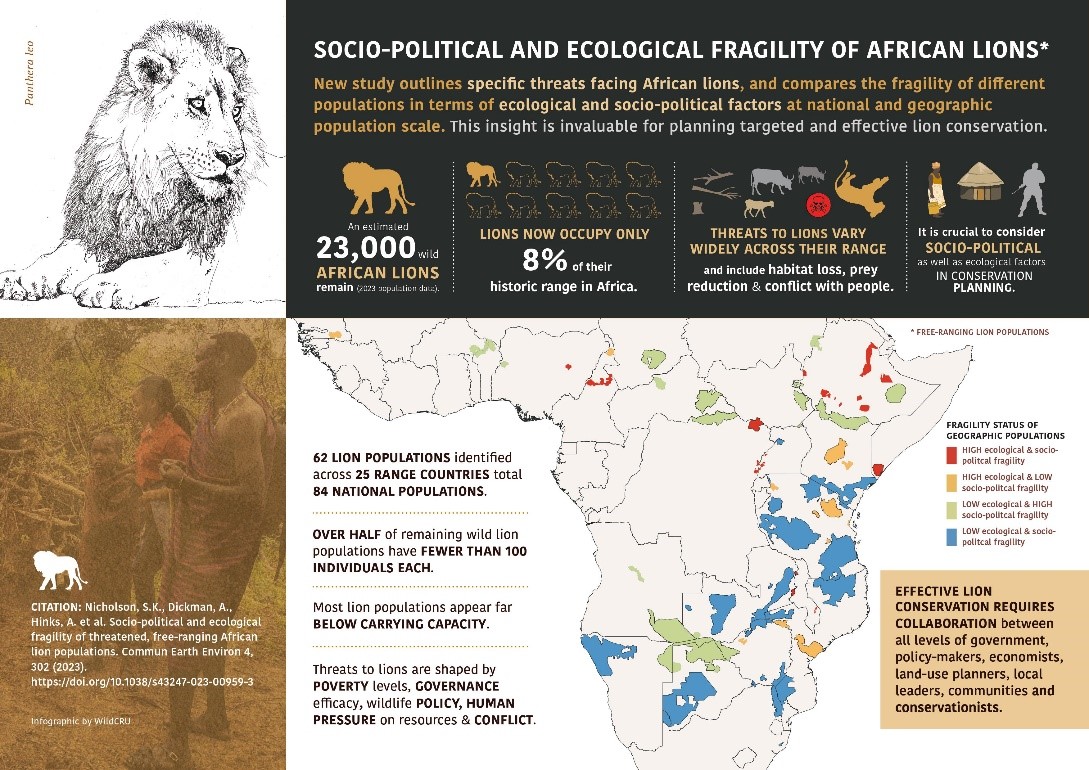
However, lion populations have dramatically declined over recent decades, with the most recent estimates suggesting 20,000 to 25,000 wild lions remaining in Africa, and they have been extirpated from 92% of their historical range. As such, effective conservation efforts are urgently needed, but the lack of comprehensive knowledge about specific threats and the socio-political contexts has hindered progress. The underlying drivers of lion threats are complex, involving socio-political factors such as poverty, governance (including corruption), wildlife policies, human pressures, and armed conflicts.
A recent study conducted a comprehensive assessment of the fragility of lion populations across their African range, considering both ecological and socio-political factors. The study first identified and mapped wild African Lion populations. The researchers then created two general categories of population fragility, ecological and socio-political, and identified factors in these two categories that may influence the survival of wild lions. For example, a smaller lion population or higher densities of people and livestock were factors contributing to higher ecological fragility, while higher corruption or lower GDP per capita would contribute to greater socio-political fragility. Once calculated, both socio-political and ecological factors were combined into a single overall fragility index, and each lion population was compared relative to all others. The fragility score does not suggest which lion populations deserve protection or funding. It does, however, highlight the varying ecological and anthropogenic pressures facing different population and which populations may require relatively more resources (financial or other) to conserve.

How you can help our cause:
DONATE VIA EFT:

The Endangered Wildlife Trust

FNB Rosebank (Branch code: 253305)

Account number: 50371564219

Use Reference: CCP LIONS


The combination of these two indices provided some interesting comparisons. Some populations may ultimately have similar fragility scores, but they are driven by different threats. Thus, while on the surface, the lone lion populations in Sudan and Benin may appear similar, they likely require different levels of investment and perhaps even different types of intervention for conservation to succeed. Pouring money into conserving Sudan’s lions may be relatively ineffective unless the socio-political factors such as the civil war are dealt with first. Thus, stakeholders, investors and conservation groups must be aware of these differences when approaching lion conservation and evaluating how much money, time or other investment may be needed to see success.
Our study revealed that Maze National Park in Ethiopia was identified as the most ecologically fragile population at both a geographic and national level. This can largely be attributed to intense edge effects from high densities of both cattle and people. When assessing at the national level, Cameroonian and Malawian lion populations were most ecologically fragile due to their small populations and isolation from other lion populations. Somalia was the most fragile lion range country from a socio-political perspective. Maze National Park and Bush-Bush (Somalia) were found to be the most fragile overall when ecological and socio-political fragility scores were combined.
Conservation is needed more than ever. Our study showed less than half of the 62 known remaining free-ranging wild African Lion populations have over 100 lions. African Lions remain in only 25 countries and nearly half of these nations have fewer than 250 individuals. Eight countries now house only a single wild lion population. Although lions are estimated at between 20,000 and 25,000 individuals, there is concern that these small populations and countries with few individuals will disappear.
These findings emphasize the need for more nuanced and precisely targeted lion conservation plans, considering both ecological and socio-political dimensions. As lions teeter on the brink of extinction, this research serves as a vital resource for informed conservation efforts. By considering ecological and socio-political factors, this model offers insights into factors affecting population persistence and successful conservation action.

Nicholson, S.K., Dickman, A., Hinks, A. et al. Socio-political and ecological fragility of threatened, free-ranging African lion populations. Commun Earth Environ 4, 302 (2023).

https://doi.org/10.1038/s43247-023-00959-3


Creating serendipity – Exploring the future of conservation in a rapidly changing world

Creating serendipity – Exploring the future of conservation in a rapidly changing world

The EWT is celebrating its 50th anniversary as one of South Africa’s leading conservation NGOs and as part of the celebration, we are hosting a day of inspirational and forward-thinking discussions to spark creative ideas about the future of conservation in Africa. We have a line-up of thought-provoking presenters and panelists from a multitude of traditionally non-conservation sectors, to stimulate debate and leverage creative thinking within the conservation realm. We aim to open the minds and challenge the mindsets of conservationists attending the event and to unlock partnership opportunities to catapult us into the next era of conservation practice.

Conservationists recognise the influence of all sectors as drivers impacting the natural world. As such, we will be exploring the knowledge and experience of experts across various sectors including economics, agriculture, mining, sustainability, information technology, artificial intelligence, and innovation through the eyes of specialists and futurists. Through this assembled expertise and via facilitated discussions, we will distil a new way of thinking about the future for the strategic conservation of our wildlife and wild places over the next few decades, in a rapidly changing world.

Join us for an exploration of the possibilities, opportunities & synergies in the next era of conservation practice.

#THENEXT50

RSVP: by 20 October 2023 Click here

08:30-16:00 formal proceedings, 16:00-19:00 cocktail event

Join us afterward for some fantastic live music, great Painted Wolf wines, and beautiful art by Alice van Jaarsveld.

EWT_CREATING SERENDIPITY_AICE VAN JAARSVELD

————-

The great minds that will spark our creative thinking

Thomas Fowler is the Chief Technology Officer at CloudSmiths and was the founder and CEO of DotModus.

Valli Moosa is the former minister of the Department of Environment and Tourism, and the former president of the IUCN. He was also the non-executive chairman of Eskom, Sun International, and Anglo America Platinum and more recently the Deputy Chairperson of the PCC.

Brian Mantlana joined the Council for Scientific and Industrial Research (CSIR) in 2017, where he now leads the Holistic Climate Change Impact area. Prior to this, he worked at SANBI and the Department of Environmental Affairs.

Toby Shapshak is editor-in-chief of Stuff and publisher of Scrolla.Africa, a Forbes senior contributor and a columnist for the  Financial Mail and Daily Maverick.

Bronwyn Williams is a futurist, economist, strategist, and business trend analyst. She is also an avid reader and a published writer.

Isaah Mhlanga is the chief economist and head of research at Rand Merchant Bank.

Martin Potgieter is a Director, Natural Capitalist, Investor, and Environmentalist at Rand Merchant Bank

Lesego Rammusi has worked as the sustainability manager at Esiswe Mining Company, as the Environmental and Social Specialist at the Land and Agricultural Development Bank of South Africa, and is currently the head of environmental and Social Sustainability at ABSA.

Sameera Munshi is the Operations Manager at the global Anglo-American Foundation, which is on a mission to empower youth through catalysing green value chains and building resilience and agency.

Andrew Ardington is the founder of the Regenerative Agriculture Association of South Africa, also known as RegenAg SA.

Graeme Codrington is a futurist, global speaker and unlearner and is an expert on the future of work and the disruptive forces that are shaping it.

————-

Event Programme

  SPEAKERS AFFILIATIONS
 

Introduction by Yolan

09:00-09:30 Thomas Fowler AI futurist
09:30-10:00 Vallie Moosa Deputy Chairperson of the Presidential Climate Commision (PCC)
10:00-10:30 Brian Mantlana Holistic Climate Change Impact area lead at the CSIR
10:30-11:00 Toby Shapshak Innovation in Africa
11:00-11:30

tea and snacks

11:30-12:00 Bronwyn Williams Futurist, Economist, Trends
12:00-12:30 Isaah Mhlanga RMB economist
12:30-13:00 Martin Potgieter RMB – Natural Capital and sustainable finance
13:00-13:30 Lesego Rammusi Head of Environmental and Social Sustainability at ABSA
13:30-14:00

tea and snacks

14:00-14:30 Sameera Munshi Anglo – Operations Manager
14:30-15:00 Andrew Ardington Regenerative Agriculture Association of Southern Africa
15:00-15:30 Graeme Codrington Futurist, Unlearner, Disruption
15:30-16:00 Panel discussion: The Next 50 – where to from here in the conservation context?

Closing and thank you – Yolan and Ian

The historical role of women in the ewt

The historical role of women in the ewt

Celebrating women in conservation

National Women’s Day draws attention to the challenges African women still face but also the ever-increasing opportunities for them to empower themselves.

In South Africa, August (Women’s Month) acknowledges these challenges and celebrates the many achievements of women in South Africa. It encourages others to learn from those who came before them and how they overcame the limitations they encountered.  Women now have louder and more powerful voices, playing a necessary role in highlighting many issues, including environmental degradation, women and child abuse, unequal pay, lack of good education for their children, and many more.

During this Women’s Month, the EWT pays homage to women in the conservation space who do their bit to save species, conserve habitats, and benefit people.

Meet these amazing women here and on social media under #EWTWomanCrushWednesday.

The historical role of women in the EWT

Clive Walker, Founder and Former Director of the EWT

In 1975, I took a group of eight women on a walking trail in the Mashatu Game Reserve in northeastern Botswana. They had told their husbands they were off to the bush for five days, and their husbands had to take care of their kids while on ‘trail’. Among them were Wendy Farrant, whose husband was an EWT trustee, and her friend Joy Cowan. Both husbands were accountants who made up a number of the professionals who made up the board of directors. The very first afternoon, we encountered on foot some 100 elephants standing in the dry Shashe river bed that borders Zimbabwe. One can only imagine the experiences that were to follow over the next four days. On the last night around our campfire, a number asked what they could do to help the EWT as they had become so fired up by their experiences, and my response was why don’t we form a ‘ladies’ committee’ and, after discussing it with the board, we did just that. The committee consisted of Wendy Farrant, Jill Morrison, Felicity Street, Joy Cowan, Maureen McCall, Jenny Doak, and Conita Walker. As volunteers, they contributed 100s of hours in administration work, ran all the fundraising functions, organised three symposiums and various workshops during my tenure and became the flag bearers of the Trust’s work. I must commend my secretary, the late Petra Mengal, who ran the zoo office, and my PA, Jane Zimmerman, who were the only two permanently employed staff and were a tower of strength to the organisation.


Ladies accompanying Clive Walker on a wilderness trail in the Mashatu Game Reserve in northeastern Botswana in 1975 (Left) and The Endangered Wildlife Trust’s Ladies Committee , formed in 1975. As volunteers, they contributed hundreds of hours in administration work, ran all the fundraising functions, organised three symposiums and various workshops, and became the flag bearers of the Trust (Right).

FAST FORWARD TO 1999

Twenty years later, another woman was trailblazing through conservation – the conservation of cranes in particular. Lindy Rodwell cofounded the EWT’s  South African Crane Working Group (SACWG) with Kevin McCann, having established and grown the Highlands Crane Group two years prior. The SACWG was formed to coordinate all crane conservation efforts across South Africa. In 1999, Lindy was the first person from the EWT, and from South Africa, to win the Whitley Award, often referred to as the ‘Green Oscars’. The award is awarded annually to individuals from the Global South by UK-based conservation charity the Whitley Fund for Nature.


Lindy Rodwell, Edward Whitley Junior, and HRH Princess Anne at the 1999 Whitley Awards at the Geographical Society in London. Lindy won a Whitely Award for her work conserving cranes.