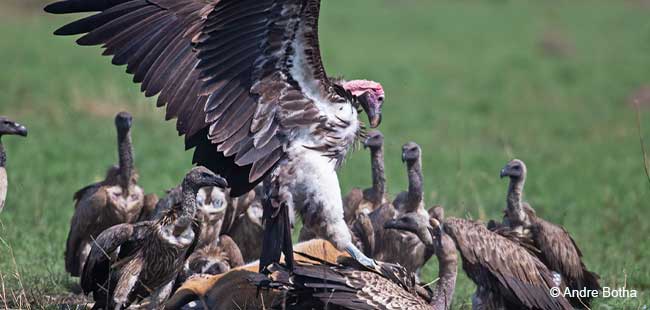
In celebration of our 50th Anniversary, the Endangered Wildlife Trust (EWT) is thrilled to announce the return of the EWT Birds of Prey Programme Conference. This conference will be held at the beautiful Swadini Forever Resort, near Hoedspruit, from 20–24 November 2023.
Join the Endangered Wildlife Trust’s Birds of Prey Programme and others in the raptor conservation sector for a week of exciting presentations, practical workshops, and field excursions. This event aims to celebrate the work and people involved in conserving birds of prey.
1. REGISTER FOR THE CONFERENCE
To register for the conference, click here (Opens 30 June, closed 30 September)
2. TO PRESENT A TALK OR POSTER AT THE CONFERENCE
To apply for a presentation slot, submit your abstract here (Opening on 6 June, closes on 15 September). Abstract requirements are indicated on the submission form.
3. WHAT’S HAPPENING?
Monday, 20 November: Arrival and a welcoming pizza dinner (please remember to note your dietary restrictions on the registration form)
Keep an eye out for announcements of keynote speakers, presenters, excursions, and practical sessions here.
Tuesday, Wednesday, and Thursday: Talks and poster sessions
Friday 24 November: Departure
IMPORTANT DATES:
Conference registration: opens 30 June and closes 30 September 2023
Abstract submission: opens 6 June and closes 15 September 2023
4. COSTS AND PRICING
| Registration Fee |
R2,850 |
Covers attendance from Tuesday to Thursday;
Covers a dinner on Monday night;
Covers lunch and tea from Tuesday to Thursday |
| NOT INCLUDED IN THE REGISTRATION FEE |
| BOPPCON T-shirt |
R300 |
Option to include one is on the registration form |
| BOPPCON Cap |
R300 |
Option to include it is on the registration form |
| Meals |
|
Breakfasts and Dinners are supplied privately by the on-site restaurant. For meal prices and menu, please see below. |
| Accommodation |
|
Accommodation is to be organised and paid for by the attendees. Please contact Cindy on 082 043 2392 or swadinibanq@foreversa.co.za for enquires or to book. |
| Excursions |
|
Cape Vulture Lodge site visit – entry |
|
|
Boat Cruise |
|
|
Moholoholo Vulture Restaurant site visit |
5. WHERE TO STAY
Swadini: A Forever Resort here
Accommodation can be organised through Cindy at Swadini.
Cindy Heine (Groups and Conference coordinator)
Tel: 015 795 5141 extension 4505
Cell: 082 043 2392
E-mail: swadinibanq@foreversa.co.za
Meals: The conference registration fee includes dinner on Monday evening and lunches on Tuesday, Wednesday, and Thursday. All other meals must be paid for by the participants themselves and can be self-catered (depending on the type of accommodation that participants book for themselves). Participants can make use of the on-site restaurant and/or shop – for a peak at the menus, see the dinner one here and the breakfast one here.
Please note that the conference centre falls within a malaria area, and we ask attendees to please take necessary precautions before, during and after their visit!
6. CONTACT US
For questions regarding the conference events & schedule, email boppcon@ewt.org.za
For questions regarding accommodation and the conference location, contact Cindy on 082 043 2392 or swadinibanq@foreversa.co.za
AFRICAN CONFERENCE FOR LINEAR INFRASTRUCTURE AND ECOLOGY
Wendy Collinson, EWT Wildlife and Transport Programme Manager, wendyc@ewt.org.za
Lourens Leeuwner, EWT Wildlife and Energy Programme Manager, lourensl@ewt.org.za
Sarah Chiles – Landscape Infrastructure Advisor – Kenya, Ewaso Lions and Grevy’s Zebra Trust, chiles.sarah@gmail.com
Harriet-Davies Mostert, EWT Head of Conservation, harrietd@ewt.org.za
The second African Conference for Linear Infrastructure and Ecology (ACLIE), co-hosted by the Endangered Wildlife Trust (EWT), Grevy’s Zebra Trust (GZT), and Ewaso Lions (EL), took place between 12 and 17 August 2021. The first ACLIE conference was held in 2019 in the iconic Kruger National Park, South Africa, with 115 participants from 21 countries. ACLIE 2021 attracted almost 200 participants from 25 countries, 11 of which were African. We also had participants with diverse backgrounds from the engineering, ecology, policy, and finance sectors.
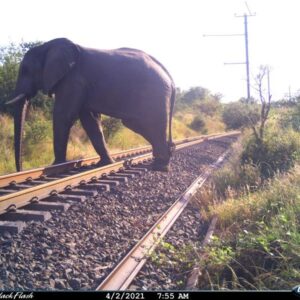
Linear infrastructure is essential for connecting society: our roads, railways, pipelines, and power lines link our cities, developments, resources, energy and water supplies. Therefore, it is perhaps ironic that linear infrastructure does exactly the opposite for natural systems – by crisscrossing landscapes, linear infrastructure serves to fragment ecosystems, isolate populations, and reduce natural flows. Roads, railways, fences, and power lines constrain animal movement, pose direct threats to species from collisions and indirect threats from increased human access to previously untapped resources, and new pathways for invasion by alien flora and fauna, with significant ecological consequences.
In many ways, Africa represents the final frontier for infrastructure development. The continent’s population has doubled in the last three decades and currently stands at 1.3 billion. Most experts agree that if it continues at its current rate, Africa’s population will double again by 2050. This means that about two-thirds of the world’s population growth is expected to take place on our continent, and by 2050 Africa will be home to more than a quarter of the world’s people. As populations and economies grow, they require greater investments in infrastructure. Over the next few decades, we will need significant investments in railways, roads, energy, and other infrastructure to meet the growing demands of emerging African economies.
ACLIE 2021 intends to foster and build on cross-sectoral African engagement and encourage the exchange of solutions around “Connecting for Resilience”. Considering the most pressing issues of our time – climate change, biodiversity loss, COVID-19, and the spectre of future pandemics – efforts to maintain ecological and human resilience are critical. The ability of ecosystems to maintain their functions and services is fundamental to sustainable development and human health.
This year’s conference was centred around four major sub-themes, one for each day. The first theme was centred around adapting to climate change, the second on innovating for mitigation and improvement, the third on planning for snowballing and cumulative impacts, and the fourth and final theme centred on applying economic tools and finance for reducing environmental impacts. After nearly a year and a half of the global pandemic, we’re all extremely familiar with online engagement, and this format has certainly enabled the participation of people from afar and allowed for constructive interaction among participants.
Each day, this conference kickstarted with an indaba, with a line-up of esteemed experts who shared their insights around the specific theme for the day. These were followed by the 20×20 sessions, where a series of presenters presented 20 images from a project they are involved in for 20 seconds. These included mitigation measures used in Cape Town to assist the Endangered Western Leopard Toad to cross the road, the use of a remotely piloted aircraft system (i.e. a drone) for marking power lines, and using bioacoustics methods to understand the linear movement of Endangered marine mammals. There were so many fantastic presentations about African issues that it is hard to select just a few to provide examples.
A new type of presentation for ACLIE was the Lion’s Den session, which provided a space where solutions were pitched to a panel of leaders, with opportunities for questions and input from the audience. Pitches included an intelligent green and grey infrastructure design system (iGGIDS), which obtained buy-in from the ‘Lions’, and the redesign of a roadkill reporting app.
Each of the first three days ended off with specialist training sessions delivered by leaders in their fields. This kind of training contributes strongly to the capacity building element of ACLIE and featured training on ‘Economic tools for informing linear infrastructure decision making’, energy system reliability through wildlife interaction mitigation’, and ‘design, construction and maintenance of wildlife crossing structures’.
Leonard Sielecki, Wildlife Program Manager from the British Columbia Ministry of Transportation and Infrastructure, said, “I am very impressed by the large South African and African representation. You have attracted a very impressive, very comprehensive range of wildlife protection-related people from the African Continent.”
Further to this, Kishaylin Chetty, Senior Environmental Advisor for Eskom, said, “The ACLIE conference is an exceptional event, that coordinates industry, civil society, government, and specialists to come together to discuss theory and feasibility surrounding linear infrastructure and its practice through Africa. The conference is a founding pillar towards responsible development in Africa.”
“ACLIE has been an extremely important convergence of knowledge, expertise, and practice from the linear infrastructure and ecology and conservation worlds. We have seen everything from demonstrations of laying overpasses to the importance of road verges and powerline diverters. Critically, we have also received commitments from major financiers of how they intend, and are, streamlining their policies to ensure that, as Africa builds new infrastructure, our landscapes will remain connected, and we will remain the drivers of the process. There are few things more hopeful”. Resson Kantai Duff, Deputy Director of Ewaso Lions
“Despite the challenges of holding a conference remotely, ACLIE 2020 was superbly organised and moderated. Participants were lively and active, and I got to meet and learn from a lot of globally experienced ecologists and industry professionals. I especially enjoyed listening to cutting edge innovations in modelling and data collection as well as successful Private-Public Partnerships that have informed infrastructure development. Can’t wait for the next conference!” David Kimiti, Deputy Director Research and Impact, Grevy’s Zebra Trust
We want to extend our thanks to AfricaMassive for logistical support of the event, Dr Rodney van der Ree and Dr Fraser Shilling for the donation of the prizes, and all the speakers and attendees, without whom this conference would not have been possible.
Finally, we’d like to announce that the next ACLIE will be held in Kenya in 2023.
LATEST STORIES
