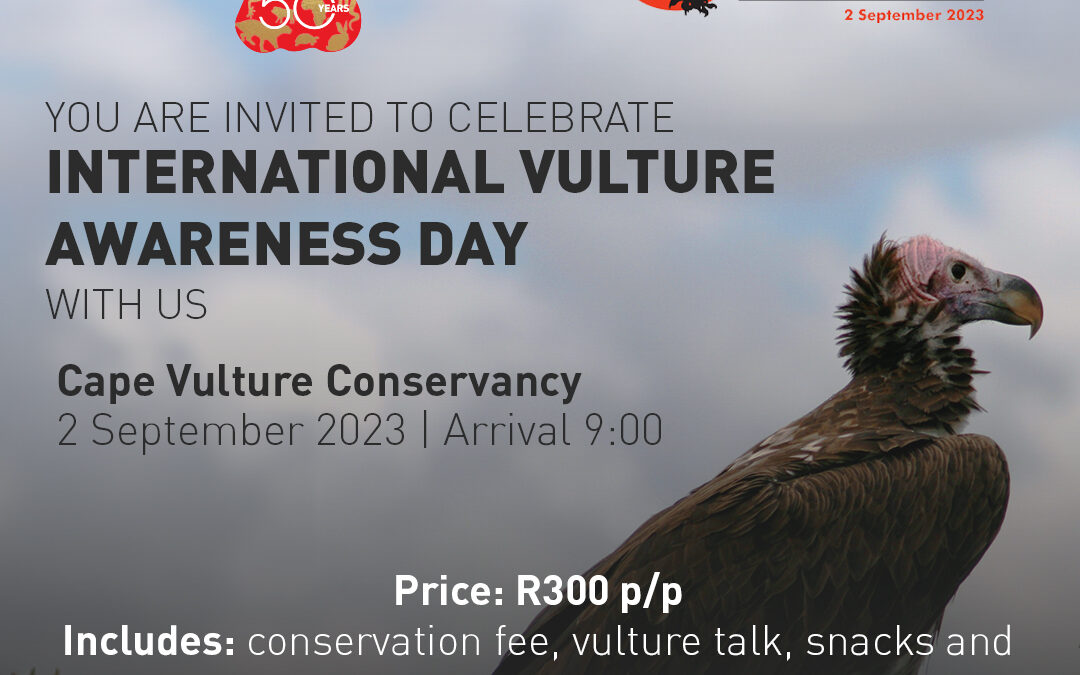
The first Saturday in September each year is International Vulture Awareness Day.
Vultures are an ecologically vital group of birds that face a range of threats in many areas that they occur. Populations of many species are under pressure and some species are facing extinction.
The International Vulture Awareness Day has grown from Vulture Awareness Days run by the Birds of Prey Programme of the Endangered Wildlife Trust in South Africa and the Hawk Conservancy Trust in England, who decided to work together and expand the initiative into an international event.
The coordinated international day promotes the conservation of vultures to a wider audience and highlights the important work being carried out by the world’s vulture conservationists.
On the first Saturday in September, each participating organisation carries out their own activities that highlight vulture conservation and awareness. This year, the EWT is hosting an event at the Cape Vulture Conservancy in the Lowveld to showcase vultures and reveal the EWT’s new Vulture Ambulance, which has already been used when responding to various wildlife emergencies around the Lowveld.
The Cape Vulture Conservancy will be providing delicious snacks and drinks, which are included in the entrance fee of R300, which also covers the conservation fee that goes to the Cape Vulture Conservancy, as well as drive to view the vultures on the Conservancy, where once can see the Cape Vultures that are breeding on the cliffs, and maybe even catch a glimpse of a Verreaux’s Eagle! We hope that this day will be a wonderful celebration of South Africa’s majestic vultures – which are an irreplaceable part of our country’s natural heritage.
RSVP here
Sign up here to let us know how you are celebrating vultures this weekend!
In celebration of our 50th Anniversary, the Endangered Wildlife Trust (EWT) is thrilled to announce the return of the EWT Birds of Prey Programme Conference. This conference will be held at the beautiful Swadini Forever Resort, near Hoedspruit, from 20–24 November 2023.
Join the Endangered Wildlife Trust’s Birds of Prey Programme and others in the raptor conservation sector for a week of exciting presentations, practical workshops, and field excursions. This event aims to celebrate the work and people involved in conserving birds of prey.
1. REGISTER FOR THE CONFERENCE
To register for the conference, click here (Opens 30 June, closed 30 September)
2. TO PRESENT A TALK OR POSTER AT THE CONFERENCE
To apply for a presentation slot, submit your abstract here (Opening on 6 June, closes on 15 September). Abstract requirements are indicated on the submission form.
3. WHAT’S HAPPENING?
Monday, 20 November: Arrival and a welcoming pizza dinner (please remember to note your dietary restrictions on the registration form)
Keep an eye out for announcements of keynote speakers, presenters, excursions, and practical sessions here.
Tuesday, Wednesday, and Thursday: Talks and poster sessions
Friday 24 November: Departure
IMPORTANT DATES:
Conference registration: opens 30 June and closes 30 September 2023
Abstract submission: opens 6 June and closes 15 September 2023
4. COSTS AND PRICING
| Registration Fee |
R2,850 |
Covers attendance from Tuesday to Thursday;
Covers a dinner on Monday night;
Covers lunch and tea from Tuesday to Thursday |
| NOT INCLUDED IN THE REGISTRATION FEE |
| BOPPCON T-shirt |
R300 |
Option to include one is on the registration form |
| BOPPCON Cap |
R300 |
Option to include it is on the registration form |
| Meals |
|
Breakfasts and Dinners are supplied privately by the on-site restaurant. For meal prices and menu, please see below. |
| Accommodation |
|
Accommodation is to be organised and paid for by the attendees. Please contact Cindy on 082 043 2392 or swadinibanq@foreversa.co.za for enquires or to book. |
| Excursions |
|
Cape Vulture Lodge site visit – entry |
|
|
Boat Cruise |
|
|
Moholoholo Vulture Restaurant site visit |
5. WHERE TO STAY
Swadini: A Forever Resort here
Accommodation can be organised through Cindy at Swadini.
Cindy Heine (Groups and Conference coordinator)
Tel: 015 795 5141 extension 4505
Cell: 082 043 2392
E-mail: swadinibanq@foreversa.co.za
Meals: The conference registration fee includes dinner on Monday evening and lunches on Tuesday, Wednesday, and Thursday. All other meals must be paid for by the participants themselves and can be self-catered (depending on the type of accommodation that participants book for themselves). Participants can make use of the on-site restaurant and/or shop – for a peak at the menus, see the dinner one here and the breakfast one here.
Please note that the conference centre falls within a malaria area, and we ask attendees to please take necessary precautions before, during and after their visit!
6. CONTACT US
For questions regarding the conference events & schedule, email boppcon@ewt.org.za
For questions regarding accommodation and the conference location, contact Cindy on 082 043 2392 or swadinibanq@foreversa.co.za
The connection between raptors and human well-being
Danielle du Toit & Dr Lindy Thompson, the EWT’s Birds of Prey Programme
In celebration of World Health Day on 7 April, we acknowledged the important role raptors (predatory birds that hunt other animals or feed on carrion) play in supporting humans and our well-being.
- Ecosystem Services
When feeding, vultures clean carcasses and reduce the spread of diseases such as anthrax and botulism. After the Asian Vulture Crisis in the late 1990s, widespread accidental poisoning caused vulture populations in India to plummet by over 90%. The loss of vultures left more food available for other scavengers, such as feral dogs, which increased in numbers, and in turn, so too did cases of rabies. Economists estimated the healthcare costs to the Indian government at US$296 million over 13 years. This study is one of a handful that tried to put a monetary value on the ecosystem services that vultures provide and the importance of their role in maintaining environmental health.

Owls and eagles provide free pest control services by hunting rodents and other species that can negatively impact human health. Barn Owls with chicks in the nest have been reported to catch up to 30 rodents in one night. Many farmers have acknowledged the importance of Verreaux’s Eagles because these birds effectively control Rock Hyrax populations, which, unchecked, could result in significant losses in crop yields.
Results of blood tests from raptors can also be used to indicate the health of an ecosystem. Recent studies in South Africa by Dr Linda van den Heever and colleagues highlighted the problem of lead poisoning in vultures and how high levels of lead in vultures’ blood most likely result from fragments of lead bullets in the carcasses the birds are eating. These microscopic lead fragments can also be found in venison eaten by people (if those carcasses were shot using lead bullets), so both vultures and people, among others, are susceptible to the same preventable health issue of lead poisoning from lead ammunition. Lead poisoning, such as that consumed from similar sources, resulted in nearly a million lives being lost in 2019 and is the cause of 30% of global intellectual disabilities in humans.
- Cultural Importance
For hundreds, if not thousands of years, raptors have been symbolic in different cultures worldwide. For example, the ancient Egyptian god Horus had the body of a man and the head of a falcon; the Romans believed that eagles represented power and strength, and humans in neolithic times used feathers and bones for ornamental, ceremonial, and functional purposes. Falconry, a hunting method using birds of prey, has been around for about 5,000 years, first known to have been practised by Mongolians. In South Africa, vulture body parts are used in traditional medicine.
Landowners in the Karoo region of South Africa approached the Endangered Wildlife Trust to assist in bringing Cape Vultures back to the area where they have been regionally extinct since the mid-1980s. Many of these farmers sink into nostalgia when remembering their childhoods filled with memories of being in the veld with vultures soaring above them. In the ‘Farmers for Vultures’ video, farmers spoke of spying on vulture nests, and others recalled how they would lie dead still in the middle of the veld in hopes that vultures would circle them. These stories show that these birds’ very existence is essential in the cultures of many people and for their well-being. Not only do these farmers love reminiscing about their younger days, but they live in the hope that one day, vultures will soar across the Karoo skies once again.
Raptors are also crucial to the tourism sector. The Kruger National Park offers tourists the opportunity to see vultures and their feeding behaviour up close. Golden Gate National Park hosts one of the few Bearded Vulture populations and feeding sites, and Cape Vulture colonies across the country have been tourist destinations for decades.
- Raptor conservation is directly beneficial to human well-being
We know that losing vultures across a landscape can cause significant negative impacts on the physical health of humans. By adjusting our practices and using lead-free ammunition, we will reduce the threat of lead poisoning in raptors and potentially similar threats to humans. By practising responsible carcass management to limit the contamination of the environment by chemicals or veterinary medicines, we are providing safe spaces for vultures to perform their ecosystem services. By moving away from using rodenticides and allowing owls and eagles to do natural pest control, we reduce the chances of being affected by the same poisons.
Conservation of species is not only based on their importance to the health of an ecosystem or the services they provide but is often rooted in ensuring physical, mental, and emotional aspects of human well-being. By tackling threats to raptors and investing resources and time into caring for the health of these species and other wildlife, we protect our fellow species and invariably make the environment safer and healthier for people.
References
(more…)
THE EASE OF OBTAINING DEADLY PESTICIDES
– A Zambian snap-assessment
André Botha, Manager, EWT Vultures for Africa
AndreB@ewt.org.za[/vc_column_text][vc_column_text]A two-week field trip to Zambia during August 2019 provided the EWT’s Vultures for Africa Programme an opportunity to conduct the first Wildlife Poisoning Response Training workshop in the North Luangwa National Park to train rangers and other staff of the Park to effectively identify and respond to wildlife poisoning incidents when they happen in this part of the Luangwa Valley. The area has been identified as a wildlife poisoning hotspot following a number of wildlife poisoning events since 2013. The largest of these events happened when a poached elephant carcass was poisoned and killed 302 vultures in October 2013. The workshop also provided an opportunity to initiate the training of three BirdWatch Zambia staff members Chaona Phiri, Mary Malasa and Kelvin Mkandawire as facilitators of possible future workshops in Zambia as part of the EWT-Hawk Conservancy-University of Reading partnership’s project supported by the US-FWS.
In the week preceding the training at North Luangwa, BirdWatch staff decided to do an assessment of the availability and accessibility of the range of pesticides commonly used in wildlife poisoning on the streets of Lusaka. A few hours of shopping confirmed that there are many dealers stocking these products and that purchasing any product is as simple as asking for it and handing over the cash. Dealers seldom bothered to enquire what the pesticides were being purchased for and no record was kept of the transactions that were concluded. Within no time, they were able to purchase substantial quantities of highly toxic chemicals such as Carbofuran (one of the most widely used pesticides in wildlife poisoning globally), Monocrotophos and Endosulfan (both banned in South Africa since the early 2010s) at very affordable prices. One kilogramme of Carbofuran was bought for a mere ZMW76,00 or R88,00.[/vc_column_text][vc_single_image image=”4267″ img_size=”large” add_caption=”yes” alignment=”center”][vc_single_image image=”4268″ img_size=”large” add_caption=”yes” alignment=”center”][vc_column_text]We were able to repeat this assessment in the eastern Zambian city of Chipata when travelling back from North Luangwa National Park a few days after training. It was hardly surprising that we were able to acquire a similar range of substances from various suppliers at affordable prices, again with little or no questions asked about our intended use thereof. Substances easily acquired included Chlorpyrifos, another pesticide banned in South Africa in 2011. It was noticeable that people of varying ages, including children, were able to walk into a store, ask for and purchase a range of chemicals and veterinary medicines in Chipata without much scrutiny or any record-keeping processes as required by law being followed. It is hardly surprising that these substances are often used in the killing of wildlife.[/vc_column_text][vc_single_image image=”4270″ img_size=”large” add_caption=”yes” alignment=”center”][vc_column_text]From Chipata we travelled to the Munyamadzi Game Reserve passing villages such as Chiabala and Chilye where we noticed small groups of young males selling large quantities of roasted rodents on sticks to passing travellers. This reminded me of a conversation during a training workshop in nearby Malawi the year before when one of the rangers shared the fact that the preferred method of killing rodents in the area was the use of Aldicarb (Temik) which killed large numbers of these animals during outbreaks. Another “advantage” associated with the use of this highly toxic pesticide was that the rodents died at or near the poisoned baits, something which does not occur with commercially available rodenticides that normally take longer to kill animals that consume them and whose victims are seldom found near where the baits have placed. The use of Aldicarb therefor makes animals killed by this means easier to collect, cook and sell to consumers as a source of protein. Consumers of animals killed in this manner seem to be oblivious to the potential risk of this practice.
The situation in Zambia is certainly not unique and we have encountered similar circumstances in most SADC and east African countries over the last few years where, even if adequate legislation and guidelines with regard to the use of highly toxic pesticides are in place, enforcement of laws and control of these substances are often poor or non-existent. This also applies to South Africa where pesticides such as Aldicarb (Temik) are the most widely used substances in the illegal poisoning of wildlife and domestic animals and can be easily obtained at minimal cost and effort in many informal markets across the country, despite being withdrawn from formal trade in 2011 and being banned since 2014.