

Woosnam’s Desert Rat
Zelotomys woosnami

2025 Red list status
Near Threatened

Regional Population Trend
Stable

Change compared
to 2016
Uplisted
Overview
Zelotomys woosnami – (Schwann, 1906)
ANIMALIA – CHORDATA – MAMMALIA – RODENTIA – MURIDAE – Zelotomys – woosnami
Common Names: Woosnam’s Broad-headed Mouse, Woosnam’s Zelotomys, Woosnam’s Desert Mouse (English), Woosnam se Woestynrot (Afrikaans), Sekuthê (Setswana)
Synonyms: No Synonyms
Taxonomic Note: The Zelotomys genus consists of two species with isolated ranges, of which only Z. woosnami occurs within the assessment region (Skinner & Chimimba 2005; Monadjem et al. 2015). Zelotomys woosnami exhibits no geographic variation, and no subspecies have been recognised (Skinner & Chimimba 2005; Monadjem et al. 2015).
Red List Status: NT – Near Threatened, B1b(i)c(iv) (IUCN version 3.1)
Assessment Information
Assessors: Smith, C.1 & da Silva, J.M.2
Reviewer: Taylor, P.3
Contributor: Patel, T.1
Institutions: 1Endangered Wildlife Trust,2South African National Biodiversity Institute,3University of the Free State
Previous Assessors and Reviewers: Wilson, B., Harvey, J. & Child, M.F.
Previous Contributors: Relton, C., Avenant, N., Avery, M., Baxter, R., MacFadyen, D., Mondajem, A., Palmer, G., Taylor, P. & Wilson, B.
Assessment Rationale
Because of their natural rarity, information on this species is sparse. It is a Kalahari endemic species that is peripheral and scarce within the assessment region. In a past survey, this species was not recorded in the North West Province, despite it supposedly occurring there. However, search effort is minimal at present, and the lack of current records is more likely an artefact of low sampling effort, in combination with natural rarity, rather than an indication of decline. However, the widespread construction of solar farms in the Northern Cape Province along with possible climate change effects, and mining outside protected areas, may already be contributing to declining habitat quality and should be monitored. Given its low densities and evidence of population fluctuations even in prime habitats, the species should be flagged as Near Threatened under criteria B, pending evidence of inferred or projected habitat decline.
Although the species is scarce and its estimated extent of occurrence within the assessment region is <20,000km2, the local population is probably augmented through dispersal across connected habitats from Namibia and Botswana where the majority of the species’ population occurs. This species may face emerging threats in association with development of solar farms, we recommend field surveys be conducted to gather information on distribution, dispersal and threats.
Regional population effects: There is possible dispersal of this species from Namibia and Botswana via the Kgalagadi Transfrontier Park and the northern border of the North West Province, as the preferred habitat is relatively contiguous. Thus, rescue effects are possible.
Reasons for Change
Reason(s) for Change in Red List Category from the Previous Assessment: Habitat is under threat from construction of solar farms in the Northern Cape, mining and climate change, all of which may already be contributing to declining habitat quality for the species.
Red List Index
Red List Index: Uplisted
Recommended Citation: Smith C & da Silva JM. 2025. A conservation assessment of Zelotomys woosnami. In Patel T, Smith C, Roxburgh L, da Silva JM & Raimondo D, editors. The Red List of Mammals of South Africa, Eswatini and Lesotho. South African National Biodiversity Institute and Endangered Wildlife Trust, South Africa.
Regional Distribution and occurrence
Geographic Range
Occurring in arid and semi-arid habitats, this is a southern African Kalahari endemic, ranging from northwestern South Africa (Northern Cape Province) through central and western Botswana to eastern and northern Namibia (Skinner & Chimimba 2005) and into extreme southwestern Angola. Within the assessment region it is sparsely distributed where mean annual rainfall is 200–500 mm (Nel 2013).
The type specimen for the species is Kuruman, South Africa (Schwann 1906), indicating that at least until the early 1900s the species was present at this southern point. Avery and Avery (2011) have Holocene records from Blinkklipkop (cave) and Wonderwerk (cave) which are about 90 km and 60 km respectively south of Kuruman, as well as from Zoovoorbij which is 30 km southwest of Upington. They also had an even earlier Pleistocene record for Wonderwerk. This suggests that historically this species had a wider range than appears to be the current case and that the range is apparently shrinking northwards. Extensive field work in Wonderwerk during the late 1980s and early 1990s did not confirm the presence of this species (J. Erasmus unpubl. data; B. Wilson pers. comm.). Additionally, Power (2014) did not capture any individuals in a recent survey in North West Province, and neither are there any Ditsong museum records for the province, though it has been mapped to occur throughout the northern Kalahari areas (Friedmann & Daly 2004; Skinner & Chimimba 2005).
Elevation / Depth / Depth Zones
Elevation Lower Limit (in metres above sea level): 800
Elevation Upper Limit (in metres above sea level): 1200
Depth Lower Limit (in metres below sea level): (Not specified)
Depth Upper Limit (in metres below sea level): (Not specified)
Depth Zone: (Not specified)
Map
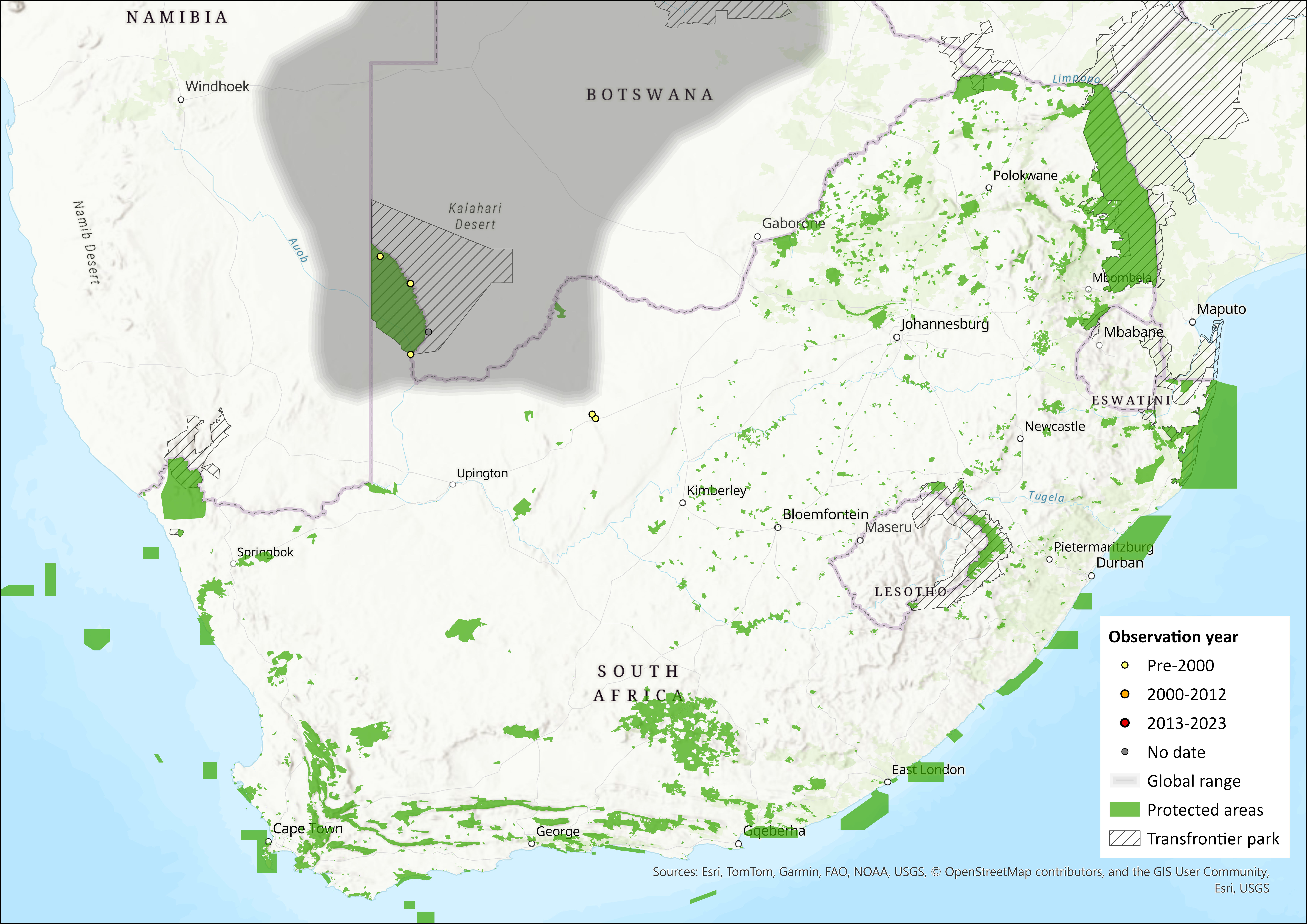
Figure 1. Distribution records for Woosnam’s Desert Rat (Zelotomys woosnami) within the assessment region (South Africa, Eswatini and Lesotho). Note that distribution data is obtained from multiple sources and records have not all been individually verified.
Biogeographic Realms
Biogeographic Realm: Afrotropical
Occurrence
Countries of Occurrence
| Country | Presence | Origin | Formerly Bred | Seasonality |
| Angola | Extant | Native | – | – |
| Botswana | Extant | Native | – | – |
| Namibia | Extant | Native | – | – |
| South Africa | Extant | Native | – | – |
Large Marine Ecosystems (LME) Occurrence
Large Marine Ecosystems: (Not specified)
FAO Area Occurrence
FAO Marine Areas: (Not specified)
Climate change
This species only occurs in the Northern Cape province, South Africa. There is a possibility that it might be affected by the 1.5-4°C increase in temperature predicted under various climate change scenarios (Engelbrecht et al. 2024). This species inhabits areas along riverbeds and sparsely vegetated pans. Rainfall is predicted to decrease in its range. These decreases will result in a more arid and drought-prone habitat which could affect food availability and suitable habitats in the species distribution range.
Population information
Zelotomys spp. are naturally a rare or uncommon species and usually only form a small percentage (< 1%) of rodent communities and numbers can fluctuate widely at the local scale (Nel 2013). There seem to be slightly higher concentrations in high dune veld compared to low dune veld areas (Nel 2013). The majority of the population is thought to exist in Botswana since most of its distribution occurs in this area. However, a study in Koanaka Hills, Botswana found this species to be relatively rare, exhibiting low population densities (Thies & Lewis 2015), suggesting that it is possibly rare or patchily distributed in this region as well.
Population Information
Current population trend: Stable; evidence of population fluctuations
Continuing decline in mature individuals? Unknown
Number of mature individuals in population: Unknown
Number of mature individuals in largest subpopulation: Unknown
Number of Subpopulations: Unknown
Severely fragmented: No
Extreme fluctuations in the number of subpopulations: Such fluctuations have been recorded in the SW Kalahari (Nel, 2013).
Continuing decline in number of subpopulations: (Not specified)
All individuals in one subpopulation: (Not specified)
Quantitative Analysis
Probability of extinction in the wild within 3 generations or 10 years, whichever is longer, maximum 100 years: (Not specified)
Probability of extinction in the wild within 5 generations or 20 years, whichever is longer, maximum 100 years: (Not specified)
Probability of extinction in the wild within 100 years: (Not specified)
Population genetics
To date, no population genetic study has been conducted on this species. However, it is presumed to exist as a single metapopulation capable of genetic exchange between neighbouring countries, Namibia and Botswana where the majority of the species’ population occurs. Based on this information, the Convention on Biological Diversity’s Global Biodiversity Framework’s complementary genetic indicator – proportion of populations maintained (PM) – would receive a value of 1.0 (all populations remaining).
While no population estimates are available and densities are generally low where they occur, the size of the metapopulation (spanning three countries) likely suggests sufficient individuals exist to maintain an effective population size (Ne) greater than 500. Using a conversion ratio of 0.1-0.3 for Ne/Nc, this would suggest an overall population size exceeding 5000 mature individuals across its full range. Based on this assumption, the GBF’s headline genetic indicator – proportion of populations with an effective population size (Ne) above 500 – is estimated at 1.0 (1/1 population with Ne >500).
It is highly recommended that a population genetic study be undertaken to better understand the population genetic structure and health of the species and to verify the estimated indicator values.
Habitats and ecology
This species has very specific micro-habitat requirements: it occurs along riverbeds and around pans frequently associated with sparsely vegetated Acacia woodlands, savannahs, riparian Acacia, open shrublands of Acacia, Grewia and Terminalia, and Rhigozum woodlands (Skinner & Chimimba 2005). It prefers sandy to fine, consolidated Kalahari-type soils and lime-clay silty soils. It is usually restricted to regions exhibiting an average annual rainfall of between 200 and 500 mm (Skinner & Chimimba 2005).
Woosnam’s Broad-headed Mouse is medium-sized, has a scaly white tail and bears a superficial resemblance to Mastomys, which has a slightly longer grey tail and a greater number of nipples (24 vs 10). It is a nocturnal and mainly terrestrial species that digs its own burrows under shrubs and trees. These burrows are 40–55 cm deep and the nest chambers are filled with finely-shredded grass (Birkenstock & Nel 1977).
Whilst it is largely granivorous, it has been recorded eating insects, vegetable matter and meat, with the latter having been possibly scavenged from other rodent carcasses (Nel 2013). These mice are usually solitary and mutually intolerant, with individuals attacking, killing and partially consuming others in captivity (Nel 2013). Interactions such as allogrooming are a prelude to mating.
The reproductive data is sparse for this species, but it appears that the birthing peaks during wet, summer months (December to April). Litter sizes range from four to 11 with the female characteristically having 10 nipples (Nel 2013). Young are weaned at 30 days and the minimum time between litters appears to be 31 days.
Ecosystem and cultural services: There is a possibility that they utilise disused burrows of other rodent species, including Tatera (now Gerbilliscus) (Shortridge 1934) and Desmodillus (Roberts 1951). Both these species are known to be reservoirs of bubonic plague (NICD 2005), and De Graaf (1981) recorded a bubonic vector flea species from this mouse. It is therefore possible that this species may also be a reservoir host, although due to the rarity of the species, the threat is not significant.
IUCN Habitats Classification Scheme
| Habitat | Season | Suitability | Major Importance? |
| 2.1. Savanna -> Savanna – Dry | – | Suitable | – |
Life History
Generation Length: (Not specified)
Age at Maturity: Female or unspecified: (Not specified)
Age at Maturity: Male: (Not specified)
Size at Maturity (in cms): Female: (Not specified)
Size at Maturity (in cms): Male: (Not specified)
Longevity: (Not specified)
Average Reproductive Age: (Not specified)
Maximum Size (in cms): (Not specified)
Size at Birth (in cms): (Not specified)
Gestation Time: (Not specified)
Reproductive Periodicity: (Not specified)
Average Annual Fecundity or Litter Size: (Not specified)
Natural Mortality: (Not specified)
Does the species lay eggs? (Not specified)
Does the species give birth to live young: (Not specified)
Does the species exhibit parthenogenesis: (Not specified)
Does the species have a free-living larval stage? (Not specified)
Does the species require water for breeding? (Not specified)
Movement Patterns
Movement Patterns: (Not specified)
Congregatory: (Not specified)
Systems
System: Terrestrial
General Use and Trade Information
This species is not traded or utilised in any form.
Local Livelihood: (Not specified)
National Commercial Value: (Not specified)
International Commercial Value: (Not specified)
End Use: (Not specified)
Is there harvest from captive/cultivated sources of this species? (Not specified)
Harvest Trend Comments: (Not specified)
Threats
No major threats have been identified for this species. However, habitat loss and deterioration through overgrazing, frequent fires and bush encroachment may cause local declines. Mining activities which impact on historical watercourses such as the Gama Gara and Kuruman Rivers may also have local negative impacts on populations. The construction of large-scale solar farms in the Northern Cape may represent an emerging threat.
Current habitat trend: Declining, overgrazing and bush encroachment may alter suitable environments. Additionally, ongoing illegal harvesting of tall trees for firewood or charcoal production may also cause declines in habitat quality. Habitat quality is also under threat from construction of solar farms in the Northern Cape, mining and climate change.
Conservation
This species occurs within the Kgalagadi Transfrontier National Park (South Africa), and although currently unconfirmed, presumably this species may occur in other protected areas within the assessment region, such as Augrabies Falls National Park. This species would likely benefit from protected area expansion, as well as stewardship schemes to protect woodland and historic water courses.
Recommendations for land managers and practitioners:
- Populations should be monitored to record any changes in abundance and distribution.
- Land managers should be encouraged to conserve woodlands and old trees.
- Future mining activities in the Kuruman area and northwards should be assessed for potential impacts on preferred habitats for this species.
- The species would benefit from suitable land management: land owners should leave corridors of grassland between grazed areas and decrease stocking rates.
Research priorities:
- Additional studies are needed into the geographic distribution of this species. In particular, surveys and monitoring of the KGNP, being its stronghold in South Africa. It’s physiological tolerance to hotter and drier climates should be evaluated from lab studies.
- Current population trends and the intensity of threats faced by local populations.
Encouraged citizen actions:
- Report sightings on virtual museum platforms (for example, iNaturalist and MammalMAP), especially outside protected areas.
- Landowners should preserve Acacia trees, both living and dead.
Bibliography
Avery, D.M. and Avery, G. 2011. Micromammals in the Northern Cape Province of South Africa, past and present. African Natural History 7: 9-39.
Beolens B, Watkins M, Grayson M. 2009. The Eponym Dictionary of Mammals. The John Hopkins University Press, Baltimore, USA.
Birkenstock E, Nel JAJ. 1977. Laboratory and field observations of Zelotomys woosnami Rodentia, Muridae. Zoologica Africana 12: 429–444.
Engelbrecht, FA., Steinkopf, J., Padavatan, J. & Midgley, GF. 2024. Projections of future climate change in southern Africa and the potential for regional tipping points. In: von Maltitz, G.P., et al. Sustainability of Southern African Ecosystems under Global Change. Ecological Studies, vol 248. Springer, Cham. https://doi.org/10.1007/978-3-031-10948-5_7.
Friedmann, Y. and Daly, B. 2004. Red Data Book of the Mammals of South Africa: A Conservation Assessment. Conservation Breeding Specialist Group (SSC/IUCN) and Endangered Wildlife Trust, Parkview, South Africa.
Monadjem, A., Taylor, P.J., Denys, C. and Cotterill, F.P.D. 2015. Rodents of Sub-Saharan Africa: A Biogeographic and Taxonomic Synthesis. De Gruyter, Berlin, Germany.
NICD. 2005. Plague control guidelines for South Africa. National Institute for Communicable Diseases, Department of Health, South Africa.
Nel JAJ. 2013. Zelotomys woosnami Woosnam’s Broad-headed Mouse. In: Happold, DCD (ed.), Mammals of Africa. Volume III: Rodents, Hares and Rabbits., pp. 568–571. Bloomsbury Publishing, London, UK.
Power, R.J. 2014. The distribution and status of mammals in the North West Province. Department of Economic Development, Environment, Conservation & Tourism, North West Provincial Government, Mahikeng.
Roberts, A. 1951. The Mammals of South Africa. Central New Agency, Johannesburg, South Africa.
Schwann H. 1906. list of mammals obtained by Messrs, R.B. Woosnam and R.E. Dent in Bechuanaland. Proceedings of the Zoological Society of London 76: 101–111.
Shortridge, G.C. 1934. The mammals of South West Africa: a biological account of the forms occurring in that region. Heinemann, London, UK.
Skinner, J.D. and Chimimba, C.T. (eds). 2005. The Mammals of the Southern African Subregion. Cambridge University Press, United Kingdom, Cambridge.
Thies ML, Lewis PJ. 2015. Effects of Fire on Small Mammals of the Koanaka Hills, Northwestern Botswana. Occasional Papers, Museum of Texas Tech University 330: 1–17.
de Graaff, G. 1981. The Rodents of Southern Africa: Notes on their Identification, Distribution, Ecology, and Taxonomy. Butterworths, Durban, Pretoria, South Africa.