

Wood’s Slit-faced Bat
Nycteris woodi

2025 Red list status
Near threatened

Regional Population Trend
Declining

Change compared
to 2016
No Change
Overview
Nycteris woodi – K. Andersen, 1914
ANIMALIA – CHORDATA – MAMMALIA – CHIROPTERA – NYCTERIDAE – Nycteris – woodi
Common Names: Wood’s Slit-faced Bat, Wood’s Long-eared Bat (English), Wood se Speetneusvlermuis, Wood-Spleetneusvlermuis, Woodse Langoorvlermuis (Afrikaans)
Synonyms: Nycteris woodi Roberts, 1946 ssp. sabiensis
Taxonomic Note:
Southern Africa
Historically, two subspecies were previously recognised: Nycteris woodi sabensis (Roberts 1946) from Zimbabwe and a Zambian counterpart, N. w. woodi (Skinner & Chimimba 2005). Since these two subspecies do not appear to be geographically isolated, they are not currently distinguished as subspecies (Monadjem et al. 2020; Cotterill 2013). It is also not considered to include N. parisii (Cotterill 2013). Taxonomic revision of this group is necessary (Monadjem et al. 2020).
Red List Status: NT – Near Threatened B1ab(ii,iii,iv,v) (IUCN version 3.1)
Assessment Information
Assessors: Richards, L.R.1 & da Silva. J.M.2
Reviewer: Smith, C.3
Institutions: 1Durban Natural Science Museum, 2South African National Biodiversity Institute, 3Endangered Wildlife Trust
Previous Assessors and Reviewers: Shoeman, C., Monadjem, A., Cohen, L., Jacobs, D., MacEwan, K., Richards, L.R., Sethusa, T. & Taylor, P.
Previous Contributors: Raimondo, D., Nicholson, S.K. & Relton, C.
Assessment Rationale
This is an edge of range species, known from four collection areas in the assessment region from northern Limpopo, including Greater Mapungubwe Transfrontier Conservation Area/Musina Nature Reserve and Kruger National Park (KNP). It is poorly known and has not been recorded in the assessment region since 1986, with one exception being from Pafuri (KNP) in July 2006 (C. Schoeman unpubl. data). This could be because it avoids mist nets and is a whispering echolocating bat, hence difficult to monitor acoustically. Although the species occurs in at least two protected areas, parts of its foraging and roosting habitats are threatened by agricultural expansion and logging. As the extent of occurrence is 8,922 km2, its habitat may be declining, it has been infrequently sampled over three decades, this population may be isolated due to presumed poor dispersal capacity based on relatively low wing loading, and the species has been found only in four locations, we list it as Vulnerable B1ab(ii,iii,iv,v). However, due to application of the regional criterion (see below) we downlist it to Near Threatened B1ab(ii,iii,iv,v). Further field studies are needed to confirm its continued presence in the assessment region to determine its range, population size and trend, and plausible threats more accurately. It should be reassessed once more data are available.
Regional population effects: This species has low wing-loading (Monadjem et al. 2020), and thus significant dispersal is unlikely. However, the resident population appears continuous with the Zimbabwean population and its habitat is connected between the regions through both the Great Limpopo Transfrontier Park and the Greater Mapungubwe Transfrontier Conservation Area. Thus, we assume rescue effects are possible.
Reasons for Change
Reason(s) for Change in Red List Category from the Previous Assessment: No change
Red List Index
Red List Index: No change
Recommended citation: Richards LR & da Silva JM. 2025. A conservation assessment of Nycteris woodi. In Patel T, Smith C, Roxburgh L, da Silva JM & Raimondo D, editors. The Red List of Mammals of South Africa, Eswatini and Lesotho. South African National Biodiversity Institute and Endangered Wildlife Trust, South Africa.
Regional Distribution and occurrence
Geographic Range
This species has been recorded from southern and northern Zimbabwe, Zambia, Malawi and the extreme northeastern regions of South Africa. One specimen is known from Chicoa in Mozambique but is probably more widespread along the Limpopo, Save and Zambezi valleys (Cotterill 2013). Similarly, one specimen has been recorded from southwestern Tanzania (Cotterill 2013). It is generally a lowland species (ACR 2020). In the assessment region, it occurs in the extreme northern areas of Limpopo (Limpopo valley) in the Great Limpopo Transfrontier Park and Greater Mapungubwe Transfrontier Conservation Area, with an estimated extent of occurrence of 8,922 km².
Elevation / Depth / Depth Zones
Elevation Lower Limit (in metres above sea level): 49 m asl (Monadjem et al. 2024)
Elevation Upper Limit (in metres above sea level): 1,417 m asl (Monadjem et al. 2024)
Depth Lower Limit (in metres below sea level): N/A
Depth Upper Limit (in metres below sea level): N/A
Depth Zone: N/A
Map
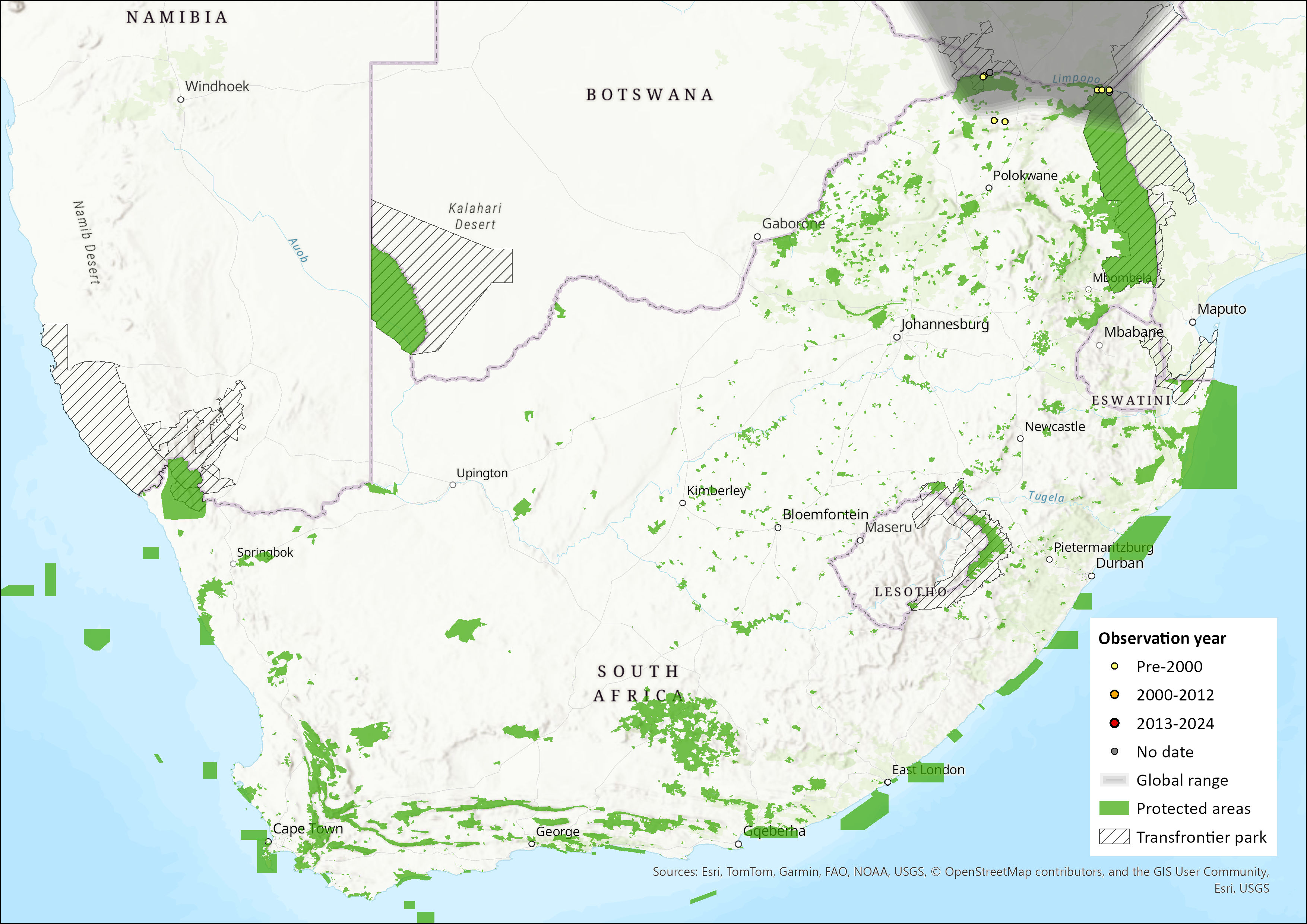 Figure 1. Distribution records for Wood’s Slit-faced Bat (Nycteris woodi) within the assessment region (South Africa, Eswatini and Lesotho). Note that distribution data is obtained from multiple sources and records have not all been individually verified.
Biogeographic Realms
Biogeographic Realm: Afrotropical
Occurrence
Countries of Occurrence
| Country | Presence | Origin | Formerly Bred | Seasonality |
| Malawi | Extant | Native | – | – |
| Mozambique | Extant | Native | – | – |
| South Africa | Extant | Native | – | – |
| Tanzania, United Republic of | Presence Uncertain | Native | – | – |
| Zambia | Extant | Native | – | – |
| Zimbabwe | Extant | Native | – | – |
Large Marine Ecosystems (LME) Occurrence
Large Marine Ecosystems: N/A
FAO Area Occurrence
FAO Marine Areas: N/A
Climate change
There are no studies that have investigated the potential effects of climate change on the species distribution, ecology or physiology. Most studies on the effects of climate change on bats are based on predictive species distribution modelling, thus there is a lack of empirical studies measuring behavioural, physiological, phenological or genetic responses to extreme and seasonal climatic changes, especially in the Global South (Festa et al. 2023; Pio et al. 2014). Globally, there have been documented declines in bat populations, species richness and distributions in relation to water availability with increasing global aridity which may become a growing concern as heat waves and maximum temperatures are expected to increase over Sub-Saharan Africa (Adams & Hayes 2021).
Furthermore, a recent assessment of South African national parks demonstrated Mapungubwe National Park as particularly vulnerable to the effects of climate change, with an anticipated change in species composition Coldrey et al. 2021). Species with limited dispersal capability, such as N. woodi, may be more susceptible than others to adverse climatic effects in such semi-arid protected areas.
Population information
The abundance of this species is not well known. It is considered one of the rarest African nycterids (Van Cakenberghe and De Vree 1985) and is poorly represented in museums with only c. 50 specimens examined in Monadjem et al. (2020). However, it is locally common in Zimbabwe, especially in the low-lying valleys of the Limpopo, Save and Zambezi rivers and tributaries (Cotterill 1996). It has been recorded in colonies of a few dozen up to 40-50 individuals (Cotterill 2013; Monadjem et al. 2020), otherwise animals have been recorded individually (ACR 2015). This species is difficult to monitor because it avoids mist nets and cannot be monitored acoustically because it is a whispering bat.
Current population trend: Suspected to be declining
Continuing decline in mature individuals? Cannot be established, however, this is suspected of the global population (Monadjem et al. 2017)
Extreme fluctuations in the number of subpopulations: Unknown
Continuing decline in number of subpopulations: Unknown
All individuals in one subpopulation: Unknown
Number of mature individuals in largest subpopulation: Possibly >250 individuals based on Cotterill (2013)
Number of Subpopulations: Presumed to be one metapopulation, but genetic studies are needed to confirm this.
Quantitative Analysis
Probability of extinction in the wild within 3 generations or 10 years, whichever is longer, maximum 100 years: (Not specified)
Probability of extinction in the wild within 5 generations or 20 years, whichever is longer, maximum 100 years: (Not specified)
Probability of extinction in the wild within 100 years: (Not specified)
Population genetics
No population genetic study has been conducted on this species. Considering the species is difficult to capture and monitor, obtaining sufficient samples for a comprehensive population genomic study will be challenging; however, environmental DNA studies could prove valuable to gaining insight into their distribution (possibly identifying new localities) and relative abundance within the region.
Habitats and ecology
It occurs in semi-arid and moist woodland savannahs (including miombo and mopane woodlands) where suitable day-roosts are available (Cotterill 2013). The natural history of this species is not well-known. It roosts in hollow trees (particularly Baobabs Adansonia digitata and Sausage Trees Kigelia africana), sandstone caves, rock fissures, mine adits and buildings (Ansell 1967; Cotterill 1996, 2013; Skinner and Chimimba 2005). Although the type specimen from Zambia was collected at 1,250 m asl, this species is typically restricted to an altitude below 1,000 m asl (Meester et al. 1986). It lives in colonies of up to 40-50 individuals (Monadjem et al. 2020). In the assessment area, the species is recorded from the Mopane Bioregion.
Like the other Nycteris species, the Wood’s Slit-faced Bat is a clutter forager, mainly feeding on Lepidoptera, Coleoptera and Diptera (Monadjem et al. 2010). Its short, broad wings allow for manoeuvrable flight patterns (Monadjem et al. 2020). Although limited data are available on the reproductive ecology of this species, it seems to be a summer breeder (Monadjem et al. 2020).
Ecosystem and cultural services: As this species is insectivorous, it may contribute to controlling insect populations (Boyles et al. 2011, Kunz et al. 2011). Bats often prey on the insect species that destroy crops (Boyles et al. 2011, Kunz et al. 2011). Ensuring a healthy population of insectivorous bats can thus result in a decrease in the use of pesticides.
IUCN Habitats Classification Scheme
| Habitat | Season | Suitability | Major Importance? |
| 2.1. Savanna -> Savanna – Dry | – | Suitable | – |
| 7.1. Caves and Subterranean Habitats (non-aquatic) -> Caves and Subterranean Habitats (non-aquatic) – Caves | – | Suitable | – |
Life History
Generation Length: Unknown
Age at Maturity: Female or unspecified: Unknown
Age at Maturity: Male: Unknown
Size at Maturity (in cms): Female: Mean forearm length = 4.08 ±0.13 cm; mean total length = 10.20 ±0.52 cm (Monadjem et al. 2020)
Size at Maturity (in cms): Male: Mean forearm length = 3.93 ±0.07 cm; mean total length = 9.61 ±0.58 cm (Monadjem et al. 2020)
Longevity: Unknown
Average Reproductive Age: Unknown
Maximum Size (in cms): Females: forearm length = 4.25 cm; Males: forearm length = 4.06 cm (Monadjem et al. 2020)
Size at Birth (in cms): Unknown
Gestation Time: Unknwon
Reproductive Periodicity: Suspected to exhibit seasonal monoestry, with pregnant females recorded in mid-August and November (Cotterill 2013).
Average Annual Fecundity or Litter Size: One pup per litter (Cotterill, 2013)
Natural Mortality: No predation records.
Breeding Strategy
Does the species lay eggs? No
Does the species give birth to live young: Yes
Does the species exhibit parthenogenesis: No
Does the species have a free-living larval stage? No
Does the species require water for breeding? No
Movement Patterns
Movement Patterns: unknown, but owing to low wing loading, the species is unlikely capable of long-distance movement or migration.
Congregatory: reported to roost in mixed sex colonies of up to 50 individuals (Cotterill 2013).
Systems
System: Terrestrial
General Use and Trade Information
There is no evidence to indicate that this species is used or traded within the assessment region.
|
Subsistence: |
Rationale: |
Local Commercial: |
Further detail including information on economic value if available: |
|
No |
– |
– |
– |
National Commercial Value: Yes, potential contribution to essential ecosystem services such as insect population control.
International Commercial Value: Yes, in the case of insect population control
End Use: None reported
Is there harvest from captive/cultivated sources of this species? Previously reported as yes, although no evidence in recent times.
Harvest Trend Comments: Unknown
Threats
No major threats have been identified for this species within the assessment region. Although much of this species range in the assessment region is within protected regions in the Limpopo Province, roost sites outside of these reserves (e.g. mine adits, storerooms, etc.) may be impacted by human disturbance, including natural roosts such as caves that are frequently utilised during traditional ceremonies and ecotourism. Habitat loss due to agricultural expansion (particularly cotton farming), persistent pesticide use and the loss of hollow Baobabs used as roosts are likely to cause local population decline (Cotterill 2013). The global assessment indicated that the species is in decline (Monadjem et al. 2017); however, with limited information and no recent data on population sizes or trends it is difficult to assess whether the same holds true for individuals within the assessment region.
Conservation
Wood’s Slit-faced Bat has been recorded from the protected Kruger National Park, Musina and Greater Mapungubwe Transfrontier Conservation Area. Additional studies into the distribution, natural history and possible threats to this poorly known species are urgently required before specific interventions can be devised. However, as cavities in large trees, such as Baobabs and Sausage Trees (Cotterill 2013), provide critical roost sites and cool microhabitats (sensu Toussaint and McKechnie 2012), the protection and preservation of these trees is considered crucial for the prolonged local presence of this species.
Recommendations for land managers and practitioners:
- Protect and preserve large trees, which provide valuable roosting sites for this species.
- Reduce persecution by landowners where the species makes use of synanthropic roosts.
- Reduce pesticide use in agricultural landscapes.
Research priorities:
- eDNA studies on the bat guano to help identify if the species exists at certain sites and hence whether the species is more widespread then currently known. Based on volume one might also be able to determine relative abundance.
- A top research priority should be targeted surveys in protected areas where the species has been previously recorded, to determine whether this species is still present within the assessment region, as well as determining its current population size and trend.
- The targeted surveys may also be beneficial in potentially identifying additional roosting sites.
- Sourcing samples for phylogeographic and landscape genetic studies to determine population genetic trends and affinities with nearest neighbour colonies.
- Investigations into the possible threats faced by this species, including impacts from climate change.
Encouraged citizen actions:
- Citizens can assist the conservation of the species by reporting sightings on virtual museum platforms (e.g., iNaturalist and MammalMAP) and therefore contribute to an understanding of the species distribution.
Bibliography
ACR. 2024. African Chiroptera Report 2012. AfricanBats NPC Pretoria, South Africa.
Adams, R.A. and Hayes, M.A. 2021. The importance of water availability to bats: climate warming and increasing global aridity. 50 years of bat research: foundations and new frontiers, pp.105-120.
Ansell, W. F. H. 1967. Additional records of Zambian Chiroptera. Arnoldia 2(38): 1-29.
Boyles JG, Cryan PM, McCracken GF, Kunz TH. 2011. Economic importance of bats in agriculture. Science 332: 41–42.
Coldrey, K.M., Turpie, J.K., Midgley, G., Scheiter, S., Hannah, L., Roehrdanz, P.R. and Foden, W.B. 2022. Assessing protected area vulnerability to climate change in a case study of South African national parks. Conservation Biology, 36(5), p.e13941.
Cotterill, F.P.D. 2013. Nycteris woodi Wood’s Slit-faced Bat. Pages 461–463 in Happold M, Happold DCD, editors. Mammals of Africa. Volume IV: Hedgehogs, Shrews and Bats. Bloomsbury Publishing, London, UK.
Cotterill, F. P. D. 1996. New distribution records of insectivorous bats of the families Nycteridae, Rhinolophidae and Vespertilionidae (Microchiroptera: Mammalia) in Zimbabwe. Arnoldia Zimbabwe 10(8): 71-89.
Driver, A., Sink, K.J., Nel, J.N., Holness, S., van Niekerk, L., Daniels, F., Jonas, Z., Majiedt, P.A., Harris, L. and Maze, K. 2012. National Biodiversity Assessment 2011: An Assessment of South Africa’s Biodiversity and Ecosystems. Synthesis Report. South African National Biodiversity Institute and Department of Environmental Affairs, Pretoria, South Africa.
Festa, F., Ancillotto, L., Santini, L., Pacifici, M., Rocha, R., Toshkova, N., Amorim, F., Benítez‐López, A., Domer, A., Hamidović, D. and Kramer‐Schadt, S. 2023. Bat responses to climate change: a systematic review. Biological Reviews, 98(1), pp.19-33.
Kunz, T.H., Braun de Torrez, E., Bauer, D., Lobova, T. and Fleming, T.H. 2011. Ecosystem services provided by bats. Annals of the New York Academy of Sciences 1223: 1–38.
Meester, J.A.J., Rautenbach, I.L., Dippenaar, N.J. and Baker, C.M. 1986. Classification of southern African mammals. Transvaal Museum Monographs 5: 1–359.
Monadjem, A., Cotterill, F.P.D., Hutson, A.M., Mickleburgh, S. & Bergmans, W. 2017. Nycteris woodi. The IUCN Red List of Threatened Species 2017: e.T14939A22014842. https://dx.doi.org/10.2305/IUCN.UK.2017-2.RLTS.T14939A22014842.en. Accessed on 07 July 2025.
Monadjem, A., Taylor, P.J., Cotterill, F.P.D. and Schoeman M.C. 2020. Bats of Southern and Central Africa: a biogeographic and taxonomic synthesis, Second Edition. University of Witwatersrand Press, Johannesburg.
Monadjem, A., Montauban, C., Webala, P.W., Laverty, T.M., Bakwo-Fils, E.M., Torrent, L., Tanshi, I., Kane, A., Rutrough, A.L., Waldien, D.L. and Taylor, P.J. 2024. African bat database: curated data of occurrences, distributions and conservation metrics for sub-Saharan bats. Scientific Data, 11(1), p.1309.
Munyati, C. and Kabanda, T.A. 2009. Using multitemporal Landsat TM imagery to establish land use pressure induced trends in forest and woodland cover in sections of the Soutpansberg Mountains of Venda region, Limpopo Province, South Africa. Regional Environmental Change 9: 41–56.
Pio, D.V., Engler, R., Linder, H.P., Monadjem, A., Cotterill, F.P., Taylor, P.J., Schoeman, M.C., Price, B.W., Villet, M.H., Eick, G. and Salamin, N. 2014. Climate change effects on animal and plant phylogenetic diversity in southern Africa. Global Change Biology, 20(5), pp.1538-1549.
Skinner, J.D. and Chimimba, C.T. (eds). 2005. The Mammals of the Southern African Subregion. Cambridge University Press, United Kingdom, Cambridge.
Toussaint, D.C. and McKechnie, A.E. 2012. Interspecific variation in thermoregulation among three sympatric bats inhabiting a hot, semi-arid environment. Journal of Comparative Physiology B 182: 1129–1140.
Van Cakenberghe, V. and De Vree, F. 1985. Systematics of African Nycteris (Mammalia: Chiroptera). Pages 53–90 in Proceedings of the International Symposium on African Vertebrates. Bonn, Germany.